
Verwandte Artikel zu Drinking Coffee Elsewhere (Alex Awards (Awards))
Inhaltsangabe
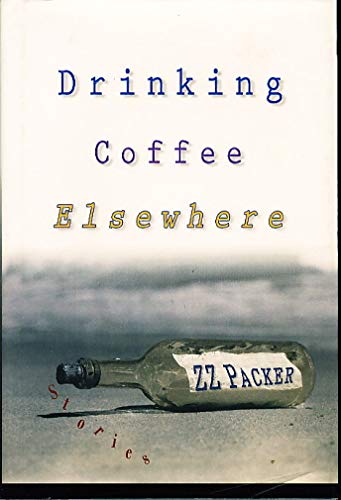
With stories in The New Yorker's debut fiction issue and in The Best American Short Stories, 2000, and as the winner of a Whiting Writers' Award and a Rona Jaffe Foundation Writers' Award, ZZ Packer has already achieved what most writers only dream about-all prior to publication of her first book.
Now, in Drinking Coffee Elsewhere, her impressive range and talent are abundantly evident. Packer dazzles with her command of language-surprising and delighting us with unexpected turns and indelible images, as she takes us into the lives of characters on the periphery, unsure of where they belong. With penetrating insight that belies her youth-she was only nineteen years old when Seventeen magazine printed her first published story-Packer takes us to a Girl Scout camp, where a troupe of black girls are confronted with a group of white girls, whose defining feature turns out to be not their race but their disabilities; to the Million Man March on Washington, where a young man must decide where his allegiance to his father lies; to Japan, where an international group of drifters find themselves starving, unable to find work.
Drinking Coffee Elsewhere is a striking debut-fresh, versatile, and captivating. It introduces us to an arresting and unforgettable new American voice.
Die Inhaltsangabe kann sich auf eine andere Ausgabe dieses Titels beziehen.
Über die Autorin bzw. den Autor
A New Yorker debut writer, ZZ Packer has had short stories published in the Best American Short Stories, 2000 (edited by E. L. Doctorow), Harper's, Story magazine, and in the anthology 25 and Under: Fiction, as well as a story read on NPR's "Selected Shorts." A graduate of Yale and the Iowa Writers' Workshop, she is the recipient of a Whiting Writers' Award and a Rona Jaffe Foundation Writers' Award. She has held Wallace Stegner and Truman Capote fellowships from Stanford University, where she is currently a Jones Lecturer.
Auszug. © Genehmigter Nachdruck. Alle Rechte vorbehalten.
Brownies
BY OUR SECOND DAY at Camp Crescendo, the girls in my Brownie troop had decided to kick the asses of each and every girl in Brownie Troop 909. Troop 909 was doomed from the first day of camp; they were white girls, their complexions a blend of ice cream: strawberry, vanilla. They turtled out from their bus in pairs, their rolled-up sleeping bags chromatized with Disney characters: Sleeping Beauty, Snow White, Mickey Mouse; or the generic ones cheap parents bought: washed-out rainbows, unicorns, curly-eyelashed frogs. Some clutched Igloo coolers and still others held on to stuffed toys like pacifiers, looking all around them like tourists determined to be dazzled.
Our troop was wending its way past their bus, past the ranger station, past the colorful trail guide drawn like a treasure map, locked behind glass.
"Man, did you smell them?" Arnetta said, giving the girls a slow once-over, "They smell like Chihuahuas. Wet Chihuahuas." Their troop was still at the entrance, and though we had passed them by yards, Arnetta raised her nose in the air and grimaced.
Arnetta said this from the very rear of the line, far away from Mrs. Margolin, who always strung our troop behind her like a brood of obedient ducklings. Mrs. Margolin even looked like a mother duck-she had hair cropped close to a small ball of a head, almost no neck, and huge, miraculous breasts. She wore enormous belts that looked like the kind that weightlifters wear, except hers would be cheap metallic gold or rabbit fur or covered with gigantic fake sunflowers, and often these belts would become nature lessons in and of themselves. "See," Mrs. Margolin once said to us, pointing to her belt, "this one's made entirely from the feathers of baby pigeons."
The belt layered with feathers was uncanny enough, but I was more disturbed by the realization that I had never actually seen a baby pigeon. I searched weeks for one, in vain-scampering after pigeons whenever I was downtown with my father.
But nature lessons were not Mrs. Margolin's top priority. She saw the position of troop leader as an evangelical post. Back at the A.M.E. church where our Brownie meetings were held, Mrs. Margolin was especially fond of imparting religious aphorisms by means of acrostics-"Satan" was the "Serpent Always Tempting and Noisome"; she'd refer to the "Bible" as "Basic Instructions Before Leaving Earth." Whenever she quizzed us on these, expecting to hear the acrostics parroted back to her, only Arnetta's correct replies soared over our vague mumblings. "Jesus?" Mrs. Margolin might ask expectantly, and Arnetta alone would dutifully answer, "Jehovah's Example, Saving Us Sinners."
Arnetta always made a point of listening to Mrs. Margolin's religious talk and giving her what she wanted to hear. Because of this, Arnetta could have blared through a megaphone that the white girls of Troop 909 were "wet Chihuahuas" without so much as a blink from Mrs. Margolin. Once, Arnetta killed the troop goldfish by feeding it a french fry covered in ketchup, and when Mrs. Margolin demanded that she explain what had happened, claimed the goldfish had been eyeing her meal for hours, then the fish-giving in to temptation-had leapt up and snatched a whole golden fry from her fingertips.
"Serious Chihuahua," Octavia added, and though neither Arnetta nor Octavia could spell "Chihuahua," had ever seen a Chihuahua, trisyllabic words had gained a sort of exoticism within our fourth-grade set at Woodrow Wilson Elementary. Arnetta and Octavia would flip through the dictionary, determined to work the vulgar-sounding ones like "Djibouti" and "asinine" into conversation.
"Caucasian Chihuahuas," Arnetta said.
That did it. The girls in my troop turned elastic: Drema and Elise doubled up on one another like inextricably entwined kites; Octavia slapped her belly; Janice jumped straight up in the air, then did it again, as if to slam-dunk her own head. They could not stop laughing. No one had laughed so hard since a boy named Martez had stuck a pencil in the electric socket and spent the whole day with a strange grin on his face.
"Girls, girls," said our parent helper, Mrs. Hedy. Mrs. Hedy was Octavia's mother, and she wagged her index finger perfunctorily, like a windshield wiper. "Stop it, now. Be good." She said this loud enough to be heard, but lazily, bereft of any feeling or indication that she meant to be obeyed, as though she could say these words again at the exact same pitch if a button somewhere on her were pressed.
But the rest of the girls didn't stop; they only laughed louder. It was the word "Caucasian" that got them all going. One day at school, about a month before the Brownie camping trip, Arnetta turned to a boy wearing impossibly high-ankled floodwater jeans and said, "What are you? Caucasian?" The word took off from there, and soon everything was Caucasian. If you ate too fast you ate like a Caucasian, if you ate too slow you ate like a Caucasian. The biggest feat anyone at Woodrow Wilson could do was to jump off the swing in midair, at the highest point in its arc, and if you fell (as I had, more than once) instead of landing on your feet, knees bent Olympic gymnast-style, Arnetta and Octavia were prepared to comment. They'd look at each other with the silence of passengers who'd narrowly escaped an accident, then nod their heads, whispering with solemn horror, "Caucasian."
Even the only white kid in our school, Dennis, got in on the Caucasian act. That time when Martez stuck a pencil in the socket, Dennis had pointed and yelled, "That was so Caucasian!"
*
WHEN YOU lived in the south suburbs of Atlanta, it was easy to forget about whites. Whites were like those baby pigeons: real and existing, but rarely seen or thought about. Everyone had been to Rich's to go clothes shopping, everyone had seen white girls and their mothers coo-cooing over dresses; everyone had gone to the downtown library and seen white businessmen swish by importantly, wrists flexed in front of them to check the time as though they would change from Clark Kent into Superman at any second. But those images were as fleeting as cards shuffled in a deck, whereas the ten white girls behind us-invaders, Arnetta would later call them-were instantly real and memorable, with their long, shampoo-commercial hair, straight as spaghetti from the box. This alone was reason for envy and hatred. The only black girl most of us had ever seen with hair that long was Octavia, whose hair hung past her butt like a Hawaiian hula dancer's. The sight of Octavia's mane prompted other girls to listen to her reverentially, as though whatever she had to say would somehow activate their own follicles. For example, when, on the first day of camp, Octavia made as if to speak, and everyone fell silent. "Nobody," Octavia said, "calls us niggers."
At the end of that first day, when half of our troop made their way back to the cabin after tag-team restroom visits, Arnetta said she'd heard one of the Troop 909 girls call Daphne a nigger. The other half of the girls and I were helping Mrs. Margolin clean up the pots and pans from the campfire ravioli dinner. When we made our way to the restrooms to wash up and brush our teeth, we met up with Arnetta midway.
"Man, I completely heard the girl," Arnetta reported. "Right, Daphne?"
Daphne hardly ever spoke, but when she did, her voice was petite and tinkly, the voice one might expect from a shiny new earring. She'd written a poem once, for Langston Hughes Day, a poem brimming with all the teacher-winning ingredients-trees and oceans, sunsets and moons-but what cinched the poem for the grown-ups, snatching the win from Octavia's musical ode to Grandmaster Flash and the Furious Five, were Daphne's last lines:
You are my father, the veteran
When you cry in the dark
It rains and rains and rains in my heart
She'd always worn clean, though faded, jumpers...
„Über diesen Titel“ kann sich auf eine andere Ausgabe dieses Titels beziehen.
Suchergebnisse für Drinking Coffee Elsewhere (Alex Awards (Awards))

Beispielbild für diese ISBN
Drinking Coffee Elsewhere
Anbieter: World of Books (was SecondSale), Montgomery, IL, USA
Verkäuferbewertung 5 von 5 Sternen

Zustand: Good. Item in good condition. Textbooks may not include supplemental items i.e. CDs, access codes etc. Artikel-Nr. 00101988212
Gebraucht kaufen
EUR 3,97
Versand gratis
Versand innerhalb von USA
Versand innerhalb von USA
Anzahl: 6 verfügbar
Beispielbild für diese ISBN
Drinking Coffee Elsewhere
Anbieter: World of Books (was SecondSale), Montgomery, IL, USA
Verkäuferbewertung 5 von 5 Sternen
Zustand: Acceptable. Item in acceptable condition! Textbooks may not include supplemental items i.e. CDs, access codes etc. Artikel-Nr. 00107560072
Gebraucht kaufen
EUR 3,97
Versand gratis
Versand innerhalb von USA
Versand innerhalb von USA
Anzahl: 1 verfügbar
Beispielbild für diese ISBN
Drinking Coffee Elsewhere
Anbieter: World of Books (was SecondSale), Montgomery, IL, USA
Verkäuferbewertung 5 von 5 Sternen
Zustand: Very Good. Item in very good condition! Textbooks may not include supplemental items i.e. CDs, access codes etc. Artikel-Nr. 00108306009
Gebraucht kaufen
EUR 3,97
Versand gratis
Versand innerhalb von USA
Versand innerhalb von USA
Anzahl: 1 verfügbar
Beispielbild für diese ISBN
Drinking Coffee Elsewhere
Verlag:
Riverhead Books (edition First Edition), 2003
ISBN 10: 1573222348
ISBN 13: 9781573222341
Gebraucht
Hardcover
Erstausgabe
Anbieter: BooksRun, Philadelphia, PA, USA
Verkäuferbewertung 5 von 5 Sternen
Hardcover. Zustand: Fair. First Edition. The item might be beaten up but readable. May contain markings or highlighting, as well as stains, bent corners, or any other major defect, but the text is not obscured in any way. Artikel-Nr. 1573222348-7-1
Gebraucht kaufen
EUR 5,14
Versand gratis
Versand innerhalb von USA
Versand innerhalb von USA
Anzahl: 1 verfügbar
Beispielbild für diese ISBN
Drinking Coffee Elsewhere
Verlag:
Penguin Publishing Group, 2003
ISBN 10: 1573222348
ISBN 13: 9781573222341
Gebraucht
Hardcover
Anbieter: Better World Books: West, Reno, NV, USA
Verkäuferbewertung 5 von 5 Sternen
Zustand: Good. Former library copy. Pages intact with minimal writing/highlighting. The binding may be loose and creased. Dust jackets/supplements are not included. Includes library markings. Stock photo provided. Product includes identifying sticker. Better World Books: Buy Books. Do Good. Artikel-Nr. GRP75652844
Gebraucht kaufen
EUR 6,14
Versand gratis
Versand innerhalb von USA
Versand innerhalb von USA
Anzahl: 1 verfügbar
Beispielbild für diese ISBN
Drinking Coffee Elsewhere
Verlag:
Penguin Publishing Group, 2003
ISBN 10: 1573222348
ISBN 13: 9781573222341
Gebraucht
Hardcover
Anbieter: Better World Books, Mishawaka, IN, USA
Verkäuferbewertung 5 von 5 Sternen
Zustand: Very Good. Former library copy. Pages intact with possible writing/highlighting. Binding strong with minor wear. Dust jackets/supplements may not be included. Includes library markings. Stock photo provided. Product includes identifying sticker. Better World Books: Buy Books. Do Good. Artikel-Nr. GRP92303444
Gebraucht kaufen
EUR 6,14
Versand gratis
Versand innerhalb von USA
Versand innerhalb von USA
Anzahl: 2 verfügbar
Beispielbild für diese ISBN
Drinking Coffee Elsewhere
Verlag:
Penguin Publishing Group, 2003
ISBN 10: 1573222348
ISBN 13: 9781573222341
Gebraucht
Hardcover
Anbieter: Better World Books, Mishawaka, IN, USA
Verkäuferbewertung 5 von 5 Sternen
Zustand: Good. Former library copy. Pages intact with minimal writing/highlighting. The binding may be loose and creased. Dust jackets/supplements are not included. Includes library markings. Stock photo provided. Product includes identifying sticker. Better World Books: Buy Books. Do Good. Artikel-Nr. GRP75652844
Gebraucht kaufen
EUR 6,14
Versand gratis
Versand innerhalb von USA
Versand innerhalb von USA
Anzahl: 1 verfügbar
Beispielbild für diese ISBN
Drinking Coffee Elsewhere
Anbieter: Wonder Book, Frederick, MD, USA
Verkäuferbewertung 5 von 5 Sternen
Zustand: Very Good. Very Good condition. Very Good dust jacket. A copy that may have a few cosmetic defects. May also contain light spine creasing or a few markings such as an owner's name, short gifter's inscription or light stamp. Artikel-Nr. B10A-02330
Gebraucht kaufen
EUR 6,21
Versand gratis
Versand innerhalb von USA
Versand innerhalb von USA
Anzahl: 1 verfügbar
Beispielbild für diese ISBN
Drinking Coffee Elsewhere
Anbieter: ThriftBooks-Dallas, Dallas, TX, USA
Verkäuferbewertung 5 von 5 Sternen
Hardcover. Zustand: Very Good. No Jacket. Missing dust jacket; May have limited writing in cover pages. Pages are unmarked. ~ ThriftBooks: Read More, Spend Less. Artikel-Nr. G1573222348I4N01
Gebraucht kaufen
EUR 6,26
Versand gratis
Versand innerhalb von USA
Versand innerhalb von USA
Anzahl: 1 verfügbar
Beispielbild für diese ISBN
Drinking Coffee Elsewhere
Anbieter: ThriftBooks-Atlanta, AUSTELL, GA, USA
Verkäuferbewertung 5 von 5 Sternen
Hardcover. Zustand: Very Good. No Jacket. May have limited writing in cover pages. Pages are unmarked. ~ ThriftBooks: Read More, Spend Less. Artikel-Nr. G1573222348I4N00
Gebraucht kaufen
EUR 6,26
Versand gratis
Versand innerhalb von USA
Versand innerhalb von USA
Anzahl: 1 verfügbar