
Verwandte Artikel zu Miracle at St. Anna
Inhaltsangabe
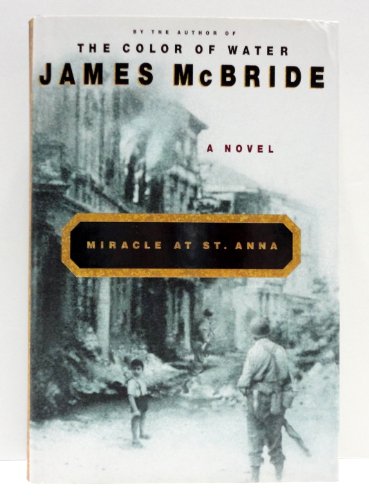
James McBride's powerful memoir, The Color of Water, was a publishing phenomenon, spending more than two years on the New York Times bestsellers list and becoming required reading in high schools and colleges across the country. Now, in his long-awaited second book, McBride turns his highly acclaimed talent as a storyteller to fiction.
Based on the historical incident of an unspeakable massacre at the site of St. Anna Di Stazzema, a small village in Tuscany, and on the experiences of the famed Buffalo soldiers from the 92nd Division in Italy during World War II, Miracle of St. Anna is a singular evocation of war, cruelty, passion, and heroism. It is the story of four American Negro soldiers, a band of partisans, and an Italian boy who encounter a miracle-though perhaps the true miracle lies in themselves.
Traversing class, race, and geography, Miracle at St. Anna is above all a hymn to the brotherhood of man and the power to do good that lives in each of us. It reveals to us a little-known but fascinating moment in history through the eyes and imagination of a gifted writer. Like The Color of Water, James McBride's stunning first novel will change the way we perceive ourselves and our world.
Die Inhaltsangabe kann sich auf eine andere Ausgabe dieses Titels beziehen.
Über die Autorin bzw. den Autor
James McBride is an award-winning writer and musician. He has been a staff writer for The Washington Post, People magazine, and The Boston Globe. His memoir and tribute to his mother, The Color of Water, spent more than two years on the New York Times bestseller list, was published worldwide, and was the winner of the prestigious Anisfield-Wolf Book Award. As a composer, he won the American Music Theater Festival's Stephen Sondheim Award for his jazz/pop musical Bobos, and has composed songs for Anita Baker, Grover Washington, Jr., and Gary Burton. A jazz saxophonist, he has performed with Rachelle Farrell and with legendary jazz performer Little Jimmy Scott.
Auszug. © Genehmigter Nachdruck. Alle Rechte vorbehalten.
Prologue All the guy wanted was a twenty-cent stamp. That's all he wanted, but when he slid his dollar bill across the post office counter at 34th Street in Manhattan, the diamond in the gold ring on his finger was so huge that postal clerk Hector Negron wanted to see whom the finger was connected to. Hector normally never looked at the faces of customers. In thirty years of working behind the window at the post office, he could think of maybe three customers whose faces he could actually remember, and two of them were relatives. One was his sister, whom he hadn't talked to in fourteen years. The other was his cousin from San Juan, who had been his first-grade teacher. Besides those two, the rest didn't count. They melded into the millions of New York schmucks who staggered to his window with a smile, hoping he would smile back, which he never did. People did not interest him anymore. He had lost his interest in them long ago, even before his wife died. But Hector loved rocks, especially the valuable ones. He'd played the numbers every single day for the past thirty years, and he often fantasized about the kind of diamonds he would buy if he won. So when the man slid his dollar bill across the counter and asked for a stamp, Hector saw the huge rock on his finger and looked up, and when he did, his heart began to pound and he felt faint; he remembered the naked terror of the dark black mountain towns of Tuscany, the old walls, the pitch-black streets as tiny as alleyways, the staircases that appeared out of nowhere, the freezing rainy nights when every stirring leaf sounded like a bomb dropping and the hooting of an owl made him piss in his pants. He saw beyond the man's face but he saw the man's face, too. It was a face he would never forget.
Hector always carried a pistol to work, and the next day, when the newspapers ran the story of how Hector pulled the pistol out of his front pocket and blew the man's face off, they talked about how Hector always carried a gun to work because he lived in Harlem and Harlem was dangerous. Hector was old. He lived alone. He'd been robbed before. He was afraid. The New York Times and the Post carried the requisite interviews of fellow postal employees gathered around a taped-up doorway saying he'd seemed about to snap and that he was ready for retirement and how they couldn't understand it all, but only one person, a rookie reporter from the Daily News named Tim Boyle, wrote anything about the statue head. It was Boyle's first day on the job, and he got lost going to the post office, and by the time he got there, the other reporters had left and all of Hector's co-workers had gone. Boyle panicked, thinking he was going to get fired-which if you're a reporter for the Daily News and you can't find the main post office in midtown Manhattan is about right-so he talked the cops into letting him ride with them up to Hector's ramshackle apartment on 145th Street. They went through Hector's things and found the head of a statue, which looked expensive. Boyle rode with the cops to Forensics, who checked it out and found nothing. But one of the cop's wives was an art lover, and the cop said this thing don't look normal, so they took it to the Museum of Natural History, who sent them to the Museum of Modern Art, who sent for a man out of NYU's art department, who came over and said, Shit, this is the missing head of the Primavera from the Santa Trinita.
The cops laughed and said Is that the Nina, the Pinta, or the Santa Maria?
The guy said, Hell no. It's a bridge in Florence.
And that's how Tim Boyle saved his job and Hector Negron made the front page of the International Herald Tribune, which on that December morning in 1983 was tossed from a tenth-story window of the Aldo Manuzio office building in Rome by a tired janitor named Franco Curzi who wanted to get home early because it was almost Christmas. It floated down and pirouetted in the air a few times and finally landed on a table at the sidewalk cafe below, as if God had placed it there, which He, in fact, had.
A tall, well-dressed Italian man with a well-trimmed beard was sitting at a table having his morning coffee when the paper landed on the table next to his. He noticed the headline and grabbed the paper.
He read holding the coffee cup in his hand, and when he was done, he dropped the coffee cup and stood so abruptly his chair skidded out behind him and the table slid forward three feet. He turned and began to walk, then trot, then run down the street. Passersby on the sidewalk gawked as the tall man in the Caraceni suit and Bruno Magli shoes tore past them at full tilt, his jacket flying behind him, his arms pumping, running down the crowded tiny streets as fast as he could go, as if by running he could leave it all behind, which was of course impossible.
Invisible
On December 12, 1944, Sam Train became invisible for the first time. He remembered it exactly.
He was standing on the bank of the Cinquale Canal, just north of Forte dei Marmi, in Italy. It was dawn. The order was to go. One hundred and twenty black soldiers from the Ninety-second Division bunched behind five tanks and watched them roll toward the water, then clumsily waded in behind them, rifles held high. On the other side, just beyond the river plains and mostly hidden in the heavy mountain forest of the Apuane Alps, five companies of Field-Marshal Albert Kesselring's 148th Brigade Division, seasoned, hardened German troops, watched and waited. They sat silently. Hardened, seasoned, exhausted, they sat burrowed into the sides of the heavily wooded mountain, peering into their scopes, watching every move. They'd been there on the Gothic line six months, a thick line of defense that stretched across the Italian peninsula, from La Spezia all the way to the Adriatic Sea, planting mines, building concrete bunkers, laying booby traps and tripwires. Exhausted, starving, knowing the war was lost, most wanted to run but could not. There were reports that many were found dead, chained to their machine guns. The orders were straight from the Fuhrer himself. Any man who deserted, any man who gave an inch would be shot without ceremony or trial. Their orders were to stand firm. There was no backing away.
Train watched as the first of the tanks hit a mine on the other side of the beach and the Germans opened up with everything-mortars, .88's, and machine -gun fire. He heard a frightened voice behind him screaming, "Kill me now! Kill me now!" and he wondered who it was. The smell of cordite and gunpowder drifted into his lungs. He felt his heart seize and stop. Then he heard someone yell, "Go, soldier!" and felt a shove, and he ran, splashing, to his own death.
He had no choice. He didn't want to run. He didn't trust his commander. The man was from the South. Train had never seen him before that morning. He was a replacement for the old captain, who'd transferred out two days before-whose name Train couldn't remember either. The men were strangers to him, but they were white, so they had to be right, or maybe not, but Train was from North Carolina and he didn't know how to stand up to white people like the coloreds from the North did. Train didn't trust them. They brought trouble with their high falutin' ways and long words and college degrees, always making the captain-what was his name? -mad. He remembered the first colored soldier he'd ever seen, back home in Highpoint, North Carolina, just before he was drafted. It was his first-ever bus ride in the city, and the man had spoiled it. The soldier got on the bus wearing a crisp army uniform with lieutenant's bars and a shoulder patch with a black buffalo on it. He took a seat down front. The bus driver said, "Move to the back, boy." The Negro opened his mouth, outraged, and said, "Fuck you." The driver slammed on the brakes and got up. Before the Yankee...
„Über diesen Titel“ kann sich auf eine andere Ausgabe dieses Titels beziehen.
Suchergebnisse für Miracle at St. Anna

Beispielbild für diese ISBN
Miracle at St Anna
Anbieter: World of Books (was SecondSale), Montgomery, IL, USA
Verkäuferbewertung 5 von 5 Sternen

Hardback. Zustand: Fair. Look out for McBride's new book, Five-Carat Soul From the New York Times bestselling author of The Good Lord Bird, winner of the 2013 National Book Award for Fiction, and Kill 'Em and Leave, a James Brown biography. James McBride's powerful memoir, The Color of Water, was a groundbreaking literary phenomenon that transcended racial and religious boundaries, garnering unprecedented acclaim and topping bestseller lists for more than two years. Now McBride turns his extraordinary gift for storytelling to fiction--in a universal tale of courage and redemption inspired by a little-known historic event. In Miracle at St. Anna, toward the end of World War I, four Buffalo Soldiers from the Army's Negro 92nd Division find themselves separated from their unit and behind enemy lines. Risking their lives for a country in which they are treated with less respect than the enemy they are fighting, they discover humanity in the small Tuscan village of St. Anna di Stazzema--in the peasants who shelter them, in the unspoken affection of an orphaned child, in a newfound faith in fellow man. And even in the face of unspeakable tragedy, they--and we--learn to see the small miracles of life. This acclaimed novel is now a major motion picture directed by Spike Lee. Artikel-Nr. 00070800125
Gebraucht kaufen
EUR 3,86
Versand gratis
Versand innerhalb von USA
Versand innerhalb von USA
Anzahl: 2 verfügbar
Beispielbild für diese ISBN
Miracle at St Anna
Anbieter: World of Books (was SecondSale), Montgomery, IL, USA
Verkäuferbewertung 5 von 5 Sternen
Hardback. Zustand: Very Good. Look out for McBride's new book, Five-Carat Soul From the New York Times bestselling author of The Good Lord Bird, winner of the 2013 National Book Award for Fiction, and Kill 'Em and Leave, a James Brown biography. James McBride's powerful memoir, The Color of Water, was a groundbreaking literary phenomenon that transcended racial and religious boundaries, garnering unprecedented acclaim and topping bestseller lists for more than two years. Now McBride turns his extraordinary gift for storytelling to fiction--in a universal tale of courage and redemption inspired by a little-known historic event. In Miracle at St. Anna, toward the end of World War I, four Buffalo Soldiers from the Army's Negro 92nd Division find themselves separated from their unit and behind enemy lines. Risking their lives for a country in which they are treated with less respect than the enemy they are fighting, they discover humanity in the small Tuscan village of St. Anna di Stazzema--in the peasants who shelter them, in the unspoken affection of an orphaned child, in a newfound faith in fellow man. And even in the face of unspeakable tragedy, they--and we--learn to see the small miracles of life. This acclaimed novel is now a major motion picture directed by Spike Lee. Artikel-Nr. 00096333050
Gebraucht kaufen
EUR 3,86
Versand gratis
Versand innerhalb von USA
Versand innerhalb von USA
Anzahl: 1 verfügbar
Beispielbild für diese ISBN
Miracle at St Anna
Anbieter: World of Books (was SecondSale), Montgomery, IL, USA
Verkäuferbewertung 5 von 5 Sternen
Hardback. Zustand: Good. Look out for McBride's new book, Five-Carat Soul From the New York Times bestselling author of The Good Lord Bird, winner of the 2013 National Book Award for Fiction, and Kill 'Em and Leave, a James Brown biography. James McBride's powerful memoir, The Color of Water, was a groundbreaking literary phenomenon that transcended racial and religious boundaries, garnering unprecedented acclaim and topping bestseller lists for more than two years. Now McBride turns his extraordinary gift for storytelling to fiction--in a universal tale of courage and redemption inspired by a little-known historic event. In Miracle at St. Anna, toward the end of World War I, four Buffalo Soldiers from the Army's Negro 92nd Division find themselves separated from their unit and behind enemy lines. Risking their lives for a country in which they are treated with less respect than the enemy they are fighting, they discover humanity in the small Tuscan village of St. Anna di Stazzema--in the peasants who shelter them, in the unspoken affection of an orphaned child, in a newfound faith in fellow man. And even in the face of unspeakable tragedy, they--and we--learn to see the small miracles of life. This acclaimed novel is now a major motion picture directed by Spike Lee. Artikel-Nr. 00095082016
Gebraucht kaufen
EUR 3,86
Versand gratis
Versand innerhalb von USA
Versand innerhalb von USA
Anzahl: 17 verfügbar
Beispielbild für diese ISBN
Miracle at St. Anna
Verlag:
Riverhead Books (edition ), 2002
ISBN 10: 1573222127
ISBN 13: 9781573222129
Gebraucht
Hardcover
Anbieter: BooksRun, Philadelphia, PA, USA
Verkäuferbewertung 5 von 5 Sternen
Hardcover. Zustand: Very Good. With dust jacket. It's a well-cared-for item that has seen limited use. The item may show minor signs of wear. All the text is legible, with all pages included. It may have slight markings and/or highlighting. Artikel-Nr. 1573222127-11-6-29
Gebraucht kaufen
EUR 4,86
Versand gratis
Versand innerhalb von USA
Versand innerhalb von USA
Anzahl: 1 verfügbar
Beispielbild für diese ISBN
Miracle at St. Anna
Anbieter: ThriftBooks-Reno, Reno, NV, USA
Verkäuferbewertung 5 von 5 Sternen
Hardcover. Zustand: Good. No Jacket. Pages can have notes/highlighting. Spine may show signs of wear. ~ ThriftBooks: Read More, Spend Less. Artikel-Nr. G1573222127I3N00
Gebraucht kaufen
EUR 6,24
Versand gratis
Versand innerhalb von USA
Versand innerhalb von USA
Anzahl: 2 verfügbar
Beispielbild für diese ISBN
Miracle at St. Anna
Anbieter: ThriftBooks-Phoenix, Phoenix, AZ, USA
Verkäuferbewertung 5 von 5 Sternen
Hardcover. Zustand: Good. No Jacket. Pages can have notes/highlighting. Spine may show signs of wear. ~ ThriftBooks: Read More, Spend Less. Artikel-Nr. G1573222127I3N00
Gebraucht kaufen
EUR 6,24
Versand gratis
Versand innerhalb von USA
Versand innerhalb von USA
Anzahl: 2 verfügbar
Beispielbild für diese ISBN
Miracle at St. Anna
Anbieter: ThriftBooks-Dallas, Dallas, TX, USA
Verkäuferbewertung 5 von 5 Sternen
Hardcover. Zustand: Very Good. No Jacket. May have limited writing in cover pages. Pages are unmarked. ~ ThriftBooks: Read More, Spend Less. Artikel-Nr. G1573222127I4N00
Gebraucht kaufen
EUR 6,27
Versand gratis
Versand innerhalb von USA
Versand innerhalb von USA
Anzahl: 1 verfügbar
Beispielbild für diese ISBN
Miracle at St. Anna
Anbieter: ThriftBooks-Dallas, Dallas, TX, USA
Verkäuferbewertung 5 von 5 Sternen
Hardcover. Zustand: Good. No Jacket. Pages can have notes/highlighting. Spine may show signs of wear. ~ ThriftBooks: Read More, Spend Less. Artikel-Nr. G1573222127I3N00
Gebraucht kaufen
EUR 6,27
Versand gratis
Versand innerhalb von USA
Versand innerhalb von USA
Anzahl: 2 verfügbar
Beispielbild für diese ISBN
Miracle at St. Anna
Anbieter: ThriftBooks-Atlanta, AUSTELL, GA, USA
Verkäuferbewertung 5 von 5 Sternen
Hardcover. Zustand: Good. No Jacket. Missing dust jacket; Pages can have notes/highlighting. Spine may show signs of wear. ~ ThriftBooks: Read More, Spend Less. Artikel-Nr. G1573222127I3N01
Gebraucht kaufen
EUR 6,27
Versand gratis
Versand innerhalb von USA
Versand innerhalb von USA
Anzahl: 1 verfügbar
Beispielbild für diese ISBN
Miracle at St. Anna
Anbieter: ThriftBooks-Atlanta, AUSTELL, GA, USA
Verkäuferbewertung 5 von 5 Sternen
Hardcover. Zustand: Good. No Jacket. Pages can have notes/highlighting. Spine may show signs of wear. ~ ThriftBooks: Read More, Spend Less. Artikel-Nr. G1573222127I3N00
Gebraucht kaufen
EUR 6,27
Versand gratis
Versand innerhalb von USA
Versand innerhalb von USA
Anzahl: 2 verfügbar