
Verwandte Artikel zu Glad You Asked: Intriguing Names, Facts, and Ideas...
Inhaltsangabe
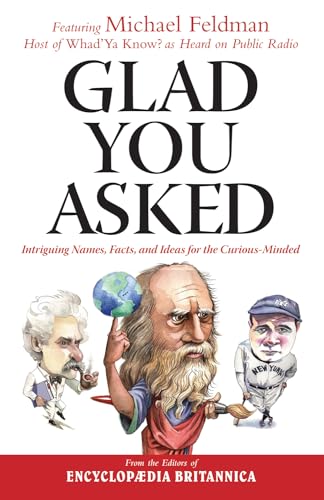
Encapsulating in brief explanations the most important people, places, things, events and ideas in the history of mankind, this educational resource features hundreds of items, many accompanied with photographs or diagrams to help provide additional information. Every entry is explained fully with a description intended to remain brief, but detailed. Running in length from 100 to 300 words, each entry is easy to read, using everyday language to explain items instead of fancy, rarely used words that appear to show off the writer&;s vocabulary. The featured categories include art, culture, and pastimes; science, technology, and life; history; the world and its wonders; religion, philosophers, and ideas; and trailblazers.
 
Die Inhaltsangabe kann sich auf eine andere Ausgabe dieses Titels beziehen.
Über die Autorin bzw. den Autor
Michael Feldman is the host of &;Whad&; Ya Know?&; which airs weekly on more than 300 public radio stations across the country. Every Saturday, more nearly 1.5 million listeners (not to mention those listening on satellite radio) tune into to learn some of the most interesting and entertaining facts about the widest variety of subjects imaginable.
Auszug. © Genehmigter Nachdruck. Alle Rechte vorbehalten.
Glad You Asked
Intriguing Names, Facts, and Ideas for the Curious-Minded
By Michael FeldmanTriumph Books
Copyright © 2006 Michael Feldman
All rights reserved.
ISBN: 978-1-57243-820-0All rights reserved.
Contents
Encyclopaedia Britannica's Thoughts On ... Introduction,
Feldman's Thoughts On ... Introduction,
Feldman's Thoughts On ... Art, Culture, and Pastimes,
Feldman's Thoughts On ... History,
Feldman's Thoughts On ... Religion, Philosophy, and Ideas,
Feldman's Thoughts On ... Science, Technology, and Life,
Feldman's Thoughts On ... The World and Its Wonders,
Feldman's Thoughts On ... Trailblazers,
Photo Credits,
CHAPTER 1
Feldman's Thoughts On ... Art, Culture, and Pastimes
Art is something you know when you see it, but culture tells you which reproduction to hang over the couch. Does the house cry out for a piece from the Ashcan school, the talented if somewhat morose city-life realists who worked after the turn of the last century and whose ranks included Edward Hopper? In the master bedroom, with its Mediterranean bedstead, wouldn't Diego Velázquez be in order, perhaps Los Borrachos (The Feast of Bacchus), or The Supper at Emmaus by Caravaggio if you want to tone things down a bit? I'd avoid the royal portraits unless you have an unusually large foyer. Kandinsky pretty much goes with any décor, but Picasso's Blue Period in the powder room has been done to death. And don't even think about a Calder unless you own the air space.
Although culture started as an opportunity for the wealthy to prove that money can't buy taste, the franchise has been extended now that pop culture has its own department; maybe Keith Haring and Michelangelo had more in common than meets the eye (Haring did not design siege weapons on the side). I think that we all can agree that manga (Japanese for comics and/or cartoons) and illustrated manuscripts were cut from the same cloth. The good thing about popular culture is that there's little to read. The bad thing about it is that it's popular and, therefore, inescapable.
Aesthetics. There, I've said it, and I'm glad. Keats wrote, "Beauty is truth, truth beauty," so we'll find little guidance there, but taste is something you can work at. Start with the curtains and don't stop there. Take an adult education course — maybe they'll have nude models. Visit a museum other than one that preserves Indiana high school basketball jerseys or Studebakers (although the one in South Bend is not to be missed the next time you're there to cheer on the Irish — hey, it's all culture). Find a gallery, pick a period you feel comfortable with — for me it would have to be the Expressionists, Otto Müller in particular because I feel like his subjects look — and immerse yourself. Start to dress like a character in early Nabokov (maybe not Humbert Humbert) after first reading all of Nabokov, including his essays, and get back to me. You might want to follow the example of my parents-in-law and join a Great Books sect in Sterling, Illinois, although if it's just a lot of Michener you could be wasting your time. Vow to learn Greek so that you can read the original Euripides, all the while remembering Chico's "You-rip-a-dese, you pay!" Make your next movie one with subtitles, but don't read them aloud. Opera is not out of the question, although probably not the Ring Cycle right off of the bat. But don't go to the opera if you're going to sit there the whole time wondering, "All right already, where's the fat lady?" Try The Merry Widow — it might be as instructive as the following entries on Art, Culture, and Pastimes.
Achebe, Chinua
Achebe, (Albert) Chinua (lumogu) (born Nov. 16, 1930, Ogidi, Nigeria) Nigerian Igbo novelist. Concerned with emergent Africa at its moments of crisis, he is acclaimed for depictions of the disorientation accompanying the imposition of Western customs and values on traditional African society. Things Fall Apart(1958) and Arrow of God (1964) portray traditional Igbo life as it clashes with colonialism. No Longer at Ease (1960), A Man of the People (1966), and Anthills of the Savannah (1988) deal with corruption and other aspects of postcolonial African life.Home and Exile (2000) is in part autobiographical, in part a defense of Africa against Western distortions.
Aesop
Supposed author of a collection of Greek fables, almost certainly a legendary figure. Though Herodotus, in the 5th century bc, said that he was an actual personage, "Aesop" was probably no more than a name invented to provide an author for fables centering on beasts. Aesopian fables emphasize the social interactions of human beings, and the morals they draw tend to embody advice on how to deal with the competitive realities of life. The Western fable tradition effectively begins with these tales. Modern editions list some 200 Aesopian fables.
Aesop, with a fox, from the central medallion of a kylix, c. 470 bc; in the Gregorian Etruscan Museum, the Vatican
Armstrong, Louis
(Born Aug. 4, 1901, New Orleans, La., U.S. — died July 6, 1971, New York, N.Y.) U.S. jazz trumpeter and singer. As a youth in New Orleans, he participated in marching, riverboat, and cabaret bands. A childhood nickname, Satchelmouth, was shortened to Satchmo and used throughout his life. In 1922 he moved to Chicago to join King Oliver's Creole Jazz Band. In 1924 he joined the Fletcher Henderson Orchestra in New York City; the following year he switched from cornet to trumpet and began recording under his own name with his Hot Five and Hot Seven ensembles. In these recordings the prevailing emphasis on collective improvisation gives way to his developing strength as a soloist and vocalist. By the time of his "West End Blues" (1928), Armstrong had established the preeminence of the virtuoso soloist in jazz. His vibrant melodic phrasing, inventive harmonic improvisation, and swinging rhythmic conception established the vernacular of jazz music. His powerful tone, great range, and dazzling velocity set a new technical standard. He also was one of the first scat singers, improvising nonsense syllables in the manner of a horn. He became something more than a jazz musician: solo attraction, bandleader, film actor, and international star.
Austen, Jane
(Born Dec. 16, 1775, Steventon, Hampshire, Eng. — died July 18, 1817, Winchester, Hampshire) English novelist. The daughter of a rector, she lived in the circumscribed world of minor landed gentry and country clergy that she was to use in her writing; her closest companion was her sister, Cassandra. Her earliest known writings are mainly parodies, notably of sentimental fiction. In her six full-length novels — Sense and Sensibility (1811),Pride and Prejudice (1813), Mansfield Park(1814), Emma (1815), Persuasion (1817), andNorthanger Abbey (published 1817 but written before the others) — she created the comedy of manners of middle-class English life in her time. Her writing is noted for its wit, realism, shrewd sympathy, and brilliant prose style. Through her treatment of ordinary people in everyday life, she was the first to give the novel its distinctly modern character. She published her novels anonymously; two appeared only after her death, which probably resulted from Addison's disease.
Baker, Josephine
Orig. Freda Josephine McDonald (born June 3, 1906, St. Louis, Mo., U.S. — died April 12, 1975, Paris, France) U.S.-born French...
„Über diesen Titel“ kann sich auf eine andere Ausgabe dieses Titels beziehen.
Suchergebnisse für Glad You Asked: Intriguing Names, Facts, and Ideas...

Beispielbild für diese ISBN
Glad You Asked: Intriguing Names, Facts, and Ideas for the Curious-Minded
Verlag:
Triumph Books (edition Illustrated), 2006
ISBN 10: 1572438207
ISBN 13: 9781572438200
Gebraucht
Hardcover
Anbieter: BooksRun, Philadelphia, PA, USA
Verkäuferbewertung 5 von 5 Sternen

Hardcover. Zustand: Very Good. Illustrated. With dust jacket. It's a well-cared-for item that has seen limited use. The item may show minor signs of wear. All the text is legible, with all pages included. It may have slight markings and/or highlighting. Artikel-Nr. 1572438207-11-1-29
Gebraucht kaufen
EUR 4,68
Versand gratis
Versand innerhalb von USA
Versand innerhalb von USA
Anzahl: 1 verfügbar
Beispielbild für diese ISBN
Glad You Asked: Intriguing Names, Facts, and Ideas for the Curious-Minded
Anbieter: World of Books (was SecondSale), Montgomery, IL, USA
Verkäuferbewertung 5 von 5 Sternen
Zustand: Very Good. Item in very good condition! Textbooks may not include supplemental items i.e. CDs, access codes etc. Artikel-Nr. 00092756305
Gebraucht kaufen
EUR 5,89
Versand gratis
Versand innerhalb von USA
Versand innerhalb von USA
Anzahl: 6 verfügbar
Beispielbild für diese ISBN
Glad You Asked: Intriguing Names, Facts, and Ideas for the Curious-Minded
Anbieter: World of Books (was SecondSale), Montgomery, IL, USA
Verkäuferbewertung 5 von 5 Sternen
Zustand: Good. Item in good condition. Textbooks may not include supplemental items i.e. CDs, access codes etc. Artikel-Nr. 00092427359
Gebraucht kaufen
EUR 5,89
Versand gratis
Versand innerhalb von USA
Versand innerhalb von USA
Anzahl: 4 verfügbar
Beispielbild für diese ISBN
Glad You Asked: Intriguing Names, Facts, and Ideas for the Curious-Minded
Anbieter: ThriftBooks-Atlanta, AUSTELL, GA, USA
Verkäuferbewertung 5 von 5 Sternen
Hardcover. Zustand: As New. No Jacket. Pages are clean and are not marred by notes or folds of any kind. ~ ThriftBooks: Read More, Spend Less. Artikel-Nr. G1572438207I2N00
Gebraucht kaufen
EUR 5,96
Versand gratis
Versand innerhalb von USA
Versand innerhalb von USA
Anzahl: 1 verfügbar
Beispielbild für diese ISBN
Glad You Asked: Intriguing Names, Facts, and Ideas for the Curious-Minded
Anbieter: Wonder Book, Frederick, MD, USA
Verkäuferbewertung 5 von 5 Sternen
Zustand: As New. Like New condition. Very Good dust jacket. A near perfect copy that may have very minor cosmetic defects. Artikel-Nr. S22B-03285
Gebraucht kaufen
EUR 6,40
Versand gratis
Versand innerhalb von USA
Versand innerhalb von USA
Anzahl: 1 verfügbar
Beispielbild für diese ISBN
Glad You Asked: Intriguing Names, Facts, and Ideas for the Curious-Minded
Anbieter: Wonder Book, Frederick, MD, USA
Verkäuferbewertung 5 von 5 Sternen
Zustand: Very Good. Very Good condition. Very Good dust jacket. A copy that may have a few cosmetic defects. May also contain light spine creasing or a few markings such as an owner's name, short gifter's inscription or light stamp. Artikel-Nr. A14K-00001
Gebraucht kaufen
EUR 6,40
Versand gratis
Versand innerhalb von USA
Versand innerhalb von USA
Anzahl: 2 verfügbar
Beispielbild für diese ISBN
Glad You Asked : Intriguing Names, Facts, and Ideas for the Curious-Minded
Anbieter: Better World Books, Mishawaka, IN, USA
Verkäuferbewertung 5 von 5 Sternen
Zustand: Very Good. Pages intact with possible writing/highlighting. Binding strong with minor wear. Dust jackets/supplements may not be included. Stock photo provided. Product includes identifying sticker. Better World Books: Buy Books. Do Good. Artikel-Nr. 1458158-6
Gebraucht kaufen
EUR 6,54
Versand gratis
Versand innerhalb von USA
Versand innerhalb von USA
Anzahl: 1 verfügbar
Beispielbild für diese ISBN
Glad You Asked : Intriguing Names, Facts, and Ideas for the Curious-Minded
Anbieter: Better World Books: West, Reno, NV, USA
Verkäuferbewertung 5 von 5 Sternen
Zustand: Good. Pages intact with minimal writing/highlighting. The binding may be loose and creased. Dust jackets/supplements are not included. Stock photo provided. Product includes identifying sticker. Better World Books: Buy Books. Do Good. Artikel-Nr. 1458156-6
Gebraucht kaufen
EUR 6,54
Versand gratis
Versand innerhalb von USA
Versand innerhalb von USA
Anzahl: 1 verfügbar
Beispielbild für diese ISBN
Glad You Asked: Intriguing Names, Facts, and Ideas For the Curious-Minded
Anbieter: Revaluation Books, Exeter, Vereinigtes Königreich
Verkäuferbewertung 5 von 5 Sternen
Hardcover. Zustand: Brand New. english language edition. 272 pages. 8.50x5.75x0.75 inches. In Stock. Artikel-Nr. 1572438207
Neu kaufen
EUR 20,82
EUR 11,79 Versand
Versand von Vereinigtes Königreich nach USA
Versand von Vereinigtes Königreich nach USA
Anzahl: 1 verfügbar