
Verwandte Artikel zu When the Final Buzzer Sounds: Nhl Greats Share Their...
Inhaltsangabe
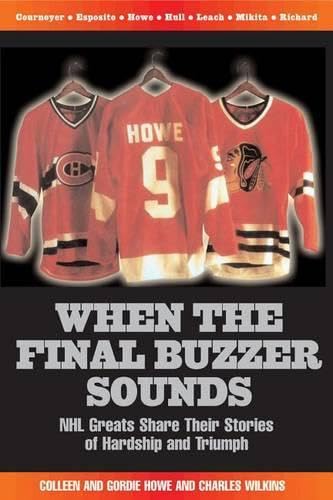
Sharing the sometimes bittersweet, sometimes unexpected, always insightful accounts of the lives of some of the NHL's most famous players after retirement and the turns their lives have taken&;often just as wild and crazy as their time on the ice&;this collection of poignant stories details the hockey's greatest players after the last goal has been tended and the final buzzer sounds. Through in-depth one-on-one interviews, the book offers vivid and captivating portraits of nine hockey greats, profiling heroes such as Phil Esposito, Bobby Hull, Gordie Howe, and Eric Nesterenko, and it chronicles the struggles and triumphs that came after a life on the ice.
Die Inhaltsangabe kann sich auf eine andere Ausgabe dieses Titels beziehen.
Über die Autorin bzw. den Autor
Colleen Howe was a sports agent and the founder of Power Play International and Power Play Publications. She was the wife of Gordie Howe. Gordie Howe is a former NHL and WHA player. He is a four-time Stanley Cup champion and the recipient of six Art Ross Trophies, six Hart Trophies, and the first NHL Lifetime Achievement Award. The Howes collaborated with Charles Wilkins on After the Applause. Wilkins is the author of Breakaway: Hockey and the Years Beyond and the coauthor of Hockey: The Illustrated History.
Auszug. © Genehmigter Nachdruck. Alle Rechte vorbehalten.
When the Final Buzzer Sounds
NHL Greats Share their Stories of Hardship and Triumph
By Collen Howe, Gordie HoweTriumph Books
Copyright © 2000 Triumph Books
All rights reserved.
ISBN: 978-1-57243-392-2All rights reserved.
Contents
Introduction by Charles Wilkins,
1. Yvan Cournoyer: A Simple Man at Heart,
2. Phil Esposito: In the Capital of the World,
3. John Ferguson: Ballet and Murder,
4. Gordie and Colleen Howe: The Flower and the Gardener,
5. Bobby Hull: A Kind of Dream,
6. Reggie Leach: In the Wilds of New Jersey,
7. Stan and Jill Mikita: Stops along the Way,
8. Eric Nesterenko: Free of the Burden of Gravity,
9. Maurice Richard: In the Mood,
Photo Gallery,
CHAPTER 1
Yvan Cournoyer: A Simple Man at Heart
When eight-year-old Kurtis Cournoyer asks his dad for a bedtime story, he knows pretty much what to expect. "Yvan sits down beside him," says Evelyn Cournoyer, "and, without exception, the first words out of Yvan's mouth are, 'Once upon a time, there was a little boy who had a dream.' ... And Kurtis and I say to ourselves, Oh, no, not the Dream again!"
The little boy, according to the tale, lived in a small town in rural Quebec and wanted nothing more in life than to play hockey for the Montreal Canadiens.
Because he was smaller than most boys his age, he was prepared to work extremely hard to make his dream come true. And every day, all winter, he spent every possible moment either on the town rink or on the tiny sheet of ice in his backyard. In summer, he fired hundreds of shots a day against the wall of his parents' garage.
Eventually, he moved with his family to Montreal, where, as a teenager, he continued to pour every ounce of his energy into improving his hockey skills.
And, sure enough, one day when he was nineteen years old, his hard work bore fruit, and he was summoned by the great coach Toe Blake to suit up with Les Glorieux, the Canadiens, the mythic standard bearers of the pride of French Canada.
He could not have been prouder as he pulled on the Canadiens sweater for his first game. And he could not have been more excited as he lined up for his first shift beside two of the heroes of his boyhood, Henri Richard and Jean Beliveau.
And he could not have been more daunted as he glanced across the face-off circle at perhaps the greatest hockey player of all time, Gordie Howe.
The Little Dreamer scored his first NHL goal that night, and the following season had his name inscribed on the glistening flanks of the Stanley Cup.
"That's where the story always ends," smiles Evelyn, "with the boy winning the Stanley Cup. Then it's lights out."
Were it not for Kurtis's sleep requirements, Yvan could easily extend the triumphal little roman à clef into the wee hours of the morning. He certainly has a storyteller's capital in his nearly five hundred big-time goals, his four All-Star team selections, and his ten Stanley Cups. He could add heroic subplots from the most remarkable hockey series ever, between the Canadians and Soviets, in 1972, or from the 1973 playoffs, when he led all combatants with fifteen goals and won the Conn Smythe Trophy as that year's premier playoff performer.
If he decided to darken the narrative, or take it into the shadows of the campfire, he could introduce his numerous debilitating injuries: to knees, back, head, shoulder, Achilles tendon, ankle; or his thirteen trips to the operating room; or the intense psychological pressures of being a marquee player in one of the fastest and most dangerous sports on earth.
He could bring in the goblins he encountered in the early autumn of 1979 when it struck him with the finality of a death sentence that the resonant dream of his boyhood was over. "I'd missed most of the previous season with a back injury," he explains, "but I'd come to training camp in September and had scored a few goals, and I thought I was going to be okay. If everything went well, I hoped to play another couple of years."
But when he awoke the morning after a preseason game against the Philadelphia Flyers, he was unable to walk, let alone skate, "and I knew that was it," he says.
The intervening years have brought Yvan enviable domestic and professional success. But any discussion of the eighteen months that followed his retirement from the Canadiens still brings a perceptible strain to his normally beatific face.
"It took me five years to accept that I was really retired!" he exclaims. "You play hockey all winter from the time you're five years old; you have the excitement, the camaraderie, the schedule to follow, and then, boom, it's over, and there's a very large hole in your life. In order to fill it, you do this, you do that, you go to work, probably at a job you don't understand, and every time you see a game, you have to convince yourself again that you're no longer a part of what's happening on the ice. Although deep down you still believe you are. You still think maybe you could play."
"Even now, looking at pictures from back then, I can see how drawn he was with the stress," says his wife, Evelyn. "We've been together more than twenty years, and in all that time, it's the only rough period he's had."
Evelyn submits that part of Yvan's postretirement agony was his lack of any choice concerning the termination of his career. "If he'd been able to say to himself, okay, I'll play this season, or the next one, and that'll be it, he'd have had at least some sense of control, as well as the time to prepare himself mentally."
What made the separation even harder for Yvan was his extraordinary emotional attachment to the Canadiens franchise, to its personnel and players, and even to its historic building. "You've got to remember," he says, "I played my entire career, from bantam to the end, in Montreal, and that from the time I started with the Junior Canadiens, at seventeen, I played at the Forum."
Not surprisingly, his evocations of those years are liberally sprinkled with the vocabulary of blood connection. Toe Blake, he says, was "like a father," his teammates "like brothers," the whole organization "one grande famille." To the players, the Forum was known affectionately as "la maison." "It wasn't my second home," says Yvan, "it was my first."
In the months that followed his abrupt departure from the game, he and Evelyn cast about futilely for a manageable approach to the future. As a distraction and a means of staying fit, they took up skiing, one of the few sports Yvan could handle with a bad back and reconstructed knees.
"One day," brightens Evelyn, "Yvan hit on the idea of a brasserie. He and I had always enjoyed restaurants, and with his popularity — well?"
A short time later, as they drove along Thirty-second Avenue in Lachine, a working-class suburb in west Montreal, where Yvan had lived as a boy, Yvan noticed a large open lot near the busy intersection of highways 13 and 20, not far from Dorval Airport. "It was a perfect spot for a restaurant," he says, and within days he was negotiating its purchase from Canadian National Railways. Within weeks, he was dickering with architects over plans for the capacious restaurant and bar that would eventually stand on the site. "Yvan always thinks big — no half measures," says Evelyn. Indeed, Brasserie 12 — so named for Yvan's sweater number — was to be a six-hundred-seat showplace, a monument not just to eating and drinking but to the life and accomplishments of its famous founder. (Coincidentally, it would stand directly across the street...
„Über diesen Titel“ kann sich auf eine andere Ausgabe dieses Titels beziehen.
Suchergebnisse für When the Final Buzzer Sounds: Nhl Greats Share Their...

Beispielbild für diese ISBN
When the Final Buzzer Sounds
Anbieter: World of Books (was SecondSale), Montgomery, IL, USA
Verkäuferbewertung 5 von 5 Sternen

Zustand: Very Good. Item in very good condition! Textbooks may not include supplemental items i.e. CDs, access codes etc. Artikel-Nr. 00096125786
Gebraucht kaufen
EUR 6,44
Versand gratis
Versand innerhalb von USA
Versand innerhalb von USA
Anzahl: 2 verfügbar
Beispielbild für diese ISBN
When the Final Buzzer Sounds
Anbieter: World of Books (was SecondSale), Montgomery, IL, USA
Verkäuferbewertung 5 von 5 Sternen
Zustand: Good. Item in good condition. Textbooks may not include supplemental items i.e. CDs, access codes etc. Artikel-Nr. 00108751010
Gebraucht kaufen
EUR 6,44
Versand gratis
Versand innerhalb von USA
Versand innerhalb von USA
Anzahl: 1 verfügbar
Beispielbild für diese ISBN
When the Final Buzzer Sounds
Anbieter: ThriftBooks-Atlanta, AUSTELL, GA, USA
Verkäuferbewertung 5 von 5 Sternen
Hardcover. Zustand: Good. No Jacket. Pages can have notes/highlighting. Spine may show signs of wear. ~ ThriftBooks: Read More, Spend Less. Artikel-Nr. G1572433922I3N00
Gebraucht kaufen
EUR 6,56
Versand gratis
Versand innerhalb von USA
Versand innerhalb von USA
Anzahl: 1 verfügbar