
Verwandte Artikel zu Making the System Work for Your Child with ADHD (Getting...
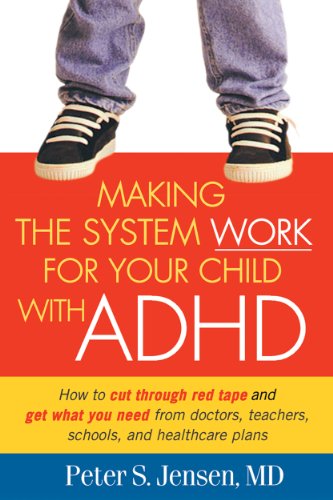
Making the System Work for Your Child with ADHD (Getting the Most Out of the System for Y) - Softcover
Inhaltsangabe
There’s lots of help out there for kids with ADHD, but getting it isn’t always easy. Where can you turn when you’ve mastered the basics and “doing everything right” isn’t enough--the insurer denies your claims, parent-teacher meetings get tense, or those motivating star charts no longer encourage good behavior?
Dr. Peter Jensen has spent years generating ways to make the healthcare and education systems work--as the father of a son with ADHD and as a scientific expert and dedicated parent advocate. No one knows more about managing the complexities of the disorder and the daily hurdles it raises. Now Dr. Jensen pools his own experiences with those of over 80 other parents to help you troubleshoot the system without reinventing the wheel. From breaking through bureaucratic bottlenecks at school to advocating for your child’s healthcare needs, this straightforward, compassionate guide is exactly the resource you’ve been looking for.
Die Inhaltsangabe kann sich auf eine andere Ausgabe dieses Titels beziehen.
Über die Autorinnen und Autoren
Peter S. Jensen, MD, is Director of the Center for the Advancement of Children's Mental Health and Ruane Professor of Child Psychiatry at the Columbia University College of Physicians and Surgeons. Previously, he was Associate Director of Child and Adolescent Research at the National Institute of Mental Health (NIMH), where he was the lead NIMH investigator on a major study of the treatment of ADHD. He is the author or editor of numerous scientific articles and books; has received prestigious national awards for his research, writing, and teaching; and serves on the board of directors of Children and Adults with Attention-Deficit/Hyperactivity Disorder (CHADD), among other organizations. This book is the first in a new series edited by Dr. Jensen, ""Making the System Work for Your Child.""
Peter S. Jensen, MD, is Director of the Center for the Advancement of Children's Mental Health and Ruane Professor of Child Psychiatry at the Columbia University College of Physicians and Surgeons. Previously, he was Associate Director of Child and Adolescent Research at the National Institute of Mental Health (NIMH), where he was the lead NIMH investigator on a major study of the treatment of ADHD. He is the author or editor of numerous scientific articles and books; has received prestigious national awards for his research, writing, and teaching; and serves on the board of directors of Children and Adults with Attention-Deficit/Hyperactivity Disorder (CHADD), among other organizations. This book is the first in a new series edited by Dr. Jensen, "Making the System Work for Your Child."
Auszug. © Genehmigter Nachdruck. Alle Rechte vorbehalten.
Making the System Work for Your Child with ADHD
By Peter S. JensenThe Guilford Press
Copyright © 2004 The Guilford Press
All rights reserved.
ISBN: 978-1-57230-870-1All rights reserved.
Contents
Cover,
Title Page,
Copyright Page,
Preface,
Part I TAKING CHARGE OF GETTING HELP FOR YOUR CHILD,
One Nowhere to Turn?: Why It's So Hard to Get the Help Your Child Deserves and What You Can Do about It,
Two Principles of Action for the Expert Parent,
Three Developing a Plan for Your Child: How to Use Your Knowledge of Yourself and Your Child to Get the Best Care Available,
Four What You Need to Get Started: Essential Tools and Resources for the Expert Parent,
Part II WHAT TO EXPECT AND HOW TO GET WHAT YOUR CHILD NEEDS,
Five Getting the Best from the Healthcare System,
Six Getting the Best from Your Child's Education,
Seven Getting the Best Out of Your Home and Family Life,
Eight Getting the Best from All the Rest,
Nine Looking Ahead,
Appendices,
Appendix A Sample Section 504/ADA Accommodation Plan,
Appendix B Parent/Advocacy Organizations and Resources You Need to Know About,
Appendix C Funding- and Insurance-Related Resources You Need to Know About,
Appendix D Legal/Advocacy Resources You Need to Know About,
Appendix E Useful Books and Resources,
Appendix F Blank Action Plans,
Appendix G Table of Psychiatric Disorders, Symptoms, and Proven Treatments,
Appendix H Sample Letters,
Appendix I Using Behavioral Strategies to Help Your Child Improve His or Her Behavior,
Appendix J Ways to Become Involved,
Index,
About the Author,
About Guilford Press,
Discover Related Guilford Books,
CHAPTER 1
NOWHERE TO TURN?
Why It's So Hard to Get the Help Your Child Deserves and What You Can Do about It
"The doctor means well, but his advice just isn't practical."
"The school says it is 'not their problem' because ADHD is not a school's responsibility but a medical problem."
"My husband thinks the 'real problem' with our child is that I am a pushover and 'just not firm enough.'"
"I never would have known how much my daughter could have done on long-acting medications, because my insurance company would not pay for them."
The fact that you're reading this book probably means you've run into some of the same obstacles as these parents. Despite repeated efforts and a firm commitment to helping your youngster with ADHD, "the system" just seems to stand in your way. Maybe it's the insurance company that won't cover the latest medication even though it's the only one that really seems to help your child concentrate at school. Or it could be your local school system, which just doesn't have enough funds to give your child extra help while letting him remain in a regular classroom, where you're sure he'll thrive—if only he could be allowed extra time for tests and be offered methods to help him stay on task. Perhaps "the system" is your own family—a spouse who "doesn't believe in ADHD," as one mother reported, relatives who shun your admittedly disruptive child and therefore your entire family unit, or siblings who are falling apart from the conflict and neglect they are suffering because the kid with ADHD needs so much time from you.
Far too often, the systems in place to help children with chronic illnesses like ADHD fall short, largely because the unique problems of an individual child require costly, time-consuming attention and the number of individual kids needing such care simply exceeds the capacity of the available resources. But sometimes the system can work for your child, if you know how to push the right buttons and pull the right levers. The trouble is, by the time you've piled up what feels like a lifetime of frustration over the system's shortcomings, you may have very little sense of what's gone wrong, much less what to do about it.
Most likely, you have already read other books on the topic of ADHD, you have consulted with your child's doctor, and perhaps you even have sought the advice of a professional counselor or therapist, such as a child psychologist or psychiatrist. Almost certainly, you have had repeated discussions with your child's teachers, and you may also have sought advice from family members and friends. So, given all the effort you have put into getting your child help, why are things still so difficult?
The short answer is that the task before you is one of the toughest any parent—and person—ever faces. As a parent of a child with ADHD, I can personally attest to a lot of trial-and-error, hit-and-miss attempts to do the right thing, only to realize later that I made yet another mistake ... despite undergraduate training in psychology, four years of medical school, and extensive training in child, adolescent, and adult psychiatry! Creating a good life and crafting a promising future for a child with ADHD is incredibly complicated. Lest you've gotten so down on yourself for "failing" that you've forgotten what you're trying to accomplish, let me remind you how high the bar has been set for you: You have to convince an underfunded school system that may be understaffed with undertrained educators to learn and use new classroom and homework systems to ensure that your child has the same chance to learn as the dozens of other children under its tutelage. You have to work with a doctor pressured by managed care to treat patients faster and more cheaply in finding medication that will calm your child down and help him concentrate, without keeping him up at night or causing other intolerable side effects. You may very well have to negotiate with your insurance company with the skill of an experienced arbitrator to get coverage for therapy, medications, and even visits to the prescribing physician. You and your child's other parent have to set aside philosophical differences and marital conflicts to form a united front to help your son or daughter with ADHD. And you have to take on these time-consuming, exhausting tasks without neglecting your other kids, harming your own health, or going broke.
Not so short an answer after all, is it? Now for the long answer.
WHY MEDICAL FACTS ARE NOT ENOUGH
What has often surprised me is that while my training has definitely been helpful, it is my experiences as a parent (including my many mistakes) that have been most valuable in assisting parents to develop workable solutions for their child with ADHD. In fact, my experiences as a parent tend to keep me honest.
I am often aware that the simple, typical medical advice I dispense in the comfortable surroundings of my office isn't nearly enough to send a parent off knowing exactly what to do at home. The difference between what I can read in any medical textbook and what works in the "real world" lies in the particulars of adapting the advice to the given circumstances of that child and family, and in debugging the tools and techniques to be applied to the many problems that get in the way.
On a Personal Note ...
To show you what I mean, let me give you one of my own trial-and-error experiences. As you might expect for a child psychiatrist, I spent no small amount of time in graduate and postgraduate training learning how to apply behavior therapy, a special form of treatment that relies on so-called rewards and consequences—point systems and the like—to help a child with behavioral problems such as ADHD, oppositionality, and aggression. Just in time, too, since my...
„Über diesen Titel“ kann sich auf eine andere Ausgabe dieses Titels beziehen.
Suchergebnisse für Making the System Work for Your Child with ADHD (Getting...

Beispielbild für diese ISBN
Making the System Work for You
Anbieter: World of Books (was SecondSale), Montgomery, IL, USA
Verkäuferbewertung 5 von 5 Sternen

Zustand: Good. Item in good condition. Textbooks may not include supplemental items i.e. CDs, access codes etc. Artikel-Nr. 00086469901
Gebraucht kaufen
EUR 3,79
Versand gratis
Versand innerhalb von USA
Versand innerhalb von USA
Anzahl: 8 verfügbar
Beispielbild für diese ISBN
Making the System Work for Your Child with ADHD
Verlag:
Guilford Publications, 2004
ISBN 10: 1572308702
ISBN 13: 9781572308701
Gebraucht
Softcover
Erstausgabe
Anbieter: Better World Books, Mishawaka, IN, USA
Verkäuferbewertung 5 von 5 Sternen
Zustand: Good. 1st Edition. Former library copy. Pages intact with minimal writing/highlighting. The binding may be loose and creased. Dust jackets/supplements are not included. Includes library markings. Stock photo provided. Product includes identifying sticker. Better World Books: Buy Books. Do Good. Artikel-Nr. GRP98413306
Gebraucht kaufen
EUR 6,28
Versand gratis
Versand innerhalb von USA
Versand innerhalb von USA
Anzahl: 1 verfügbar
Beispielbild für diese ISBN
Making the System Work for Your Child with ADHD
Verlag:
Guilford Publications, 2004
ISBN 10: 1572308702
ISBN 13: 9781572308701
Gebraucht
Softcover
Erstausgabe
Anbieter: Better World Books, Mishawaka, IN, USA
Verkäuferbewertung 5 von 5 Sternen
Zustand: Very Good. 1st Edition. Pages intact with possible writing/highlighting. Binding strong with minor wear. Dust jackets/supplements may not be included. Stock photo provided. Product includes identifying sticker. Better World Books: Buy Books. Do Good. Artikel-Nr. 14169692-6
Gebraucht kaufen
EUR 6,28
Versand gratis
Versand innerhalb von USA
Versand innerhalb von USA
Anzahl: 1 verfügbar
Beispielbild für diese ISBN
Making the System Work for Your Child with ADHD
Anbieter: Wonder Book, Frederick, MD, USA
Verkäuferbewertung 5 von 5 Sternen
Zustand: As New. Like New condition. A near perfect copy that may have very minor cosmetic defects. Artikel-Nr. Z12K-00694
Gebraucht kaufen
EUR 6,35
Versand gratis
Versand innerhalb von USA
Versand innerhalb von USA
Anzahl: 1 verfügbar
Beispielbild für diese ISBN
Making the System Work for Your Child with ADHD
Anbieter: Wonder Book, Frederick, MD, USA
Verkäuferbewertung 5 von 5 Sternen
Zustand: Very Good. Very Good condition. A copy that may have a few cosmetic defects. May also contain light spine creasing or a few markings such as an owner's name, short gifter's inscription or light stamp. Artikel-Nr. I06D-00910
Gebraucht kaufen
EUR 6,35
Versand gratis
Versand innerhalb von USA
Versand innerhalb von USA
Anzahl: 1 verfügbar
Beispielbild für diese ISBN
Making the System Work for Your Child with ADHD
Anbieter: Wonder Book, Frederick, MD, USA
Verkäuferbewertung 5 von 5 Sternen
Zustand: Good. Good condition. A copy that has been read but remains intact. May contain markings such as bookplates, stamps, limited notes and highlighting, or a few light stains. Bundled media such as CDs, DVDs, floppy disks or access codes may not be included. Artikel-Nr. P03C-01588
Gebraucht kaufen
EUR 6,35
Versand gratis
Versand innerhalb von USA
Versand innerhalb von USA
Anzahl: 1 verfügbar
Beispielbild für diese ISBN
Making the System Work for Your Child with ADHD
Anbieter: ThriftBooks-Reno, Reno, NV, USA
Verkäuferbewertung 5 von 5 Sternen
Paperback. Zustand: Very Good. No Jacket. May have limited writing in cover pages. Pages are unmarked. ~ ThriftBooks: Read More, Spend Less. Artikel-Nr. G1572308702I4N00
Gebraucht kaufen
EUR 6,45
Versand gratis
Versand innerhalb von USA
Versand innerhalb von USA
Anzahl: 1 verfügbar
Beispielbild für diese ISBN
Making the System Work for Your Child with ADHD
Anbieter: ThriftBooks-Dallas, Dallas, TX, USA
Verkäuferbewertung 5 von 5 Sternen
Paperback. Zustand: Fair. No Jacket. Readable copy. Pages may have considerable notes/highlighting. ~ ThriftBooks: Read More, Spend Less. Artikel-Nr. G1572308702I5N00
Gebraucht kaufen
EUR 6,45
Versand gratis
Versand innerhalb von USA
Versand innerhalb von USA
Anzahl: 1 verfügbar
Beispielbild für diese ISBN
Making the System Work for Your Child with ADHD
Anbieter: ThriftBooks-Atlanta, AUSTELL, GA, USA
Verkäuferbewertung 5 von 5 Sternen
Paperback. Zustand: Very Good. No Jacket. May have limited writing in cover pages. Pages are unmarked. ~ ThriftBooks: Read More, Spend Less. Artikel-Nr. G1572308702I4N00
Gebraucht kaufen
EUR 6,45
Versand gratis
Versand innerhalb von USA
Versand innerhalb von USA
Anzahl: 1 verfügbar
Beispielbild für diese ISBN
Making the System Work for Your Child with ADHD
Anbieter: ThriftBooks-Dallas, Dallas, TX, USA
Verkäuferbewertung 5 von 5 Sternen
Paperback. Zustand: Very Good. No Jacket. May have limited writing in cover pages. Pages are unmarked. ~ ThriftBooks: Read More, Spend Less. Artikel-Nr. G1572308702I4N00
Gebraucht kaufen
EUR 6,45
Versand gratis
Versand innerhalb von USA
Versand innerhalb von USA
Anzahl: 1 verfügbar