
Verwandte Artikel zu Things That Are
Inhaltsangabe
<div>The debut collection of a writer whose accolades precede her: a Whiting Award, a Rona Jaffe Award, a <i>Best American Essays</i> selection, and a Pushcart Prize, all received before her first book-length publication. This book represents a major break-out of an entirely new brand of nonfiction writer, in a mode like that of Ander Monson, John D'Agata, and Eula Biss, but a new sort of beast entirely its own.<br><br><i>Things That Are</i> takes jellyfish, fainting goats, and imperturbable caterpillars as just a few of its many inspirations. In a series of essays that progress from the tiniest earth dwellers to the most far flung celestial bodies—considering the similarity of gods to donkeys, the inexorability of love and vines, the relations of exploding stars to exploding sea cucumbers—Amy Leach rekindles a vital communion with the wild world, dormant for far too long. <i>Things That Are</i> is not specifically of the animal, the human, or the phenomenal; it is a book of wonder, one the reader cannot help but leave with their perceptions both expanded and confounded in delightful ways.<br></div>
Die Inhaltsangabe kann sich auf eine andere Ausgabe dieses Titels beziehen.
Über die Autorin bzw. den Autor
<div>Since receiving her MFA from the University of Iowa in 2005, <strong>Amy Leach</strong> has been recognized with the Whiting Writers’ Award (2010), a <em>Best American Essays</em> selection (2009), a Rona Jaffe Foundation Award (2008), and a 2011 Pushcart Prize. Her essays have appeared in numerous literary journals and reviews, including <em>Tin House</em>, <em>Orion Magazine</em>, <em>A Public Space</em>, and <em>Los Angeles Review</em>. She lives in Chicago, where she plays the piano, performs in a bluegrass band, and teaches writing at Loyola and Northwestern Universities.<br><br><br>Q&A with Amy Leach, author of <em>Things That Are</em><br><br><strong>Your essays peer into the often-overlooked phenomena of the natural world; what do you hope your readers will gain from your writings?</strong><br><br>Amy Leach: Someone told me that animals are disappearing from our dreams. It is sad, and impoverishing, that animals are underrepresented in our imagination, our art, and our lives. One of the things I was trying to do, in writing these essays, was furnish my own imagination with various creatures, various lives, various experiences of the world. This project brought me a lot of joy, and joy is what I'd hope to share with readers.<br><br><strong>What is your favorite word, whether real or made-up? When you love a word, do you fill your pages with it or save it for the perfect moment?</strong><br><br>Amy Leach: My favorite word is dog and I could say it all day long, though I restrained myself in the writing of this book from sprinkling every sentence with dogs. It was interesting rereading the essays all together and noticing which words turn up repeatedly, like oblivious. I think I am always writing it down in my notebook as a word to use, oblivious to the fact that I have already used it many times. I also love the word sheep and am not temperate in using it. <br><br><strong>Space dust, pea tendrils, frogs from Borneo, and the Earth’s mousy core—your essays range wildly between species and phenomena. Where do you pull inspiration from? Have you ever pulled a dictionary of natural history off a shelf, opened it to a page, and simply said, “I think I’ll write about the Pinwheel Galaxy today”?</strong><br><br>Amy Leach: A friend shipped me a 24-volume wildlife encyclopedia several years ago, and that has certainly provided frog inspiration and mouse inspiration. Sometimes inspiration came circuitously: the pea-tendril essay started out as a cabbage essay, and the panda bear essay started out as an essay about neutrinos, with panda bears as minor characters; in both cases I had to abandon my first subject for one that interested me more. Of course sometimes inspiration arrives more directly: seeing bright red mushrooms in the forest, squirrels chasing each other underneath ferns, moths walking across parking lots. <br><br><strong>What about research outside the encyclopedia? Do you seek out natural phenomena off the page?<br></strong><br><br>Amy Leach: Writing each essay was its own complete experience. While I was writing “Silly Lillies,” I bicycled up to the botanic garden every other day to admire the huge ruffly lotus leaves and the pink water lily blossoms. For the writing of the "The Wild What," I was in the Adirondacks where the stars shine unimpeded, and every night, after writing about the Great Bear all day, I could sit outside and appreciate the Great Bear itself.<br><br><strong>The book includes a “Glossary of Strange Beasts and Phenomena” which contains entries that seem almost too fantastical to believe—did you invent any of these, or are they really all true?</strong><br><br>Amy Leach: Besides Planet Huffenpuff, I did not invent any of the words in the Glossary. But it was fun excavating old fantastic words and doing my part to restore to them their former privileges. Defining them, at the end of the book, took me back to fifth grade; I remember in fifth grade writing my own definitions of words; it's as fun as it ever was. <br></div>
Von der hinteren Coverseite
Of all the wondrous things that are catalogued in this brave little book, the most wondrously fresh and novel may be the uncanny Ms. Leach’s own gamin-sly, rhythm-rhymey voice, and oh that flint-flighty, rapt-capacious mind of hers. Besides which, no one conjures a presenter present tense than she. Sheer scrambling delight.”
Lawrence Weschler, author of Mr Wilson's Cabinet of Wonder and Uncanny Valley: Adventures in the Narrative
Like a descendant of Lewis Carroll and Emily Dickinson, Amy Leach brings new meaning to the world without us, and within. A reader entering this book to learn more about the universe will exit knowing much more about her own self. At once large and intimate, these essays introduce one of the most exciting and original writers in America.”
Yiyun Li, author of Gold Boy, Emerald Girl and The Vagrants
I know of no other writer on earthor in the skylike Amy Leach. One of the pleasures ofThings That Are is the surprise of finding, among the mouldywarps and whimwhams and leguminous exoplanets of our galaxy, truths about ourselvesunearthed and unaired.”
Eula Biss, author of Notes from No Man’s Land
Infernally addictive.”
David Abram, author of Becoming Animal
In a series of essays that progress from the tiniest Earth dwellers to far-flung celestial bodiesconsidering everything from the similarity of gods to donkeys, to exploding stars and exploding sea cucumbersAmy Leach (Rona Jaffe and Whiting Award winner) rekindles our communion with the world. This groundbreaking debut delights and confounds the senses in wondrous ways.
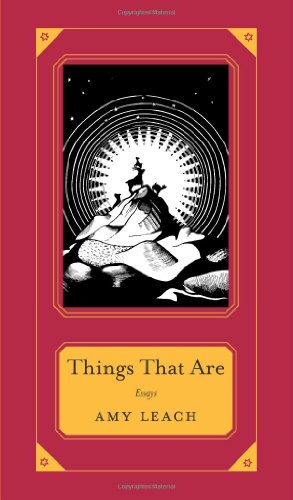
Cover illustration:
© Nate Christopherson
„Über diesen Titel“ kann sich auf eine andere Ausgabe dieses Titels beziehen.
Suchergebnisse für Things That Are

Beispielbild für diese ISBN
Things That Are
Anbieter: World of Books (was SecondSale), Montgomery, IL, USA
Verkäuferbewertung 5 von 5 Sternen

Hardback. Zustand: Very Good. The debut collection of a writer whose accolades precede her: a Whiting Award, a Rona Jaffe Award, a Best American Essays selection, and a Pushcart Prize, all received before her first book-length publication. This book represents a major break-out of an entirely new brand of nonfiction writer, in a mode like that of Ander Monson, John D'Agata, and Eula Biss, but a new sort of beast entirely its own. Things That Are takes jellyfish, fainting goats, and imperturbable caterpillars as just a few of its many inspirations. In a series of essays that progress from the tiniest earth dwellers to the most far flung celestial bodies--considering the similarity of gods to donkeys, the inexorability of love and vines, the relations of exploding stars to exploding sea cucumbers--Amy Leach rekindles a vital communion with the wild world, dormant for far too long. Things That Are is not specifically of the animal, the human, or the phenomenal; it is a book of wonder, one the reader cannot help but leave with their perceptions both expanded and confounded in delightful ways. Artikel-Nr. CIN1571313346VG
Gebraucht kaufen
EUR 5,50
Versand gratis
Versand innerhalb von USA
Versand innerhalb von USA
Anzahl: 1 verfügbar
Beispielbild für diese ISBN
Things That Are
Anbieter: ThriftBooks-Atlanta, AUSTELL, GA, USA
Verkäuferbewertung 5 von 5 Sternen
Hardcover. Zustand: Very Good. No Jacket. May have limited writing in cover pages. Pages are unmarked. ~ ThriftBooks: Read More, Spend Less. Artikel-Nr. G1571313346I4N00
Gebraucht kaufen
EUR 6,13
Versand gratis
Versand innerhalb von USA
Versand innerhalb von USA
Anzahl: 1 verfügbar
Beispielbild für diese ISBN
Things That Are
Anbieter: ThriftBooks-Atlanta, AUSTELL, GA, USA
Verkäuferbewertung 5 von 5 Sternen
Hardcover. Zustand: Good. No Jacket. Pages can have notes/highlighting. Spine may show signs of wear. ~ ThriftBooks: Read More, Spend Less. Artikel-Nr. G1571313346I3N00
Gebraucht kaufen
EUR 6,13
Versand gratis
Versand innerhalb von USA
Versand innerhalb von USA
Anzahl: 1 verfügbar
Beispielbild für diese ISBN
Things That Are
Anbieter: ThriftBooks-Atlanta, AUSTELL, GA, USA
Verkäuferbewertung 5 von 5 Sternen
Hardcover. Zustand: Good. No Jacket. Former library book; Pages can have notes/highlighting. Spine may show signs of wear. ~ ThriftBooks: Read More, Spend Less. Artikel-Nr. G1571313346I3N10
Gebraucht kaufen
EUR 6,13
Versand gratis
Versand innerhalb von USA
Versand innerhalb von USA
Anzahl: 1 verfügbar
Beispielbild für diese ISBN
Things That Are
Anbieter: Better World Books, Mishawaka, IN, USA
Verkäuferbewertung 5 von 5 Sternen
Zustand: Very Good. Former library copy. Pages intact with possible writing/highlighting. Binding strong with minor wear. Dust jackets/supplements may not be included. Includes library markings. Stock photo provided. Product includes identifying sticker. Better World Books: Buy Books. Do Good. Artikel-Nr. 5470748-6
Gebraucht kaufen
EUR 6,18
Versand gratis
Versand innerhalb von USA
Versand innerhalb von USA
Anzahl: 1 verfügbar
Beispielbild für diese ISBN
Things That Are
Anbieter: Better World Books, Mishawaka, IN, USA
Verkäuferbewertung 5 von 5 Sternen
Zustand: Good. Pages intact with minimal writing/highlighting. The binding may be loose and creased. Dust jackets/supplements are not included. Stock photo provided. Product includes identifying sticker. Better World Books: Buy Books. Do Good. Artikel-Nr. 5466582-6
Gebraucht kaufen
EUR 6,18
Versand gratis
Versand innerhalb von USA
Versand innerhalb von USA
Anzahl: 1 verfügbar
Beispielbild für diese ISBN
Things That Are
Anbieter: Better World Books: West, Reno, NV, USA
Verkäuferbewertung 5 von 5 Sternen
Zustand: Good. Former library copy. Pages intact with minimal writing/highlighting. The binding may be loose and creased. Dust jackets/supplements are not included. Includes library markings. Stock photo provided. Product includes identifying sticker. Better World Books: Buy Books. Do Good. Artikel-Nr. 1455357-6
Gebraucht kaufen
EUR 6,18
Versand gratis
Versand innerhalb von USA
Versand innerhalb von USA
Anzahl: 1 verfügbar
Beispielbild für diese ISBN
Things That Are
Anbieter: Sell Books, Elland, YORKS, Vereinigtes Königreich
Verkäuferbewertung 5 von 5 Sternen
hardcover. Zustand: Good. Our good condition books are generally good for reading but not for gifting or collecting. They could have imperfections such as creasing, fanning, inscriptions, margin notes, yellowing, staining on edge or cover or pages, bumps, scuffs, etc etc (sometimes multiple of these). It's a wide category that encompasses anything that isn't almost-new down to anything that is slightly better than poor. We would NOT recommend gifting Good books - these should be considered reading copies. Our books are dispatched from a Yorkshire former cotton mill. We list via barcode/ISBN so please note that the images are stock images and may not be the exact copy you receive, furthermore the details about edition and year might not be accurate as many publishers reuse the same ISBN for multiple editions and as we simply scan a barcode or enter an ISBN we do not check the validity of the edition data when listing. If you're looking for an exact edition please don't order (at least not without checking with us first, although we don't always have time to check). We aim to dispatch prompty, the service used will depend on order value and book size. We can ship to most countries, see our shipping policies. Payment is via Abe only. Artikel-Nr. SBAB-L-BJN00237-MIX-20230807-G
Gebraucht kaufen
EUR 18,17
EUR 9,25 Versand
Versand von Vereinigtes Königreich nach USA
Versand von Vereinigtes Königreich nach USA
Anzahl: 1 verfügbar
Beispielbild für diese ISBN
Things That Are
Anbieter: Magers and Quinn Booksellers, Minneapolis, MN, USA
Verkäuferbewertung 5 von 5 Sternen
hardcover. Zustand: Like New. May have light shelf wear and/or a remainder mark. Complete. Clean pages. hardcover. Artikel-Nr. 753742
Gebraucht kaufen
EUR 27,52
EUR 3,56 Versand
Versand innerhalb von USA
Versand innerhalb von USA
Anzahl: 1 verfügbar
Beispielbild für diese ISBN
Things That Are
Anbieter: Revaluation Books, Exeter, Vereinigtes Königreich
Verkäuferbewertung 5 von 5 Sternen
Hardcover. Zustand: Brand New. 192 pages. 8.75x5.75x0.75 inches. In Stock. Artikel-Nr. 1571313346
Neu kaufen
EUR 63,09
EUR 11,93 Versand
Versand von Vereinigtes Königreich nach USA
Versand von Vereinigtes Königreich nach USA
Anzahl: 1 verfügbar