
Verwandte Artikel zu Our Way To Fight: Israeli and Palestinian Activists...
Inhaltsangabe
The news coming out of the Israel-Palestine conflict remains grim. The region remains a symbol of instability fueled by violence and hatred.
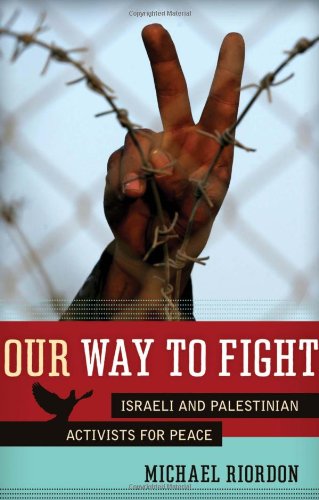
In Our Way to Fight, journalist and author Michael Riordon offers a different perspective, exploring the conflict through local Israeli and Palestinian peace activists who break all stereotypes. Riordon travels to thousand-year-old olive groves, besieged villages, refugee camps, checkpoints, and barracks, talking with people on both sides of the Wall who fight violence and war through creative resistance. He uncovers the crises that stirred them to act, the risks they face in working for peace, and the small victories that sustain them.
In the face of deepening conflict, Our Way to Fight is a portrait of courageous grassroots action that provides hope for a livable future and inspiration to peace activists in all nations.
Die Inhaltsangabe kann sich auf eine andere Ausgabe dieses Titels beziehen.
Über die Autorin bzw. den Autor
A writer and an award-winning documentary filmmaker, Michael Riordon is the author of An Unauthorized Biography of the World: Oral History on the Front Lines and three other books.
Auszug. © Genehmigter Nachdruck. Alle Rechte vorbehalten.
Our Way to Fight
Israeli and Palestinian Activists for Peace
By Michael RiordonChicago Review Press Incorporated
Copyright © 2011 Michael Riordon
All rights reserved.
ISBN: 978-1-56976-778-8All rights reserved.
Contents
Acknowledgements,
Introduction,
1 A Day in the Country,
2 My Way to Fight,
3 The Jerusalem Syndrome,
4 Bridge to the World,
5 Witness,
6 There is a Law,
7 This is My Homeland,
8 Facts Under the Ground,
9 A Drop in the Sea,
10 Dreams Have Their Uses,
11 Civil-izing Israel,
12 The Generation that Matters,
13 Naming Palestine,
14 A Cure for Amnesia,
15 The Tempo of History,
16 Hello?,
17 Cracks in the Wall,
18 The Safety of Sleep,
Index,
CHAPTER 1
A Day in the Country
From Jerusalem the train winds slowly north through the olive and cypress-pillared Soreq River valley, dust-dry in late summer. The track follows a late nineteenth-century Ottoman route, one of countless marks left by earlier empires on this land.
Facing me sit two soldiers in olive green. With buds in ears, he nods to music in his head; she dozes behind high-fashion sunglasses. Across the aisle, three soldiers play cards, sleeves rolled neatly to the elbow. All have assault rifles propped beside them or nestled in laps.
We pass a hillside village, children in dark blue uniforms walking to school; a sand quarry, orchards, towns, a forest of construction cranes, crimson bougainvillea spilling over a wall, one gaunt cow grazing in a field of rubble.
DOROTHY NAOR
The train terminates at Tel Aviv, Israel's metropolis. In the Central Station hall, more soldiers sprawl among their packs. Outside, the city quavers under a blanket of humid heat. Through ranks of buses I see an older-model green Volkswagen Passat, a woman waving, short grey hair – this would be Dorothy Naor.
Introductions done, I launch into small talk about the weather, a Canadian habit. But Dorothy interrupts, "I want to get on the road right away. We have a long day ahead of us." She doesn't seem so much rude as driven.
She lives up the Mediterranean coast in Herzliya, named for Theodor Herzl, a revered founder of Zionism. Dorothy was born in San Francisco in 1932. At 18 she flew to the new state of Israel, then only two years old, for a Zionist leadership training course. "Like many of us who grew up during the Holocaust, I was convinced that the only place where Jews could be safe would be in a country of our own. And now suddenly here it was! Of course I was quickly enamoured with lots of Israelis I met, including the one I married." They met at university in California.
With help from a Hungarian uncle, Eric Naor had slipped out of Austria at age ten with an older brother, after the Nazi coup in 1938. They made their way to Palestine, then under British rule. Of their immediate family, Eric and his brother were the only survivors; the others died in concentration camps.
After fighting in the 1948 war of independence, and proudly taking the name of his new country, Israel Naor went to California to study water engineering. There he met Dorothy, working on a PhD in English. They married in 1952, and four years later they emigrated, or made aliyah – Hebrew for "ascending" – to the promised land.
"I thought it would be the perfect place to raise our kids," says Dorothy, "a place of our own where Jewish customs, holidays and culture would be the norm." Working for an Israeli engineering company, Israel Naor specialized in international waterworks, dams and canals. Dorothy raised the kids, completed her PhD at Tel Aviv University, and taught English in several countries where they went for Israel's work.
East of Tel Aviv the air clears visibly, as if the windshield had been washed. Under a cloudless sky, the land here looks hard and white, scraped bare.
THE GREEN LINE
"Now pay attention here," Dorothy says with pointed emphasis – I can hear the teacher. "We've just crossed the so-called Green Line. That means we have left Israel and are now in the Palestinian territories. But do you see any sign to that effect, 'Welcome to the West Bank?' Of course not, the Israeli government would never allow it. This is psychological expansion. We're meant to regard all of this land as part of Israel."
The "Green Line" refers to the truce line between Israel and its older neighbours – Egypt, Jordan, Lebanon and Syria – after the 1948 war. It left the new state with almost 80 per cent of the land that had constituted the British colony of Palestine.
As Israel expands, the Green Line has become little more than a historical footnote, a myth. Dorothy tells me that Israel is the only country in the world that refuses to define its borders.
We're flying east on newly built Road 5, wide and smooth. It links Tel Aviv to massive Israeli settlements deep in the northern West Bank. "This used to be Palestinian farmland," my guide explains, "but hardly any of the colonists are farmers. They all work in the city – morning and afternoon you'll see long lines of commuters on this road. Not only are we stealing the land, we're also urbanizing it, the way we've done with so much of Israel."
Why does she say "colonists" instead of the usual "settlers"? "I prefer to call them what they are", Dorothy replies crisply. "The distortion of words is another form of occupation, one that should offend anyone who cares about language. 'Settlement' sounds much nicer, especially to Americans who did exactly the same thing. But when you occupy other people's land and build towns on it, that's a colony."
I watch her as she drives, face set, a little fierce, but with enough laugh lines to imply the delight she takes in her eight grandchildren. She wears sturdy sandals, jeans and a white shirt, long-sleeved for modesty because we'll be visiting Palestinians during Ramadan, the holiest time of the year. To respect our hosts who will be fasting dawn to dusk, we won't eat or drink.
Dorothy makes this journey often, either to educate foreigners like me or to transport Palestinians from the West Bank, often children with serious illness, to hospital in Israel. I suspect this formidable grandmother would not be easy for young Israeli soldiers to turn back at the checkpoints.
How did she first encounter Palestinians? "For many years I never met any. We weren't supposed to, you know, except maybe the occasional gardener. Of course there were things that bothered me, but with the kids, the PTA [Parent-Teacher Association], teaching and everything, who had time to ask questions?"
What things bothered her? "Oh, lots of things, things you have to work harder each time to ignore. Probably the first big shock I couldn't ignore was when Goldstein murdered all those people in the mosque." On 25 February 1994, American-Israeli settler Baruch Goldstein entered a mosque in the West Bank city of Hebron, in army uniform and carrying an assault rifle. Unimpeded by Israeli soldiers on duty there, he opened fire on the worshippers, killing 29–52 (Israeli and Palestinian sources differ on the count), and wounding more than 100, before survivors beat him to death.
Dorothy says, "What disturbed me almost as much as the massacre was the fact that, instead of removing the colonists from Kiryat Arba, Rabin locked up the Palestinians." On orders from Israeli Prime Minister Yitzak Rabin, the army imposed a two-week curfew, 24 hours a day, on the 120,000 Palestinian...
„Über diesen Titel“ kann sich auf eine andere Ausgabe dieses Titels beziehen.
Suchergebnisse für Our Way To Fight: Israeli and Palestinian Activists...

Beispielbild für diese ISBN
Our Way To Fight: Israeli and
Anbieter: World of Books (was SecondSale), Montgomery, IL, USA
Verkäuferbewertung 5 von 5 Sternen

Zustand: Very Good. Item in very good condition! Textbooks may not include supplemental items i.e. CDs, access codes etc. Artikel-Nr. 00080976260
Gebraucht kaufen
EUR 3,21
Versand gratis
Versand innerhalb von USA
Versand innerhalb von USA
Anzahl: 1 verfügbar
Beispielbild für diese ISBN
Our Way to Fight : Israeli and Palestinian Activists for Peace
Verlag:
Chicago Review Press, Incorporated, 2011
ISBN 10: 1569767785
ISBN 13: 9781569767788
Gebraucht
Softcover
Anbieter: Better World Books, Mishawaka, IN, USA
Verkäuferbewertung 5 von 5 Sternen
Zustand: Very Good. Former library copy. Pages intact with possible writing/highlighting. Binding strong with minor wear. Dust jackets/supplements may not be included. Includes library markings. Stock photo provided. Product includes identifying sticker. Better World Books: Buy Books. Do Good. Artikel-Nr. 3749527-6
Gebraucht kaufen
EUR 6,16
Versand gratis
Versand innerhalb von USA
Versand innerhalb von USA
Anzahl: 3 verfügbar
Beispielbild für diese ISBN
Our Way To Fight: Israeli and Palestinian Activists for Peace
Verlag:
Chicago Review Pr 01/y /01 M, 2011
ISBN 10: 1569767785
ISBN 13: 9781569767788
Gebraucht
Paperback
Anbieter: Bahamut Media, Reading, Vereinigtes Königreich
Verkäuferbewertung 4 von 5 Sternen

Paperback. Zustand: Very Good. Shipped within 24 hours from our UK warehouse. Clean, undamaged book with no damage to pages and minimal wear to the cover. Spine still tight, in very good condition. Remember if you are not happy, you are covered by our 100% money back guarantee. Artikel-Nr. 6545-9781569767788
Gebraucht kaufen
EUR 12,12
EUR 8,23 Versand
Versand von Vereinigtes Königreich nach USA
Versand von Vereinigtes Königreich nach USA
Anzahl: 1 verfügbar
Beispielbild für diese ISBN
Our Way To Fight: Israeli and Palestinian Activists for Peace
Anbieter: AwesomeBooks, Wallingford, Vereinigtes Königreich
Verkäuferbewertung 5 von 5 Sternen
Paperback. Zustand: Very Good. Our Way To Fight: Israeli and Palestinian Activists for Peace This book is in very good condition and will be shipped within 24 hours of ordering. The cover may have some limited signs of wear but the pages are clean, intact and the spine remains undamaged. This book has clearly been well maintained and looked after thus far. Money back guarantee if you are not satisfied. See all our books here, order more than 1 book and get discounted shipping. Artikel-Nr. 7719-9781569767788
Gebraucht kaufen
EUR 23,24
EUR 4,86 Versand
Versand von Vereinigtes Königreich nach USA
Versand von Vereinigtes Königreich nach USA
Anzahl: 2 verfügbar
Beispielbild für diese ISBN
Our Way To Fight Israeli and Palestinian Activists for Peace
Anbieter: Mooney's bookstore, Den Helder, Niederlande
Verkäuferbewertung 4 von 5 Sternen
Zustand: Very Good. Artikel-Nr. 4C311ACE35EBCA8
Gebraucht kaufen
EUR 43,15
EUR 14,95 Versand
Versand von Niederlande nach USA
Versand von Niederlande nach USA
Anzahl: 1 verfügbar