
Verwandte Artikel zu Team Challenges: 170+ Group Activities to Build Cooperation,...
Team Challenges: 170+ Group Activities to Build Cooperation, Communication, and Creativity - Softcover
Inhaltsangabe
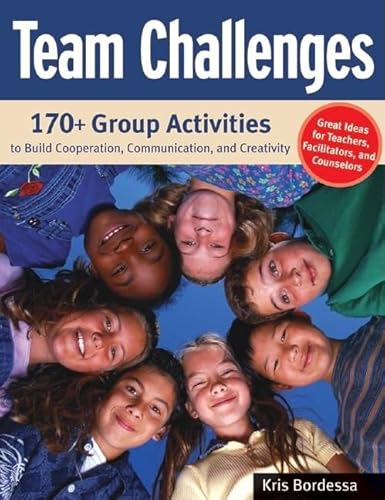
This helpful resource is designed to offer teachers, facilitators, and parents a wide variety of activities designed to cultivate children's problem-solving skills while fostering cooperation between group members. These hands-on projects teach children to experiment with building methods, discover new uses for everyday items, try on new personas, and express themselves as they work toward a solution as a team. Team members are required to think outside the box, communicate clearly, and cooperate with each other in order to complete each task. Activities include planning a five-day trek through the mountains; building a bridge out of marshmallows, straws, and paper; and moving a group of ping-pong balls from one location to another without touching the balls directly. Children will learn not only from each other, but also from observing how other teams navigate the tasks.
Die Inhaltsangabe kann sich auf eine andere Ausgabe dieses Titels beziehen.
Über die Autorin bzw. den Autor
Kris Bordessa has written for more than 50 family and educational publications, including American Girl, Nick Jr. Family Magazine, Home Education Magazine, and Parenting.
Auszug. © Genehmigter Nachdruck. Alle Rechte vorbehalten.
Team Challenges
170+ Group Activities to Build Cooperation, Communication, and Creativity
By Kris BordessaChicago Review Press Incorporated
Copyright © 2006 Kris Bordessa
All rights reserved.
ISBN: 978-1-56976-201-1All rights reserved.
Contents
Acknowledgments,
Introduction,
1 Creativity, Cooperation, and Communication What Are They Good For?,
2 Get It Together Gather Your Group and Prepare for Some Fun,
3 Everything but the Kitchen Sink Commonly Used Materials and Their Uncommon Us es,
4 Tiny Tasks Warm Up with These Quick Activities,
5 Talk It Up 37 Discuss Options, Share Ideas, and Make Connections,
6 Construction for the Whole Crew 65 Building Towers, Bridges, Roads, and Mbre,
7 Move It! Physical Activities,
8 Show Me the Funny Improv Hilarity at Its Best,
9 Trouble with Tasks? Working Through Some Difficult Spots,
Resources Creative-Problem-Solving Programs for Youth,
CHAPTER 1
Creativity, Cooperation, and Communication
What Are They Good For?
Creativity
What makes a person creative? Is it the ability to wield a paintbrush, bringing an image to life on canvas? Is it the ability to sculpt clay into a breathtaking likeness of a living being? Is it composing music? Is it a gardener's ability to landscape in colors that flow through the garden like a vivid sunset?
People will readily give Monet, Beethoven, and Van Gogh credit for being creative souls, but likening one's own creativity to that of such revered figures is usually unthinkable. In fact, many people will deny having any creative ability at all. Artistic creativity is what most people think of when they hear the word creative, and the artistic genius of Monet, Beethoven, and Van Gogh is indeed rare. But creativity isn't just about art. What, then, is it about?
Creativity is a thought process that allows for much experimentation. It's a fresh way of looking at old situations. It's a unique perspective. It's the ability to perceive situations or our surroundings in a new and unusual manner. Our world is filled with creative individuals — sometimes where we'd least expect them. When Charles Menches ran out of dishes in which to serve his ice cream at the 1904 World's Fair, he didn't panic: he created the ice cream cone. And when Bette Nesmith Graham, a single mother, went to work as a typist to support her children in 1951, she found she wasn't always accurate. To remedy the situation, she created what she called Mistake Out. Twenty-eight years later she sold her invention — renamed White Out — to the Gillette Corporation for $47.5 million.
Think about other innovations that shape our daily lives. Thomas Edison was thinking outside the box, way before the term was cool, when he lit up our nights. The world we live in would look quite different today without Bill Gates and Henry Ford. And without creativity, we would never have known the Chia Pet, the Swiffer, or the Clapper. Creative people thought of many of the items we take for granted today. They imagined an entirely new invention or expanded on an old one to create a completely new idea.
Creative thinkers of the future will have the opportunity to solve many problems — and there are plenty to go around. The search for a cure to the common cold has been fruitless. The coils on refrigerators get dusty, toilet seats are left up, and diapers still need to be changed. When some creative soul comes along with a solution for these problems, our world will indeed change for the better.
"Why didn't I think of that?" How many times have you said that to yourself upon seeing a new product or clever idea? People just like you dreamed up these innovations, but they had something else going for them: they were creative problem solvers.
Creative thinking isn't only about inventing products, though. Attacking a problem from a different angle and coming up with a solution can also result in successful plans and ideas that will benefit all involved. For years, our nation has struggled with difficult problems that won't be solved until someone thinks of a new solution. The energy crisis comes and goes without ever reaching a suitable conclusion. Our waste continues to overwhelm us, filling up landfills in spite of our recycling efforts. Poverty levels are high, and homelessness is much more common than it should be in our wealthy nation. Just imagine the problems that future generations could overcome if parents and teachers learned to guide children and young adults toward creative thinking skills!
If there's any doubt in your mind about the desirability of a creative mind, consider this: classified ads are rife with employers seeking "creative self-starters" and prospective college students are encouraged to show creativity in their enrollment applications. Kids well versed in the art of creative thinking will have a jump start in life.
Teaching a group of kids to problem solve creatively is a task well worth undertaking. It is also a job that takes patience, tenacity, and some creativity of your own. If you've picked up this book, it is likely that you understand the need for adults to encourage creativity in young people. But how do you go about teaching kids to think creatively?
Creativity can't be taught in the same manner that math, for example, can be taught. There are no facts to memorize, no right or wrong answers. Creativity is difficult to quantify. In a classroom setting, students who correctly answer questions or solve problems are rewarded with high marks. But, in life, once we leave the confines of the school setting, very few of the decisions we make have a single, correct answer. Life offers plenty of options along the way, minus an instruction manual or answer key. As in life, with creative thinking there is seldom a right answer. Creativity is a thought process that can be encouraged through open-ended learning activities, discussions, and challenges. Enter Team Challenges. Each task in this book provides the opportunity to expand the mind and solve problems in multiple ways, all while having fun.
Fostering creativity among children and young adults is something that should be a priority for every parent, teacher, and group leader. Kids will grow into creative adults only if we provide opportunities for exploring a variety of possibilities and allow them to express their ideas in a setting free of judgment, ridicule, or comparison. Creative thinking is a skill that can be encouraged in every person on earth. And well it should be. Creative thinkers are able to freely express unique ideas, solve problems, and act in a resourceful manner, all of which are assets to society.
Cooperation
Remember back in grade school, when report cards happily proclaimed, "Works well with others"? Getting along with our peers was an important part of our day. As adults, we no longer depend on such a proclamation; however, our interactions with others do earn us a reputation that often precedes us. The adult version of "works well with others" is a glowing recommendation from a friend or coworker. People who are easy to get along with, dependable, and considerate of others' ideas will naturally gain the respect of the people they deal with.
Teaching kids to work together as a group maximizes their understanding of teamwork, creates a feeling of belonging and trust, and encourages creative problem solving. Students have the opportunity to learn as part of a group when they work together toward a common goal....
„Über diesen Titel“ kann sich auf eine andere Ausgabe dieses Titels beziehen.
Suchergebnisse für Team Challenges: 170+ Group Activities to Build Cooperation,...

Beispielbild für diese ISBN
Team Challenges: 170+ Group Activities to Build Cooperation, Communication, and Creativity
Anbieter: World of Books (was SecondSale), Montgomery, IL, USA
Verkäuferbewertung 5 von 5 Sternen

Zustand: Very Good. Item in very good condition! Textbooks may not include supplemental items i.e. CDs, access codes etc. Artikel-Nr. 00105293060
Gebraucht kaufen
EUR 3,80
Versand gratis
Versand innerhalb von USA
Versand innerhalb von USA
Anzahl: 2 verfügbar
Beispielbild für diese ISBN
Team Challenges: 170+ Group Activities to Build Cooperation, Communication, and Creativity
Anbieter: World of Books (was SecondSale), Montgomery, IL, USA
Verkäuferbewertung 5 von 5 Sternen
Zustand: Good. Item in good condition. Textbooks may not include supplemental items i.e. CDs, access codes etc. Artikel-Nr. 00081133980
Gebraucht kaufen
EUR 3,80
Versand gratis
Versand innerhalb von USA
Versand innerhalb von USA
Anzahl: 9 verfügbar
Beispielbild für diese ISBN
Team Challenges: 170+ Group Activities to Build Cooperation, Communication, and Creativity
Anbieter: ThriftBooks-Atlanta, AUSTELL, GA, USA
Verkäuferbewertung 5 von 5 Sternen
Paperback. Zustand: Very Good. No Jacket. May have limited writing in cover pages. Pages are unmarked. ~ ThriftBooks: Read More, Spend Less. Artikel-Nr. G1569762015I4N00
Gebraucht kaufen
EUR 5,94
Versand gratis
Versand innerhalb von USA
Versand innerhalb von USA
Anzahl: 1 verfügbar
Beispielbild für diese ISBN
Team Challenges: 170+ Group Activities to Build Cooperation, Communication, and Creativity
Anbieter: ThriftBooks-Atlanta, AUSTELL, GA, USA
Verkäuferbewertung 5 von 5 Sternen
Paperback. Zustand: Good. No Jacket. Pages can have notes/highlighting. Spine may show signs of wear. ~ ThriftBooks: Read More, Spend Less. Artikel-Nr. G1569762015I3N00
Gebraucht kaufen
EUR 5,94
Versand gratis
Versand innerhalb von USA
Versand innerhalb von USA
Anzahl: 1 verfügbar
Beispielbild für diese ISBN
Team Challenges: 170+ Group Activities to Build Cooperation, Communication, and Creativity
Verlag:
Chicago Review Press (edition 52694th), 2005
ISBN 10: 1569762015
ISBN 13: 9781569762011
Gebraucht
Paperback
Anbieter: BooksRun, Philadelphia, PA, USA
Verkäuferbewertung 5 von 5 Sternen
Paperback. Zustand: Very Good. 52694th. It's a well-cared-for item that has seen limited use. The item may show minor signs of wear. All the text is legible, with all pages included. It may have slight markings and/or highlighting. Artikel-Nr. 1569762015-11-6
Gebraucht kaufen
EUR 6,18
Versand gratis
Versand innerhalb von USA
Versand innerhalb von USA
Anzahl: 1 verfügbar
Beispielbild für diese ISBN
Team Challenges : 170+ Group Activities to Build Cooperation, Communication, and Creativity
Verlag:
Chicago Review Press, Incorporated, 2005
ISBN 10: 1569762015
ISBN 13: 9781569762011
Gebraucht
Softcover
Anbieter: Better World Books, Mishawaka, IN, USA
Verkäuferbewertung 5 von 5 Sternen
Zustand: Good. Pages intact with minimal writing/highlighting. The binding may be loose and creased. Dust jackets/supplements are not included. Stock photo provided. Product includes identifying sticker. Better World Books: Buy Books. Do Good. Artikel-Nr. 3972576-6
Gebraucht kaufen
EUR 6,22
Versand gratis
Versand innerhalb von USA
Versand innerhalb von USA
Anzahl: 1 verfügbar
Beispielbild für diese ISBN
Team Challenges : 170+ Group Activities to Build Cooperation, Communication, and Creativity
Verlag:
Chicago Review Press, Incorporated, 2005
ISBN 10: 1569762015
ISBN 13: 9781569762011
Gebraucht
Softcover
Anbieter: Better World Books, Mishawaka, IN, USA
Verkäuferbewertung 5 von 5 Sternen
Zustand: Good. Former library copy. Pages intact with minimal writing/highlighting. The binding may be loose and creased. Dust jackets/supplements are not included. Includes library markings. Stock photo provided. Product includes identifying sticker. Better World Books: Buy Books. Do Good. Artikel-Nr. 6481803-6
Gebraucht kaufen
EUR 6,22
Versand gratis
Versand innerhalb von USA
Versand innerhalb von USA
Anzahl: 1 verfügbar
Beispielbild für diese ISBN
Team Challenges : 170+ Group Activities to Build Cooperation, Communication, and Creativity
Verlag:
Chicago Review Press, Incorporated, 2005
ISBN 10: 1569762015
ISBN 13: 9781569762011
Gebraucht
Softcover
Anbieter: Better World Books, Mishawaka, IN, USA
Verkäuferbewertung 5 von 5 Sternen
Zustand: Very Good. Pages intact with possible writing/highlighting. Binding strong with minor wear. Dust jackets/supplements may not be included. Stock photo provided. Product includes identifying sticker. Better World Books: Buy Books. Do Good. Artikel-Nr. 14926135-75
Gebraucht kaufen
EUR 6,22
Versand gratis
Versand innerhalb von USA
Versand innerhalb von USA
Anzahl: 3 verfügbar
Beispielbild für diese ISBN
Team Challenges: 170+ Group Activities to Build Cooperation, Communication, and Creativity
Anbieter: Wonder Book, Frederick, MD, USA
Verkäuferbewertung 5 von 5 Sternen
Zustand: Very Good. Very Good condition. A copy that may have a few cosmetic defects. May also contain light spine creasing or a few markings such as an owner's name, short gifter's inscription or light stamp. Artikel-Nr. U14A-05921
Gebraucht kaufen
EUR 6,29
Versand gratis
Versand innerhalb von USA
Versand innerhalb von USA
Anzahl: 1 verfügbar
Beispielbild für diese ISBN
Team Challenges: 170+ Group Activities to Build Cooperation, Communication, and Creativity
Anbieter: ThriftBooks-Phoenix, Phoenix, AZ, USA
Verkäuferbewertung 5 von 5 Sternen
Paperback. Zustand: Good. No Jacket. Pages can have notes/highlighting. Spine may show signs of wear. ~ ThriftBooks: Read More, Spend Less. Artikel-Nr. G1569762015I3N00
Gebraucht kaufen
EUR 7,02
Versand gratis
Versand innerhalb von USA
Versand innerhalb von USA
Anzahl: 1 verfügbar