
Verwandte Artikel zu Optimizing Talent in the Federal Workforce: Best Practices...
Inhaltsangabe
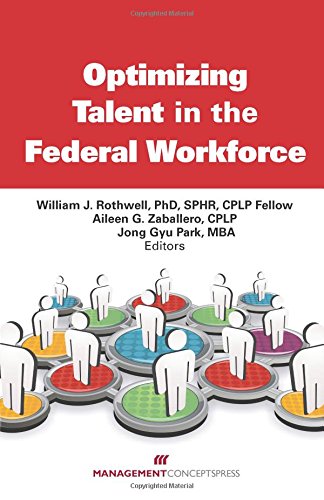
Taxpayers deserve the very best from public services, and first-rate public services can only be provided by outstanding government workers. Federal human resource managers face the challenge of attracting and retaining high-caliber individuals within the constraints of ever-tightening budgets and often-conflicting political directives. From a talent management perspective, Optimizing Talent in the Federal Workforce explores: • Best practices for recruiting and selecting employees • Proven methods for developing and training employees • Optimal deployment and placement processes. This text is a must-read for anyone in or working toward a government management position.
Die Inhaltsangabe kann sich auf eine andere Ausgabe dieses Titels beziehen.
Über die Autorin bzw. den Autor
William J. Rothwell, Ph.D., SPHR, CPLP Fellow is a professor in the Workforce Education and Development program, Department of Learning and Performance Systems, at The Pennsylvania State University.He has authored, co-authored, edited, or co-edited more than 80 books as well as numerous book chapters and articles. He is currently president of Rothwell & Associates, Inc.
Aileen G. Zaballero, MS, CPLP , is a dual PhD candidate in Workforce Education and Development and Comparative International Education, with an emphasis on organization development, at Penn State University. She is a Certified Professional in Learning and Performance through the American Society for Training and Development.
Jong Gyu Park is a PhD candidate in the Workforce Education and Development program, with an emphasis on human resource development and organization development, at Penn State University. He also is a PhD candidate in Business Administration, with an emphasis on management and organization, at Sungkyunkwan University School of Business in Seoul, South Korea.
Auszug. © Genehmigter Nachdruck. Alle Rechte vorbehalten.
Optimizing Talent in the Federal Workforce
By William J. Rothwell, Aileen G. Zaballero, Jong Gyu ParkManagement Concepts Press
Copyright © 2014 Management Concepts, Inc.
All rights reserved.
ISBN: 978-1-56726-434-0All rights reserved.
Contents
Preface,
Acknowledgments,
Chapter 1: Introduction By Christos Anagiotos and Aileen G. Zaballero,
Chapter 2: Recruiting and Selecting the Best People By Maria Spencer and Thomas Argondizza,
Chapter 3: Developing and Training the Best People By Aileen G. Zaballero and Thomas Argondizza,
Chapter 4: Deploying and Placing the Best People By Aileen G. Zaballero, Catherine Haynes, and Sarah Stager,
Chapter 5: Engaging the Best People By Aileen G. Zaballero and Jennifer Myers,
Chapter 6: Retaining the Best People By Jong Gyu Park and Maria Spencer,
Chapter 7: Knowledge Transfer By Christos Anagiotos, Catherine Haynes, and James Alexander,
Resources,
References,
Index,
CHAPTER 1
Introduction
Christos Anagiotos and Aileen G. Zaballero
According to the U.S. Office of Personnel Management (OPM; 2012a), the federal government has a civilian workforce of 2.76 million employees. However, budgetary constraints coupled with an increased demand to attract and retain talent have imposed complex challenges. A surge in the number of senior federal employees becoming eligible for retirement is causing national leaders to take heed of these challenges; meanwhile, the "technical skills required in today's workplace continue to necessitate advanced employee training efforts" (Condrey et al., 2012:1). Government human capital leaders are seeking solutions to improve the federal human resource (HR) systems that will optimize talent. However, several issues pertaining to the existing system must be addressed:
• Recruiting and selecting
• Developing and training
• Deploying and placing
• Retaining
• Transferring knowledge.
The aforementioned HR functions have changed as today's global markets compete in the "war for talent" (KPMG International, 2012:2). HR departments in both the private and public sectors have shifted from playing predominantly administrative roles to achieving strategic missions and objectives where resources are often scarce. Federal agencies in particular are attempting to adopt new HR practices to succeed during this complex period. The alignment of talent management to business objectives will require systematic and strategic initiatives.
HISTORICAL EVOLUTION
In the early 1920s, personnel management was strictly focused on the administrative function of employee recordkeeping. During this period, the government's influence on employee relations was nonexistent. Employee abuses, including unsafe working conditions and child labor, were very common. However, during World War II the need to motivate employees to be more productive became important. Furthermore, classifications of workers and occupational categories that altered the recruitment and selection process were developed (Kavanagh et al., 2012).
The civil rights movement in the 1960s was the impetus for many new federal labor regulations. During this period, the government became responsible for policing discriminatory employment practices. Personnel departments were encumbered with legislative regulations that demanded data collection to substantiate that there were no unfair or discriminatory practices. The combination of optimizing employee productivity and the desire to avoid punitive damages for noncompliance resulted in the expansion of personnel manage
„Über diesen Titel“ kann sich auf eine andere Ausgabe dieses Titels beziehen.
Suchergebnisse für Optimizing Talent in the Federal Workforce: Best Practices...

Beispielbild für diese ISBN
Optimizing Talent in the Federal Workforce
Verlag:
Berrett-Koehler Publishers, 2014
ISBN 10: 1567264344
ISBN 13: 9781567264340
Gebraucht
Softcover
Anbieter: Wonder Book, Frederick, MD, USA
Verkäuferbewertung 5 von 5 Sternen

Zustand: Very Good. Very Good condition. A copy that may have a few cosmetic defects. May also contain light spine creasing or a few markings such as an owner's name, short gifter's inscription or light stamp. Artikel-Nr. E06M-0390
Gebraucht kaufen
EUR 23,70
Versand gratis
Versand innerhalb von USA
Versand innerhalb von USA
Anzahl: 1 verfügbar