
Verwandte Artikel zu Magical Use of Thought Forms: A Proven System of Mental...
Inhaltsangabe
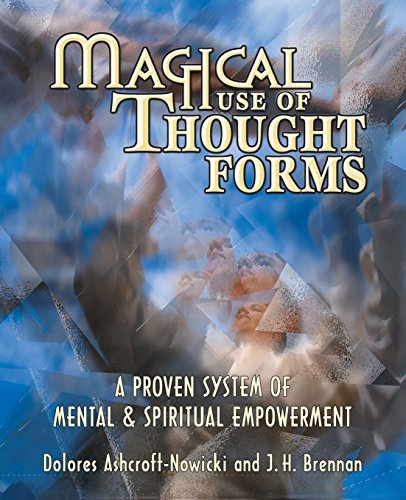
In this comprehensive reference manual, two leading occult researchers present step-by-step instructions, some never before in print, for developing the most basic and essential skills for magical practitioners of any tradition—creating thought forms through astral manipulation.
Magical Use of Thought Forms includes sections on the structure of reality and on new visualization techniques to build correct astral images for highly potent magical work, from creating a Familiar or Guardian to building a Memory Palace, Also revealed in this extraordinary guide:
- The occult art of observation
- How to build up desire as fuel for a potent astral engine
- The three-point location of occult power in the physical brain
- The creation of advanced astral structures including Godforms and angelics, audial images, and astral landscapes
The most spectacular aspect of this book is the instruction given for the performance of the legendary alchemical experiment: the creation of the homunculus, an animated form that can last up to several hours.
Die Inhaltsangabe kann sich auf eine andere Ausgabe dieses Titels beziehen.
Über die Autorin bzw. den Autor
Dolores Ashcroft-Nowicki is one of the most respected and experienced esoteric practitioners currently at work in the British Isles. Dolores was born in Channel Island of Jersey off the coast of France. She was trained in the Fraternity of the Inner Light and worked as a Cosmic Mediator with Walter Ernest, the Grand Maistre of British Occultism. Dolores is a third degree adept and Qabbalist.
She not only teaches the Craft but also is the current director of the Servants of the Light, a Hermetic order descended from Dion Fortune's Society of the Inner Light. She travels extensively, teaching a wide range of occult subjects to pupils in both the U.K. and United States. Ashcroft-Nowicki lives in Channel Island of Jersey with her Husband.
J. H. Brennan (Ireland) is the acclaimed author of over 90 books, both fiction and non-fiction, including Forbidden Truth, The Alien's Handbook, and The Spy's Handbook (all published by Faber & Faber), Death: The Great Mystery of Life (Carroll & Graf), Martian Genesis and The Atlantis Enigma (both published by Dell), The Magical I Ching and Time Travel (both published by Llewellyn), and the popular Book of Wizardry (Llewellyn) under the alias Cornelius Rumstuckle. His works have appeared in more than fifty countries in Europe, Asia, North and South America, and Australia.
Brennan is best known for his young adult fiction series, Herbie Brennan's Faerie Wars (Bloomsbury) with combined sales exceeding 7.5 million. The creator of several role-playing books, his solo fantasy gamebook series GrailQuest (Dell) has sold over 6.5 million copies.
He resides in County Carlow, Ireland with his wife and ten cats.
~Auszug. © Genehmigter Nachdruck. Alle Rechte vorbehalten.
Werewolves are not the only unlikely creatures with a widespread provenance. From the werefoxes and werehares of China to the werecats of tropical Africa, there is a whole menagerie of animals into which certain humans are reputed to change.
In The Way of the Shaman, Professor Michael Harner writes:
The connectedness between humans and the animal world is very basic in shamanism, with the shaman utilizing his knowledge and methods to participate in the power of that world. Through his guardian spirit or power animal, the shaman connects with the power of the animal world, the mammals, birds, fish, and other beings. The shaman has to have a particular guardian in order to do his work, and his guardian helps him in certain special ways.
The choice of spirit was never arbitrary, for it was believed that a link with a particular animal was already there, forged by the nature of the shaman, even though the shaman might not be aware of it. Thus the spirit would often make itself known, in visions or dreams, before the shaman practiced those techniques that called it to him. This calling had many benefits. Says Harner:
A power animal or guardian spirit, as I first learned among the Jivaro, not only increases one's physical energy and ability to resist contagious disease, but also increases one's mental alertness and self-confidence.2
When the shaman entered nonordinary reality in search of the animal, she would often become temporarily possessed by it. This naturally led to the concept of were animals, the belief-which to many tribes was a matter of simple experience-that certain individuals could literally shapeshift and become the animal concerned.
But were animals are only one example of a whole range of curious phenomena that we all know to be impossible, yet have for centuries been supported by countless legends, myths, and even eyewitness accounts.
When Irish author Bram Stoker crafted his legendary vampire Dracula, the character was based on a fifteenth-century Balkan noble named Vlad the Impaler and named after dracul, the Rumanian word for devil. But Stoker did not create the vampire legend, although he added immeasurably to it. There is a mention of blood-drinking ghosts in Homer's Odyssey. In Hebrew mythology, Adam's first wife Lilith is described as a vampiric character, preying on babies. The same theme is taken up in Arab, Celtic, and Roman mythology, all of which contain references to blood-drinking demons of one sort or another. But the vampire legend familiar today derives directly from an outbreak of vrykolka activity throughout the Balkans and Greece in the seventeenth century. According to popular belief and what purported to be widespread eyewitness reports, vrykolkas were resurrected corpses that fed on the blood of the living. In Hungary, the Magyar term for them was vampir, a word that, with only a slight change, carried the legend into the English-speaking world. By 1746, the first scholarly work on the creatures had appeared, written by Dom Augustine Calmet, a French monk.
Bilocation-the appearance of the same person in two different places at once-is another impossibility, but one apparently achieved by several Christian monks and saints. The list of bilocators includes St. Anthony of Padua, St. Ambrose of Milan, St. Severus of Ravenna, and, in modern times, Padre Pio, an Italian monk. Some of the appearances have been well attested. When Pope Clement XIV was on his deathbed, he had a visit from St. Alphonsus Maria de Ligouri, who was seen by several members of the Papal Court at the pope's bedside. But Alphonsus was confined to his cell at the time-a four-days' journey away.
Another ability frequently attributed to saints is levitation. St. Joseph of Cupertino and St. Theresa of Avila were both reputed to do it frequently. One eyewitness swore Theresa remained airborne, eighteen inches off the ground, for about half an hour. The great Tibetan yogi Milarepa went one better: according to contemporary accounts, he was able to walk and even sleep while levitating. In the nineteenth century, the spiritualist medium Daniel Dunglas Home surprised several witnesses by floating out of a third story window and into another. The Italian medium Amedee Zuccarini was photographed levitating with his feet some twenty inches above the nearest support.
In a somewhat similar category is the experience of a British psychologist named Kenneth Bacheldor, who became interested in the widespread reports of table-turning during the Victorian craze for spiritualism. Bacheldor set up groups to investigate, and, after several months of experimentation, developed a system that allowed tables to move by themselves under tightly controlled test conditions. His work culminated with infrared video of a table levitated several inches off the floor with no one touching it.
Levitating tables also featured in an experiment carried out by Dr. George Owens and his wife, Iris, two members of the Canadian Society for Psychical Research, who decided they would try to make an artificial ghost. To this end, they and fellow members of their group created a fictional character named Philip who lived during Cromwellian times (mid-seventeenth century) at a place called Diddington Manor in England. Philip had an affair with a gypsy girl named Magda; his wife found out and denounced Magda as a witch. When she was burned at the stake, Philip committed suicide by throwing himself from the battlements of his ancestral home.
The romantic tale was entirely fictional, except for the detail of Diddington Manor, which actually does exist. The Owens group pinned photos of the manor around the walls of their room and sat regularly in a classical spiritualist sto make contact with the character they had created. After several months, they were rewarded by a paranormal rapping. A code was soon established to allow them to communicate with the entity behind the rapping . . . the entity turned out to be Philip, and gave its history in the terms of the fictional life story already agreed.
But Philip added so many accurate historical details to the account that the sitters began to wonder if they might have accidentally hit on a real person. Research showed they had not, yet Philip exhibited a far greater familiarity with the Cromwellian period than any member of the group. Furthermore, he proved able to levitate tables and once "walked" one up a short flight of steps.
A variation on the Philip experiment was conducted by Dolores and myself in Britain using techniques of ritual evocation to speed up the process. As a result, a member of our group was temporarily possessed by the "spirit" of an entirely fictitious Saxon priestess.
Astral projection is another well-attested impossibility. My first experience of the phenomenon occurred when I rose in the middle of the night to visit the bathroom and discovered I could not open the bedroom door. After a puzzling moment, I discovered my hand had passed through the doorknob and my (physical) body was still lying in bed beside my wife. It took me six attempts to persuade the body to get up. During one of them I strolled through a solid wall.
This (strictly temporary) ability seems almost humdrum when set beside what happened to Benedetto Supino in 1982. A schoolboy at the time, he was reading a comic in a dentist's waiting room when the paper went on fire. Since that time, anything he touches scorches and he has proved capable of setting things alight just by looking at them. Examined by doctors at the Tivoli Medical Center, he was pronounced "entirely normal"-a diagnosis both he and his family might question.
In 1967, another teenager, Anne-Marie Schaberl, exhibited even stranger powers-although at first no one realized they were...
„Über diesen Titel“ kann sich auf eine andere Ausgabe dieses Titels beziehen.
Suchergebnisse für Magical Use of Thought Forms: A Proven System of Mental...

Beispielbild für diese ISBN
Magical Use of Thought Forms: A Proven System of Mental & Spiritual Empowerment
Anbieter: World of Books (was SecondSale), Montgomery, IL, USA
Verkäuferbewertung 5 von 5 Sternen

Zustand: Acceptable. Item in Acceptable condition. Textbooks may not include supplemental items i.e. CDs, access codes etc. Artikel-Nr. 00109714945
Gebraucht kaufen
EUR 8,05
Versand gratis
Versand innerhalb von USA
Versand innerhalb von USA
Anzahl: 1 verfügbar
Beispielbild für diese ISBN
Magical Use of Thought Forms: A Proven System of Mental & Spiritual Empowerment
Anbieter: World of Books (was SecondSale), Montgomery, IL, USA
Verkäuferbewertung 5 von 5 Sternen
Zustand: Good. Item in good condition. Textbooks may not include supplemental items i.e. CDs, access codes etc. Artikel-Nr. 00103620930
Gebraucht kaufen
EUR 8,05
Versand gratis
Versand innerhalb von USA
Versand innerhalb von USA
Anzahl: 1 verfügbar
Beispielbild für diese ISBN
Magical Use of Thought Forms: A Proven System of Mental & Spiritual Empowerment
Anbieter: World of Books (was SecondSale), Montgomery, IL, USA
Verkäuferbewertung 5 von 5 Sternen
Zustand: Acceptable. Item in acceptable condition! Textbooks may not include supplemental items i.e. CDs, access codes etc. Artikel-Nr. 00109733580
Gebraucht kaufen
EUR 11,08
Versand gratis
Versand innerhalb von USA
Versand innerhalb von USA
Anzahl: 1 verfügbar
Beispielbild für diese ISBN
Magical Use of Thought Forms: A Proven System of Mental and Spiritual Empowerment
Verlag:
Llewellyn Publications,U.S., United States, Minnesota, 2001
ISBN 10: 1567180841
ISBN 13: 9781567180848
Gebraucht
Paperback
Anbieter: WorldofBooks, Goring-By-Sea, WS, Vereinigtes Königreich
Verkäuferbewertung 5 von 5 Sternen
Paperback. Zustand: Very Good. Two leading occult researchers present a comprehensive training manual on how to create thought forms through astral manipulation. It includes sections on the structure of reality as well as visualization tricks that train the inner eye to build correct images. The book has been read, but is in excellent condition. Pages are intact and not marred by notes or highlighting. The spine remains undamaged. Artikel-Nr. GOR003292598
Gebraucht kaufen
EUR 18,38
EUR 6,53 Versand
Versand von Vereinigtes Königreich nach USA
Versand von Vereinigtes Königreich nach USA
Anzahl: 1 verfügbar
Beispielbild für diese ISBN
Magical Use of Thought Forms: A Proven System of Mental & Spiritual Empowerment
Anbieter: Revaluation Books, Exeter, Vereinigtes Königreich
Verkäuferbewertung 5 von 5 Sternen
Paperback. Zustand: Brand New. 272 pages. 9.00x7.75x0.75 inches. In Stock. Artikel-Nr. xr1567180841
Neu kaufen
EUR 25,53
EUR 14,58 Versand
Versand von Vereinigtes Königreich nach USA
Versand von Vereinigtes Königreich nach USA
Anzahl: 2 verfügbar
Beispielbild für diese ISBN
Magical Use of Thought Forms: A Proven System of Mental & Spiritual Empowerment
Anbieter: Revaluation Books, Exeter, Vereinigtes Königreich
Verkäuferbewertung 5 von 5 Sternen
Paperback. Zustand: Brand New. 272 pages. 9.00x7.75x0.75 inches. In Stock. Artikel-Nr. __1567180841
Neu kaufen
EUR 27,09
EUR 14,58 Versand
Versand von Vereinigtes Königreich nach USA
Versand von Vereinigtes Königreich nach USA
Anzahl: 1 verfügbar
Beispielbild für diese ISBN
Magical Use of Thought Forms: A Proven System of Mental and Spiritual Empowerment
Anbieter: Kennys Bookstore, Olney, MD, USA
Verkäuferbewertung 5 von 5 Sternen
Zustand: New. 2001. paperback. . . . . . Books ship from the US and Ireland. Artikel-Nr. V9781567180848
Neu kaufen
EUR 35,89
EUR 9,14 Versand
Versand innerhalb von USA
Versand innerhalb von USA
Anzahl: Mehr als 20 verfügbar
Beispielbild für diese ISBN
Magical Use of Thought Forms
Anbieter: Majestic Books, Hounslow, Vereinigtes Königreich
Verkäuferbewertung 4 von 5 Sternen

Zustand: New. pp. xvi + 253 Illus. Artikel-Nr. 6660040
Neu kaufen
EUR 47,77
EUR 7,58 Versand
Versand von Vereinigtes Königreich nach USA
Versand von Vereinigtes Königreich nach USA
Anzahl: 1 verfügbar
Foto des Verkäufers
MAGICAL USE OF THOUGHT FORMS
Anbieter: moluna, Greven, Deutschland
Verkäuferbewertung 5 von 5 Sternen
Zustand: New. Über den AutorDolores Ashcroft-Nowicki is one of the most respected and experienced esoteric practitioners currently at work in the British Isles. Dolores was born in Channel Island of Jersey off the coast of France. She was trained. Artikel-Nr. 904333961
Neu kaufen
EUR 26,47
EUR 48,99 Versand
Versand von Deutschland nach USA
Versand von Deutschland nach USA
Anzahl: 2 verfügbar