
Verwandte Artikel zu A Game of Inches: The Stories Behind the Innovations...
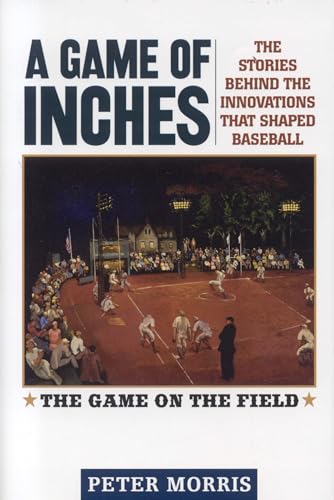
A Game of Inches: The Stories Behind the Innovations That Shaped Baseball: The Game on the Field - Hardcover
Inhaltsangabe
As befits a game traditionally passed from one generation to the next, baseball has always had a special reverence for origins. Claims of being first with any element of the game are disputed with fervor and passion. When the octogenarian Fred Goldsmith died in 1939, a headline proclaimed, 'Goldsmith Dies Insisting He Invented Curve Ball'; Fred Goldsmith understood the secret of immortality. Yet while countless thousands of words have been spilled on the subject of baseball “firsts,” there has been no definitive source for the settlement of disputes. Peter Morris's endlessly fascinating A Game of Inches has now arrived to fill the void. Impeccably researched and engagingly written, this treasure trove will surprise, delight, and educate even the most knowledgeable fan by dispelling cherished myths and revealing the source of many of baseball's features that we now take for granted. The scope of A Game of Inches is encyclopedic, with nearly a thousand entries that illuminate the origins of items ranging from catchers' masks to hook slides to intentional walks to cork-center baseballs. But this is much more than just a reference guide. Award-winning author Peter Morris explains the context that led each new item to emerge when it did, and chronicles the often surprising responses to these innovations. Of few books can it genuinely be said that once you start reading, it's hard to put it down—but A Game of Inches is one of them. It belongs in the pantheon of great baseball books, and will give any reader a deeper appreciation of why baseball matters so much to Americans. (A companion volume, A Game of Inches: The Game Behind the Scenes, was published in the fall of 2006.)
Die Inhaltsangabe kann sich auf eine andere Ausgabe dieses Titels beziehen.
Über die Autorin bzw. den Autor
Peter Morris won the coveted Seymour Medal of the Society for American Baseball Research (SABR) for his book Baseball Fever, about early baseball in Michigan. He has also been honored by USA Today Sports Weekly. A graduate of the University of Toronto and Michigan State University and a former national and international Scrabble champion, he is now a researcher at the Michigan Public Health Institute and lives in Haslett, Michigan. Visit the author's website (www.petermorrisbooks.com) for more information.
Auszug. © Genehmigter Nachdruck. Alle Rechte vorbehalten.
A GAME OF INCHES
The Stories Behind the Innovations That Shaped BaseballBy Peter MorrisIvan R. Dee
Copyright © 2006 Peter MorrisAll right reserved.
ISBN: 978-1-56663-677-3
Contents
Preface.............................................................................................xxiAcknowledgments.....................................................................................xxvIntroduction: What Makes an Innovation Dangerous?...................................................3CHAPTER 1: THE THINGS WE TAKE FOR GRANTEDCHAPTER 2: BATTING(i) Variations on a Theme: Refinements to Approaches, Swings, and Stances(ii) Less Is More: The Bunt and Other Novel Approaches to Hitting(iii) And When All Else Fails: Trying to Be a Successful Hitter Without Hitting(iv) PreparationCHAPTER 3: PITCHING(i) Deliveries(ii) Pitches(iii) Pitching Tactics(iv) Measures of SuccessCHAPTER 4: FIELDING(i) Choosing How to Fill Positions(ii) Positioning of the Fielders(iii) Teamwork(iv) Devising Alternate Methods of Retiring PlayersCHAPTER 5: BASERUNNING(i) Stolen Bases(ii) Slides(iii) Stop, Thief!: Pickoffs, Pitchouts, and Other Countermoves by the Defense(iv) Plays(v) Turf Wars(vi) Novelty PlaysCHAPTER 6: MANAGERIAL STRATEGIES(i) Who's in Charge Here?(ii) Substitutions(iii) Lineups(iv) Intentional Walks(v) Signs(vi) Playing by "The Book"(vii) Miscellaneous Managerial StrategiesCHAPTER 7: COACHING(i) Directing Traffic(ii) Coaching Staffs(iii) Teaching TechniquesCHAPTER 8: UMPIRES(i) Growth of the Profession(ii) Kill the Ump!(iii) The Umpire Strikes Back: Discipline(iv) Making the Call(v) Communicating(vi) The Tools of the TradeCHAPTER 9: EQUIPMENT(i) Baseballs(ii) Bats(iii) Gloves(iv) Protective Equipment(v) Miscellaneous EquipmentCHAPTER 10: UNIFORMSCHAPTER 11: SKULLDUGGERY(i) Garden Variety Trickery(ii) Gardening Variety TrickeryCHAPTER 12: TIMEOUTSBibliography........................................................................................501Index...............................................................................................517
Chapter One
THE THINGS WE TAKE FOR GRANTED
BASEBALL abounds with the kinds of questions that inquisitive young children love to ask and that their parents dread trying to answer: Why does the home team bat last? Why are the bases run counterclockwise? Why can't a player come back into a game as in other sports?
It is not entirely a cop-out to say, "Because that's the rule." In some cases, the closest we can come to the origins of these underlying rules and customs is that someone (we're not sure who) decided it should be that way (we're not sure why). But this chapter will, at the very least, try to illuminate the historical developments that helped make possible many of the things we take for granted when we watch a baseball game.
1.1 Clubs. Baseball teams are still often referred to as clubs, but the current meaning bears little relationship to the original one. Early baseball matches were contested by clubs, and when the term "team" first appeared in the mid-1860s it was an indication that the way the game was being played had changed for good.
The change in terminology is significant because clubs were such an integral element of nineteenth-century life. A club was a restricted group of people from similar backgrounds and was primarily social in nature. As Americans moved from the farms to the cities and began to lead less active lives, clubs began to experiment with sporting diversions to give their members much-needed exercise.
The Olympic Ball Club of Philadelphia was founded on July 4, 1833, playing what is now generally described as "town ball." The club survived long enough to celebrate its golden anniversary, though by 1860 it had switched to baseball. Rochester, New York, also had a club devoted to bat and ball games in the 1830s (Stephen Fox, Big Leagues, 168-172).
But the club that is generally credited with being the first baseball club is the Knickerbocker Base Ball Club of New York City, because this club introduced so many of the elements of today's game. Formally organized on September 23, 1845, the Knickerbockers quickly adopted detailed rules for playing baseball and modified them over the next decade. Many of the rules they developed-two sides, nine players a side, base runners not being retired by being hit by a thrown ball-form the basis of today's game.
Just as important, the Knickerbockers wrote down their rules and arranged for them to be distributed. (The Olympic Ball Club had had a written constitution as early as 1837, which still survives and is reprinted in Dean Sullivan's Early Innings, pages 5-8. But the rules were all administrative in nature, so there is no reason to think that other clubs would have requested copies.) As will be explained in the next two entries, the Knickerbockers' rules were a vital step that made it possible for the game to spread.
1.2 Rules. Of course baseball has always had rules, right? Only in a limited sense. In the first half of the nineteenth century, bat and ball games were almost exclusively children's activities. Similar to hopscotch or tag or marbles, a game might be played on a particular day and in a particular place according to specific conventions, but the same rules wouldn't necessarily apply the next day or in the next county. Baseball in those days was truly "just a game."
The Knickerbockers adopted their first rules on September 13, 1845, which represented a significant step toward a more organized and formal game. Their rules were as follows:
1. Members must strictly observe the time agreed upon for exercise, and be punctual in their attendance.
2. When assembled for exercise, the President, or in his absence, the Vice-President, shall appoint an Umpire, who shall keep the game in a book provided for that purpose, and note all violations of the By-Laws and Rules during the time of exercise.
3. The presiding officer shall designate two members as Captains, who shall retire and make the match to be played, observing at the same time that the players opposite to each other should be as nearly equal as possible, the choice of sides to be then tossed for, and the first in hand to be decided in like manner.
4. The bases shall be from "home" to second base, forty-two paces; from first to third bases, forty-two paces, equidistant.
5. No stump match shall be played on a regular day of exercise.
6. If there should not be a sufficient number of members of the Club present at the time agreed upon to commence exercise, gentlemen not members may be chosen in to make up the match, which shall not be broken up to take in members that may afterwards appear; but in all cases, members shall have the preference, when present, at the making of a match.
7. If members appear after the game is commenced, they may be chosen if mutually agreed upon.
8. The game to consist of twenty-one counts, or aces; but at the conclusion an equal number of hands must be played.
9. The ball must be pitched, not thrown, for the bat.
10. A ball knocked out of the field, or outside the range of the first or third base, is foul.
11. Three balls being struck at and missed and the last one caught, is a hand out; if not caught is considered fair, and the striker bound to run.
12. If a ball be struck, or tipped, and caught, either flying or on the first bound, it is a hand out.
13. A player running the bases shall be out, if the...
„Über diesen Titel“ kann sich auf eine andere Ausgabe dieses Titels beziehen.
Suchergebnisse für A Game of Inches: The Stories Behind the Innovations...

Beispielbild für diese ISBN
A Game of Inches: The Stories Behind the Innovations That Shaped Baseball: The Game on the Field, Volume 1
Anbieter: ThriftBooks-Dallas, Dallas, TX, USA
Verkäuferbewertung 5 von 5 Sternen

Hardcover. Zustand: Good. No Jacket. Pages can have notes/highlighting. Spine may show signs of wear. ~ ThriftBooks: Read More, Spend Less. Artikel-Nr. G1566636779I3N00
Gebraucht kaufen
EUR 5,87
Versand gratis
Versand innerhalb von USA
Versand innerhalb von USA
Anzahl: 1 verfügbar
Beispielbild für diese ISBN
A Game of Inches: The Stories Behind the Innovations That Shaped Baseball: The Game on the Field, Volume 1
Anbieter: ThriftBooks-Phoenix, Phoenix, AZ, USA
Verkäuferbewertung 5 von 5 Sternen
Hardcover. Zustand: Good. No Jacket. Former library book; Pages can have notes/highlighting. Spine may show signs of wear. ~ ThriftBooks: Read More, Spend Less. Artikel-Nr. G1566636779I3N10
Gebraucht kaufen
EUR 5,87
Versand gratis
Versand innerhalb von USA
Versand innerhalb von USA
Anzahl: 1 verfügbar
Beispielbild für diese ISBN
A Game of Inches: The Stories Behind the Innovations That Shaped Baseball: The Game on the Field, Volume 1
Anbieter: ThriftBooks-Atlanta, AUSTELL, GA, USA
Verkäuferbewertung 5 von 5 Sternen
Hardcover. Zustand: Good. No Jacket. Missing dust jacket; Pages can have notes/highlighting. Spine may show signs of wear. ~ ThriftBooks: Read More, Spend Less. Artikel-Nr. G1566636779I3N01
Gebraucht kaufen
EUR 5,87
Versand gratis
Versand innerhalb von USA
Versand innerhalb von USA
Anzahl: 1 verfügbar
Beispielbild für diese ISBN
A Game of Inches: The Stories Behind the Innovations That Shaped Baseball: The Game on the Field, Volume 1
Anbieter: ThriftBooks-Dallas, Dallas, TX, USA
Verkäuferbewertung 5 von 5 Sternen
Hardcover. Zustand: Good. No Jacket. Former library book; Pages can have notes/highlighting. Spine may show signs of wear. ~ ThriftBooks: Read More, Spend Less. Artikel-Nr. G1566636779I3N10
Gebraucht kaufen
EUR 5,87
Versand gratis
Versand innerhalb von USA
Versand innerhalb von USA
Anzahl: 1 verfügbar
Beispielbild für diese ISBN
A Game of Inches: The Stories Behind the Innovations That Shaped Baseball: The Game on the Field, Volume 1
Anbieter: ThriftBooks-Reno, Reno, NV, USA
Verkäuferbewertung 5 von 5 Sternen
Hardcover. Zustand: Very Good. No Jacket. May have limited writing in cover pages. Pages are unmarked. ~ ThriftBooks: Read More, Spend Less. Artikel-Nr. G1566636779I4N00
Gebraucht kaufen
EUR 5,87
Versand gratis
Versand innerhalb von USA
Versand innerhalb von USA
Anzahl: 1 verfügbar
Beispielbild für diese ISBN
A Game of Inches: The Stories Behind the Innovations That Shaped Baseball: The Game on the Field, Volume 1
Anbieter: ThriftBooks-Reno, Reno, NV, USA
Verkäuferbewertung 5 von 5 Sternen
Hardcover. Zustand: Good. No Jacket. Former library book; Pages can have notes/highlighting. Spine may show signs of wear. ~ ThriftBooks: Read More, Spend Less. Artikel-Nr. G1566636779I3N10
Gebraucht kaufen
EUR 5,87
Versand gratis
Versand innerhalb von USA
Versand innerhalb von USA
Anzahl: 1 verfügbar
Beispielbild für diese ISBN
A Game of Inches: The Stories Behind the Innovations That Shaped Baseball: The Game on the Field, Volume 1
Anbieter: ThriftBooks-Dallas, Dallas, TX, USA
Verkäuferbewertung 5 von 5 Sternen
Hardcover. Zustand: Very Good. No Jacket. Former library book; May have limited writing in cover pages. Pages are unmarked. ~ ThriftBooks: Read More, Spend Less. Artikel-Nr. G1566636779I4N10
Gebraucht kaufen
EUR 5,87
Versand gratis
Versand innerhalb von USA
Versand innerhalb von USA
Anzahl: 1 verfügbar
Beispielbild für diese ISBN
A Game of Inches: The Stories Behind the Innovations That Shaped Baseball: The Game on the Field, Volume 1
Anbieter: World of Books (was SecondSale), Montgomery, IL, USA
Verkäuferbewertung 5 von 5 Sternen
Zustand: Good. Item in good condition. Textbooks may not include supplemental items i.e. CDs, access codes etc. Artikel-Nr. 00096948429
Gebraucht kaufen
EUR 5,90
Versand gratis
Versand innerhalb von USA
Versand innerhalb von USA
Anzahl: 3 verfügbar
Beispielbild für diese ISBN
A Game of Inches : The Stories Behind the Innovations That Shaped Baseball: the Game on the Field, Volume 1
Anbieter: Better World Books, Mishawaka, IN, USA
Verkäuferbewertung 5 von 5 Sternen
Zustand: Very Good. Former library copy. Pages intact with possible writing/highlighting. Binding strong with minor wear. Dust jackets/supplements may not be included. Includes library markings. Stock photo provided. Product includes identifying sticker. Better World Books: Buy Books. Do Good. Artikel-Nr. 4149676-75
Gebraucht kaufen
EUR 7,27
Versand gratis
Versand innerhalb von USA
Versand innerhalb von USA
Anzahl: 1 verfügbar
Beispielbild für diese ISBN
A Game of Inches : The Stories Behind the Innovations That Shaped Baseball: the Game on the Field, Volume 1
Anbieter: Better World Books: West, Reno, NV, USA
Verkäuferbewertung 5 von 5 Sternen
Zustand: Fine. Used book that is in almost brand-new condition. May contain a remainder mark. Better World Books: Buy Books. Do Good. Artikel-Nr. 18405903-6
Gebraucht kaufen
EUR 7,27
Versand gratis
Versand innerhalb von USA
Versand innerhalb von USA
Anzahl: 1 verfügbar