
Verwandte Artikel zu An Arsonist's Guide to Writers' Homes in New...
Inhaltsangabe
A lot of remarkable things have happened in the life of Sam Pulsifer, the hapless hero of this incendiary novel, beginning with the ten years he spent in prison for accidentally burning down Emily Dickinson's house and unwittingly killing two people. emerging at age twenty-eight, he creates a new life and identity as a husband and father. But when the homes of other famous New England writers suddenly go up in smoke, he must prove his innocence by uncovering the identity of this literary-minded arsonist.
In the league of such contemporary classics as A Confederacy of Dunces and The World According to Garp, An Arsonist's Guide to Writers' Homes in New England is an utterly original story about truth and honesty, life and the imagination.
In the league of such contemporary classics as A Confederacy of Dunces and The World According to Garp, An Arsonist's Guide to Writers' Homes in New England is an utterly original story about truth and honesty, life and the imagination.
Die Inhaltsangabe kann sich auf eine andere Ausgabe dieses Titels beziehen.
Über die Autorin bzw. den Autor
Brock Clarke teaches creative writing at the University of Cincinnati.
Von der hinteren Coverseite
Sam Pulsifer, the hapless hero of this incendiary novel has come to the end of a very long and unusual journey, and for the second time in is life he has the time to think about all the things that have and have not come to pass.
The truth is, a lot of remarkable things have happened in Sam's life. He spent ten years in prison for accidentally burning down poet Emily Dickinson's house—and unwittingly killing two people in the process. He emerged at age twenty-eight and set about creating a new life—almost a new identity—for himself. He went to college, found love, got married, fathered two children, and made a new start—and then watched in almost silent awe as the vengeful past caught up with him, right at his own front door.
As, one by one, the homes of other famous New England writers are torched, Sam knows that he is most certainly not the guilty one. To prove his innocence, he sets out to uncover the identity of this literary-minded arsonist. What he discovers, and how he deals with the reality of his discoveries, is both hilariously funny and heartbreakingly sad. For, as Sam learns, the truth has a way of eluding capture, and then, when you finally get close enough to embrace it, it turns and kicks you in the ass.
In the league of such contemporary classics as A Confederacy of Dunces, Catch-22, Little Big Man, and The World According to Garp, An Arsonist's Guide to Writers' Homes in New England is an original and exciting work - a novel disguised as a memoir; a mystery that cloaks itself in humor; an artful piece of literature that bites the hand that breeds it. A heartbreaking story about truth and honesty and the damage they do, it's above all a massive piece of entertainment that will make you think and make you care.
Aus dem Klappentext
Sam Pulsifer, the hapless hero of this incendiary novel has come to the end of a very long and unusual journey, and for the second time in is life he has the time to think about all the things that have and have not come to pass.
The truth is, a lot of remarkable things have happened in Sam's life. He spent ten years in prison for accidentally burning down poet Emily Dickinson's house and unwittingly killing two people in the process. He emerged at age twenty-eight and set about creating a new life almost a new identity for himself. He went to college, found love, got married, fathered two children, and made a new start and then watched in almost silent awe as the vengeful past caught up with him, right at his own front door.
As, one by one, the homes of other famous New England writers are torched, Sam knows that he is most certainly not the guilty one. To prove his innocence, he sets out to uncover the identity of this literary-minded arsonist. What he discovers, and how he deals with the reality of his discoveries, is both hilariously funny and heartbreakingly sad. For, as Sam learns, the truth has a way of eluding capture, and then, when you finally get close enough to embrace it, it turns and kicks you in the ass.
In the league of such contemporary classics as A Confederacy of Dunces, Catch-22, Little Big Man, and The World According to Garp, An Arsonist's Guide to Writers' Homes in New England is an original and exciting work - a novel disguised as a memoir; a mystery that cloaks itself in humor; an artful piece of literature that bites the hand that breeds it. A heartbreaking story about truth and honesty and the damage they do, it's above all a massive piece of entertainment that will make you think and make you care.
Auszug. © Genehmigter Nachdruck. Alle Rechte vorbehalten.
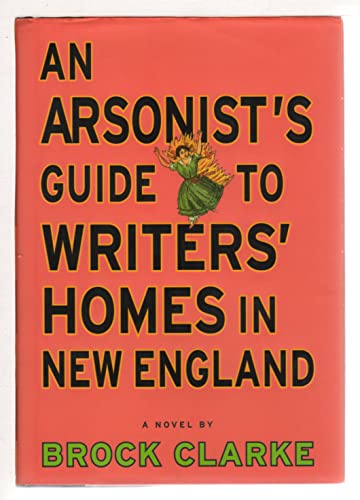
An Arsonist's Guide to Writers' Homes in New England
A NOVEL By BROCK CLARKEAlgonquin Books of Chapel Hill
Copyright © 2007 Brock ClarkeAll right reserved.
ISBN: 978-1-56512-551-3
Chapter One
I, Sam Pulsifer, am the man who accidentally burned down the Emily Dickinson House in Amherst, Massachusetts, and who in the process killed two people, for which I spent ten years in prison and, as letters from scholars of American literature tell me, for which I will continue to pay a high price long into the not-so-sweet hereafter. This story is locally well known, and so I won't go into it here. It's probably enough to say that in the Massachusetts Mt. Rushmore of big, gruesome tragedy, there are the Kennedys, and Lizzie Borden and her ax, and the burning witches at Salem, and then there's me.So anyway, I served my time, and since the sentencing judge took mercy on me, I served my time at the minimum-security prison up at Holyoke. At Holyoke there were bond analysts and lawyers and day traders and city managers and school administrators, all of them caught with their hands in the till and nothing at all like me, an eighteen-year-old accidental arsonist and murderer with blood and soot on his hands and a heavy heart and plenty to learn and no high school diploma. I flung in and tried. I took a biweekly self-improvement seminar called the College of Me, in which I learned the life-changing virtues of patience, hard work, and positive attitude, and in which I earned my GED. I also hung around this group of high-stepping bond analysts from Boston who were in the clink for insider trading. While they were inside, the bond analysts had set out to write their fond, freewheeling memoirs about their high crimes and misdemeanors and all the cashish-that's the way they talked-they had made while screwing old people out of their retirement funds and kids out of their college savings. These guys seemed to know everything, the whole vocabulary of worldly gain and progress, so I paid extra attention during their memoir-brainstorming sessions, listened closely to their debates over how much the reading public did or did not need to know about their tortured childhoods in order to understand why they needed to make so much money in the manner in which they made it. I took notes as they divided the world between those who had stuff taken from them and those who took, those who did bad things in a good way-gracefully, effortlessly-and those bumblers who bumbled their way through life.
"Bumblers," I said.
"Yes," they said, or one of them did. "Those who bumble."
"Give me an example," I said, and they stared at me with those blue-steel stares they were born with and didn't need to learn at Choate or Andover, and they stared those stares until I realized that I was an example, and so this is what I learned from them: that I was a bumbler, I resigned myself to the fact and had no illusions about striving to be something else-a bond analyst or a memoirist, for instance-and just got on with it. Life, that is.
I learned something from everyone, is the point, even while I was fending off the requisite cell-block buggerer, a gentle but crooked corporate accountant at Arthur Andersen who was just finding his true sexual self and who told me in a cracked, aching voice that he wanted me-wanted me, that is, until I told him I was a virgin, which I was, and which, for some reason, made him not want me anymore, which meant that people did not want to sleep with twenty-eight-year-old male virgins, which I thought was useful to know.
Finally, I learned to play basketball from this black guy named Terrell, which was one of the big joys of my life in prison and which ended badly. Terrell, who had written checks to himself when he was the Worcester city treasurer, was in prison for the last three of my ten years, and whenever he would beat me in one-on-one (this wasn't often, even when I was first learning to play, because although he was very strong, Terrell was also shorter than I was and about as sleek as a fire hydrant; plus, he was twice my age and his knees were completely shot and would crack like dry wood when he ran)-whenever he would beat me, Terrell would yell out, "I'm a grown-ass man." That sounded good, and so after our last game, which I won easily, I also yelled out, "I'm a grown-ass man." Terrell thought I was mocking him, so he started hitting me around the head, and since I get passive in the face of true anger, I just stood there and took Terrell's abuse and didn't try to defend myself. As the guards dragged him to solitary, he promised that he would beat on me a little more once he got out, which he shouldn't have, because, of course, the guards then gave him more solitary than they might have otherwise. By the time Terrell got out, I'd already been released from prison and was home, living with my parents.
That didn't work out too well, living with my parents. For one, my burning down the Emily Dickinson House caused them some real heartbreak, because my mother was a high school English teacher, my father an editor for the university press in town, and beautiful words really mattered to them; they didn't care anything for movies or TV, but you could always count on a good poem to make them cry or sigh meaningfully. For another, their neighbors in Amherst weren't exactly happy that I'd burned down the town's most famous house and killed two of its citizens in the bargain, so they took it out on my parents. People never had trouble finding our old, creaking house on Chicopee Street: it was always the one with the driveway that had been spray-painted murderer! (which I understand) or fascist! (which I don't), or with some quote from Dickinson herself that seemed to promise vengeance, but you could never tell exactly what the vengeance might be, because there were a lot of words and the spray-painter always got sloppy and illegible from fatigue or maybe overemotion. It only got worse when I went home after prison. There was some picketing by the local arts council and some unwelcome, unflattering news coverage, and neighborhood kids who cared nothing about Emily Dickinson or her house started egging the place and draping our noble birches with toilet paper, and for a while there it was like Halloween every day. Then things really got serious and someone slashed every tire on my parents' Volvo, and once, in a fit of anger or grief, someone hurled a Birkenstock through one of our bay windows. It was a man's right shoe, size twelve.
All of this happened within the first month of my return home. At the end of the month, my parents suggested I move out. I remember it was August, because the three of us were sitting on our front porch and the neighbors' flags were out, caught between the Fourth of July and Labor Day and in full flutter, and the light was spectral through the maple and birch leaves and it was all very pretty. You can imagine how much my parents' request that I leave home wounded me, even though the College of Me said that life after prison wouldn't be easy and that I shouldn't fool myself into thinking otherwise.
"But where should I go?" I asked them.
"You could go anywhere," my mother said. Back then I thought she was the harder parent of the two and had had high hopes for me, so the disappointment weighed on her more heavily. I remember that my mother was a dry well at my trial when the jury brought back the verdict, although my father had wept loudly and wetly, and he was starting to cry now, too. I hated to see them like this: one cold, the other weepy. There was a time when I was six and they taught...
„Über diesen Titel“ kann sich auf eine andere Ausgabe dieses Titels beziehen.
Suchergebnisse für An Arsonist's Guide to Writers' Homes in New...

Beispielbild für diese ISBN
An Arsonist's Guide to Writers' Homes in New England: A Novel
Anbieter: World of Books (was SecondSale), Montgomery, IL, USA
Verkäuferbewertung 5 von 5 Sternen

Zustand: Good. Item in good condition. Textbooks may not include supplemental items i.e. CDs, access codes etc. Artikel-Nr. 00097108995
Gebraucht kaufen
EUR 4,82
Versand gratis
Versand innerhalb von USA
Versand innerhalb von USA
Anzahl: 6 verfügbar
Beispielbild für diese ISBN
An Arsonist's Guide to Writers' Homes in New England: A Novel
Verlag:
Algonquin Books (edition 1), 2007
ISBN 10: 1565125517
ISBN 13: 9781565125513
Gebraucht
Hardcover
Anbieter: BooksRun, Philadelphia, PA, USA
Verkäuferbewertung 5 von 5 Sternen
Hardcover. Zustand: Very Good. 1. It's a well-cared-for item that has seen limited use. The item may show minor signs of wear. All the text is legible, with all pages included. It may have slight markings and/or highlighting. Artikel-Nr. 1565125517-8-1
Gebraucht kaufen
EUR 6,31
Versand gratis
Versand innerhalb von USA
Versand innerhalb von USA
Anzahl: 1 verfügbar
Beispielbild für diese ISBN
An Arsonist's Guide to Writers' Homes in New England
Verlag:
Algonquin Books of Chapel Hill, 2007
ISBN 10: 1565125517
ISBN 13: 9781565125513
Gebraucht
Hardcover
Erstausgabe
Anbieter: Better World Books, Mishawaka, IN, USA
Verkäuferbewertung 5 von 5 Sternen
Zustand: Very Good. 1st Edition. Former library copy. Pages intact with possible writing/highlighting. Binding strong with minor wear. Dust jackets/supplements may not be included. Includes library markings. Stock photo provided. Product includes identifying sticker. Better World Books: Buy Books. Do Good. Artikel-Nr. 7638265-75
Gebraucht kaufen
EUR 6,35
Versand gratis
Versand innerhalb von USA
Versand innerhalb von USA
Anzahl: 1 verfügbar
Beispielbild für diese ISBN
An Arsonist's Guide to Writers' Homes in New England
Verlag:
Algonquin Books of Chapel Hill, 2007
ISBN 10: 1565125517
ISBN 13: 9781565125513
Gebraucht
Hardcover
Erstausgabe
Anbieter: Better World Books, Mishawaka, IN, USA
Verkäuferbewertung 5 von 5 Sternen
Zustand: Good. 1st Edition. Former library copy. Pages intact with minimal writing/highlighting. The binding may be loose and creased. Dust jackets/supplements are not included. Includes library markings. Stock photo provided. Product includes identifying sticker. Better World Books: Buy Books. Do Good. Artikel-Nr. GRP72800007
Gebraucht kaufen
EUR 6,35
Versand gratis
Versand innerhalb von USA
Versand innerhalb von USA
Anzahl: 1 verfügbar
Beispielbild für diese ISBN
An Arsonist's Guide to Writers' Homes in New England: A Novel
Anbieter: Wonder Book, Frederick, MD, USA
Verkäuferbewertung 5 von 5 Sternen
Zustand: As New. Like New condition. Like New dust jacket. A near perfect copy that may have very minor cosmetic defects. Artikel-Nr. R11A-01801
Gebraucht kaufen
EUR 6,42
Versand gratis
Versand innerhalb von USA
Versand innerhalb von USA
Anzahl: 1 verfügbar
Beispielbild für diese ISBN
An Arsonist's Guide to Writers' Homes in New England: A Novel
Anbieter: Wonder Book, Frederick, MD, USA
Verkäuferbewertung 5 von 5 Sternen
Zustand: Good. Good condition. Good dust jacket. . A copy that has been read but remains intact. May contain markings such as bookplates, stamps, limited notes and highlighting, or a few light stains. Artikel-Nr. K10N-00932
Gebraucht kaufen
EUR 6,42
Versand gratis
Versand innerhalb von USA
Versand innerhalb von USA
Anzahl: 1 verfügbar
Beispielbild für diese ISBN
An Arsonist's Guide to Writers' Homes in New England
Anbieter: ThriftBooks-Dallas, Dallas, TX, USA
Verkäuferbewertung 5 von 5 Sternen
Hardcover. Zustand: Very Good. No Jacket. May have limited writing in cover pages. Pages are unmarked. ~ ThriftBooks: Read More, Spend Less. Artikel-Nr. G1565125517I4N00
Gebraucht kaufen
EUR 7,33
Versand gratis
Versand innerhalb von USA
Versand innerhalb von USA
Anzahl: 1 verfügbar
Beispielbild für diese ISBN
An Arsonist's Guide to Writers' Homes in New England
Anbieter: ThriftBooks-Atlanta, AUSTELL, GA, USA
Verkäuferbewertung 5 von 5 Sternen
Hardcover. Zustand: Very Good. No Jacket. Missing dust jacket; May have limited writing in cover pages. Pages are unmarked. ~ ThriftBooks: Read More, Spend Less. Artikel-Nr. G1565125517I4N01
Gebraucht kaufen
EUR 7,33
Versand gratis
Versand innerhalb von USA
Versand innerhalb von USA
Anzahl: 1 verfügbar
Beispielbild für diese ISBN
An Arsonist's Guide to Writers' Homes in New England
Anbieter: ThriftBooks-Reno, Reno, NV, USA
Verkäuferbewertung 5 von 5 Sternen
Hardcover. Zustand: Very Good. No Jacket. May have limited writing in cover pages. Pages are unmarked. ~ ThriftBooks: Read More, Spend Less. Artikel-Nr. G1565125517I4N00
Gebraucht kaufen
EUR 7,33
Versand gratis
Versand innerhalb von USA
Versand innerhalb von USA
Anzahl: 1 verfügbar
Beispielbild für diese ISBN
An Arsonist's Guide to Writers' Homes in New England
Anbieter: ThriftBooks-Atlanta, AUSTELL, GA, USA
Verkäuferbewertung 5 von 5 Sternen
Hardcover. Zustand: Very Good. No Jacket. May have limited writing in cover pages. Pages are unmarked. ~ ThriftBooks: Read More, Spend Less. Artikel-Nr. G1565125517I4N00
Gebraucht kaufen
EUR 7,33
Versand gratis
Versand innerhalb von USA
Versand innerhalb von USA
Anzahl: 1 verfügbar