
Verwandte Artikel zu How to Get Your Child to Love Reading
Inhaltsangabe
"An exuberant treasure trove for parents."
—Publishers Weekly
Are children reading enough? Not according to most parents and teachers, who know that reading aloud with children fosters a lifelong love of books, ensures better standardized test scores, promotes greater success in school, and helps instill the values we most want to pass on.
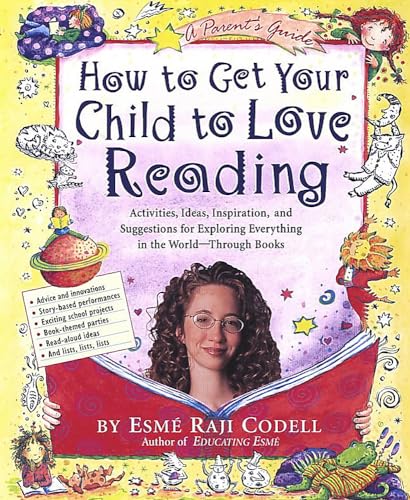
Esmé Raji Codell—an inspiring children's literature specialist and an energetic teacher—has the solution. She's turned her years of experience with children, parents, librarians, and fellow educators into a great big indispensable volume designed to help parents get their kids excited about reading.
Here are hundreds of easy and inventive ideas, innovative projects, creative activities, and inspiring suggestions that have been shared, tried, and proven with children from birth through eighth grade.
This five-hundred-page volume is brimming with themes for superlative storytimes and book-based birthday parties, ideas for mad-scientist experiments and half-pint cooking adventures, stories for reluctant readers and book groups for boys, step-by-step instructions for book parades, book-related crafts, storytelling festivals, literature-based radio broadcasts, readers' theater, and more. There are book lists galore, with subject-driven reading recommendations for science, math, cooking, nature, adventure, music, weather, gardening, sports, mythology, poetry, history, biography, fiction, and fairy tales. Codell's creative thinking and infectious enthusiasm will empower even the busiest parents and children to include literature in their lives.
Esmé Raji Codell—an inspiring children's literature specialist and an energetic teacher—has the solution. She's turned her years of experience with children, parents, librarians, and fellow educators into a great big indispensable volume designed to help parents get their kids excited about reading.
Here are hundreds of easy and inventive ideas, innovative projects, creative activities, and inspiring suggestions that have been shared, tried, and proven with children from birth through eighth grade.
This five-hundred-page volume is brimming with themes for superlative storytimes and book-based birthday parties, ideas for mad-scientist experiments and half-pint cooking adventures, stories for reluctant readers and book groups for boys, step-by-step instructions for book parades, book-related crafts, storytelling festivals, literature-based radio broadcasts, readers' theater, and more. There are book lists galore, with subject-driven reading recommendations for science, math, cooking, nature, adventure, music, weather, gardening, sports, mythology, poetry, history, biography, fiction, and fairy tales. Codell's creative thinking and infectious enthusiasm will empower even the busiest parents and children to include literature in their lives.
Die Inhaltsangabe kann sich auf eine andere Ausgabe dieses Titels beziehen.
Über die Autorin bzw. den Autor
A nationally renowned advocate for literacy and literature-based instruction, Esmé Raji Codell is today "one of the nation's most sought-after voices for empowering teachers" (People) and a "Superstar of Education" (Scolastic Instructor). Esmé has been interviewed on CBS This Morning, CNN, C-SPAN’s Book Talk, and NPR. The author of How to Get Your Child to Love Reading as well as award-winning books for children, Esmé lives with her husband and son in Chicago, where she spent many years as an educator in Chicago public schools and now runs the popular children's literature Web site PlanetEsme.com and the unique literary salon, the PlanetEsme Bookroom.
Auszug. © Genehmigter Nachdruck. Alle Rechte vorbehalten.
This book started with a potato. I was sitting at my kitchen table, staring at a dimpled, wrinkling, sprouting old potato. I thought to myself, if I had a potato, nothing but a potato, how could I teach a classroom full of children?
Well, I could cut a potato in half. (I can use the paring knife from my own kitchen, right?) We could review fractions. With one half, I could cut a design and do potato prints. We could plant the eyes from the other half of the potato (it can have eyes, right?) and grow more potatoes, charting their growth. We could write a story about a potato, or write a book of potato recipes or potato poems. If we grew enough potatoes, we could make potato stamps of all the letters of the alphabet, and I could teach reading. I could go to the public library and find "The Potato with Big Ideas" from Little Old Mrs. Pepperpot by Alf Proysen or Brave Potatoes by Toby Speed. We could talk about the Irish potato famine of 1845, maybe read true accounts from Feed the Children First by Mary E. Lyons or Black Potatoes by Susan Campbell Bartoletti. We could write letters to the executives at Frito-Lay about their potato chips, or Playskool regarding their product, Mr. Potato Head.
Perhaps I am a bit potato headed myself, wasting precious time plotting the pedagogy of potatoes, but it begs the question, how do we teach our children, using what is available to us? Moreover, is there anything available to us that is as plentiful and versatile as potatoes, ready to feed all appetites?
Yes, there is. Children's literature is our national potato. Thousands of studies from the U.S. Department of Education as well as findings by independent researchers here and abroad consistently credit the utilization of children's literature for everything from school achievement to emotional development to increased life span and higher standards of living. So many of the dreams and goals we have for children, and that they have for themselves, can be advanced through the use of children's literature. So much of the blame exchanged between school, community, and family about education's failure can be converted into shared responsibility and success through children's literature. But the thing is, if you hand somebody a potato, or if you hand somebody a children's book, and he doesn't know how to make it cook . . . well, then.
This book is a recipe book for children's literature: how to serve it up so it's delicious and varied. Children's literature makes for a main course or a sustaining side dish, so you can use these recipes no matter what is on the menu in your child's classroom. First, let's recognize the main ingredient: trade literature, which is the kind of books and reading material you can find readily available at bookstores and libraries. These books have clearly designated authors and illustrators, with characters that usually appear in print before they appear on a television screen. I was trained as a teacher but it was not through teacher training that I discovered there was the whole world in children's literature. Instead, it was during the seven years I spent in children's bookselling before I got my degree. Every genre and every subject was there in the bookstores, many at a level of quality that rivaled or exceeded that of adult literature-only specially designed with children in mind and encompassing so much energy, joy, and imagination that these elements became the criteria for excellence. This inspired me entirely. While studying to become a teacher, I could imagine nothing greater than delivering this world to the children I would teach. This dream became my energy and my joy. It was as the great Russian writer Maxim Gorky wrote about his discovery of books in My Apprenticeship: "I came to appreciate what good books really were and realized how much I needed them and they gradually gave me a stoical confidence in myself: I was not alone in this world and I would not perish!" By using children's literature, I had the utmost faith that when I became a teacher, I, too, would not perish or feel alone, which is a wonderful and sometimes unusual thing for a teacher to believe. But I considered myself in an even more formidable position to use exclamation points than Gorky, because not only would I not perish, not only would I not be alone in the world, I had the tool that would allow me to help children to feel the same amazing way.
As strongly as I feel about advocating for the child, I feel equally as strong about advocating for the author. If, in the course of delivering literature-based education, we can constantly remind children that authors and illustrators are real and singular people, with intentions, then we are not only giving children the books, we are giving them the people behind the books. And if you are talking about reading, you are talking about connecting the two. In facilitating this connection, the most important question we can ask about a book is, "Why did the author write this?" In other words, "What did the author want to share?" This is a very difficult question, and it is the most important question, because it connects the child across time and space with this real person, this author, who had something to share, and cared enough to share it. This is extraordinary magic, a trick that allows a child who can read the option of never being quite as alone as a child who cannot. "Why did the author write this?" is also a question that can be asked of any book on any level, thus opening up a world of picture books to older readers, because any reading is made more sophisticated when this relationship is addressed. The connection between the author or illustrator and the young reader is a particularly remarkable relationship in which an adult trusts a child with all sorts of dreams and stories and memories and confidences and explanations. For many children, this relationship with an author may be the first emotional bond shared with an adult outside her own family and community. From this perspective, it should not be taken lightly.
If your child understands that a book is an extension of an author, then your child will also understand that he may not always connect with an author's style, just like he may not always like everybody he meets. And he will understand that he can always get another book and read what someone else has to share. With the right guidance and some freedom of choice, he will find authors he likes. Most problems arise in school settings when too many mismatches have been bound into one big fat textbook that the child is assigned every day, or if the literature made available to that child is of poor quality or incongruous with the child's ability and interests. When this happens, no one can accuse a child of being unjustified if he forms negative associations with books and takes that bloodcurdling leap into the world of "I hate reading." If reading is indeed a relationship between author and reader, people in the position of matching children with books are responsible for making informed choices so that the children are matched appropriately, so that they are most receptive to what the author or illustrator is trying to communicate. This is only difficult if you (a) don't know the body of literature available, (b) don't know the child, or (c) don't have access to books. I hope the thematic storytime adventures in this book will offer you a chance to know children's literature and to use it to connect with the children you love.
Potato Possibilities
When I figured out what I most enjoyed was sharing literature, I changed my job from "Madame EsmT, Classroom Teacher" to "Madame EsmT, School Librarian" so I could do more of what I loved. Whether working as a bookseller, storyteller, teacher, or librarian, I have discovered approaches that complement and support literature-based learning. Approaches are merely tools that allow us to present the main ingredient in...
„Über diesen Titel“ kann sich auf eine andere Ausgabe dieses Titels beziehen.
Suchergebnisse für How to Get Your Child to Love Reading

Beispielbild für diese ISBN
How to Get Your Child to Love Reading
Anbieter: World of Books (was SecondSale), Montgomery, IL, USA
Verkäuferbewertung 5 von 5 Sternen

Zustand: Good. Item in good condition. Textbooks may not include supplemental items i.e. CDs, access codes etc. Artikel-Nr. 00089483796
Gebraucht kaufen
EUR 4,05
Versand gratis
Versand innerhalb von USA
Versand innerhalb von USA
Anzahl: 5 verfügbar
Beispielbild für diese ISBN
How to Get Your Child to Love Reading
Anbieter: World of Books (was SecondSale), Montgomery, IL, USA
Verkäuferbewertung 5 von 5 Sternen
Zustand: Very Good. Item in very good condition! Textbooks may not include supplemental items i.e. CDs, access codes etc. Artikel-Nr. 00096859687
Gebraucht kaufen
EUR 4,05
Versand gratis
Versand innerhalb von USA
Versand innerhalb von USA
Anzahl: 3 verfügbar
Beispielbild für diese ISBN
How to Get Your Child to Love Reading
Verlag:
Algonquin Books (edition 1), 2003
ISBN 10: 1565123085
ISBN 13: 9781565123083
Gebraucht
Paperback
Anbieter: BooksRun, Philadelphia, PA, USA
Verkäuferbewertung 5 von 5 Sternen
Paperback. Zustand: Very Good. 1. It's a well-cared-for item that has seen limited use. The item may show minor signs of wear. All the text is legible, with all pages included. It may have slight markings and/or highlighting. Artikel-Nr. 1565123085-11-6
Gebraucht kaufen
EUR 6,05
Versand gratis
Versand innerhalb von USA
Versand innerhalb von USA
Anzahl: 1 verfügbar
Beispielbild für diese ISBN
How to Get your Child to Love Reading
Anbieter: Wonder Book, Frederick, MD, USA
Verkäuferbewertung 5 von 5 Sternen
Zustand: As New. Like New condition. A near perfect copy that may have very minor cosmetic defects. Artikel-Nr. X07D-01736
Gebraucht kaufen
EUR 6,43
Versand gratis
Versand innerhalb von USA
Versand innerhalb von USA
Anzahl: 1 verfügbar
Beispielbild für diese ISBN
How to Get your Child to Love Reading
Anbieter: Wonder Book, Frederick, MD, USA
Verkäuferbewertung 5 von 5 Sternen
Zustand: Very Good. Very Good condition. A copy that may have a few cosmetic defects. May also contain light spine creasing or a few markings such as an owner's name, short gifter's inscription or light stamp. Artikel-Nr. X02G-01293
Gebraucht kaufen
EUR 6,43
Versand gratis
Versand innerhalb von USA
Versand innerhalb von USA
Anzahl: 4 verfügbar
Beispielbild für diese ISBN
How to Get Your Child to Love Reading
Verlag:
Algonquin Books of Chapel Hill, 2003
ISBN 10: 1565123085
ISBN 13: 9781565123083
Gebraucht
Softcover
Erstausgabe
Anbieter: Better World Books, Mishawaka, IN, USA
Verkäuferbewertung 5 von 5 Sternen
Zustand: Good. 1st Edition. Former library copy. Pages intact with minimal writing/highlighting. The binding may be loose and creased. Dust jackets/supplements are not included. Includes library markings. Stock photo provided. Product includes identifying sticker. Better World Books: Buy Books. Do Good. Artikel-Nr. GRP60895057
Gebraucht kaufen
EUR 6,51
Versand gratis
Versand innerhalb von USA
Versand innerhalb von USA
Anzahl: 2 verfügbar
Beispielbild für diese ISBN
How to Get Your Child to Love Reading
Verlag:
Algonquin Books of Chapel Hill, 2003
ISBN 10: 1565123085
ISBN 13: 9781565123083
Gebraucht
Softcover
Erstausgabe
Anbieter: Better World Books, Mishawaka, IN, USA
Verkäuferbewertung 5 von 5 Sternen
Zustand: Very Good. 1st Edition. Pages intact with possible writing/highlighting. Binding strong with minor wear. Dust jackets/supplements may not be included. Stock photo provided. Product includes identifying sticker. Better World Books: Buy Books. Do Good. Artikel-Nr. 5279186-75
Gebraucht kaufen
EUR 6,51
Versand gratis
Versand innerhalb von USA
Versand innerhalb von USA
Anzahl: 3 verfügbar
Beispielbild für diese ISBN
How to Get Your Child to Love Reading
Verlag:
Algonquin Books of Chapel Hill, 2003
ISBN 10: 1565123085
ISBN 13: 9781565123083
Gebraucht
Softcover
Erstausgabe
Anbieter: Better World Books, Mishawaka, IN, USA
Verkäuferbewertung 5 von 5 Sternen
Zustand: Good. 1st Edition. Pages intact with minimal writing/highlighting. The binding may be loose and creased. Dust jackets/supplements are not included. Stock photo provided. Product includes identifying sticker. Better World Books: Buy Books. Do Good. Artikel-Nr. GRP105355713
Gebraucht kaufen
EUR 6,51
Versand gratis
Versand innerhalb von USA
Versand innerhalb von USA
Anzahl: 2 verfügbar
Beispielbild für diese ISBN
How to Get Your Child to Love Reading
Verlag:
Algonquin Books of Chapel Hill, 2003
ISBN 10: 1565123085
ISBN 13: 9781565123083
Gebraucht
Softcover
Erstausgabe
Anbieter: Better World Books, Mishawaka, IN, USA
Verkäuferbewertung 5 von 5 Sternen
Zustand: Very Good. 1st Edition. Former library copy. Pages intact with possible writing/highlighting. Binding strong with minor wear. Dust jackets/supplements may not be included. Includes library markings. Stock photo provided. Product includes identifying sticker. Better World Books: Buy Books. Do Good. Artikel-Nr. GRP65483597
Gebraucht kaufen
EUR 6,51
Versand gratis
Versand innerhalb von USA
Versand innerhalb von USA
Anzahl: 2 verfügbar
Beispielbild für diese ISBN
How to Get Your Child to Love Reading
Anbieter: ThriftBooks-Atlanta, AUSTELL, GA, USA
Verkäuferbewertung 5 von 5 Sternen
Paperback. Zustand: Very Good. No Jacket. May have limited writing in cover pages. Pages are unmarked. ~ ThriftBooks: Read More, Spend Less. Artikel-Nr. G1565123085I4N00
Gebraucht kaufen
EUR 6,87
Versand gratis
Versand innerhalb von USA
Versand innerhalb von USA
Anzahl: 1 verfügbar