
Verwandte Artikel zu The Eco Guide To Careers That Make A Difference: Environment...
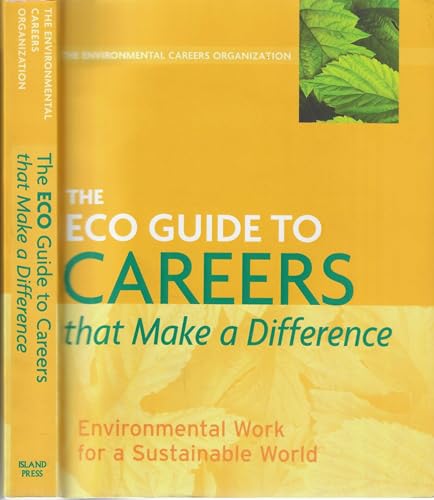
The Eco Guide To Careers That Make A Difference: Environmental Work for a Sustainable World (The Environmental Careers Organization) - Softcover
Inhaltsangabe
How can you make a real difference in the world and make a good living at the same time? The ECO Guide to Careers That Make a Difference: Environmental Work for a Sustainable World provides the answer.
Developed by The Environmental Careers Organization (ECO, the creators of the popular Complete Guide to Environmental Careers), this new volume is unlike any careers book you've seen before. Reaching far beyond job titles and resume tips, The ECO Guide immerses you in the strategies and tactics that leading edge professionals are using to tackle pressing problems and create innovative solutions.
To bring you definitive information from the real world of environmental problem-solving, The ECO Guide has engaged some of the nation's most respected experts to explain the issues and describe what's being done about them today. You'll explore: Global climate change with Eileen Claussen, Pew Center for Global Climate Change; Biodiversity loss with Stuart Pimm, Nicholas School for the Environment at Duke University; Green Business with Stuart Hart, Kenan-Flager Business School at University of North Carolina; Ecotourism with Martha Honey, The International Ecotourism Society; Environmental Justice with Robert Bullard, Environmental Justice Center at Clark Atlanta University; Alternative Energy with Seth Dunn, Worldwatch Institute; Water Quality with Sandra Postel, Global Water Policy Project; Green Architecture with William McDonough, McDonough + Partners; and twelve other critical issues.
To demonstrate even more clearly what eco-work feels like on the ground, The ECO Guide offers vivid "Career Snapshots" of selected employers and the professionals that work there. You'll visit government agencies like the USDA Forest Service, nonprofit organizations like Conservation International and Project Wild, and local advocates like Alternatives for Community and Environment. You'll go inside environmental businesses like Wildland Adventures and Stonyfield Farms. And you'll learn from academic institutions like the National Center for Atmospheric Research and the Gund Institute for Ecological Economics.
ECO also identifies and describes forty specific jobs that are representative of environmental career opportunities in the twenty-first century. It provides dozens of the best Internet resources. And most importantly, The ECO Guide offers all of the insight about current trends you expect from ECO, the acknowledged leaders in environmental career information.
Developed by The Environmental Careers Organization (ECO, the creators of the popular Complete Guide to Environmental Careers), this new volume is unlike any careers book you've seen before. Reaching far beyond job titles and resume tips, The ECO Guide immerses you in the strategies and tactics that leading edge professionals are using to tackle pressing problems and create innovative solutions.
To bring you definitive information from the real world of environmental problem-solving, The ECO Guide has engaged some of the nation's most respected experts to explain the issues and describe what's being done about them today. You'll explore: Global climate change with Eileen Claussen, Pew Center for Global Climate Change; Biodiversity loss with Stuart Pimm, Nicholas School for the Environment at Duke University; Green Business with Stuart Hart, Kenan-Flager Business School at University of North Carolina; Ecotourism with Martha Honey, The International Ecotourism Society; Environmental Justice with Robert Bullard, Environmental Justice Center at Clark Atlanta University; Alternative Energy with Seth Dunn, Worldwatch Institute; Water Quality with Sandra Postel, Global Water Policy Project; Green Architecture with William McDonough, McDonough + Partners; and twelve other critical issues.
To demonstrate even more clearly what eco-work feels like on the ground, The ECO Guide offers vivid "Career Snapshots" of selected employers and the professionals that work there. You'll visit government agencies like the USDA Forest Service, nonprofit organizations like Conservation International and Project Wild, and local advocates like Alternatives for Community and Environment. You'll go inside environmental businesses like Wildland Adventures and Stonyfield Farms. And you'll learn from academic institutions like the National Center for Atmospheric Research and the Gund Institute for Ecological Economics.
ECO also identifies and describes forty specific jobs that are representative of environmental career opportunities in the twenty-first century. It provides dozens of the best Internet resources. And most importantly, The ECO Guide offers all of the insight about current trends you expect from ECO, the acknowledged leaders in environmental career information.
Die Inhaltsangabe kann sich auf eine andere Ausgabe dieses Titels beziehen.
Über die Autorin bzw. den Autor
The Environmental Careers Organization is a national, nonprofit organization, with offices in Boston, San Francisco, and Seattle, devoted to protecting and enhancing the environment through the development of diverse leaders, the promotion of careers, and the inspiration of individual action.
Auszug. © Genehmigter Nachdruck. Alle Rechte vorbehalten.
The Eco Guide to Careers that make a Difference
By Environmental Careers OrganizationISLAND PRESS
Copyright © 2004 Environmental Careers Organization
All rights reserved.
ISBN: 978-1-55963-967-5All rights reserved.
Contents
About Island Press,
About The Environmental Careers Organization (ECO),
THE ENVIRONMENTAL CAREERS ORGANIZATION,
Title Page,
Copyright Page,
Preface,
Acknowledgments,
Featured Jobs,
Career Spotlights,
Introduction,
Sector by Sector Snapshot of Environmental Careers Today,
Public Sector,
Private Sector,
Building Your Environmental Career,
Seven Steps to a Great Environmental Career,
Step One: Know Yourself,
Step Two: Get Focused,
Step Three: Know What's Going On in the World Around You,
Step Four: Grow and Maintain Your Career Network,
Step Five: Get the Skills and Experience That You Need,
Step Six: Master the Job Search Basics,
Step Seven: Be a Great Performer, Leave a Legacy,
Conversations with the Experts - WORKING THE ISSUES,
1. AGRICULTURE AND FOOD SECURITY,
2. AIR QUALITY,
3. ARCHITECTURE, CONSTRUCTION, AND DESIGN,
4. BIODIVERSITY LOSS AND SPECIES EXTINCTION,
5. CLIMATE CHANGE,
6. COASTAL ENVIRONMENTS AND OCEANS,
7. ECONOMICS,
8. ECOTOURISM,
9. ENERGY,
10. ENVIRONMENTAL EDUCATION,
11. ENVIRONMENTAL JUSTICE,
12. FISHERIES,
13. FORESTRY,
14. FRESHWATER QUALITY, USE, AND PROTECTION,
15. GREENING OF BUSINESS,
16. SMART GROWTH,
17. RECYCLING AND SOLID WASTE,
18. SUSTAINABLE CONSUMPTION AND GREEN LIFESTYLES,
19. TOXICS AND THE ENVIRONMENT,
Index,
Island Press Board of Directors,
CHAPTER 1
Sector by Sector Snapshot of Environmental Careers Today
What is the current status of "green" employment in the United States? As we've seen, the movement for a more sustainable economy has begun to reach beyond traditional conservation, environmental protection, and natural resource management institutions. The basic ideas of sustainability, however, are still far from being fully incorporated into our mainstream society. With this in mind, where are the jobs today for people who want to combine ecological and social goals? The overview below provides a snapshot of current trends at some leading public and private environmental employers, and suggests directions for job seekers and career planners.
Public Sector
• Federal Government
From the 1970s through the early 1990s, the federal government was clearly a primary source of national environmental progress. Since that time, environmental concerns seem to have slipped from the top of Washington's priority list. Congressional leaders appear to be skeptical about (if not hostile to) the expansion of environmental regulatory power and the purchase of new public lands. Moreover, the federal conservation workforce is not as big as it used to be.
Even in its somewhat diminished state, however, the federal government remains the largest single employer in the world of environmental careers. Over 200,000 people worked in full-time, permanent positions for federal environmental and conservation agencies in 2004, most of them at the small collection of well-known agencies detailed in Table 1.
The sheer size and authority of the government, coupled with the huge amounts of money it spends on state and local government, nonprofit groups, and private contractors, guarantee a prominent role for Washington on every sustainability issue. It's the U.S. government, after all, that owns and runs the national forests, wildlife refuges, parks, and other protected areas. Congress ultimately controls the direction of national policy on air, water, climate, toxics, agriculture, and energy issues. Federal priorities in environmental science dominate research funding for scholars and graduate students. And, in a global world, it's important to note that only Washington can commit the nation to critical international environmental and trade agreements.
Finally, it makes sense to examine the federal government's environmental workforce at length because much of the nation's public and private eco-employment has grown up in reaction or as a complement to the federal role in environmental protection and natural resource management. Understanding the federal workforce is a window into environmental career opportunities everywhere.
• Environmental Protection Agency
Through rule making and regulatory enforcement, the Environmental Protection Agency (EPA) assures that business, industry, and government agencies comply with the National Environmental Policy Act, Clean Air Act, Clean Water Act, Safe Drinking Water Act, Resource Conservation and Recovery Act (for hazardous waste management), Toxic Substances Control Act, and Pollution Prevention Act, among others. In this role, the agency often sets the standards that become our national environmental goals. Since much of this authority for on-the-ground pollution control work has been delegated to the fifty states, the EPA's role is often one of management and oversight.
In addition to responsibility for enforcing major laws, the EPA is also charged with running the "Superfund" program to clean up the nation's most toxic sites, and it has major responsibilities for environmental education, environmental justice, and brownfields redevelopment. Finally, the EPA conducts and supports scientific research.
Although the agency can be thought of as a "national cop on the environmental beat," it has shown a strong interest in additional methods for improving environmental quality. A 2004 EPA report entitled Innovating for Better Environmental Results reviews a long list of initiatives involving experimental technologies (such as nanotechnology), integrated environmental management systems, "sector strategies" that target the unique environmental concerns of specific industries, voluntary programs, and market-based incentives for pollution prevention. The search for innovative and less costly methods that produce improved results will certainly continue under both Republican and Democratic administrations.
Environmental scientists, engineers, and lawyers make up the vital core of the EPA workforce, for obvious reasons, but that has been changing. Information technology specialists are in very high demand now, as are economists, businesspeople, financial analysts, and talented managers for complex public-private partnerships.
• National Park Service
One of the nation's best-loved agencies, the National Park Service operates hundreds of national parks, from well-known treasures like Yosemite, Grand Canyon, and Yellowstone, to tiny properties that attract only a handful of visitors. Because many parks are simultaneously nature reserves, sites for scientific research, and outdoor recreation areas for millions of people, pressure is always on park professionals to balance public access with the need to protect the natural bounty that inspired us to protect these areas in the first place. Maintaining that balance has been made even more difficult in recent years by the need to deal with a serious backlog of needed improvements that will require millions of additional dollars beyond current budgets.
The core of the National Park Service workforce is its cadre of park rangers, a growing number of whom are unfortunately required to handle law enforcement issues along with environmental education and conservation...
„Über diesen Titel“ kann sich auf eine andere Ausgabe dieses Titels beziehen.
Suchergebnisse für The Eco Guide To Careers That Make A Difference: Environment...

Beispielbild für diese ISBN
The ECO Guide to Careers that
Anbieter: World of Books (was SecondSale), Montgomery, IL, USA
Verkäuferbewertung 5 von 5 Sternen

Zustand: Very Good. Item in very good condition! Textbooks may not include supplemental items i.e. CDs, access codes etc. Artikel-Nr. 00110176497
Gebraucht kaufen
EUR 4,30
Versand gratis
Versand innerhalb von USA
Versand innerhalb von USA
Anzahl: 1 verfügbar
Beispielbild für diese ISBN
The ECO Guide to Careers that
Anbieter: World of Books (was SecondSale), Montgomery, IL, USA
Verkäuferbewertung 5 von 5 Sternen
Zustand: Good. Item in good condition. Textbooks may not include supplemental items i.e. CDs, access codes etc. Artikel-Nr. 00097838708
Gebraucht kaufen
EUR 4,30
Versand gratis
Versand innerhalb von USA
Versand innerhalb von USA
Anzahl: 1 verfügbar
Beispielbild für diese ISBN
The ECO Guide to Careers that Make a Difference: Environmental Work For A Sustainable World (The Environmental Careers Organization)
Verlag:
Island Press (edition Revised), 2004
ISBN 10: 1559639679
ISBN 13: 9781559639675
Gebraucht
Paperback
Anbieter: BooksRun, Philadelphia, PA, USA
Verkäuferbewertung 5 von 5 Sternen
Paperback. Zustand: Very Good. Revised. It's a well-cared-for item that has seen limited use. The item may show minor signs of wear. All the text is legible, with all pages included. It may have slight markings and/or highlighting. Artikel-Nr. 1559639679-8-1
Gebraucht kaufen
EUR 5,57
Versand gratis
Versand innerhalb von USA
Versand innerhalb von USA
Anzahl: 1 verfügbar
Beispielbild für diese ISBN
The ECO Guide to Careers that
Anbieter: World of Books (was SecondSale), Montgomery, IL, USA
Verkäuferbewertung 5 von 5 Sternen
Zustand: Good. Good condition ex-library book with usual library markings and stickers. Artikel-Nr. 00106836436
Gebraucht kaufen
EUR 5,66
Versand gratis
Versand innerhalb von USA
Versand innerhalb von USA
Anzahl: 1 verfügbar
Beispielbild für diese ISBN
The Eco Guide to Careers That Make a Difference: Environmental Work for a Sustainable World
Anbieter: ThriftBooks-Atlanta, AUSTELL, GA, USA
Verkäuferbewertung 5 von 5 Sternen
Paperback. Zustand: Very Good. No Jacket. May have limited writing in cover pages. Pages are unmarked. ~ ThriftBooks: Read More, Spend Less. Artikel-Nr. G1559639679I4N00
Gebraucht kaufen
EUR 6,00
Versand gratis
Versand innerhalb von USA
Versand innerhalb von USA
Anzahl: 1 verfügbar
Beispielbild für diese ISBN
The Eco Guide to Careers That Make a Difference: Environmental Work for a Sustainable World
Anbieter: ThriftBooks-Dallas, Dallas, TX, USA
Verkäuferbewertung 5 von 5 Sternen
Paperback. Zustand: Very Good. No Jacket. May have limited writing in cover pages. Pages are unmarked. ~ ThriftBooks: Read More, Spend Less. Artikel-Nr. G1559639679I4N00
Gebraucht kaufen
EUR 6,03
Versand gratis
Versand innerhalb von USA
Versand innerhalb von USA
Anzahl: 1 verfügbar
Beispielbild für diese ISBN
The ECO Guide to Careers That Make a Difference : Environmental Work for a Sustainable World
Anbieter: Better World Books, Mishawaka, IN, USA
Verkäuferbewertung 5 von 5 Sternen
Zustand: Good. 4th Edition. Former library copy. Pages intact with minimal writing/highlighting. The binding may be loose and creased. Dust jackets/supplements are not included. Includes library markings. Stock photo provided. Product includes identifying sticker. Better World Books: Buy Books. Do Good. Artikel-Nr. 3733576-75
Gebraucht kaufen
EUR 6,29
Versand gratis
Versand innerhalb von USA
Versand innerhalb von USA
Anzahl: 2 verfügbar
Beispielbild für diese ISBN
The ECO Guide to Careers That Make a Difference : Environmental Work for a Sustainable World
Anbieter: Better World Books Ltd, Dunfermline, Vereinigtes Königreich
Verkäuferbewertung 5 von 5 Sternen
Zustand: Good. 4th Edition. Former library copy. Pages intact with minimal writing/highlighting. The binding may be loose and creased. Dust jackets/supplements are not included. Includes library markings. Stock photo provided. Product includes identifying sticker. Better World Books: Buy Books. Do Good. Artikel-Nr. 3733576-75
Gebraucht kaufen
EUR 5,62
EUR 5,83 Versand
Versand von Vereinigtes Königreich nach USA
Versand von Vereinigtes Königreich nach USA
Anzahl: 1 verfügbar
Beispielbild für diese ISBN
The ECO Guide to Careers That Make a Difference: Environmental Work for a Sustainable World (The Environmental Careers Organization)
Anbieter: medimops, Berlin, Deutschland
Verkäuferbewertung 5 von 5 Sternen
Zustand: very good. Gut/Very good: Buch bzw. Schutzumschlag mit wenigen Gebrauchsspuren an Einband, Schutzumschlag oder Seiten. / Describes a book or dust jacket that does show some signs of wear on either the binding, dust jacket or pages. Artikel-Nr. M01559639679-V
Gebraucht kaufen
EUR 4,37
EUR 10,00 Versand
Versand von Deutschland nach USA
Versand von Deutschland nach USA
Anzahl: 1 verfügbar
Beispielbild für diese ISBN
Eco Guide To Careers That Make A Difference
Anbieter: Romtrade Corp., STERLING HEIGHTS, MI, USA
Verkäuferbewertung 5 von 5 Sternen
Zustand: New. This is a Brand-new US Edition. This Item may be shipped from US or any other country as we have multiple locations worldwide. Artikel-Nr. ABBB-98659