
Verwandte Artikel zu The Western Confluence: A Guide to Governing Natural...
Inhaltsangabe
For 150 years, the American West has been shaped by persistent conflicts over natural resources. This has given rise to a succession of strategies for resolving disputes-prior appropriation, scientific management, public participation, citizen ballot initiatives, public interest litigation, devolution, and interest-based negotiation. All of these strategies are still in play, yet the West remains mired in gridlock. In fact, these strategies are themselves a source of conflict.
The Western Confluence is designed to help us navigate through the gridlock by reframing natural resource disputes and the strategies for resolving them. In it, authors Matthew McKinney and William Harmon trace the principles of natural resource governance across the history of western settlement and reveal how they have met at the beginning of the twenty-first century to create a turbid, often contentious confluence of laws, regulations, and policies. They also offer practical suggestions for resolving current and future disputes. Ultimately, Matthew McKinney and William Harmon argue, fully integrating the values of interest-based negotiation into the briar patch of existing public decision making strategies is the best way to foster livable communities, vibrant economies, and healthy landscapes in the West.
Relying on the authors' first-hand experience and compelling case studies, The Western Confluence offers useful information and insight for anyone involved with public decision making, as well as for professionals, faculty, and students in natural resource management and environmental studies, conflict management, environmental management, and environmental policy.
Die Inhaltsangabe kann sich auf eine andere Ausgabe dieses Titels beziehen.
Über die Autorin bzw. den Autor
Charles Wilkinson is Moses Lasky Professor of Law at the University of Colorado in Boulder, Colorado. Among his books are Crossing the Next Meridian (Island Press, 1992) and The Eagle Bird (Pantheon, 1992).
Auszug. © Genehmigter Nachdruck. Alle Rechte vorbehalten.
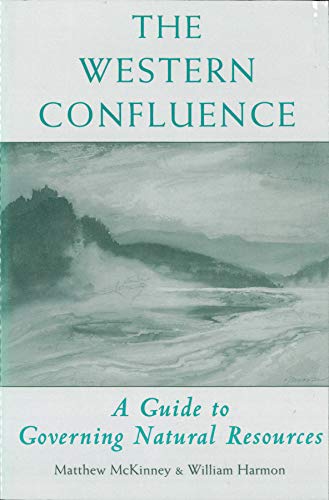
The Western Confluence
A Guide to Governing Natural Resources
By William Harmon, Matthew McKinneyISLAND PRESS
Copyright © 2004 Matthew McKinney and William Harmon
All rights reserved.
ISBN: 978-1-55963-963-7All rights reserved.
Contents
About Island Press,
Title Page,
Copyright Page,
Dedication,
List of Tables,
Table of Figures,
Foreword,
Preface,
Introduction,
1 - The Nature of Western Resource Disputes,
2 - First in Time, First in Right,
3 - The Promise of Scientific Expertise,
4 - Integrating Science and Citizens,
5 - Citizens Strike Back,
6 - This Land Is Our Land,
7 - Sharing Responsibility,
8 - A Changing Landscape,
9 - The Architecture of Dialogue,
Acknowledgments,
Appendix - Project Evaluation Form,
About the Authors,
Index,
Island Press Board of Directors,
CHAPTER 1
The Nature of Western Resource Disputes
The Klamath Basin situation is a dramatic illustration of the type of disputes common throughout the West at the beginning of the twenty-first century. A quick scan of any local newspaper or one of the West's regional news media, such as High Country News or Headwaters News, provides a bird's-eye view of an endless parade of disputes similar in tone to the Klamath debate. Despite the variety of natural resource issues, and the vastness of the West, these disputes tend to share a number of common characteristics. But to understand the interplay of these characteristics, it helps to first understand something of the nature of the West itself.
Nature of the West
Wallace Stegner, one of the more astute observers of the region, said that the two most compelling factors shaping society in the West are its aridity and its high concentration of federal public lands. With the exception of a few areas along the Pacific Coast, most of the region receives less than twenty inches of rain each year, making it a semi-arid to arid environment.
Ongoing concerns over the chronic drought seem to forget this basic fact of physical geography. The history of the region's settlement and development, however, makes it clear that the West is a "hydraulic society," dependent on a vast network of dams, reservoirs, and canals to move water from its source to where it is most needed—for mining and agriculture, and increasingly for urban centers and instream environmental values. In the West, conflicts arise over water in part because so many different users rely on common waterworks.
While the lack of water (and generally poor soils) in the West has determined mining, ranching, and agricultural practices and shaped urban growth patterns, it is the region's landscape that most impresses and captivates people. From high plains to rugged mountains, from deserts to rain forests, the West is defined by its wide-open spaces, abundant wildlife, and unparalleled scenery. The landscape has shaped history, inspired myths, and attracted people from all walks of life. It is also the focus of many public policy debates, largely because so much of the West is common ground.
More than 90 percent of all federal land is found in the eleven westernmost states and Alaska. The U.S. Forest Service and the Bureau of Land Management administer about 34 percent of the western landscape, including 83 percent of Nevada, more than 60 percent of Idaho and Utah, and more than 45 percent in four other western states (Arizona, California, Oregon, and Wyoming). The region also holds most of the nation's tribal lands, constituting about one-fifth of the landscape in the eleven westernmost states. Finally, these western states also hold about 45 million acres of "school trust" lands—federal land grants given upon statehood to help fund education. Taken together, these public and tribal lands dominate not only the physical geography of the region but also its politics.
Since the 1990s, the West has also been the country's fastest-growing region. The five fastest-growing states of that decade were Nevada, Arizona, Colorado, Utah, and Idaho. Between 1990 and 1998, the region's cities grew by 25 percent and its rural areas by 18 percent, both significantly higher rates than elsewhere in the United States. According to the 2000 U.S. Census, Americans on the move are turning once-quiet suburbs in Arizona, Nevada, and California into the fastest-growing cities in the country. Some of the people moving to these suburbs left larger nearby cities, but much of the growth comes from the continued migration of people from other regions. The West is also one of the most urbanized regions of the country, with most people living in cities and with rural areas averaging fewer than ten people per square mile.
Historically, disputes over natural resources in the West have changed along with the demographics of the region. The first conflicts were between settlers and natives over land ownership. Once this issue was more or less established, conflicts emerged among settlers wanting to use the same resource—minerals, grazing lands, and water—for the same purpose. As people started moving into the West in the 1960s, more and more disputes arose over the use of common resources for different purposes. Debates over consumptive versus nonconsumptive uses of the land, commodity versus noncommodity uses, the economy versus the environment, and visions of the "Old West" versus the "New West" have been driven in large part by the changing demographics of the region.
Some of the West's fastest-growing cities are not job centers but residential, large-scale communities, revealing that not everyone who moves to the West is looking for work. That said, some of the region's growth is due to "footloose entrepreneurs," people whose work (computers and software, biotechnology, telecommunications, and so on) allows them to locate anywhere. Such people are increasingly attracted to both urban and rural places in the West. This shift in demographics, along with changes in the global economy, means that the region has slowly moved from a resource-based economy to a knowledge-based economy. Many western politicians continue to promote the myth that the economy revolves around the extraction of natural resources, but there is an emerging consensus among economists of all stripes that the region's future will revolve around a knowledge-based economy, not the traditional industries of farming, ranching, mining, and logging. Today, the West's natural assets—open space, forests, rivers, and vistas—add more economic value by attracting footloose entrepreneurs than can be gleaned by developing the raw materials.
As the demographics and economies of the West diversify, the region's political geography appears to be seeking its own gyroscopic balance. After the 2002 elections, the West's 117 congressional districts were split: 59 Republican, 58 Democrat. Similarly, of the eleven governorships, five were Republican (Colorado, Idaho, Montana, Nevada, and Utah) and six were in Democrat hands (Arizona, California, New Mexico, Oregon, Washington, and Wyoming). The 2003 recall of Democrat Gray Davis in California, and the subsequent election of Republican Arnold Schwarzenegger, though widely seen as a contest of charisma rather than partisanship, shifted that ratio to six Republican, five Democrat. During this same period, Democrats controlled only two of the eleven western state legislatures (California and New Mexico). Republicans controlled both the house and senate in seven states (Arizona, Colorado, Idaho,...
„Über diesen Titel“ kann sich auf eine andere Ausgabe dieses Titels beziehen.
Suchergebnisse für The Western Confluence: A Guide to Governing Natural...

Beispielbild für diese ISBN
The Western Confluence : A Guide to Governing Natural Resources
Verlag:
Island Press, 2004
ISBN 10: 1559639636
ISBN 13: 9781559639637
Gebraucht
Softcover
Erstausgabe
Anbieter: Better World Books: West, Reno, NV, USA
Verkäuferbewertung 5 von 5 Sternen

Zustand: Fine. 1st Edition. Used book that is in almost brand-new condition. May contain a remainder mark. Better World Books: Buy Books. Do Good. Artikel-Nr. 14762115-75
Gebraucht kaufen
EUR 6,64
Versand gratis
Versand innerhalb von USA
Versand innerhalb von USA
Anzahl: 1 verfügbar
Beispielbild für diese ISBN
The Western Confluence : A Guide to Governing Natural Resources
Verlag:
Island Press, 2004
ISBN 10: 1559639636
ISBN 13: 9781559639637
Gebraucht
Softcover
Erstausgabe
Anbieter: Better World Books: West, Reno, NV, USA
Verkäuferbewertung 5 von 5 Sternen
Zustand: Good. 1st Edition. Former library copy. Pages intact with minimal writing/highlighting. The binding may be loose and creased. Dust jackets/supplements are not included. Includes library markings. Stock photo provided. Product includes identifying sticker. Better World Books: Buy Books. Do Good. Artikel-Nr. 13791186-6
Gebraucht kaufen
EUR 6,64
Versand gratis
Versand innerhalb von USA
Versand innerhalb von USA
Anzahl: 1 verfügbar
Beispielbild für diese ISBN
The Western Confluence: A Guide To Governing Natural Resources
Verlag:
Island Press (edition Illustrated), 2004
ISBN 10: 1559639636
ISBN 13: 9781559639637
Gebraucht
Paperback
Anbieter: BooksRun, Philadelphia, PA, USA
Verkäuferbewertung 5 von 5 Sternen
Paperback. Zustand: Very Good. Illustrated. It's a well-cared-for item that has seen limited use. The item may show minor signs of wear. All the text is legible, with all pages included. It may have slight markings and/or highlighting. Artikel-Nr. 1559639636-11-1
Gebraucht kaufen
EUR 6,64
Versand gratis
Versand innerhalb von USA
Versand innerhalb von USA
Anzahl: 2 verfügbar
Beispielbild für diese ISBN
The Western Confluence: A Guide to Governing Natural Resources
Anbieter: ThriftBooks-Dallas, Dallas, TX, USA
Verkäuferbewertung 5 von 5 Sternen
Paperback. Zustand: Very Good. No Jacket. May have limited writing in cover pages. Pages are unmarked. ~ ThriftBooks: Read More, Spend Less. Artikel-Nr. G1559639636I4N00
Gebraucht kaufen
EUR 8,66
Versand gratis
Versand innerhalb von USA
Versand innerhalb von USA
Anzahl: 1 verfügbar
Beispielbild für diese ISBN
The Western Confluence: A Guide to Governing Natural Resources
Anbieter: N. Fagin Books, Chicago, IL, USA
Verkäuferbewertung 5 von 5 Sternen
Soft cover. Zustand: Near Fine. 2004. Natural History, Conservation. Island Press. Very good - near fine paperback 297p. 9/25. Artikel-Nr. -1372093749
Gebraucht kaufen
EUR 9,18
EUR 5,34 Versand
Versand innerhalb von USA
Versand innerhalb von USA
Anzahl: 1 verfügbar
Beispielbild für diese ISBN
The Western Confluence A Guide To Governing Natural Resources
Anbieter: Revaluation Books, Exeter, Vereinigtes Königreich
Verkäuferbewertung 5 von 5 Sternen
Paperback. Zustand: Brand New. 1st edition. 297 pages. 8.75x6.00x0.75 inches. In Stock. Artikel-Nr. 1559639636
Neu kaufen
EUR 68,60
EUR 14,89 Versand
Versand von Vereinigtes Königreich nach USA
Versand von Vereinigtes Königreich nach USA
Anzahl: 1 verfügbar