
Verwandte Artikel zu Health and Community Design: The Impact Of The Built...
Inhaltsangabe
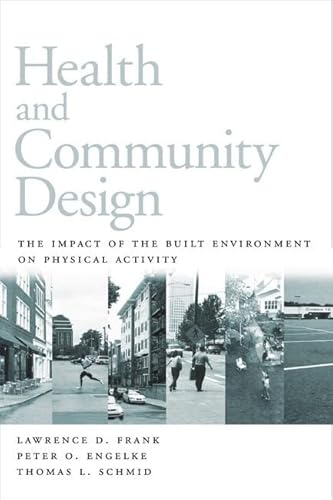
Health and Community Design is a comprehensive examination of how the built environment encourages or discourages physical activity, drawing together insights from a range of research on the relationships between urban form and public health. It provides important information about the factors that influence decisions about physical activity and modes of travel, and about how land use patterns can be changed to help overcome barriers to physical activity. Chapters examine:
- • the historical relationship between health and urban form in the United States
• why urban and suburban development should be designed to promote moderate types of physical activity
• the divergent needs and requirements of different groups of people and the role of those needs in setting policy
• how different settings make it easier or more difficult to incorporate walking and bicycling into everyday activities
Die Inhaltsangabe kann sich auf eine andere Ausgabe dieses Titels beziehen.
Über die Autorin bzw. den Autor
Lawrence D. Frank, Peter O. Engelke, and Thomas L. Schmid
Auszug. © Genehmigter Nachdruck. Alle Rechte vorbehalten.
Health and Community Design
The Impact of the Built Environment on Physical Activity
By Lawrence D. Frank, Peter O. Engelke, Thomas L. SchmidISLAND PRESS
Copyright © 2003 Lawrence D. Frank and Peter O. Engelke
All rights reserved.
ISBN: 978-1-55963-917-0All rights reserved.
Contents
ABOUT ISLAND PRESS,
Title Page,
Copyright Page,
Table of Figures,
List of Tables,
PREFACE AND ACKNOWLEDGMENTS,
CHAPTER ONE - Introduction,
CHAPTER TWO - Public Health and Urban Form in America,
CHAPTER THREE - Physical Activity and Public Health,
CHAPTER FOUR - Physical Activity,
CHAPTER FIVE - Physical Activity,
CHAPTER SIX - Understanding the Built Environment,
CHAPTER SEVEN - Transportation Systems,
CHAPTER EIGHT - Land Use Patterns,
CHAPTER NINE - Urban Design Characteristics,
CHAPTER TEN - Application of Principles,
CHAPTER ELEVEN - Conclusion,
APPENDIX - Summary of Selected Traffic Calming Studies,
ENDNOTES,
GLOSSARY,
REFERENCES,
ABOUT THE AUTHORS,
INDEX,
ISLAND PRESS BOARD OF DIRECTORS,
CHAPTER 1
Introduction
We ought to plan the ideal of our city with an eye to four considerations. The first, as being the most indispensable, is health.
ARISTOTLE, Politics (ca. 350 B.C.)
Community design influences human behavior. The ways that cities, suburbs, and towns are designed and built impact the people who work, live, and play in them. The placement, layout, and design of transportation systems, of office complexes, of parks, and of the countless physical elements that make up communities result in real places that have real significance in terms of how we spend our time and what activities we engage in. Where people live, where they work, how they get around, how much pollution they produce, what kinds of environmental hazards they face, and what kinds of amenities they enjoy are a direct product of how communities are designed. This book is about how our communities influence one important type of behavior, physical activity, and the health outcomes that are associated with it.
Unfortunately, the great majority of Americans do not get enough physical activity to maintain their health over the long run. Physical inactivity is an enormous health problem in this country, contributing to, among other things, premature death, chronic disease, osteoporosis, poor mental health, and obesity. The environments in which most people spend their time—the modern American city and the suburbs and exurbs that have been the dominant form of development in this country for over a half century—are an important contributor to this problem. The cities and suburbs that we inhabit are not now, and have not been for a long time, places that encourage some critically important forms of physical activity. In short, our physical environment inhibits many forms of activity, such as walking, and has become a significant barrier to more active lifestyles.
A century ago, American cities were highly walkable places. They were compact. Commercial, retail, and even industrial operations existed in close proximity to housing, allowing people to walk to work or school or the store. Out of necessity, buildings and streets were designed to the human scale. Streetcar and trolley systems provided a major form of transportation for millions of passengers every day, in every major city in the nation, which meant that people had the means to make longer journeys without the use of a car. When combined, all of this produced environments in which someone could satisfy their basic daily needs within a comfortable walking distance of their home or within a distance reachable through a combination of walking and trolley riding.
Unfortunately, the burgeoning cities of the industrial era also brought with them a host of serious problems. They were dirty and polluted. They were crowded. Most importantly, they produced health problems for their inhabitants. The worst of these were the communicable disease epidemics—typhus, yellow fever, and all manner of other infectious diseases—that swept through them with frightening regularity. The very conditions that made the industrial city a highly walkable place, including its concentration of people, its mixing of uses, and its high density of buildings, came to be blamed—not quite accurately, as research eventually showed—for creating the conditions in which epidemics could occur. So during the nineteenth and early twentieth centuries, critics tore away at the intellectual foundation of the compact industrial city. They sought to replace it with a new paradigm, a new way of thinking about how to build cities. In the old city's place they created the modern decentralized city, where housing was separated from workplaces and buildings placed far apart from one another, separated by expanses of grass and trees. America's new cities of big lawns and big distances would, they hoped and expected, produce more healthy living. What resulted was the city that we are so familiar with today—dominated by suburbs, spread out, with different uses separated one from another and almost everything reliant on automobile travel. This mass suburbaniz ation also led directly to a decline, in terms of population, wealth, and public investment in the older, established central parts of most cities, resulting in the widespread abandonment of the fabric of the old walkable city.
Widespread criticism of this development model has appeared only during the last couple of decades. Much of it is a reaction to the omnipresent automobile congestion that is the hallmark of the decentralized city. Some of it is centered on the monstrous-yet-monotonous ugliness of the endless strip malls and parking lots that have proliferated from one end of the country to the other. Many people are concerned about the environmental consequences of the modern city. These concerns focus on the enormous amount of land consumed, the air quality problems produced by all of the cars needed to keep these cities running, the vast quantities of municipal water that is required to irrigate the lawns of the new suburban landscapes, or the rainwater that is wasted as polluted runoff from parking lots and streets. An even more recent source of criticism is from the field of public health, which is beginning to explore potentially uncomfortable linkages between the decentralized city and different indicators of health.
Physical Activity, Past and Present
In the old cities, getting enough physical activity during one's day wasn't an issue because it was as much a part of life as eating or sleeping. Today, physical activity has been engineered out of most aspects of life. Work is no longer physically demanding for most people and daily living patterns, from mowing the grass to cooking dinner to washing clothes, require significantly less manual effort than they once did. The modern city has changed all of this, creating environments in which it is less and less common to work physical activity into the everyday patterns of life. The dominant forms of community design have contributed to this decline by making walking and cycling for transportation difficult if not impossible. Many of the reasons why are clear to even the casual observer. Long distances between places mean that most people cannot walk or bicycle from one place to another. The streets and roads that connect these far-flung places are designed for cars, often making them unsafe and extremely unattractive for...
„Über diesen Titel“ kann sich auf eine andere Ausgabe dieses Titels beziehen.
Suchergebnisse für Health and Community Design: The Impact Of The Built...

Beispielbild für diese ISBN
Health and Community Design Th
Anbieter: World of Books (was SecondSale), Montgomery, IL, USA
Verkäuferbewertung 5 von 5 Sternen

Zustand: Good. Item in good condition. Textbooks may not include supplemental items i.e. CDs, access codes etc. Artikel-Nr. 00099617476
Gebraucht kaufen
EUR 5,27
Versand gratis
Versand innerhalb von USA
Versand innerhalb von USA
Anzahl: 3 verfügbar
Beispielbild für diese ISBN
Health and Community Design Th
Anbieter: World of Books (was SecondSale), Montgomery, IL, USA
Verkäuferbewertung 5 von 5 Sternen
Zustand: Very Good. Item in very good condition! Textbooks may not include supplemental items i.e. CDs, access codes etc. Artikel-Nr. 00106707331
Gebraucht kaufen
EUR 5,27
Versand gratis
Versand innerhalb von USA
Versand innerhalb von USA
Anzahl: 1 verfügbar
Beispielbild für diese ISBN
Health and Community Design: The Impact Of The Built Environment On Physical Activity
Verlag:
Island Press (edition 1), 2003
ISBN 10: 1559639172
ISBN 13: 9781559639170
Gebraucht
Paperback
Anbieter: BooksRun, Philadelphia, PA, USA
Verkäuferbewertung 5 von 5 Sternen
Paperback. Zustand: Fair. 1. The item might be beaten up but readable. May contain markings or highlighting, as well as stains, bent corners, or any other major defect, but the text is not obscured in any way. Artikel-Nr. 1559639172-7-1
Gebraucht kaufen
EUR 5,29
Versand gratis
Versand innerhalb von USA
Versand innerhalb von USA
Anzahl: 1 verfügbar
Beispielbild für diese ISBN
Health and Community Design: The Impact of the Built Environment on Physical Activity
Anbieter: ThriftBooks-Dallas, Dallas, TX, USA
Verkäuferbewertung 5 von 5 Sternen
Paperback. Zustand: Very Good. No Jacket. May have limited writing in cover pages. Pages are unmarked. ~ ThriftBooks: Read More, Spend Less. Artikel-Nr. G1559639172I4N00
Gebraucht kaufen
EUR 5,91
Versand gratis
Versand innerhalb von USA
Versand innerhalb von USA
Anzahl: 1 verfügbar
Beispielbild für diese ISBN
Health and Community Design: The Impact of the Built Environment on Physical Activity
Anbieter: ThriftBooks-Atlanta, AUSTELL, GA, USA
Verkäuferbewertung 5 von 5 Sternen
Paperback. Zustand: Fair. No Jacket. Readable copy. Pages may have considerable notes/highlighting. ~ ThriftBooks: Read More, Spend Less. Artikel-Nr. G1559639172I5N00
Gebraucht kaufen
EUR 5,91
Versand gratis
Versand innerhalb von USA
Versand innerhalb von USA
Anzahl: 1 verfügbar
Beispielbild für diese ISBN
Health and Community Design : The Impact of the Built Environment on Physical Activity
Anbieter: Better World Books, Mishawaka, IN, USA
Verkäuferbewertung 5 von 5 Sternen
Zustand: Fine. Used book that is in almost brand-new condition. May contain a remainder mark. Better World Books: Buy Books. Do Good. Artikel-Nr. 56381853-6
Gebraucht kaufen
EUR 6,47
Versand gratis
Versand innerhalb von USA
Versand innerhalb von USA
Anzahl: 1 verfügbar
Beispielbild für diese ISBN
Health and Community Design : The Impact of the Built Environment on Physical Activity
Anbieter: Better World Books, Mishawaka, IN, USA
Verkäuferbewertung 5 von 5 Sternen
Zustand: Good. Former library copy. Pages intact with minimal writing/highlighting. The binding may be loose and creased. Dust jackets/supplements are not included. Includes library markings. Stock photo provided. Product includes identifying sticker. Better World Books: Buy Books. Do Good. Artikel-Nr. 1425862-6
Gebraucht kaufen
EUR 6,47
Versand gratis
Versand innerhalb von USA
Versand innerhalb von USA
Anzahl: 1 verfügbar
Beispielbild für diese ISBN
Health and Community Design : The Impact of the Built Environment on Physical Activity
Anbieter: Better World Books, Mishawaka, IN, USA
Verkäuferbewertung 5 von 5 Sternen
Zustand: Good. Pages intact with minimal writing/highlighting. The binding may be loose and creased. Dust jackets/supplements are not included. Stock photo provided. Product includes identifying sticker. Better World Books: Buy Books. Do Good. Artikel-Nr. 4428379-75
Gebraucht kaufen
EUR 6,47
Versand gratis
Versand innerhalb von USA
Versand innerhalb von USA
Anzahl: 1 verfügbar
Beispielbild für diese ISBN
Health and Community Design : The Impact of the Built Environment on Physical Activity
Anbieter: Better World Books Ltd, Dunfermline, Vereinigtes Königreich
Verkäuferbewertung 5 von 5 Sternen
Zustand: Good. Former library copy. Pages intact with minimal writing/highlighting. The binding may be loose and creased. Dust jackets/supplements are not included. Includes library markings. Stock photo provided. Product includes identifying sticker. Better World Books: Buy Books. Do Good. Artikel-Nr. 1425862-6
Gebraucht kaufen
EUR 6,69
EUR 5,82 Versand
Versand von Vereinigtes Königreich nach USA
Versand von Vereinigtes Königreich nach USA
Anzahl: 1 verfügbar
Beispielbild für diese ISBN
Health and Community Design : The Impact of the Built Environment on Physical Activity
Anbieter: Better World Books Ltd, Dunfermline, Vereinigtes Königreich
Verkäuferbewertung 5 von 5 Sternen
Zustand: Very Good. Pages intact with possible writing/highlighting. Binding strong with minor wear. Dust jackets/supplements may not be included. Stock photo provided. Product includes identifying sticker. Better World Books: Buy Books. Do Good. Artikel-Nr. 13420073-75
Gebraucht kaufen
EUR 6,74
EUR 5,82 Versand
Versand von Vereinigtes Königreich nach USA
Versand von Vereinigtes Königreich nach USA
Anzahl: 2 verfügbar