
Verwandte Artikel zu Seeing Things Whole: The Essential John Wesley Powell...
Inhaltsangabe
John Wesley Powell was an American original. He was the last of the nation's great continental explorers and the first of a new breed of public servant: part scientist, part social reformer, part institution builder. His work and life reveal an enduringly valuable way of thinking about land, water, and society as parts of an interconnected whole; he was America's first great bioregional thinker.
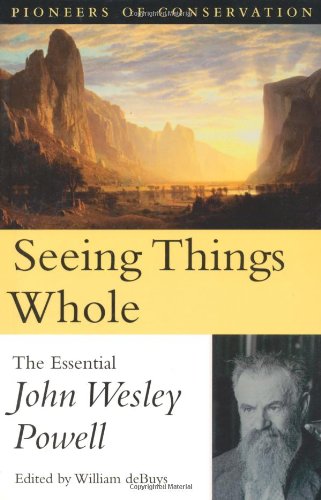
Seeing Things Whole presents John Wesley Powell in the full diversity of his achievements and interests, bringing together in a single volume writings ranging from his gripping account of exploring the Colorado River through the Grand Canyon to his views on the evolution of civilization, along with the seminal writings in which he sets forth his ideas on western settlement and the allocation and management of western resources.
The centerpiece of Seeing Things Whole is a series of selections from the famous 1878 Report on the Lands of the Arid Region and related magazine articles in which Powell further develops the themes of the report. In those, he recommends organizing the Arid Lands into watershed commonwealths governed by resident citizens whose interlocking interests create the checks and balances essential to wise stewardship of the land. This was the central focus of John Wesley Powell's bioregional vision, and it remains a model for governance that many westerners see as a viable solution to the resource management conflicts that continue to bedevil the region.
Throughout the collection, award-winning writer and historian William deBuys brilliantly sets the historical context for Powell's work. Section introductions and extensive descriptive notes take the reader through the evolution of John Wesley Powell's interests and ideas from his role as an officer in the Civil War through his critique of Social Darwinism and landmark categorization of Indian languages, to the climatic yet ultimately futile battles he fought to win adoption of his land-use proposals.
Seeing Things Whole presents the essence of the extraordinary legacy that John Wesley Powell has left to the American people, and to people everywhere who strive to reconcile the demands of society with the imperatives of the land.
Die Inhaltsangabe kann sich auf eine andere Ausgabe dieses Titels beziehen.
Über die Autorin bzw. den Autor
William deBuys is a historian, conservationist, and writer based in Santa Fe, New Mexico. His books include Enchantment and Exploitation (University of New Mexico Press, 1989), River of Traps (University of New Mexico Press, 1996), and Salt Dreams (University of New Mexico Press, 1999).
John Wesley Powell (1834 – 1902) was a US soldier, geologist, explorer of the American West, and director of major scientific and cultural institutions. He is famous for the 1869 Powell Geographic Expedition, a three-month river trip down the Green and Colorado rivers that included the first known passage through the Grand Canyon.
Auszug. © Genehmigter Nachdruck. Alle Rechte vorbehalten.
Seeing Things Whole
The Essential John Wesley Powell
By William deBuysISLAND PRESS
Copyright © 2001 William deBuys
All rights reserved.
ISBN: 978-1-55963-873-9All rights reserved.
Contents
Other titles from William deBuys,
Title Page,
Copyright Page,
ACKNOWLEDGMENTS,
INTRODUCTION - Seeing Things Whole,
BIOGRAPHICAL CHRONOLOGY,
PART I - Down the Colorado: Letters from the Wilderness Post,
SELECTION 1 - The Party Has Reached This Point in Safety,
SELECTION 2 - The Wreck of the No-Name,
PART II - Voyage into the Great Unknown,
SELECTION 3 - Through the Grand Canyon from the Little Colorado to the Virgin River,
PART III - Among the Natives of the Colorado Plateau,
SELECTION 4 - Camped with the Shivwits and the Fate of the Separated Three,
SELECTION 5 - The Ancient Province of Tusayan,
PART IV - Report on the Lands of the Arid Region,
SELECTION 6 - Preface and Table of Contents,
SELECTION 7 - Physical Characteristics of the Arid Region,
SELECTION 8 - The Land System Needed for the Arid Region,
PART V - The Nation's Expert,
SELECTION 9 - Trees on Arid Lands,
SELECTION 10 - The Lesson of Conemaugh,
SELECTION 11 - Address to the Montana Constitutional Convention,
PART VI - Advice for the Century,
SELECTION 12 - The Irrigable Lands of the Arid Region,
SELECTION 13 - The Non-Irrigable Lands of the Arid Region,
SELECTION 14 - Institutions for the Arid Lands,
PART VII - A Philosopher for Humankind,
SELECTION 15 - From Barbarism to Civilization,
SELECTION 16 - Competition as a Factor in Human Evolution,
WORKS BY JOHN WESLEY POWELL,
SECONDARY WORKS CITED,
INDEX,
CHAPTER 1
SELECTION 1
The Party Has Reached This Point in Safety
Camp at the Mouth of Niutah, June 29, 1869.
Dr. Edwards:
My Dear Sir: The party has reached this point in safety, having run four canyons, of about twenty-five miles in length each, the walls of which were from 2,000 to 2,800 feet hight [sic]. We found falls and dangerous rapids, when we were compelled to make portages of rations, etc., and let the boats down with lines. We wrecked one of our boats and lost about one-third of our supplies and part of the instruments.
The instruments were duplicated, but the loss of rations will compel us to shorten the time for the work. You will perceive an account of our trip more in detail in the Chicago Tribune, as I shall send some letters to it for publication. In the wreck I lost my papers, and have to use plant dryers for my letter paper. I have not made a large general collection, but have some fine fossils, a grand geological section, and a good map.
Shall walk to the Niutah Indian Agency, about twenty-five or thirty miles from camp, where I shall mail this letter, and hope to get letters and some news.
Powell dispatched this letter from the Uinta Indian Agency to Dr. Richard Edwards, president of the Normal University at Bloomington, Illinois. The New York Times reprinted it on July 23, 1869.
The boats seem to be a success; although filled with water by the waves many times, they never sink. The light cabins attached to the end act well as buoys. The wreck was due to misunderstanding the signal, the Captain of the boat keeping it too far out in the river, and so was not able to land above the falls, but was drifted over.
We shall rest here for eight or ten days, make repairs and dry our rations, which have been wet so many times that they are almost in a spoiling condition, in fact, we have lost nearly half by now by one mishap and another. I have personally enjoyed myself much, the scenery being wild and grand beyond description. All in good health, all in good spirits, and all in high hopes of success. I shall hasten to the Grand and Green, as I am very anxious to make observations on the 7th of August of the eclipse. With earnest wishes for your continued success and prosperity at Normal, I am with great respect yours, cordially,
[Signed] J. W. Powell
CHAPTER 2SELECTION 2
The Wreck of the No-Name
Colorado River Exploring Expedition, Echo Park, Mouth of Bear River, June 18, 1869.
On the 8th our boats entered the Canon of Lodore—a name suggested by one of the men, and it has been adopted. We soon came to rapids, over which the boats had to be taken with lines. We had a succession of these until noon. I must explain the plan of running these places. The light boat, "Emma Dean," with two good oarsmen and myself explore them, then with a flag I signal the boats to advance, and guide them by signals around dangerous rocks. When we come to rapids filled with boulders, I sometimes find it necessary to walk along the shore for examination. If 'tis thought possible to run, the light boat proceeds. If not, the others are flagged to come on to the head of the dangerous place, and we let down with lines, or make a portage.
As indicated in the previous letter to Edwards, Powell gave a fuller account of the expedition's experiences in letters he sent to the Chicago Tribune. This one, published in the Tribune of August 20, 1869 (and reprinted in the Utah Historical Quarterly, v. 15, 1947), describes the wreck of the No-Name, which occurred on June 8 according to most reconstructions of the trip. Powell's published accounts give the date as June 9, but from the mouth of Lodore to the layover at the Yampa, his dates are consistently 1 day behind those of other journal keepers of the expedition. See Cooley, The Great Unknown, 124.
At the foot of one of these runs, early in the afternoon, I found a place where it would be necessary to make a portage, and, signalling the boats to come down, I walked along the bank to examine the ground for the portage, and left one of the men of my boat to signal the others to land at the right point. I soon saw one of the boats land all right, and felt no more care about them. But five minutes after I heard a shout, and looking around, saw one of the boats coming over the falls. Capt. Howland, of the "No Name," had not seen the signal in time, and the swift current had carried him to the brink. I saw that his going over was inevitable, and turned to save the third boat. In two minutes more I saw that [boat] turn the point and head to shore, and so I went after the boat going over the falls. The first fall was not great, only two or three feet, and we had often run such, but below it continued to tumble down 20 or 30 feet more, in a channel filled with dangerous rocks that broke the waves into whirlpools and beat them into foam. I turned just to see the boat strike a rock and throw the men and cargo out. Still they clung to her sides and clambered in again and saved part of the oars, but she was full of water, and they could not manage her. Still down the river they went, two or three hundred yards to another rocky rapid just as bad, and the boat struck again amidships, and was dashed to pieces. The men were thrown into the river and carried beyond my sight. Very soon I turned the point, and could see a man's head above the waters seemingly washed about by a whirlpool below a rock. This was Frank Goodman clinging to the rock, with a grip on which life depended. As I came opposite I saw Howland trying to go to his aid from the island. He finally got near enough to Frank to reach him by the end of a pole, and letting go of the rock, he grasped it, and was pulled out. Seneca Howland, the captain's brother,...
„Über diesen Titel“ kann sich auf eine andere Ausgabe dieses Titels beziehen.
Suchergebnisse für Seeing Things Whole: The Essential John Wesley Powell...

Beispielbild für diese ISBN
Seeing Things Whole: The Essential John Wesley Powell
Verlag:
Princeton University Press, 2004
ISBN 10: 1559638737
ISBN 13: 9781559638739
Gebraucht
Paperback
Anbieter: World of Books (was SecondSale), Montgomery, IL, USA
Verkäuferbewertung 5 von 5 Sternen

Paperback. Zustand: Good. This is an anthology of the major writings of one of the great figures of the 19th century American West, John Wesley Powell. It includes some of his adventure writing, but focuses more on his recommendations for the settlement and governance of the West and conservation of Western resources. Artikel-Nr. 00105874355
Gebraucht kaufen
EUR 5,82
Versand gratis
Versand innerhalb von USA
Versand innerhalb von USA
Anzahl: 1 verfügbar
Beispielbild für diese ISBN
Seeing Things Whole: The Essential John Wesley Powell (Pioneers of Conservation)
Verlag:
Island Press (edition 2nd), 2004
ISBN 10: 1559638737
ISBN 13: 9781559638739
Gebraucht
Paperback
Anbieter: BooksRun, Philadelphia, PA, USA
Verkäuferbewertung 5 von 5 Sternen
Paperback. Zustand: Very Good. 2nd. It's a well-cared-for item that has seen limited use. The item may show minor signs of wear. All the text is legible, with all pages included. It may have slight markings and/or highlighting. Artikel-Nr. 1559638737-11-1
Gebraucht kaufen
EUR 5,83
Versand gratis
Versand innerhalb von USA
Versand innerhalb von USA
Anzahl: 1 verfügbar
Beispielbild für diese ISBN
Seeing Things Whole: The Essential John Wesley Powell
Anbieter: ThriftBooks-Dallas, Dallas, TX, USA
Verkäuferbewertung 5 von 5 Sternen
Paperback. Zustand: Very Good. No Jacket. May have limited writing in cover pages. Pages are unmarked. ~ ThriftBooks: Read More, Spend Less. Artikel-Nr. G1559638737I4N00
Gebraucht kaufen
EUR 7,57
Versand gratis
Versand innerhalb von USA
Versand innerhalb von USA
Anzahl: 1 verfügbar
Beispielbild für diese ISBN
Seeing Things Whole : The Essential John Wesley Powell
Anbieter: Better World Books: West, Reno, NV, USA
Verkäuferbewertung 5 von 5 Sternen
Zustand: Very Good. Former library copy. Pages intact with possible writing/highlighting. Binding strong with minor wear. Dust jackets/supplements may not be included. Includes library markings. Stock photo provided. Product includes identifying sticker. Better World Books: Buy Books. Do Good. Artikel-Nr. 39591703-75
Gebraucht kaufen
EUR 9,43
Versand gratis
Versand innerhalb von USA
Versand innerhalb von USA
Anzahl: 1 verfügbar