
Verwandte Artikel zu Ecological Integrity: Integrating Environment, Conservation,...
Inhaltsangabe
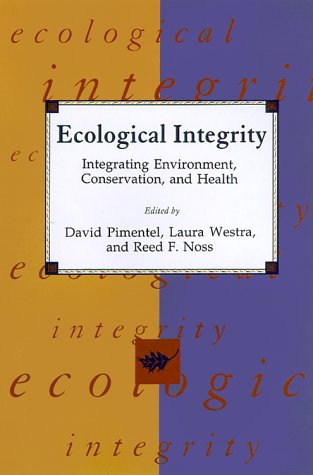
Global Integrity Project has brought together leading scientists and thinkers from around the world to examine the combined problems of threatened and unequal human well-being, degradation of the ecosphere, and unsustainable economies. Based on the proposition that healthy, functioning ecosystems are a necessary prerequisite for both economic security and social justice, the project is built around the concept of ecological integrity and its practical implications for policy and management.Ecological Integrity presents a synthesis and findings of the project. Contributors -- including Robert Goodland, James Karr, Orie Loucks, Jack Manno, William Rees, Mark Sagoff, Robert Ulanowicz, Philippe Crabbe, Laura Westra, David Pimentel, Reed Noss, and others -- examine the key elements of ecological integrity and consider what happens when integrity is lost or compromised. The book: examines historical and philosophical foundations of the concept of ecological integrity explores how integrity can be measured examines the relationships among ecological integrity, human health, and food production looks at economic and ethical issues that need to be considered in protecting ecological integrity offers concrete recommendations for reversing ecological degradation while promoting social and economic justice and welfare .Contributors argue that there is an urgent need for rapid and fundamental change in the ecologically destructive patterns of collective human behavior if society is to survive and thrive in coming decades.Ecological Integrity is a groundbreaking book that integrates environmental science, economics, law, and ethics in problem analysis, synthesis, and solution, and is a vital contribution for anyone concerned with interactions between human and planetary health.
Die Inhaltsangabe kann sich auf eine andere Ausgabe dieses Titels beziehen.
Über die Autorin bzw. den Autor
David Pimentel is professor of ecology and agricultural science at Cornell University. Laura Westra is Barbara B. and Bertram J. Cohn Professor of Environmental Studies at Sarah Lawrence College in Bronxville, New York. Reed F. Noss is president and chief scientist for Conservation Science, Inc., president of the Society for Conservation Biology, and an international lecturer on biodiversity topics. He lives in Corvallis, Oregon.
Auszug. © Genehmigter Nachdruck. Alle Rechte vorbehalten.
Ecological Integrity
Integrating Environment, Conservation, and Health
By David Pimentel, Laura Westra, Reed F. NossISLAND PRESS
Copyright © 2000 Island Press
All rights reserved.
ISBN: 978-1-55963-808-1All rights reserved.
Contents
About Island Press,
Title Page,
Copyright Page,
Dedication,
PART I - Introduction and Outline of the Integrity Concept,
CHAPTER 1 - Introduction,
CHAPTER 2 - Ecological Integrity and the Aims of the Global Integrity Project,
PART II - Historical and Philosophical Foundations,
CHAPTER 3 - Ecological Integrity and the Darwinian Paradigm,
CHAPTER 4 - Ecosystem Design in Historical and Philosophical Context,
CHAPTER 5 - Reconstructing Ecology,
CHAPTER 6 - Toward the Measurement of Ecological Integrity,
PART III - The Sustainability and Integrity of Natural Resource Systems,
CHAPTER 7 - Environmental Sustainability and Integrity in the Agriculture Sector,
CHAPTER 8 - Patch Disturbance, Ecofootprints, and Biological Integrity: Revisiting the Limits to Growth (or Why Industrial Society Is Inherently Unsustainable),
CHAPTER 9 - Can Canadian Approaches to Sustainable Forest Management Maintain Ecological Integrity?,
CHAPTER 10 - Pattern of Forest Integrity in the Eastern United States and Canada: Measuring Loss and Recovery,
CHAPTER 11 - Maintaining the Ecological Integrity of Landscapes and Ecoregions,
CHAPTER 12 - Health, Integrity, and Biological Assessment: The Importance of Measuring Whole Things,
CHAPTER 13 - Global Change, Fisheries, and the Integrity of Marine Ecosystems: The Future Has Already Begun,
PART IV - Human and Societal Health,
CHAPTER 14 - Global Environmental Change in the Coming Century: How Sustainable Are Recent Health Gains?,
CHAPTER 15 - Epidemiologic Methods for Assessing the Health Impact of Diminishing Ecological Integrity,
CHAPTER 16 - Institutionalized Environmental Violence and Human Rights,
PART V - The Economics and Ethics of Achieving Global Ecological Integrity,
CHAPTER 17 - The Cost of the Wild: International Equity and the Losses from Environmental Conservation,
CHAPTER 18 - A Complex Systems Approach to Urban Ecosystem Integrity: The Benefit Side,
CHAPTER 19 - A Biocentric Defense of Environmental Integrity,
CHAPTER 20 - Commodity Potential: An Approach to Understanding the Ecological Consequences of Markets,
CHAPTER 21 - The State of the Planet at the Five-Year Review of Rio and the Prospects for Protecting Worldwide Ecological Integrity,
PART VI - Synthesis,
CHAPTER 22 - Implementing Global Ecological Integrity: A Synthesis,
About the Contributors,
Index,
Island Press Board of Directors,
CHAPTER 1
Introduction
Peter Miller and William E. Rees
The Easter Islanders, aware that they were almost completely isolated from the rest of the world, must surely have realized that their very existence depended on the limited resources of a small island. After all, it was small enough for them to walk round the entire island in a day or so and see for themselves what was happening to the forests. Yet they were unable to devise a system that allowed them to find the right balance with their environment.
Clive Ponting, A Green History of the World
Is humankind fatally flawed, doomed—even in full knowledge—to repeat history on ever greater spatial scales until the brilliant light of civilization is forever snuffed out in one great final crash? After all, the human story is replete with bright beginnings, glorious middles, and tragic ends. In recent millennia advanced civilizations on virtually every continent have collapsed as a result of the destructive overexploitation of their supportive ecosystems. In many cases the descent was marked by famine, disease, and the decline of civil society, ultimately leading to war, social chaos, and cannibalism (e.g., the Maoris in New Zealand and Easter Islanders).
All this we know—and yet industrial civilization willfully imposes a greater burden on the environment than any previous culture. The degradation of natural systems appears in the loss of biodiversity and functionality in aquatic and terrestrial ecosystems; the decline of significant biological populations, including most of the world's wild fisheries; new disease vectors; ozone depletion; global warming; soil loss, salinization, and desertification; and freshwater and groundwater depletion and pollution. Economies that have supported precarious progress for some are unsustainable because aggregate demand exceeds the capacities of natural systems for productivity and waste absorption (Goodland 1992; Karr and Chu 1995; Wackernagel and Rees 1996; following chapters in the present volume). To paraphrase Ponting (1991, p. 7), we are aware that Earth is completely isolated from the rest of the universe and we realize that our very existence depends on the limited resources of this one small planet. After all, it is small enough for us to fly around in a day or so and see for ourselves what is happening to the forests (and plains and waters). Yet we seem unable to devise a system that allows us to find the right balance with the ecosphere.
Ironically, the very things that define our industrial culture dull the average citizen's sense of vulnerability even as they sweep humanity ever closer to the edge of danger. People are temporarily shielded from the destruction of local ecosystems that have long sustained them. Newfoundland fishers survive the collapse of the cod stocks on transfer payments from the rest of Canada (and we can always import fish from elsewhere); famine in the Sahel is suspended by international relief organizations; and people everywhere are spared the consequences of deteriorating soils by artificial fertilizers that help maintain food production.
A central premise of this book is that such contemporary social and technological buffers merely delay and deepen the ultimate collapse of industrial society. True, trade and technology create the illusion of increasing local carrying capacity. But the reality is that, by enabling continued population and material growth and by dispersing the ecological impacts, the trappings of modernity actually increase the total human load on the ecosphere while simultaneously reducing global carrying capacity (Rees 1996). This ensures that the entire human enterprise will reach critical limits of biophysical integrity at the same time. (Concern over ozone depletion and climate change are thus but early ripples in the sea of contemporary complacency.)
To some readers, this apocalyptic vision will seem excessively pessimistic. Looking back on the past century (and millennium), we who live in North America, Europe, and other high-income countries see our history as a story of progress. In terms of material well-being—the endless parade of globally sourced goods that stock our markets and plentiful supplies of cheap energy—and in terms of the trappings of civilized existence—access to culture, entertainment, travel, education, health care, information, and comfortable homes with clean running water and piped sewage—the material comfort and health of ordinary citizens of the high-income countries today vastly exceeds that of even royalty in previous ages. We are, on average, simply better off by any economic measure than our predecessors. Little wonder our culture has until recently brimmed with confidence in our individual and collective capacity to continue to improve...
„Über diesen Titel“ kann sich auf eine andere Ausgabe dieses Titels beziehen.
Suchergebnisse für Ecological Integrity: Integrating Environment, Conservation,...

Beispielbild für diese ISBN
Ecological Integrity: Integrating Environment, Conservation, and Health
Anbieter: WorldofBooks, Goring-By-Sea, WS, Vereinigtes Königreich
Verkäuferbewertung 5 von 5 Sternen

Paperback. Zustand: Very Good. The book has been read, but is in excellent condition. Pages are intact and not marred by notes or highlighting. The spine remains undamaged. Artikel-Nr. GOR013183879
Gebraucht kaufen
EUR 2,58
EUR 6,68 Versand
Versand von Vereinigtes Königreich nach USA
Versand von Vereinigtes Königreich nach USA
Anzahl: 1 verfügbar
Beispielbild für diese ISBN
Ecological Integrity : Integrating Environment, Conservation, and Health
Verlag:
Island Press, 2000
ISBN 10: 1559638087
ISBN 13: 9781559638081
Gebraucht
Softcover
Erstausgabe
Anbieter: Better World Books Ltd, Dunfermline, Vereinigtes Königreich
Verkäuferbewertung 5 von 5 Sternen
Zustand: Very Good. 1st Edition. Former library copy. Pages intact with possible writing/highlighting. Binding strong with minor wear. Dust jackets/supplements may not be included. Includes library markings. Stock photo provided. Product includes identifying sticker. Better World Books: Buy Books. Do Good. Artikel-Nr. GRP63516356
Gebraucht kaufen
EUR 5,72
EUR 5,96 Versand
Versand von Vereinigtes Königreich nach USA
Versand von Vereinigtes Königreich nach USA
Anzahl: 1 verfügbar