
Verwandte Artikel zu Measures of Success: Designing, Managing, and Monitoring...
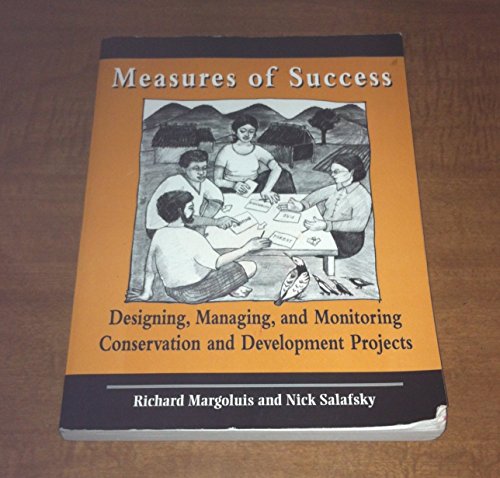
Measures of Success: Designing, Managing, and Monitoring Conservation and Developing Projects - Softcover
Inhaltsangabe
Measures of Success is a practical, hands-on guide to designing, managing, and measuring the impacts of community-oriented conservation and development projects. It presents a simple, clear, logical, and yet comprehensive approach to developing and implementing effective programs, and can help conservation and development practitioners use principles of adaptive management to test assumptions about their projects and learn from the results.
The book presents a systematic approach to improving the focus, effectiveness, and efficiency of projects, with specific guidelines and advice on:
- designing a realistic conceptual framework based on local site conditions
- developing clearly defined goals, objectives, and activities
- creating a monitoring plan that can be used to assess whether goals and objectives are being met
- integrating social and biological science techniques to collect the most relevant and useful data in the most cost-effective way
- using the information obtained through the monitoring plan to modify the project and learn from the result
The text is developed in eight chapters that follow the structure of a planning process from conception to completion, with the chapters linked by four scenarios that serve as teaching case studies throughout the book. Examples from these scenarios illustrate the processes and tools discussed, and each scenario case study is presented in its entirety in an appendix to the volume. The approach has been developed and field tested by practitioners working in many different projects in Latin America, Africa, and Asia, and their experience and input ensure that the guide is both practical and useful.
Measures of Success is the only work of its kind currently available, and represents an invaluable resource for field-based practitioners, project managers, and local community leaders, as well as for international NGO staff, college and university teachers and students, researchers, and government officials.
Die Inhaltsangabe kann sich auf eine andere Ausgabe dieses Titels beziehen.
Über die Autorin bzw. den Autor
Richard Margoluis is director of the Analysis and Adaptive Management Program of the Biodiversity Support Program (BSP).
Nick Salafsky is a senior program officer/scientist for BSP's Biodiversity Conservation Network. BSP is a USAID-funded consortium of World Wildlife Fund, The Nature Conservancy, and World Resources Institute.
Auszug. © Genehmigter Nachdruck. Alle Rechte vorbehalten.
Measures of Success
Designing, Managing, and Monitoring Conservation and Development Projects
By Nick Salafsky, Richard A. Margoluis, Anna BallaISLAND PRESS
Copyright © 1998 Richard A. Margoluis and Niklaus N. Salafsky
All rights reserved.
ISBN: 978-1-55963-612-4All rights reserved.
Contents
About Island Press,
About the Biodiversity Support Program,
Title Page,
Copyright Page,
Dedication,
Preface,
Acknowledgments,
Chapter 1 - Introduction,
Chapter 2 - Clarify Group's Mission,
Chapter 3 - Design a Conceptual Model Based on Local Site Conditions,
Chapter 4 - Develop a Management Plan: Goals, Objectives, Activities,
Chapter 5 - Develop a Monitoring Plan,
Chapter 6 - Implement Management and Monitoring Plans,
Chapter 7 - Analyze Data and Communicate Results,
Chapter 8 - Use Results to Adapt and Learn,
Appendix A - Project Plans for Scenarios,
Appendix B - Glossary of Select Terms,
Index,
About the Authors,
Island Press Board of Directors,
CHAPTER 1
Introduction
Four Project Scenarios
Measures of Success is structured around four scenarios that show the many challenges of managing conservation and development projects around the world. These projects are implemented by various types of groups, including nongovernmental organizations (NGOs), government agencies, local communities, and advocacy groups. We will draw on these scenarios throughout the guide to illustrate our approach to project design, management, and monitoring. The complete scenarios are also presented in Appendix A. Although the scenarios are hypothetical, they are based on real sites and projects. We hope that you will find elements of your project among them so that they may give you some ideas for your site. The projects presented in these scenarios are being carried out by our project team.
Tropical Forest Scenario
Suppose you are the manager of an NGO that is responsible for managing the Indah Biosphere Reserve. The core area of the reserve contains approximately 100,000 hectares of tropical moist forest which includes a mixture of primary and secondary forests. The 80,000 hectare buffer zone around the core area contains 30 small villages whose residents include native and migrant peoples. Residents of the villages are primarily subsistence farmers who grow grains, other food crops, and a few cash crops in small shifting agricultural plots in the forest. Residents also collect timber and nontimber forest products (NTFPs) which they use in their homes and sell in local markets. From what you can tell, it appears that the major threats to the forest include expansion of farms into forest areas, local overharvesting of forest products, commercial logging, expansion of cattle ranches, and the development of a large dam for hydro-electric power generation. At this point, the NGO that you are working for is planning a project that will involve working with community members to develop a few of the forest products for national and international sale and other interventions.
Savannah Scenario
Suppose you are a wildlife biologist working for the local office of the Government Park Service to coordinate a project to design and implement a conservation plan for Karimara National Park. The park is 750,000 hectares of savannah and grasslands in a semi-arid, subtropical setting with an additional 500,000 hectares of land in wildlife management areas (WMAs) around the park. Outside of the WMAs are a number of settlements inhabited by semi-nomadic livestock herders who graze their cattle in the WMAs and occasionally in the park. Residents of the settlements depend on their livestock and limited hunting and gathering of wild animals and plants for subsistence. Major threats to the park include overgrazing, overhunting, and poaching of large mammal species, and the effects of a rapidly increasing and unregulated foreign tourism industry. The Government Park Service is considering taking a number of steps to protect the park against these threats.
Coastal Scenario
Suppose you are the formally educated son or daughter of the traditional leader of a coastal village who has been chosen by your people to help them find the best way to maintain their resources for future generations. Your village is located at the mouth of a river flowing from upland forests through mangrove forests into Bocoro Bay. The residents of your village get most of their food from fishing and gathering shellfish in the river and coral reefs surrounding the bay. Residents cook their food and build their houses using wood from the mangrove forests growing along the coast. Over the past few years, you and your neighbors have noticed that residents of neighboring villages are increasingly coming into your village's traditional fishing grounds. In addition, large fishing boats from other countries have begun operating in the same area. The elders of the community have noticed over time that local fishermen have to go farther away from the community to catch enough fish to eat and sell and that they are catching smaller fish. In addition, silt and pollution coming down the river have ruined many of the reefs. Furthermore, it is becoming harder to find shrimp in coastal areas near small rivers where the mangroves have been cut down. The elders are now proposing to enhance your people's traditional resource management systems to conserve the plant and animal resources in the bay for future generations.
Wetlands Scenario
Suppose you are the manager of a local chapter of a conservation advocacy group whose members live near the Everson Watershed. The wetlands in the watershed serve as important habitats for migratory birds and for a number of fish and game species. These species support extensive recreational uses of the area including birdwatching, canoeing, fishing, and hunting. The wetlands are also part of the water supply system for major urban areas in the watershed. The wetlands are threatened by growing development and urbanization including road construction and dredging. They are also affected by water pollution (especially from agricultural chemicals) and invasions of exotic plant and animal species. You are planning to work with local landowners and governments to purchase or obtain conservation easements on lands containing critical wetland and upstream habitat. In addition, your organization is hoping to work to educate the public about the importance of the upstream habitats in maintaining the wetlands. Finally, you are hoping to devise a management plan to help control some of the impacts of exotic species.
Purpose of This Guide
Conservation and development
projects have as their primary goal the conservation of natural ecosystems and species. They are based on the philosophy that, in order to maintain economic and community development, a healthy and viable natural resource base must be sustained. They operate by involving and addressing the needs of human stakeholders—the people who have an interest in the natural resources of the project site.
A common challenge found in our scenarios and all other conservation and development projects is to be able to measure the success of project interventions. In order to ensure that desired conservation impacts occur, you need to know which actions work and which don't—and you need to know why. You also need to make sure that your project...
„Über diesen Titel“ kann sich auf eine andere Ausgabe dieses Titels beziehen.
Suchergebnisse für Measures of Success: Designing, Managing, and Monitoring...

Beispielbild für diese ISBN
Measure of Success: Designing, Monitoring and Managing Conservation and Development Projects: Designing, Managing, and Monitoring Conservation and Development Projects
Anbieter: AwesomeBooks, Wallingford, Vereinigtes Königreich
Verkäuferbewertung 5 von 5 Sternen

paperback. Zustand: Very Good. Anna Balla (illustrator). Measure of Success: Designing, Monitoring and Managing Conservation and Development Projects: Designing, Managing, and Monitoring Conservation and Development Projects This book is in very good condition and will be shipped within 24 hours of ordering. The cover may have some limited signs of wear but the pages are clean, intact and the spine remains undamaged. This book has clearly been well maintained and looked after thus far. Money back guarantee if you are not satisfied. See all our books here, order more than 1 book and get discounted shipping. Artikel-Nr. 7719-9781559636124
Gebraucht kaufen
EUR 10,14
EUR 4,87 Versand
Versand von Vereinigtes Königreich nach USA
Versand von Vereinigtes Königreich nach USA
Anzahl: 2 verfügbar
Beispielbild für diese ISBN
Measure of Success: Designing, Monitoring and Managing Conservation and Development Projects
Verlag:
Island Press 30/06/1998, 1998
ISBN 10: 1559636122
ISBN 13: 9781559636124
Gebraucht
Paperback
Anbieter: Bahamut Media, Reading, Vereinigtes Königreich
Verkäuferbewertung 4 von 5 Sternen

Paperback. Zustand: Very Good. Anna Balla (illustrator). Shipped within 24 hours from our UK warehouse. Clean, undamaged book with no damage to pages and minimal wear to the cover. Spine still tight, in very good condition. Remember if you are not happy, you are covered by our 100% money back guarantee. Artikel-Nr. 6545-9781559636124
Gebraucht kaufen
EUR 10,49
EUR 8,25 Versand
Versand von Vereinigtes Königreich nach USA
Versand von Vereinigtes Königreich nach USA
Anzahl: 1 verfügbar
Beispielbild für diese ISBN
Measures of Success: Designing, Monitoring, and Managing Conservation and Development Projects
Anbieter: ThriftBooks-Dallas, Dallas, TX, USA
Verkäuferbewertung 5 von 5 Sternen
Paperback. Zustand: Good. No Jacket. Anna Balla (illustrator). Pages can have notes/highlighting. Spine may show signs of wear. ~ ThriftBooks: Read More, Spend Less. Artikel-Nr. G1559636122I3N00
Gebraucht kaufen
EUR 28,40
Versand gratis
Versand innerhalb von USA
Versand innerhalb von USA
Anzahl: 1 verfügbar
Beispielbild für diese ISBN
Measures of Success: Designing, Managing, and Monitoring Conservation and Development Projects: Designing, Monitoring and Managing Conservation and Development Projects
Verlag:
Island Press, 1998
ISBN 10: 1559636122
ISBN 13: 9781559636124
Gebraucht
Encuadernación de tapa blanda
Anbieter: Libros Ramban, Santander, S, Spanien
Verkäuferbewertung 4 von 5 Sternen
Encuadernación de tapa blanda. Zustand: Como Nuevo. Anna Balla (illustrator). 4ª Edición. 378 páginas. Artikel-Nr. ABE-1596804860206
Gebraucht kaufen
EUR 18,00
EUR 14,50 Versand
Versand von Spanien nach USA
Versand von Spanien nach USA
Anzahl: 1 verfügbar
Beispielbild für diese ISBN
Measures of Success: Designing, Managing, and Monitoring Conservation and Development Projects
Verlag:
Princeton University Press, 1998
ISBN 10: 1559636122
ISBN 13: 9781559636124
Gebraucht
Paperback
Anbieter: World of Books (was SecondSale), Montgomery, IL, USA
Verkäuferbewertung 5 von 5 Sternen
Paperback. Zustand: Good. Anna Balla (illustrator). Measures of Success is a practical, hands-on guide to designing, managing, and measuring the impacts of community-oriented conservation and development projects. It presents a simple, clear, logical, and yet comprehensive approach to developing and implementing effective programs, and can help conservation and development practitioners use principles of adaptive management to test assumptions about their projects and learn from the results.The book presents a systematic approach to improving the focus, effectiveness, and efficiency of projects, with specific guidelines and advice on: designing a realistic conceptual framework based on local site conditions developing clearly defined goals, objectives, and activities creating a monitoring plan that can be used to assess whether goals and objectives are being met integrating social and biological science techniques to collect the most relevant and useful data in the most cost-effective way using the information obtained through the monitoring plan to modify the project and learn from the resultThe text is developed in eight chapters that follow the structure of a planning process from conception to completion, with the chapters linked by four scenarios that serve as teaching case studies throughout the book. Examples from these scenarios illustrate the processes and tools discussed, and each scenario case study is presented in its entirety in an appendix to the volume. The approach has been developed and field tested by practitioners working in many different projects in Latin America, Africa, and Asia, and their experience and input ensure that the guide is both practical and useful.Measures of Success is the only work of its kindcurrently available, and represents an invaluable resource for field-based practitioners, project managers, and local community leaders, as well as for international NGO staff, college and university teachers and students, researchers, and government officials. Artikel-Nr. 00105354350
Gebraucht kaufen
EUR 60,67
Versand gratis
Versand innerhalb von USA
Versand innerhalb von USA
Anzahl: 1 verfügbar
Beispielbild für diese ISBN
Measures of Success: Designing, Managing, and Monitoring Conservation and Developing Projects
Anbieter: Revaluation Books, Exeter, Vereinigtes Königreich
Verkäuferbewertung 5 von 5 Sternen
Paperback. Zustand: Brand New. Anna Balla (illustrator). 1st edition. 362 pages. 11.00x9.00x1.00 inches. In Stock. Artikel-Nr. __1559636122
Neu kaufen
EUR 55,98
EUR 17,72 Versand
Versand von Vereinigtes Königreich nach USA
Versand von Vereinigtes Königreich nach USA
Anzahl: 1 verfügbar