
Verwandte Artikel zu Natural Hazard Mitigation: Recasting Disaster Policy...
Inhaltsangabe
The first half of the 1990s saw the largest and most costly floods, hurricanes, and earthquakes in the history of the United States. While natural hazards cannot be prevented, their human impacts can be greatly reduced through advance action that mitigates risks and reduces vulnerability.
Natural Hazard Mitigation describes and analyzes the way that hazard mitigation has been carried out in the U.S. under our national disaster law, the Robert T. Stafford Disaster Relief and Emergency Assistance Act. It is the first systematic study of the complete intergovernmental system for natural hazard mitigation, including its major elements and the linkages among them.
The book:
- analyzes the effectiveness of the Stafford Act and investigates what is contained in state hazard mitigation plans required by the Act
- studies how federal hazard mitigation funds have been spent
- explores what goes into decision making following a major disaster
- looks at how government mitigation officials rate the effectiveness of the mitigation system
- suggests changes that could help solve the widely recognized problems with current methods of coping with disasters
Damages from natural disasters are reaching catastrophic proportions, making natural hazard mitigation an important national policy issue. The findings and recommendations presented in this volume should help to strengthen natural hazard mitigation policy and practice, thereby serving to reduce drains on the federal treasury that pay for preventable recovery and relief costs, and to spare residents in areas hit by natural disasters undue suffering and expense. It is an informative and eye-opening study for planners, policymakers, students of planning and geography, and professionals working for government agencies that deal with natural hazards.
Die Inhaltsangabe kann sich auf eine andere Ausgabe dieses Titels beziehen.
Über die Autorinnen und Autoren
Timothy Beatley is the Teresa Heinz Professor of Sustainable Communities at the School of Architecture at the University of Virginia, where he has taught for over twenty-five years. His primary teaching and research interests are in environmental planning and policy, with a special emphasis on coastal and natural hazards planning, environmental values and ethics, and biodiversity conservation. He has published extensively in these areas, including the following books: Ethical Land Use; Habitat Conservation Planning: Endangered Species and Urban Growth; Natural Hazard Mitigation; and An Introduction to Coastal Zone Management. In recent years much of his research and writing has been focused on the subject of sustainable communities and creative strategies by which cities and towns can reduce their ecological footprints, while at the same time becoming more livable and equitable places. His books that explore these issues include Biophilic Cities, Resilient Cities, and Blue Urbanism (Island Press).
David Brower is a faculty member in the Department of City and Regional Planning at the University of North Carolina, Chapel Hill.
Auszug. © Genehmigter Nachdruck. Alle Rechte vorbehalten.
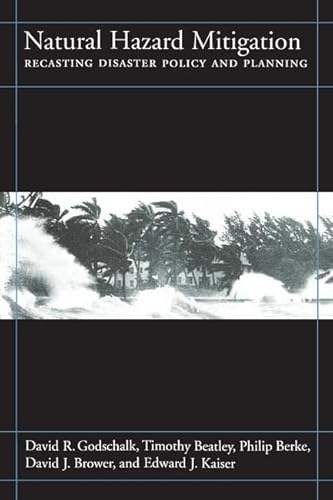
Natural Hazard Mitigation
Recasting Disaster Policy and Planning
By David R. Godschalk, Timothy Beatley, Philip Berke, David J. Brower, Edward J. Kaiser, Charles C. Bohl, R. Matthew GoebelISLAND PRESS
Copyright © 1999 Island Press
All rights reserved.
ISBN: 978-1-55963-602-5All rights reserved.
Contents
About Island Press,
Title Page,
Copyright Page,
Table of Figures,
Preface,
Acknowledgment,
PART I - Coping with Floods Earthquakes, and Hurricanes: U.S. Hazard Mitigation Policy,
CHAPTER 1 - Mitigating Natural Hazards: A National Challenge,
CHAPTER 2 - Evolving Mitigation Policy Directions,
PART II - Mitigation in Action: Six Disaster Cases,
An Overview of the Six Disaster Cases,
Mitigation Planning Lessons,
Lessons in Mitigation Project Implementation,
Lessons in Mitigation Strategy,
Lessons in Institutional Arrangements for Mitigation,
Conclusions,
Reference,
CHAPTER 3 - Florida After Hurricane Andrew,
CHAPTER 4 - Missouri After the Midwest Floods of 1993,
CHAPTER 5 - Iowa After the Midwest Floods of 1993,
CHAPTER 6 - California After the Loma Prieta and Northridge Earthquakes,
CHAPTER 7 - Massachusetts After Hurricane Bob and Other Storms,
CHAPTER 8 - Tennessee After a Series of Floods and Storms,
PART III - Assessing the National Mitigation System,
CHAPTER 9 - State Hazard Mitigation Plans: Falling Short of Their Potential,
CHAPTER 10 - The Hazard Mitigation Grant Program: Scattered Spending,
CHAPTER 11 - State Implementation of Natural Disaster Mitigation Policy: A Flowed System,
PART IV - Recanting the National Mitigation System,
CHAPTER 12 - Ethical Guidelines for Hazard Mitigation,
CHAPTER 13 - Natural Hazard Mitigation: Planning for Sustainable Communities,
About the Authors,
Index,
Island Press Board of Directors,
CHAPTER 1
Mitigating Natural Hazards: A National Challenge
Screaming headlines announce another presidential declaration of disaster as the latest flood, hurricane, or earthquake strikes a populated area. Television airs images of devastated homes and freeways. Governors demand federal disaster relief funds. Hearts go out to unfortunate victims huddled in shelters. The Federal Emergency Management Agency rushes in with recovery and rebuilding programs. This frenzied scenario has been repeated many times, with each new disaster seemingly bigger than the last. In fact, the first half of the 1990s saw the largest and most costly floods, hurricanes, and earthquakes in U.S. history.
Why are these disaster damages growing so large? Do we simply have to bite the bullet and keep rebuilding our disaster-stricken communities? Is something wrong with our national disaster policy? Could some of the damage and suffering from natural disasters be prevented?
To answer these questions, this book digs into the decisions and programs behind the headlines. It is the first complete analysis of the outcomes of the Stafford Act, the basic U.S. disaster law, to examine how natural hazard mitigation—the technical term for prevention of future harm from disasters—has worked over time and how it can be made to work more effectively in the future. Its authors are the first to study how federal hazard mitigation funds have actually been spent since the Stafford Act was adopted in 1988, what is actually contained in state hazard mitigation plans required by the Stafford Act, what goes on in mitigation decision making following a major disaster, how government mitigation officials rate the effectiveness of the mitigation system, and what changes are being considered to solve the widely recognized problems with the present way of coping with natural disasters.
Importance of Natural Hazard Mitigation
Disasters happen when nature's extreme forces strike exposed people and property. These recurring natural phenomena, such as floods, hurricanes, and earthquakes, are known as natural hazard events. When natural hazard events take place in unpopulated areas, no disaster occurs, when they take place in developed areas, damaging life and property, they are called natural disasters. The magnitude of a disaster depends on the intensity of the natural hazard event, the number of people and structures exposed to it, and the effectiveness of pre-event mitigation actions in protecting people and property from hazard forces.
Natural disasters have grown larger as more people and property have become exposed to natural hazards. Unfortunately, the places where hazards occur are often the same places where people want to live—along ocean shores and riverfronts or near earthquake faults. As more urban development takes place in such high-hazard areas, the risk of damage and injury from disasters multiplies. During the first half of the 1990s, the United States suffered unparalleled damage from natural disasters. Hurricanes, floods, earthquakes, and other natural disasters caused billions of dollars in damage, destroyed homes and businesses, and cut off roads, bridges, water systems, and other public infrastructure.
Yet much of the damage and suffering from natural disasters can be prevented. Natural hazard events cannot be prevented from occurring, but their impacts on people and property can be reduced if advance action is taken to mitigate risks and minimize vulnerability to natural disasters. Following disasters in the early 1990s, the U.S. Congress directed the Federal Emergency Management Agency to place its highest priority on natural hazard mitigation, shifting its emphasis from responding to, and recovering from, disasters once they have occurred to mitigating future hazard events. This marked a fundamental change, moving from reactive to proactive national emergency management policy.
This book describes and analyzes the way hazard mitigation has been carried out in the United States under the national disaster law—the Robert T. Stafford Disaster Relief and Emergency Assistance Act, enacted in 1988. We seek to answer questions about how the requirements of this law, establishing a national system for hazard mitigation, have worked in practice and how they might be made to work better. Our goal is a sound system of natural hazard mitigation, which we believe is a prerequisite to a safe future for the nation and its communities.
The Concept of Natural Hazard Mitigation
Natural hazard mitigation is advance action taken to reduce or eliminate the long-term risk to human life and property from natural hazards. Typically carried out as part of a coordinated mitigation strategy or plan, such actions, usually termed either structural or nonstructural, depending on whether they affect buildings or land use, include the following:
• Strengthening buildings and infrastructure exposed to hazards by means of building codes, engineering design, and construction practices to increase the resilience and damage resistance of the structures, as well as building protective structures such as dams, levees, and seawalls (structural mitigation)
• Avoiding hazard areas by directing new development away from known hazard locations through land use plans and regulations and by relocating damaged existing development to safe areas following a disaster (nonstructural mitigation)
• Maintaining protective features of the natural environment by protecting sand dunes, wetlands, forests and vegetated areas, and other ecological elements that absorb and...
„Über diesen Titel“ kann sich auf eine andere Ausgabe dieses Titels beziehen.
Suchergebnisse für Natural Hazard Mitigation: Recasting Disaster Policy...

Beispielbild für diese ISBN
Natural Hazard Mitigation: Recasting Disaster Policy And Planning
Anbieter: World of Books (was SecondSale), Montgomery, IL, USA
Verkäuferbewertung 5 von 5 Sternen

Zustand: Acceptable. Item in acceptable condition! Textbooks may not include supplemental items i.e. CDs, access codes etc. Artikel-Nr. 00102518875
Gebraucht kaufen
EUR 6,50
Versand gratis
Versand innerhalb von USA
Versand innerhalb von USA
Anzahl: 1 verfügbar
Beispielbild für diese ISBN
Natural Hazard Mitigation: Recasting Disaster Policy And Planning
Anbieter: World of Books (was SecondSale), Montgomery, IL, USA
Verkäuferbewertung 5 von 5 Sternen
Zustand: Good. Item in good condition. Textbooks may not include supplemental items i.e. CDs, access codes etc. Artikel-Nr. 00093635806
Gebraucht kaufen
EUR 6,50
Versand gratis
Versand innerhalb von USA
Versand innerhalb von USA
Anzahl: 1 verfügbar
Beispielbild für diese ISBN
Natural Hazard Mitigation : Recasting Disaster Policy and Planning
Anbieter: Better World Books, Mishawaka, IN, USA
Verkäuferbewertung 5 von 5 Sternen
Zustand: Very Good. Pages intact with possible writing/highlighting. Binding strong with minor wear. Dust jackets/supplements may not be included. Stock photo provided. Product includes identifying sticker. Better World Books: Buy Books. Do Good. Artikel-Nr. 11405721-6
Gebraucht kaufen
EUR 6,51
Versand gratis
Versand innerhalb von USA
Versand innerhalb von USA
Anzahl: 1 verfügbar
Beispielbild für diese ISBN
Natural Hazard Mitigation : Recasting Disaster Policy and Planning
Anbieter: Better World Books, Mishawaka, IN, USA
Verkäuferbewertung 5 von 5 Sternen
Zustand: Good. Former library copy. Pages intact with minimal writing/highlighting. The binding may be loose and creased. Dust jackets/supplements are not included. Includes library markings. Stock photo provided. Product includes identifying sticker. Better World Books: Buy Books. Do Good. Artikel-Nr. GRP63220597
Gebraucht kaufen
EUR 6,51
Versand gratis
Versand innerhalb von USA
Versand innerhalb von USA
Anzahl: 1 verfügbar
Beispielbild für diese ISBN
Natural Hazard Mitigation: Recasting Disaster Policy and Planning
Anbieter: ThriftBooks-Atlanta, AUSTELL, GA, USA
Verkäuferbewertung 5 von 5 Sternen
Paperback. Zustand: Fair. No Jacket. Readable copy. Pages may have considerable notes/highlighting. ~ ThriftBooks: Read More, Spend Less. Artikel-Nr. G1559636025I5N00
Gebraucht kaufen
EUR 6,52
Versand gratis
Versand innerhalb von USA
Versand innerhalb von USA
Anzahl: 1 verfügbar
Beispielbild für diese ISBN
Natural Hazard Mitigation: Recasting Disaster Policy And Planning
Anbieter: Romtrade Corp., STERLING HEIGHTS, MI, USA
Verkäuferbewertung 5 von 5 Sternen
Zustand: New. This is a Brand-new US Edition. This Item may be shipped from US or any other country as we have multiple locations worldwide. Artikel-Nr. ABBB-203017
Beispielbild für diese ISBN
Natural Hazard Mitigation
Anbieter: Majestic Books, Hounslow, Vereinigtes Königreich
Verkäuferbewertung 4 von 5 Sternen

Zustand: New. pp. 591. Artikel-Nr. 5277795
Neu kaufen
EUR 67,82
EUR 7,76 Versand
Versand von Vereinigtes Königreich nach USA
Versand von Vereinigtes Königreich nach USA
Anzahl: 1 verfügbar
Beispielbild für diese ISBN
Natural Hazard Mitigation Recasting Disaster Policy And Planning
Anbieter: Revaluation Books, Exeter, Vereinigtes Königreich
Verkäuferbewertung 5 von 5 Sternen
Paperback. Zustand: Brand New. 1st edition. 575 pages. 9.00x6.50x1.25 inches. In Stock. Artikel-Nr. 1559636025
Neu kaufen
EUR 65,34
EUR 14,93 Versand
Versand von Vereinigtes Königreich nach USA
Versand von Vereinigtes Königreich nach USA
Anzahl: 1 verfügbar