
Verwandte Artikel zu Coming Home to the Pleistocene
Inhaltsangabe
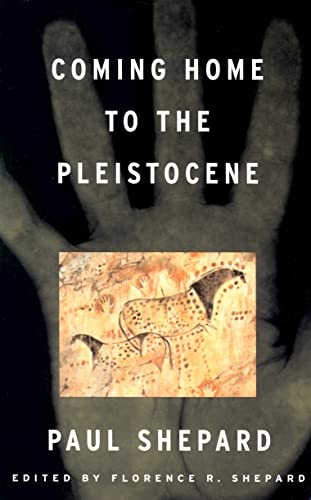
"When we grasp fully that the best expressions of our humanity were not invented by civilization but by cultures that preceded it, that the natural world is not only a set of constraints but of contexts within which we can more fully realize our dreams, we will be on the way to a long overdue reconciliation between opposites which are of our own making." --from Coming Home to the Pleistocene Paul Shepard was one of the most profound and original thinkers of our time. Seminal works like The Tender Carnivore and the Sacred Game, Thinking Animals, and Nature and Madness introduced readers to new and provocative ideas about humanity and its relationship to the natural world. Throughout his long and distinguished career, Paul Shepard returned repeatedly to his guiding theme, the central tenet of his thought: that our essential human nature is a product of our genetic heritage, formed through thousands of years of evolution during the Pleistocene epoch, and that the current subversion of that Pleistocene heritage lies at the heart of today's ecological and social ills. Coming Home to the Pleistocene provides the fullest explanation of that theme. Completed just before his death in the summer of 1996, it represents the culmination of Paul Shepard's life work and constitutes the clearest, most accessible expression of his ideas. Coming Home to the Pleistocene pulls together the threads of his vision, considers new research and thinking that expands his own ideas, and integrates material within a new matrix of scientific thought that both enriches his original insights and allows them to be considered in a broader context of current intellectual controversies. In addition, the book explicitly addresses the fundamental question raised by Paul Shepard's work: What can we do to recreate a life more in tune with our genetic roots? In this book, Paul Shepard presents concrete suggestions for fostering the kinds of ecological settings and cultural practices that are optimal for human health and well-being. Coming Home to the Pleistocene is a valuable book for those familiar with the life and work of Paul Shepard, as well as for new readers seeking an accessible introduction to and overview of his thought.
Die Inhaltsangabe kann sich auf eine andere Ausgabe dieses Titels beziehen.
Über die Autorin bzw. den Autor
Paul Shepard; Edited by Florence R. Shepard
Auszug. © Genehmigter Nachdruck. Alle Rechte vorbehalten.
Coming Home to the Pleistocene
By Paul Shepard, Florence R. ShepardISLAND PRESS
Copyright © 1998 Florence Shepard
All rights reserved.
ISBN: 978-1-55963-590-5All rights reserved.
Contents
Title Page,
Copyright Page,
Preface,
Introduction,
I - The Relevance of the Past,
II - Getting a Genome,
III - How We Once Lived,
IV - How the Mind Once Lived,
V - Savages Again,
VI - Romancing the Potato,
VII - The Cowboy Alternative,
VIII - Wildness and Wilderness,
IX - The New Mosaic: A Primal Closure,
Bibliography,
Index,
CHAPTER 1
The Relevance of the Past
HISTORY IS NOT A CHRONICLE but a Hebrew invention about the way the cosmos works, a notion that became the accepted "word" for the civilized world. One of the problems with this version is that it does not see the past reoccurring in the present. Yet Octavio Paz reminds us: "The past reappears because it is a hidden present. I am speaking of the real past, which is not the same as 'what took place.' ... What took place is indeed the past, yet there is something that ... takes place but does not wholly recede into the past, a constantly returning present." History as written documentation of "what happened" is antithetical to a "constantly returning present," and as a result its perception of time and change is narrowly out of harmony with the natural world. Written history is the word. Time is an unfinished, extemporaneous narrative.
Prehistoric humans, in contrast, were autochthonous, that is, "native to their place." They possessed a detailed knowledge that was passed on from generation to generation by oral tradition through myths—stories that framed their beliefs in the context of ancestors and the landscape of the natural world. They lived within a "sacred geography" that consisted of a complex knowledge of place, terrain, and plants and animals embedded in a phenology of seasonal cycles. But they were also close to the earth in a spiritual sense, joined in an intricate configuration of sacred associations with the spirit of place within their landscape. Time and space as well as animals—humans—gods—all life and nonliving matter formed a continuum that related to themes of fertility and death and the sacredness of all things. During prehistory, which is most of the time that humans have been on earth, the dead and their burial places were venerated and mythic ancestors were part of the living present, the dreamtime ones whose world was also the ground of present being. Ignore them as we will, they are with us still.
The roots of history as written, as Herbert Schneidau has shown us, were formulated by the Hebrew demythologizers who created a reality outside the rhythmic cosmos of the gentiles who surrounded them and who were grounded in prehistoric, mythical consciousness with rituals of eternal return, mimetic conveyance of values and ideas, the central metaphor of nature as culture, and, most of all, the incorporation of the past into the present. Unlike history, prehistory does not participate in the dichotomy that divides experience into good and evil, eternal and temporal. Rather, it belongs to a syncretic system that accepts multiple truths and meanings and attempts to reconcile them. This state of consciousness is not due to a rational process. The mythic mind, as John Cobb Jr. has explained it, does not recognize the "separateness of subject and object" but instead sees "a flow of subjective and objective contributions ... bound together" where there is no "clear consciousness of subject as subject or of object as object."
The Hebrews, who initiated the move away from the earth and toward the historical view, did not try to reconcile opposing beliefs. Nor did they have a sense of place. To the contrary they insisted on "deracination from the spirit of place" and asserted that they were "journeyers" to the Promised Land. In the Hebrew view, the realm of the sacred was granted only to Yahweh. Objections to the oldest traditions of time and the past imply a deeper strain that has to do not with the content of history, but with a self-conscious alienation that first became evident in the Hebrews. The assault on the local wisdom of primal peoples culminated in the outwardness of nature and the inwardness of the personality.
Focusing on heavenly domination over earthly phenomena, history became an attempt to look away from earth. The Hebrews and the Greeks, who were their contemporaries and whose parallel culture in the Eastern Mediterranean shares many common features with that of the Hebrews, saw alienation as the touchstone of humankind. They understood themselves as outside the nature-centered belief systems of other peoples, whose cosmologies linked past, present, and future in stories and art with eternal cycles and sacred places. History is a way of perceiving human existence that opposes and destroys its predecessor, the mythic world, which sees time as a continuous return and space as sacred, where all life is autochthonous.
The Hebrew and Greek founders of history were not so intent on rejecting nature as they were on understanding temporal events as unique. The Hebrews, the Greeks, and, following in their steps, the Christians asserted that events are novel, uncertain, tangential, and contingent rather than embedded and structured, the result of the thoughts of a living, omniscient, unknowable God. The past was a highway on which there could be no return.
The prototype of this linear sequence of ever-new events, where nothing was repeated and to which nothing returned, was the Old Testament, a record of tribal endogamy, identity, and vision. Thirty-two hundred years later, history has grown fat with the civilized written records that replaced oral traditions and added vast secular data to religious history. This breakaway from the mythic life, which linked our species to the natural world, began when the early Hebrews rejected the nature/process stories and rites of their pagan contemporaries for the myth of a single god who, outside the world, reached into his creation, willfully deranging its rhythms, acting arbitrarily, making life a kind of novel, a history. The effort of the Hebrews to distance themselves from the sacred immanence in the natural order initiated what Cobb has called the "reflective consciousness" of humankind in the "Axial Period" (between 800 and 200 B.C.)—a transitional state of human cognition in which the archaic mind was altered and a "conscious control of symbolization and action" emerged. Although the Hebrews had begun to develop a "reflective consciousness," a state of consciousness in which they actively attempted to understand their place in the greater scheme of things, they were still locked into a kind of projection of their unconscious that symbolized subjective elements arising from a deep substratum of the mind.
The Greeks, Cobb argues, succeeded in distancing themselves from sacred immanence in the natural order through further development of the "reflective consciousness." The change of the "structure of existence," the way they envisioned the possibilities in their lives, moved from the unconscious to the conscious. In the case of Homeric Man, "the object of conscious experience ... was primordially the sensuously given world ... in which the subjective was subordinated to the objective." Out of this grew "esthetic distancing"—an ability to see beauty in the world, in nature, in the human body, and in temples and other human artifacts, esthetically pleasing forms corresponding to rational psychic...
„Über diesen Titel“ kann sich auf eine andere Ausgabe dieses Titels beziehen.
Suchergebnisse für Coming Home to the Pleistocene

Beispielbild für diese ISBN
Coming Home to the Pleistocene
Verlag:
Island Press (edition ), 2004
ISBN 10: 1559635908
ISBN 13: 9781559635905
Gebraucht
Paperback
Anbieter: BooksRun, Philadelphia, PA, USA
Verkäuferbewertung 5 von 5 Sternen

Paperback. Zustand: Very Good. It's a well-cared-for item that has seen limited use. The item may show minor signs of wear. All the text is legible, with all pages included. It may have slight markings and/or highlighting. Artikel-Nr. 1559635908-11-1
Gebraucht kaufen
EUR 10,45
Versand gratis
Versand innerhalb von USA
Versand innerhalb von USA
Anzahl: 1 verfügbar
Beispielbild für diese ISBN
Coming Home to the Pleistocene
Anbieter: ThriftBooks-Dallas, Dallas, TX, USA
Verkäuferbewertung 5 von 5 Sternen
Paperback. Zustand: Fair. No Jacket. Readable copy. Pages may have considerable notes/highlighting. ~ ThriftBooks: Read More, Spend Less. Artikel-Nr. G1559635908I5N00
Gebraucht kaufen
EUR 12,48
Versand gratis
Versand innerhalb von USA
Versand innerhalb von USA
Anzahl: 1 verfügbar
Beispielbild für diese ISBN
Coming Home to the Pleistocene
Anbieter: PBShop.store UK, Fairford, GLOS, Vereinigtes Königreich
Verkäuferbewertung 5 von 5 Sternen
PAP. Zustand: New. New Book. Shipped from UK. Established seller since 2000. Artikel-Nr. WP-9781559635905
Neu kaufen
EUR 28,31
EUR 4,85 Versand
Versand von Vereinigtes Königreich nach USA
Versand von Vereinigtes Königreich nach USA
Anzahl: 2 verfügbar
Beispielbild für diese ISBN
Coming Home to the Pleistocene
Anbieter: Majestic Books, Hounslow, Vereinigtes Königreich
Verkäuferbewertung 4 von 5 Sternen

Zustand: New. pp. 208. Artikel-Nr. 5893763
Neu kaufen
EUR 34,67
EUR 7,58 Versand
Versand von Vereinigtes Königreich nach USA
Versand von Vereinigtes Königreich nach USA
Anzahl: 3 verfügbar
Beispielbild für diese ISBN
Coming Home to the Pleistocene
Anbieter: Ria Christie Collections, Uxbridge, Vereinigtes Königreich
Verkäuferbewertung 5 von 5 Sternen
Zustand: New. In English. Artikel-Nr. ria9781559635905_new
Neu kaufen
EUR 33,68
EUR 10,93 Versand
Versand von Vereinigtes Königreich nach USA
Versand von Vereinigtes Königreich nach USA
Anzahl: 5 verfügbar
Beispielbild für diese ISBN
Coming Home to the Pleistocene
Anbieter: Kennys Bookstore, Olney, MD, USA
Verkäuferbewertung 5 von 5 Sternen
Zustand: New. The Pleistocene was the age of our hunter-gatherer ancestors. Shepard sets out to show how much of what we call "culture" can be traced back through our evolution from that formative stage. Num Pages: 237 pages, tables. BIC Classification: RNT. Category: (P) Professional & Vocational; (U) Tertiary Education (US: College). Dimension: 152 x 229 x 11. Weight in Grams: 314. . 2004. 2nd Edition. Paperback. . . . . Books ship from the US and Ireland. Artikel-Nr. V9781559635905
Neu kaufen
EUR 45,11
EUR 9,15 Versand
Versand innerhalb von USA
Versand innerhalb von USA
Anzahl: 1 verfügbar
Beispielbild für diese ISBN
Coming Home to the Pleistocene
Anbieter: Revaluation Books, Exeter, Vereinigtes Königreich
Verkäuferbewertung 5 von 5 Sternen
Paperback. Zustand: Brand New. 1st edition. 195 pages. 8.75x5.50x0.75 inches. In Stock. Artikel-Nr. x-1559635908
Neu kaufen
EUR 44,20
EUR 11,66 Versand
Versand von Vereinigtes Königreich nach USA
Versand von Vereinigtes Königreich nach USA
Anzahl: 2 verfügbar
Beispielbild für diese ISBN
COMING HOME TO THE PLEISTOCENE
Anbieter: Speedyhen, Hertfordshire, Vereinigtes Königreich
Verkäuferbewertung 5 von 5 Sternen
Zustand: NEW. Artikel-Nr. NW9781559635905
Neu kaufen
EUR 26,79
EUR 47,83 Versand
Versand von Vereinigtes Königreich nach USA
Versand von Vereinigtes Königreich nach USA
Anzahl: 3 verfügbar
Foto des Verkäufers
Coming Home to the Pleistocene
Anbieter: moluna, Greven, Deutschland
Verkäuferbewertung 5 von 5 Sternen
Zustand: New. The Pleistocene was the age of our hunter-gatherer ancestors. Shepard sets out to show how much of what we call culture can be traced back through our evolution from that formative stage.Über den AutorBefore his death in 1996,. Artikel-Nr. 596318551
Neu kaufen
EUR 35,41
EUR 48,99 Versand
Versand von Deutschland nach USA
Versand von Deutschland nach USA
Anzahl: 3 verfügbar