
Inhaltsangabe
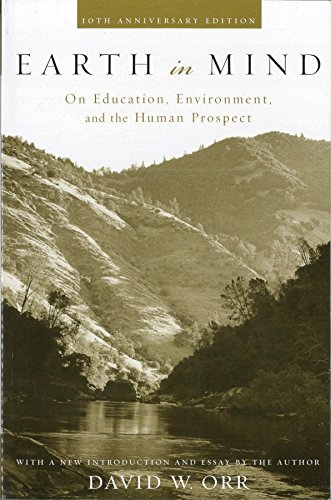
In Earth in Mind, noted environmental educator David W. Orr focuses not on problems in education, but on the problem of education. Much of what has gone wrong with the world, he argues, is the result of inadequate and misdirected education that:
- alienates us from life in the name of human domination
- causes students to worry about how to make a living before they know who they are
- overemphasizes success and careers
- separates feeling from intellect and the practical from the theoretical
- deadens the sense of wonder for the created world
The author begins by establishing the grounds for a debate about education and knowledge. He describes the problems of education from an ecological perspective, and challenges the "terrible simplifiers" who wish to substitute numbers for values. He follows with a presentation of principles for re-creating education in the broadest way possible, discussing topics such as biophilia, the disciplinary structure of knowledge, the architecture of educational buildings, and the idea of ecological intelligence. Orr concludes by presenting concrete proposals for reorganizing the curriculum to draw out our affinity for life.
Die Inhaltsangabe kann sich auf eine andere Ausgabe dieses Titels beziehen.
Über die Autorin bzw. den Autor
David W. Orr is chair of the environmental studies program at Oberlin College, and education editor of the journal Conservation Biology His previous books include Ecological Literacy and
Environmental Responsibility.
Von der hinteren Coverseite
In Earth in Mind, Orr focuses not on problems in education, but on the problem of education. Much of what has gone wrong with the world, he argues, is the result of inadequate and misdirected education that alienates us from life in the name of human domination; causes students to worry about how to make a living before they know who they are; overemphasizes success and careers; separates feeling from intellect and the practical from the theoretical and deadens the sense of wonder for the created world. The crisis we face, Orr explains, is one of mind, perception, and values. It is, first and foremost, an educational challenge.
Auszug. © Genehmigter Nachdruck. Alle Rechte vorbehalten.
Earth in Mind
On Education, Environment, and the Human Prospect
By David W. OrrISLAND PRESS
Copyright © 2004 David W. Orr
All rights reserved.
ISBN: 978-1-55963-495-3All rights reserved.
Contents
ABOUT ISLAND PRESS,
Dedication,
Title Page,
Copyright Page,
ACKNOWLEDGMENTS,
INTRODUCTION TO THE 10TH ANNIVERSARY EDITION,
INTRODUCTION,
PART ONE - THE PROBLEM OF EDUCATION,
CHAPTER ONE - What Is Education For?,
CHAPTER TWO - The Dangers of Education,
CHAPTER THREE - The Problem of Education,
CHAPTER FOUR - The Business of Education,
PART TWO - FIRST PRINCIPLES,
CHAPTER FIVE - Love,
CHAPTER SIX - Some Thoughts on Intelligence,
CHAPTER SEVEN - Reflections on Water and Oil,
CHAPTER EIGHT - Virtue,
CHAPTER NINE - Forests and Trees,
CHAPTER TEN - Politics,
CHAPTER ELEVEN - Economics,
CHAPTER TWELVE - Judgment: Pascal's Wager and Economics in a Hotter Time,
PART THREE - RETHINKING EDUCATION,
CHAPTER THIRTEEN - Rating Colleges,
CHAPTER FOURTEEN - The Problem of Disciplines and the Discipline of Problems,
CHAPTER FIFTEEN - Professionalism and the Human Prospect,
CHAPTER SIXTEEN - Designing Minds,
CHAPTER SEVENTEEN - Architecture as Pedagogy,
CHAPTER EIGHTEEN - Agriculture and the Liberal Arts,
CHAPTER NINETEEN - Educating a Constituency for the Long Haul,
PART FOUR - DESTINATIONS,
SOURCES,
CHAPTER TWENTY - Love It or Lose It: The Coming Biophilia Revolution,
CHAPTER TWENTY-ONE - A World That Takes Its Environment Seriously,
CHAPTER TWENTY-TWO - Prices and the Life Exchanged: Costs of the U.S. Food System,
CHAPTER TWENTY-THREE - Refugees or Homecomers? Conjectures About the Future of Rural America,
CHAPTER TWENTY-FOUR - Hope in Hard Times,
Conclusion: Earth in Mind,
INDEX,
ISLAND PRESS BOARD OF DIRECTORS,
CHAPTER 1
What Is Education For?
IF TODAY is a typical day on planet earth, we will lose 116 square miles of rain forest, or about an acre a second. We will lose another 72 square miles to encroaching deserts, the results of human mismanagement and overpopulation. We will lose 40 to 250 species, and no one knows whether the number is 40 or 250. Today the human population will increase by 250,000. And today we will add 2,700 tons of chlorofluorocarbons and 15 million tons of carbon dioxide to the atmosphere. Tonight the earth will be a little hotter, its waters more acidic, and the fabric of life more threadbare. By year's end the numbers are staggering: The total loss of rain forest will equal an area the size of the state of Washington; expanding deserts will equal an area the size of the state of West Virginia; and the global population will have risen by more than 90,000,000. By the year 2000 perhaps as much as 20% of the life forms extant on the planet in the year 1900 will be extinct.
The truth is that many things on which our future health and prosperity depend are in dire jeopardy: climate stability, the resilience and productivity of natural systems, the beauty of the natural world, and biological diversity.
It is worth noting that this is not the work of ignorant people. Rather, it is largely the results of work by people with BAs, BSs, LLBs, MBAs, and PhDs. Elie Wiesel once made the same point, noting that the designers and perpetrators of Auschwitz, Dachau, and Buchenwald—the Holocaust—were the heirs of Kant and Goethe, widely thought to be the best educated people on earth. But their education did not serve as an adequate barrier to barbarity. What was wrong with their education? In Wiesel's (1990) words,
It emphasized theories instead of values, concepts rather than human beings, abstraction rather than consciousness, answers instead of questions, ideology and efficiency rather than conscience.
I believe that the same could be said of our education. Toward the natural world it too emphasizes theories, not values; abstraction rather than consciousness; neat answers instead of questions; and technical efficiency over conscience. It is a matter of no small consequence that the only people who have lived sustainably on the planet for any length of time could not read, or like the Amish do not make a fetish of reading. My point is simply that education is no guarantee of decency, prudence, or wisdom. More of the same kind of education will only compound our problems. This is not an argument for ignorance but rather a statement that the worth of education must now be measured against the standards of decency and human survival—the issues now looming so large before us in the twenty-first century. It is not education, but education of a certain kind, that will save us.
Myth
What went wrong with contemporary culture and education? We can find insight in literature, including Christopher Marlowe's portrayal of Faust who trades his soul for knowledge and power, Mary Shelley's Dr. Frankenstein who refuses to take responsibility for his creation, and Herman Melville's Captain Ahab who says "All my means are sane, my motive and my object mad." In these characters we encounter the essence of the modern drive to dominate nature.
Historically, Francis Bacon's proposed union between knowledge and power foreshadowed the contemporary alliance between government, business, and knowledge that has wrought so much mischief. Galileo's separation of the intellect foreshadowed the dominance of the analytical mind over that part given to creativity, humor, and wholeness. And in Descartes's epistemology, one finds the roots of the radical separation of self and object. Together these three laid the foundations for modern education, foundations that now are enshrined in myths that we have come to accept without question. Let me suggest six.
First, there is the myth that ignorance is a solvable problem. Ignorance is not a solvable problem; it is rather an inescapable part of the human condition. We cannot comprehend the world in its entirety. The advance of knowledge always carried with it the advance of some form of ignorance. For example, in 1929 the knowledge of what a substance like chlorofluorocarbons (CFCs) would do to the stratospheric ozone and climate stability was a piece of trivial ignorance as the compound had not yet been invented. But in 1930 after Thomas Midgely, Jr., discovered CFCs, what had been a piece of trivial ignorance became a critical life-threatening gap in human understanding of the biosphere. Not until the early 1970s did anyone think to ask "What does this substance do to what?" In 1986 we discovered that CFCs had created a hole in the ozone over the South Pole the size of the lower 48 U.S. states; by the early 1990s, CFCs had created a worldwide reduction of ozone. With the discovery of CFCs, knowledge increased, but like the circumference of an expanding circle, ignorance grew as well.
A second myth is that with enough knowledge and technology, we can, in the words of Scientific American (1989), "manage planet earth." Higher education has largely been shaped by the drive to extend human domination to its fullest. In this mission, human intelligence may have taken the wrong road. Nonetheless, managing the planet has a nice ring to it. It appeals to our fascination with digital readouts, computers, buttons, and dials. But the complexity of earth and its life systems can never be safely managed. The ecology of the top inch of topsoil is still largely unknown as is its relationship to the larger systems of the biosphere. What...
„Über diesen Titel“ kann sich auf eine andere Ausgabe dieses Titels beziehen.
Weitere beliebte Ausgaben desselben Titels

Suchergebnisse für Earth in Mind: On Education, Enviroment, and the Human...

Beispielbild für diese ISBN
Earth in Mind: On Education, Environment, and the Human Prospect
Anbieter: World of Books (was SecondSale), Montgomery, IL, USA
Verkäuferbewertung 5 von 5 Sternen

Zustand: Very Good. Item in very good condition! Textbooks may not include supplemental items i.e. CDs, access codes etc. Artikel-Nr. 00100053273
Gebraucht kaufen
EUR 3,97
Versand gratis
Versand innerhalb von USA
Versand innerhalb von USA
Anzahl: 1 verfügbar
Beispielbild für diese ISBN
Earth in Mind: On Education, Environment, and the Human Prospect
Anbieter: World of Books (was SecondSale), Montgomery, IL, USA
Verkäuferbewertung 5 von 5 Sternen
Zustand: Good. Item in good condition. Textbooks may not include supplemental items i.e. CDs, access codes etc. Artikel-Nr. 00102978113
Gebraucht kaufen
EUR 3,97
Versand gratis
Versand innerhalb von USA
Versand innerhalb von USA
Anzahl: 2 verfügbar
Beispielbild für diese ISBN
Earth in Mind : On Education, Environment, and the Human Prospect
Anbieter: Better World Books, Mishawaka, IN, USA
Verkäuferbewertung 5 von 5 Sternen
Zustand: Very Good. Pages intact with possible writing/highlighting. Binding strong with minor wear. Dust jackets/supplements may not be included. Stock photo provided. Product includes identifying sticker. Better World Books: Buy Books. Do Good. Artikel-Nr. 9073651-6
Gebraucht kaufen
EUR 5,88
Versand gratis
Versand innerhalb von USA
Versand innerhalb von USA
Anzahl: 1 verfügbar
Beispielbild für diese ISBN
Earth in Mind: On Education, Environment, and the Human Prospect
Anbieter: Books From California, Simi Valley, CA, USA
Verkäuferbewertung 4 von 5 Sternen

paperback. Zustand: Very Good. Cover and edges may have some wear. Artikel-Nr. mon0004022355
Gebraucht kaufen
EUR 3,16
EUR 4,36 Versand
Versand innerhalb von USA
Versand innerhalb von USA
Anzahl: 2 verfügbar
Beispielbild für diese ISBN
Earth in Mind: On Education, Environment, and the Human Prospect (Second Edition, Revised)
Verlag:
Island Press July 2004, 2004
ISBN 10: 1559634952
ISBN 13: 9781559634953
Gebraucht
Paper Back
Anbieter: Eagle Eye Books, Decatur, GA, USA
Verkäuferbewertung 4 von 5 Sternen
Paper Back. Zustand: Used. Artikel-Nr. 903514
Gebraucht kaufen
EUR 6,29
EUR 3,49 Versand
Versand innerhalb von USA
Versand innerhalb von USA
Anzahl: 1 verfügbar
Beispielbild für diese ISBN
Earth in Mind: On Education, Environment, and the Human Prospect (Second Edition, Revised)
Verlag:
Island Press July 2004, 2004
ISBN 10: 1559634952
ISBN 13: 9781559634953
Gebraucht
Paper Back
Anbieter: Eagle Eye Books, Decatur, GA, USA
Verkäuferbewertung 4 von 5 Sternen
Paper Back. Zustand: Used. Artikel-Nr. 895220
Gebraucht kaufen
EUR 7,19
EUR 3,49 Versand
Versand innerhalb von USA
Versand innerhalb von USA
Anzahl: 1 verfügbar
Beispielbild für diese ISBN
Earth in Mind: On Education, Environment, and the Human Prospect
Anbieter: Visible Voice Books, Cleveland, OH, USA
Verkäuferbewertung 5 von 5 Sternen
paperback. Zustand: Very Good. Island Press July 2004 8vo. 221 pages. Artikel-Nr. 188009
Gebraucht kaufen
EUR 7,19
EUR 3,93 Versand
Versand innerhalb von USA
Versand innerhalb von USA
Anzahl: 1 verfügbar
Beispielbild für diese ISBN
Earth in Mind : On Education, Environment, and the Human Prospect
Anbieter: Better World Books Ltd, Dunfermline, Vereinigtes Königreich
Verkäuferbewertung 5 von 5 Sternen
Zustand: Good. Former library copy. Pages intact with minimal writing/highlighting. The binding may be loose and creased. Dust jackets/supplements are not included. Includes library markings. Stock photo provided. Product includes identifying sticker. Better World Books: Buy Books. Do Good. Artikel-Nr. 6415848-6
Gebraucht kaufen
EUR 5,99
EUR 5,85 Versand
Versand von Vereinigtes Königreich nach USA
Versand von Vereinigtes Königreich nach USA
Anzahl: 1 verfügbar
Beispielbild für diese ISBN
Earth in Mind : On Education, Environment, and the Human Prospect
Anbieter: Better World Books Ltd, Dunfermline, Vereinigtes Königreich
Verkäuferbewertung 5 von 5 Sternen
Zustand: Very Good. Former library copy. Pages intact with possible writing/highlighting. Binding strong with minor wear. Dust jackets/supplements may not be included. Includes library markings. Stock photo provided. Product includes identifying sticker. Better World Books: Buy Books. Do Good. Artikel-Nr. GRP88121706
Gebraucht kaufen
EUR 5,99
EUR 5,85 Versand
Versand von Vereinigtes Königreich nach USA
Versand von Vereinigtes Königreich nach USA
Anzahl: 1 verfügbar
Beispielbild für diese ISBN
Earth in Mind: On Education, Enviroment, and the Human Prospect
Anbieter: Magers and Quinn Booksellers, Minneapolis, MN, USA
Verkäuferbewertung 5 von 5 Sternen
paperback. Zustand: Very Good. May have light to moderate shelf wear and/or a remainder mark. Complete. Clean pages. paperback. Artikel-Nr. 493829
Gebraucht kaufen
EUR 8,77
EUR 3,49 Versand
Versand innerhalb von USA
Versand innerhalb von USA
Anzahl: 1 verfügbar