
Verwandte Artikel zu A Region at Risk: The Third Regional Plan for the New...
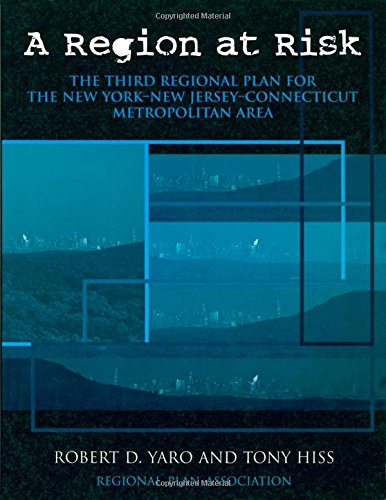
A Region at Risk: The Third Regional Plan for the New York-New Jersey-Connecticut Metropolitan Area - Softcover
Inhaltsangabe
Regional Plan Association, the nation's oldest regional planning organization, has worked since 1929 to improve the quality of life in the New York-New Jersey-Connecticut metropolitan area. The Association has crafted two long-term plans and successfully promoted their implementation through advocacy and coalition building.The Association's Third Regional Plan describes a series of key initiatives aimed at not only improving quality of life, but also at increasing economic competitiveness, encouraging more sustainable patterns of growth, and expanding opportunities and choice in employment, housing, and community.The Plan presents five major campaigns, each of which combines the goals of economic, equity, and environmental improvements. They are: Greensward -- to protect and restore large natural resource systems at the periphery of urbanized areas Centers -- to "recenter" regions that have experienced decades of sprawl growth Mobility -- to transform existing transit infrastructure to create a regional express rail network that would dramatically improve public transit, reduce highway congestion, and speed freight movement Workforce -- to provide the region's workforce with the skills and opportunities needed to participate in the economy of the future Governance -- to rationalize the activities of existing authorities, encourage service sharing among municipal governments, and encourage more effective state and regional land-use planning programs While focusing on the New York-New Jersey-Connecticut metropolitan area, the Plan's broad themes have universal applicability to regions throughout the industrialized world.
Die Inhaltsangabe kann sich auf eine andere Ausgabe dieses Titels beziehen.
Auszug. © Genehmigter Nachdruck. Alle Rechte vorbehalten.
A Region at Risk
The Third Regional Plan For The New York-New Jersey-Connecticut Metropolitan Area
By Robert Yaro, Tony HissISLAND PRESS
Copyright © 1996 Regional Plan Association
All rights reserved.
ISBN: 978-1-55963-492-2All rights reserved.
Contents
About Island Press,
About Regional Plan Association,
Title Page,
Copyright Page,
Table of Figures,
Plates,
Foreword,
Introduction,
Part I - Overview: A Region at Risk,
Notes,
Chapter 1 - The Three E's,
Chapter 2 - Toward Solutions: Five Campaigns,
Part II - Where We Are, Where We Are Headed,
Note,
Chapter 3 - Economy: Transformation to a Competitive Global Economy,
Chapter 4 - Equity: The Region's Society in the Past, Present, and Future,
Chapter 5 - Environment: Green Infrastructure Under Siege,
Part III - Five Major Campaigns,
Chapter 6 - The Greensward Campaign,
Chapter 7 - The Centers Campaign,
Chapter 8 - The Mobility Campaign,
Chapter 9 - The Workforce Campaign,
Chapter 10 - The Governance Campaign,
Part IV - From Plan to Action,
Note,
Chapter 11 - Paying for the Plan,
Chapter 12 - Coordinating Implementation of the Plan,
Conclusion: Recapturing the Promise,
Appendix: - Envisioning Two Futures,
Acknowledgments,
Index,
Figure Credits,
Island Press Board of Directors,
CHAPTER 1
The Three E's
EACH OF THE "THREE E'S" also has broad applicability to metropolitan regions throughout the industrialized world. Virtually every North American metropolitan region, both large and small, faces similar concerns—among them are shifting employment prospects created by global competition, industry restructuring, and immigration; growing disparities between poor central cities and inner suburbs and rich outer suburbs; and sprawl and gridlock as a result of decentered, automobile-based growth. It has become clear that the "Three E's" now provide a universal context for discussing regional issues.
Economy
With national governments less able to regulate economic activity, regions have a growing need to develop their own strategies. They must focus on their particular advantages in the global marketplace—the clusters of related industries that anchor their economy, the talents of their population, and the character of their communities and environment—to move beyond policies that rely solely on tax cuts, business incentives, and promotional campaigns. The right mix of investments in advanced infrastructure, workforce skills, and quality of life improvements are crucial to long-term success, and this will require collaborative relationships between business, government, and labor to succeed.
The strategies outlined in this plan—maintaining a diverse, high-skill workforce, investing in an extensive but aging transit system, and energizing people's entrepreneurial talents with more efficient, flexible systems of governance—emerge from the particular strengths and industry profile of the Tri-State region.
Equity
Every world center faces daunting challenges to reverse the divisive trends resulting from economic transformation and global resettlement patterns. Global competition, technological change, and corporate restructuring have resulted in widening income disparities between the affluent and the poor, exacerbating long-standing racial and class divisions. Simultaneously, a handful of regions—including New York, Chicago, Miami, and Toronto—are attracting most of the vast number of immigrants flocking to North America, creating a truly multicultural society. Declining numbers of low-skill jobs, stagnant incomes for the middle-class, and increasing numbers of newcomers are creating larger concentrations of poor residents in metropolitan areas at a time when economic conditions are particularly fluid.
New residents bring with them enormous talent and cultural diversity—New York City, for one, could never have come into being without them. However, accommodating new residents requires new investments in schools, in workforce training, and in housing and public services. Federal funding has not been provided for these purposes. Localities have been left to deal with these new demands while conditions for many native-born residents are worsening, particularly for those in low-skill jobs. The benefits of immigration are certainly worth the effort to address its short-term costs, but it is equally important to ensure that people already here have the same kind of amenities and opportunities that we extend to newcomers.
In the metropolitan context, these forces have also had an impact on the gap between cities and suburbs. The movement of middle-class residents of all racial and ethnic groups from cities to the outer suburbs has left central cities for the poorest residents. And in many regions, inner suburbs now have more in common with center cities than they do with outer suburbs. Most regions continue to develop new rings of suburban growth, threatening to further isolate downtowns and center-city neighborhoods and diminish their tax base at the same time that urban welfare, police, education, and other costs continue to escalate. At the same time, middle-income whites continue to migrate out of this region—and from metropolitan Chicago, Los Angeles, Boston, and similar places—to smaller communities. Continuation of this trend could lead to even deeper racial and social polarization for the entire country.
Environment
The extreme deconcentration of North America's metropolitan regions has played havoc with the green infrastructure of watersheds, farmland, estuaries, woodlands, and other resources that make life in these places possible and desirable. While open "greenfields" are increasingly prone to development, vast areas of our cities have become desolate "brownfields"—contaminated urban lands abandoned by both business and government. Conventional solid waste management and pollution control facilities seem to have only limited success in protecting the environment. And they are expensive because they rely on "end of the pipe" treatment and focus on cleaning up toxic materials after they have already been made rather than redesigning industries so that they process only benign materials. Many taxes and regulations designed to protect the environment have the perverse effect of discouraging both traditional and neo-traditional compact development, which generates far less pollution than sprawl.
CHAPTER 2Toward Solutions: Five Campaigns
IN MANY AREAS of post-modern and post-industrial life, changes are accelerating beyond anyone's ability to see more than a few years ahead. Places, on the other hand, have qualities that can endure and gather strength, age after age. And this region, by simply anchoring itself firmly to its own superb natural abundance and extraordinary human achievements and talents, can create a permanent quality of life and structure for living that can both accommodate and weather all the changes that may come its way.
RPA has identified five crosscutting campaigns designed to respond in a comprehensive way to the issues defined by the "Three E's." Most of these initiatives could be adapted to the needs of other large and small North American metropolitan regions. In the Tri-State Metropolitan Region, the continuing "Three E" strengths of the place—our ecosystems, our centers, our transportation systems, our people, and our...
„Über diesen Titel“ kann sich auf eine andere Ausgabe dieses Titels beziehen.
Suchergebnisse für A Region at Risk: The Third Regional Plan for the New...

Beispielbild für diese ISBN
Region at Risk: The Third Regional Plan for the New York-New Jersey-Connecticut Metropolitan Area
Verlag:
Princeton University Press, 1996
ISBN 10: 1559634928
ISBN 13: 9781559634922
Gebraucht
Paperback
Anbieter: World of Books (was SecondSale), Montgomery, IL, USA
Verkäuferbewertung 5 von 5 Sternen

Paperback. Zustand: Very Good. The plan for this area envisages protection of the peripheral natural resources, improvements to the tra nsport infrastructure, skills training for the region''s work force, recentering of areas that have sprawled, and rational isation of the basic services. '. Artikel-Nr. 00104328273
Gebraucht kaufen
EUR 13,93
Versand gratis
Versand innerhalb von USA
Versand innerhalb von USA
Anzahl: 1 verfügbar
Beispielbild für diese ISBN
A Region at Risk : The Third Regional Plan for the New York-New Jersey-Connecticut Metropolitan Area
Verlag:
Island Press, 1996
ISBN 10: 1559634928
ISBN 13: 9781559634922
Gebraucht
Softcover
Erstausgabe
Anbieter: Better World Books, Mishawaka, IN, USA
Verkäuferbewertung 5 von 5 Sternen
Zustand: Very Good. 1st Edition. Pages intact with possible writing/highlighting. Binding strong with minor wear. Dust jackets/supplements may not be included. Stock photo provided. Product includes identifying sticker. Better World Books: Buy Books. Do Good. Artikel-Nr. 49884234-6
Gebraucht kaufen
EUR 13,94
Versand gratis
Versand innerhalb von USA
Versand innerhalb von USA
Anzahl: 1 verfügbar
Beispielbild für diese ISBN
A Region at Risk : The Third Regional Plan for the New York-New Jersey-Connecticut Metropolitan Area
Verlag:
Island Press, 1996
ISBN 10: 1559634928
ISBN 13: 9781559634922
Gebraucht
Softcover
Erstausgabe
Anbieter: Better World Books, Mishawaka, IN, USA
Verkäuferbewertung 5 von 5 Sternen
Zustand: Good. 1st Edition. Pages intact with minimal writing/highlighting. The binding may be loose and creased. Dust jackets/supplements are not included. Stock photo provided. Product includes identifying sticker. Better World Books: Buy Books. Do Good. Artikel-Nr. 15253458-6
Gebraucht kaufen
EUR 13,94
Versand gratis
Versand innerhalb von USA
Versand innerhalb von USA
Anzahl: 1 verfügbar
Beispielbild für diese ISBN
A Region at Risk : The Third Regional Plan for the New York-New Jersey-Connecticut Metropolitan Area
Verlag:
Island Press, 1996
ISBN 10: 1559634928
ISBN 13: 9781559634922
Gebraucht
Softcover
Erstausgabe
Anbieter: Better World Books, Mishawaka, IN, USA
Verkäuferbewertung 5 von 5 Sternen
Zustand: Good. 1st Edition. Former library copy. Pages intact with minimal writing/highlighting. The binding may be loose and creased. Dust jackets/supplements are not included. Includes library markings. Stock photo provided. Product includes identifying sticker. Better World Books: Buy Books. Do Good. Artikel-Nr. 3733210-6
Gebraucht kaufen
EUR 13,94
Versand gratis
Versand innerhalb von USA
Versand innerhalb von USA
Anzahl: 1 verfügbar
Beispielbild für diese ISBN
A Region at Risk: The Third Regional Plan For The New York-New Jersey-Connecticut Metropolitan Area
Verlag:
Island Press (edition First Edition), 1996
ISBN 10: 1559634928
ISBN 13: 9781559634922
Gebraucht
Paperback
Erstausgabe
Anbieter: BooksRun, Philadelphia, PA, USA
Verkäuferbewertung 5 von 5 Sternen
Paperback. Zustand: Very Good. First Edition. It's a well-cared-for item that has seen limited use. The item may show minor signs of wear. All the text is legible, with all pages included. It may have slight markings and/or highlighting. Artikel-Nr. 1559634928-11-1
Gebraucht kaufen
EUR 14,03
Versand gratis
Versand innerhalb von USA
Versand innerhalb von USA
Anzahl: 1 verfügbar
Beispielbild für diese ISBN
A Region at Risk: The Third Regional Plan For The New York-New Jersey-Connecticut Metropolitan Area
Anbieter: Books From California, Simi Valley, CA, USA
Verkäuferbewertung 4 von 5 Sternen

paperback. Zustand: Good. Minimal markings from previous owner threwout pages. Minor scuffing on cover. Artikel-Nr. mon0003686451
Gebraucht kaufen
EUR 17,81
EUR 4,45 Versand
Versand innerhalb von USA
Versand innerhalb von USA
Anzahl: 1 verfügbar