
Inhaltsangabe
Paul Shepard has been one of the most brilliant and original thinkers in the field of human evolution and ecology for more than forty years. His thought-provoking ideas on the role of animals in human thought, dreams, personal identity, and other psychological and religious contexts have been presented in a series of seminal writings, including Thinking Animals, The Tender Carnivore and the Sacred Game, and now The Others, his most eloquent book to date.
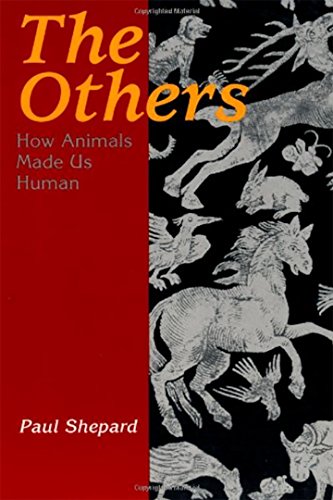
The Others is a fascinating and wide-ranging examination of how diverse cultures have thought about, reacted to, and interacted with animals. Shepard argues that humans evolved watching other animal species, participating in their world, suffering them as parasites, wearing their feathers and skins, and making tools of their bones and antlers. For millennia, we have communicated their significance by dancing, sculpting, performing, imaging, narrating, and thinking them. The human species cannot be fully itself without these others.
Shepard considers animals as others in a world where otherness of all kinds is in danger, and in which otherness is essential to the discovery of the true self. We must understand what to make of our encounters with animals, because as we prosper they vanish, and ultimately our prosperity may amount to nothing without them.
Die Inhaltsangabe kann sich auf eine andere Ausgabe dieses Titels beziehen.
Über die Autorin bzw. den Autor
Before his death in 1996, Paul Shepard was Avery Professor of Human Ecology and Natural Philosophy at Pitzer College and the Claremont Graduate School. Among his books are The Others: How Animals Make Us Human (Island Press/ Shearwater Books, 1995) and Encounters with Nature, (Island Press/Shearwater Books, 1999).
Auszug. © Genehmigter Nachdruck. Alle Rechte vorbehalten.
The Others
How Animals Made Us Human
By Paul ShepardISLAND PRESS
Copyright © 1996 Paul Shepard
All rights reserved.
ISBN: 978-1-55963-434-2All rights reserved.
Contents
Title Page,
Copyright Page,
Dedication,
Epigraph,
Introduction: The Encounter,
PART I - The Animal Fare,
1 - The Ecological Doorway to Symbolic Thought,
2 - The Swallow,
PART II - Cognition,
3 - The Skills of Cognition: Pigeonholes, Dinosaurs, and Hobbyhorses,
4 - Savanna Dreaming: The Fox at the Fringe of the Field,
PART III - Identify,
5 - The Self as Menagerie,
6 - Aping the Others,
7 - The Ecology of Narration,
8 - Membership,
PART IV - Change,
9 - The Masters of Transformation,
10 - Heads, Faces, and Masks,
11 - The Pet World,
12 - The Gift of Music,
13 - Ontogeny Revisited: Teddy, Pooh, Paddington, Yogi, and Smokey,
PART V - The Cosmos,
14 - The Meaning of Dragons and Why the Gods Ride on Animals,
15 - Augury and Holograms,
16 - Bovine Epiphanies: Fecundity and Power,
17 - Lying Down with Lambs and Lions in the Christian Zoo,
18 - Hounding Nature: The Nightmares of Domestication,
PART VI - Counterplayers,
19 - The Miss Muffet Syndrome: Fearing Animals,,
20 - Cuckoo Clocks and Bluebirds of Happiness: Animals as Machines,
21 - The Great Interspecies Confusion,
22 - Final Animals and Economic Imperatives,
23 - Rights and Kindness: A Can of Worms,
24 - The Many and the Fuzzy: Plurality and Ambiguity,
Notes,
Acknowledgments,
Index,
CHAPTER 1
The Ecological Doorway to Symbolic Thought
One must die into creaturehood, transcending the assurances of "programmed cultural heroics. "Being a self-conscious animal means "to know that one is food for worms. "This is the terror: to have emerged from nothing, to have a name, consciousness of self, deep inner feelings, and excruciating inner yearning for life and self-expression—and with all this yet to die.
ERNEST BECKER
THE HUMAN MIND is the result of a long series of interactions with other animals. The mind is inseparable from the brain, which evolved among our primate ancestors as part of an ecological heritage. That heritage began with life on the ground, continued in the trees, and millions of years later came back to the ground. This upstairs-downstairs legacy, arboreal and terrestrial, is not unique to our descent but is widespread among monkeys and apes, so that to understand our kind of consciousness—higher-level thinking, artistic expression, and abstraction—requires some further explanation and is linked to our perception of animals in a roundabout way.
What follows is a possible scenario, spanning some sixty million years, beginning with the earliest primate, a ground-squirrel-like form living among the roots and leafy debris beneath the great ceiling of tropical forest. As this creature was nocturnal in habit, its sensory life was dominated by smell and sound rather than sight, by sniffing scent marks and the trails of beetles or listening to the scurry of feet, the faint popping of worms, or the calls and rustle that meant danger. Like redolent tracks making a course through the underbrush, the sequence of sounds was a trail of exclamations marking the position of some shifting body, a series informing the listener—the little, furry, pre-primate grubbers in the dark—of the movement of food, danger, others. Repeated sounds, remembered, revealed changes in position and movement, signaling whether something was approaching or receding or passing by. It required a good brain to hold that pattern in mind—marking the creation of an auditory world in which rhythms and musical phrases such as the successive notes of birdsong are heard as a melody. The writer and paleontologist Loren Eiseley referred to this as "time-binding."
Some descendents of those first tree-shrew ancestors went from the ground into the trees, perhaps as the flowering trees replaced coniferous forests over much of the tropics. In time, some of their descendents would be monkeys. In their brains were the neural networks making the recognition of patterns of sound possible. Remembering from one moment to the next—time-binding—by the listening mind was extended to vision, providing the primates with a mental basis for eliding sight into visual fields and visual fields into a visual world. The first step in our thinking was in that arboreal reorganization of an obsolete sound/smell memory by transferring its function to the eyes. Color vision returned—that extraordinary reptilian adjunct to keen sight, surrendered by the early mammals in the dark, lost still to most families of mammals. The early monkeys, in those tropical forest canopies, also altered the central nervous system by linking emotion to awareness of novelty and change, creating monkey excitability and sentient behavior. A great leap in brain size, unmatched among most other mammals, succeeded our ancestral primates' ascent into the trees, associated with pioneering a hazardous life in three dimensions, coping with storms, leopards, snakes, eagles, and gravity.
Speed in the trees nourished intelligence. Other animals live in trees without becoming large-brained, but for the primates life in three dimensions seems to have entailed the fourth, a subjectivity of time itself, implicated in their life strategy. That strategy included an intense and unrelenting social association. If any generalization can be made of simians that illuminates our own nature and our relations to other animals it is an "attention structure" which turns all information into social significance and is keyed to nuance and change in the visual world.
The drama which began when some small, nose-twitching mammals left the night shift in the basement of the tropics and scurried up into the branching trails of the bright upper canopy climaxed when their descendents took their shrill and panicky ways, their color vision, excellent brains, and devotion to the social context of all information, back down from the trees, out of the deep forest, and into the savannas. There the venatic (hunting /eluding) game of the predator and prey was played. Mind would be the child of the hunt. The prehumans joined a long-standing cybernetic system in which two great groups of savanna mammals—large carnivores and the herbivores upon which they preyed—linked destinies in a game of escalating wit.
In order to appreciate that game we must interrupt this account of our prehistory to examine the Game as it had been played for forty million years. Mind was evolving among the large predatory and prey mammals in open country. The fossil skulls of these hoofed and pawed forms reveal their progressively increasing brain size and the physical evidence of continuous improvement in the ability of each group to think through its situation and anticipate the moves of those to whom it was bound by the eternal ties of the hunt. As the complexity of their brains increased and their cognition became more subtle, they began to know the world by constructing mental representations of reality rather than simply responding to signals. How rare this event was can be seen in brain evolution in general. We brainy primates think of cognitive ability as being so valuable that evolution should always favor larger brain size; but beyond the size needed for basic bodily functions, brains are biologically expensive and risky. Flexibility in behavior and a...
„Über diesen Titel“ kann sich auf eine andere Ausgabe dieses Titels beziehen.
Weitere beliebte Ausgaben desselben Titels

Suchergebnisse für The Others, P: How Animals Made Us Human

Foto des Verkäufers
The Others: How Animals Made Us Human
Anbieter: Dream Books Co., Denver, CO, USA
Verkäuferbewertung 5 von 5 Sternen

Zustand: acceptable. This copy has clearly been enjoyedâ"expect noticeable shelf wear and some minor creases to the cover. Binding is strong, and all pages are legible. May contain previous library markings or stamps. Artikel-Nr. DBV.1559634340.A
Gebraucht kaufen
EUR 16,72
Versand gratis
Versand innerhalb von USA
Versand innerhalb von USA
Anzahl: 1 verfügbar
Beispielbild für diese ISBN
The Others How Animals Made Us Human
Anbieter: Revaluation Books, Exeter, Vereinigtes Königreich
Verkäuferbewertung 5 von 5 Sternen
Paperback. Zustand: Brand New. 1st edition. 384 pages. 9.50x6.00x1.00 inches. In Stock. Artikel-Nr. x-1559634340
Neu kaufen
EUR 97,66
EUR 14,41 Versand
Versand von Vereinigtes Königreich nach USA
Versand von Vereinigtes Königreich nach USA
Anzahl: 2 verfügbar
Foto des Verkäufers
OTHERS P
Anbieter: moluna, Greven, Deutschland
Verkäuferbewertung 5 von 5 Sternen
Zustand: New. Shepard shows how the human relationship with animals has altered over time: as we have prospered, they have vanished.KlappentextPaul Shepard has been one of the most brilliant and original thinkers in the field of human evolution an. Artikel-Nr. 596318512
Neu kaufen
EUR 75,37
EUR 48,99 Versand
Versand von Deutschland nach USA
Versand von Deutschland nach USA
Anzahl: Mehr als 20 verfügbar
Foto des Verkäufers
The Others : How Animals Made Us Human
Anbieter: AHA-BUCH GmbH, Einbeck, Deutschland
Verkäuferbewertung 5 von 5 Sternen
Taschenbuch. Zustand: Neu. Neuware - Paul Shepard has been one of the most brilliant and original thinkers in the field of human evolution and ecology for more than forty years. His thought-provoking ideas on the role of animals in human thought, dreams, personal identity, and other psychological and religious contexts have been presented in a series of seminal writings, including Thinking Animals, The Tender Carnivore and the Sacred Game, and now The Others, his most eloquent book to date. Artikel-Nr. 9781559634342
Neu kaufen
EUR 101,20
EUR 62,61 Versand
Versand von Deutschland nach USA
Versand von Deutschland nach USA
Anzahl: 2 verfügbar