
Verwandte Artikel zu Pronouncing Dictionary of Proper Names: Pronunciations...
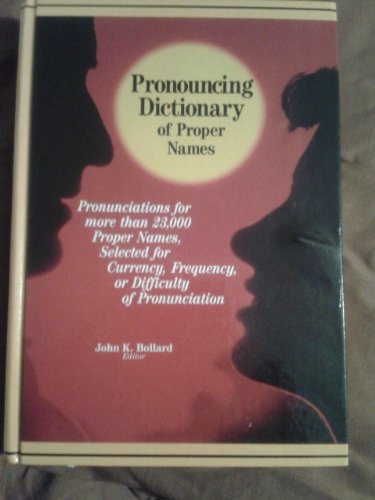
Pronouncing Dictionary of Proper Names: Pronunciations for More Than 23,000 Proper Names, Selected for Currency, Frequency, or Difficulty of Pronunc - Hardcover
Rezensionen
"Traditional lexicography meets the latest technology" proclaims the press release accompanying this book. Pronunciation for 23,000 names is given in two forms: simple respelling and the International Phonetic Alphabet (IPA) used by linguists. After pronunciations were written by editor Bollard, they were loaded into a speech-synthesizing computer and the synthesized entries were listened to for correction and refinement.
Entries include place-names currently in the news and "other important places, celebrities, political and historical figures, company and product names, biblical names, and literary references." There is a strong emphasis on current names, which may explain the inclusion of the pop groups INXS and Depeche Mode, and the exclusion of ABBA. On the other hand, the Marquis de Sade is included, but pop singer Sade is not. An emphasis on terms "difficult to pronounce" does not explain the inclusion of Bruce Willis and Hal Linden. Some names that are important in the academic world are not here: no Simone Weil, Merleau Ponty, or Julia Kristeva, for example. Also lacking are TV star Xuxa and Serbian president Slobodan Milosevic.
The introduction explains variant U.S. regional pronunciation for such words as Mary and the two pronunciation systems used in the book. The running footers on each page of text provide a key to the respelled pronunciations. A key to the symbols used in the IPA is on the endsheet.
Some of these personal and place-names will appear in geographic dictionaries or in desk dictionaries, though usually only with some variant of IPA pronunciation. Several encyclopedias provide pronunciation for places and people that appear as entries. The NBC Handbook of Pronunciation (4th ed., rev., Harper, 1991) also uses a respelling system for more than 21,000 words, but most are not proper names. Although it's unfortunate that the Pronouncing Dictionary wastes space on such names as Sonny Bono and Toni Tenille, academic and public libraries will want to consider purchase.
Not a comprehensive pronouncing dictionary, this new volume concentrates on 23,000 proper names most frequently found in speech, broadcast, and print. Comparable American pronouncing dictionaries are becoming quite dated, with NBC Handbook of Pronunciation (HarperCollins, 1984. 4th ed.) and Samuel Noory's Dictionary of Pronunciation (Cornwall Bks., 1981. 4th ed.) the major works in the field. Pronunciations appear in side-by-side columns in both an easy-to-understand respelling system, which uses combinations of letters to represent sounds and keeps diacriticals and other symbols to a minimum, and in the symbols of the International Phonetic Alphabet used by language specialists and in standard dictionaries. The names are briefly identified but not fully defined. Pronunciations reflect variations in American dialects and represent local or personal pronunciation. For instance, Maya Angelou's own pronunciation of her last name is given in addition to two other common pronunciations. This work is easy to use and well designed; a key to the respelling system appears at the foot of each page, with a fuller form of the key printed inside the front and back covers. The explanations contained in the introduction are detailed and useful. Recommended for most collections.
- Paul D'Alessandro, Portland P.L., Me.
Copyright 1993 Reed Business Information, Inc.
„Über diesen Titel“ kann sich auf eine andere Ausgabe dieses Titels beziehen.
Suchergebnisse für Pronouncing Dictionary of Proper Names: Pronunciations...

Beispielbild für diese ISBN
Pronouncing Dictionary of Proper Names: Pronunciations for More Than 23,000 Proper Names, Selected for Currency, Frequency, or Difficulty of Pronunciation
Verlag:
Omnigraphics (edition ), 1992
ISBN 10: 1558883118
ISBN 13: 9781558883116
Gebraucht
Hardcover
Anbieter: BooksRun, Philadelphia, PA, USA
Verkäuferbewertung 5 von 5 Sternen

Hardcover. Zustand: Fair. The item might be beaten up but readable. May contain markings or highlighting, as well as stains, bent corners, or any other major defect, but the text is not obscured in any way. Artikel-Nr. 1558883118-7-1
Gebraucht kaufen
EUR 11,69
Versand gratis
Versand innerhalb von USA
Versand innerhalb von USA
Anzahl: 1 verfügbar
Beispielbild für diese ISBN
Pronouncing Dictionary of Proper Names: Pronunciations for More Than 23,000 Proper Names, Selected for Currency, Frequency, or Difficulty of Pronunciation
Anbieter: ThriftBooks-Atlanta, AUSTELL, GA, USA
Verkäuferbewertung 5 von 5 Sternen
Hardcover. Zustand: Good. No Jacket. Pages can have notes/highlighting. Spine may show signs of wear. ~ ThriftBooks: Read More, Spend Less. Artikel-Nr. G1558883118I3N00
Gebraucht kaufen
EUR 13,77
Versand gratis
Versand innerhalb von USA
Versand innerhalb von USA
Anzahl: 1 verfügbar
Beispielbild für diese ISBN
Pronouncing Dictionary of Proper Names: Pronunciations for More Than 23,000 Proper Names, Selected for Currency, Frequency, or Difficulty of Pronunciation
Anbieter: ThriftBooks-Phoenix, Phoenix, AZ, USA
Verkäuferbewertung 5 von 5 Sternen
Hardcover. Zustand: Good. No Jacket. Pages can have notes/highlighting. Spine may show signs of wear. ~ ThriftBooks: Read More, Spend Less. Artikel-Nr. G1558883118I3N00
Gebraucht kaufen
EUR 13,77
Versand gratis
Versand innerhalb von USA
Versand innerhalb von USA
Anzahl: 1 verfügbar
Beispielbild für diese ISBN
Pronouncing Dictionary of Proper Names : Pronunciations of the Names of Notable People, Places and Things
Verlag:
Omnigraphics, Incorporated, 1993
ISBN 10: 1558883118
ISBN 13: 9781558883116
Gebraucht
Hardcover
Anbieter: Better World Books, Mishawaka, IN, USA
Verkäuferbewertung 5 von 5 Sternen
Zustand: Very Good. Former library copy. Pages intact with possible writing/highlighting. Binding strong with minor wear. Dust jackets/supplements may not be included. Includes library markings. Stock photo provided. Product includes identifying sticker. Better World Books: Buy Books. Do Good. Artikel-Nr. 2684570-6
Gebraucht kaufen
EUR 13,91
Versand gratis
Versand innerhalb von USA
Versand innerhalb von USA
Anzahl: 1 verfügbar
Beispielbild für diese ISBN
Pronouncing Dictionary of Proper Names : Pronunciations of the Names of Notable People, Places and Things
Verlag:
Omnigraphics, Incorporated, 1993
ISBN 10: 1558883118
ISBN 13: 9781558883116
Gebraucht
Hardcover
Anbieter: Better World Books, Mishawaka, IN, USA
Verkäuferbewertung 5 von 5 Sternen
Zustand: Good. Former library copy. Pages intact with minimal writing/highlighting. The binding may be loose and creased. Dust jackets/supplements are not included. Includes library markings. Stock photo provided. Product includes identifying sticker. Better World Books: Buy Books. Do Good. Artikel-Nr. 2684569-75
Gebraucht kaufen
EUR 13,91
Versand gratis
Versand innerhalb von USA
Versand innerhalb von USA
Anzahl: 1 verfügbar