
Verwandte Artikel zu Successful Kindergarten Transition: Your Guide to Connecting...
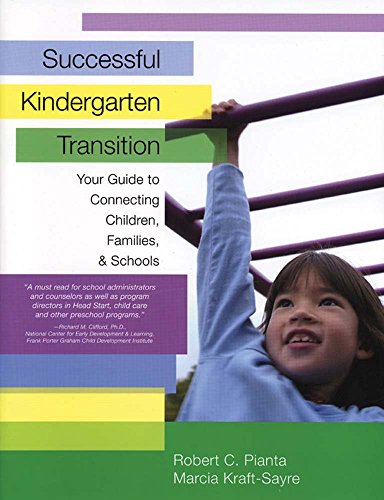
Successful Kindergarten Transition: Your Guide to Connecting Children, Families, and Schools: Your Guide to Connecting Children, Families, & Schools - Softcover
Inhaltsangabe
A smooth transition to kindergarten is an essential part of a child's early academic experience—and now there's a how-to handbook with field-tested methods to help schools and programs make it happen. Perfect for preschool and kindergarten teachers, administrators, and family support specialists, this practical guide is built around a model that has been adopted in many diverse schools and communities. Step by step, the book helps professionals and caregivers
- Develop a solid transition plan. Readers will learn how to form a collaborative team; foster strong social connections among children, families, and professionals; create a menu of transition activities that can be tailored to each child's needs; and establish a timeline for putting the transition plan into action.
- Implement the plan. Readers will discover how to anticipate barriers; keep families involved; and conduct ongoing assessment, evaluation, and revision of transition activities. Appendices include photocopiable forms such as brainstorming sheets, parent interview forms, timeline worksheets, and questionnaires for teachers, principals, and family workers.
- Stay motivated and inspired. Readers will learn from the experience of others with insight from real families, educators, and school personnel, plus sample menus of activities they can use in their own homes and classrooms.
A must-read for everyone involved in early education, this hands-on resource can help make the transition to kindergarten smoother—for young children and the professionals and families who care about them.
Die Inhaltsangabe kann sich auf eine andere Ausgabe dieses Titels beziehen.
Über die Autorin bzw. den Autor
Robert C. Pianta, Ph.D., is Dean of the Curry School of Education, Director of the Center for Advanced Study in Teaching and Learning and Novartis U.S. Foundation Professor of Education at the University of Virginia, Charlottesville. A former special education teacher, Dr. Pianta is a developmental, school, and clinical child psychologist whose work focuses on assessment and improvement of teacher-student interactions and their role in fostering children's learning and development.
Dr. Pianta is a principal investigator on several major grants including the National Center for Research in Early Childhood Education and the Virginia Education Sciences Training Program, and he has worked closely with the Gates Foundation-funded Measure of Effective Teaching project.
He is the author of more than 250 journal articles, chapters, and books in the areas of early childhood education, teacher performance assessment, professional development, and teacher–child relationships, and he consults regularly with federal agencies, foundations and universities.
Marcia Kraft-Sayre, L.C.S.W., is Regional Project Coordinator for the National Center for Early Development & Learning (NCEDL) Multi-State Study of Pre-Kindergarten at the University of Virginia. She has also served as Coordinator for the NCEDL Kindergarten Transition Project. Her current work entails managing data collection for a national study of state-funded prekindergarten programs. She is the co-author of several articles about the transition to kindergarten. For 15 years prior to coming to NCEDL, she worked as a clinical social worker with children and families in mental health and medical settings.
Auszug. © Genehmigter Nachdruck. Alle Rechte vorbehalten.
Excerpted from Chapter 1 of Successful Kindergarten Transition: Your Guide to Connecting Children, Families, and Schools
By Robert C. Pianta, Ph.D., and Marcia Kraft-Sayre, L.C.S.W.
Copyright ©2003. Brookes Publishing. All rights reserved.
By Robert C. Pianta, Ph.D., and Marcia Kraft-Sayre, L.C.S.W.
Copyright ©2003. Brookes Publishing. All rights reserved.
MODELS OF TRANSITION
Children's transition into kindergarten can be considered in a variety of ways. To understand the approach to transition described in this volume, it is useful to describe other models of transition. Four ways to think about transition are 1)a skills only model that targets children's skills as the key influence on school adjustment, 2) anenvironmental input model, in which children's skills at any given time are influenced by their experiences in key settings, 3) alinked environments model that, building on the others, recognizes the importance of connections across settings (e.g., relationships between parents and preschool providers), and 4) adevelopmental model of transition, which incorporates all of the elements of the prior models, emphasizes connections and linkages across settings over time, and also informs our approach. (See Rimm-Kauffman & Pianta, 2001, for a fuller discussion of these models.)
The following presentation of the models of transition is not an academic exercise removed from the reality of practices and experiences—it is a useful tool that reflects them. The description of each model presents quotations from interviews we conducted with parents, teachers, school administrators, and other professionals connected with transition planning. The quotations offer a glimpse into the ways that these different people experience transition and the ideas that guide their work.
Skills Only Model
The skills only model is a child-focused perspective that views the transition to kindergarten in terms of the abilities and skills the child brings with him or her on the first day of school (see Figure 1.1). School adjustment is understood in terms of child characteristics, such as readiness and level of maturation.
"You start seeing behavior problems and adjustment problems in preschool. Sometimes at the start of kindergarten, it can still be just a maturity issue, but if it is a maturity issue, then at the end of kindergarten and the beginning of first grade they get over it."
Furthermore, in this model, children's problems in school may not be viewed as related to their transition experiences. Transition, in this case, is narrowly defined:
"This child doesn't have any problems with transition even though she has other issues, academic issues that I see, but not transition issues."
Although children's skills and abilities do indeed play a role in their adjustment to school (Alexander & Entwisle, 1988; Christian, Morrison, & Bryant, 1998), their skills and abilities do not account for the majority of individual differences in children's school adjustment (LaParo & Pianta, 1998; Pianta & McCoy, 1997). For example, measures of children's academic and cognitive abilities and skills in preschool account for less than 30% of the differences in these skills among children once they enter kindergarten. Measurements of the social skills valued by kindergarten teachers as signs of adjustment correspond even less in preschool and kindergarten. Thus, understanding transition outcomes requires focusing on influences on school outcomes beyond characteristics of the child.
Environmental Input Model
The environmental input model describes experiences in a variety of social settings as contributing to children's skills and adjustment at any given time (see Figure 1.2). Input from experiences with family, peers, school, and community settings affect the child's skills. For example, peer relationships and classroom characteristics, such as class size and classroom quality, influence the child's performance (Graue, 1999; Howes, 1990; Ladd & Price, 1987). Many people who agree with this model of transition believe that social experiences outside of school (e.g., whether a parent reads to the child, teaches him or her letters, or shows the child how to tie a shoe) can affect how a child adjusts to school.
School adjustment is viewed as a function of the structure and emotional climate of the classroom. Positive teacher qualities, a clear structure, and older peers serving as buddies can help children's transition to the new environment:
"Having nurturing qualities in teachers is what really helps any kid get used to school as a first-time experience."
"Setting limits and having a routine for them are important."
"I try to keep my schedule exactly the same, and if I can do that for them, then they're fine."
What is missing from this model is an emphasis on experiences over time and how different settings are connected to one another. The teachers quoted here do not see transition and school adjustment as interrelated processes. For them, the adjustment to school pertains strictly to what happens in the kindergarten classroom and not to the child's family relationships or previous experiences. These teachers understand transition as occurring only within this setting, and they do not connect this context with other contexts, such as the home environment or preschool experiences. Nor are contexts viewed as interacting over time. For example, this teacher does not see parental factors as related to children's adjustment:
"I don't think the parent's expectations really have a lot to do with how well the kids [make the] transition. Those are just parent issues that they have sometimes coming from certain situations, but that doesn't really make a difference to me at least with how the kids do."Linked Environments Model
The linked environments model includes the ways in which connections between key settings or people in key settings in the child's life (e.g., the parents' comfort and communication with the preschool teacher) can affect the child's adjustment. In the linked environments model, children's skills; experiences with family, peers, schools, and the community; and the connections among people and settings all influence school adjustment at a given time (see Figure 1.3). For example, family involvement indirectly influences children's school success. Strong connections between families and schools are linked with positive child outcomes beyond any direct effect the families or the schools have on children (Epstein, 1996; Reynolds, 1989). Although this model considers the interactions of multiple relationships surrounding the child, it regards these relationships as static rather than as developing over time.
Whereas some kindergarten teachers do not identify previous experiences and family background as contributing to children's school adjustment, others believe that positive family environments, preschool, and other structured experiences contribute to a successful transition. If children lack these experiences or face emotional challenges, teachers often feel that the adjustment to kindergarten may be a problem:
"Just the fact that they are in a preschool and doing something and not doing whatever they might do at home — at least they're being exposed to books one year earlier."
"I find the hardest children to deal with here in the classroom are those who are able to run free at home, who don't have the structure, and whose parents don't have control."
"The ones that have the biggest problems are the ones that haven't had a routine, and don't know what that is to have some expectations." These teachers mention the importance of parent attitude and involvement in promoting children's adjustment. Parents' comfort level influences the transition for children:
"Parents' attitude plays a big part. If a parent...
„Über diesen Titel“ kann sich auf eine andere Ausgabe dieses Titels beziehen.
Suchergebnisse für Successful Kindergarten Transition: Your Guide to Connecting...

Beispielbild für diese ISBN
Successful Kindergarten Transition: Your Guide to Connecting Children, Families, and Schools
Anbieter: World of Books (was SecondSale), Montgomery, IL, USA
Verkäuferbewertung 5 von 5 Sternen

Paperback. Zustand: Good. This handbook includes methods to help schools and programmes make the transition to kindergarten happen smoothly. The guide is built around a model that has been adopted in many diverse schools and communities. It helps professionals develop a transition plan and implement the plan. Artikel-Nr. 00049233126
Gebraucht kaufen
EUR 4,88
Versand gratis
Versand innerhalb von USA
Versand innerhalb von USA
Anzahl: 3 verfügbar
Beispielbild für diese ISBN
Successful Kindergarten Transition: Your Guide to Connecting Children, Families, and Schools
Verlag:
Brookes Publishing (edition Care about Them. ed.), 2003
ISBN 10: 1557666156
ISBN 13: 9781557666154
Gebraucht
Paperback
Anbieter: BooksRun, Philadelphia, PA, USA
Verkäuferbewertung 5 von 5 Sternen
Paperback. Zustand: Very Good. Care about Them. ed. It's a well-cared-for item that has seen limited use. The item may show minor signs of wear. All the text is legible, with all pages included. It may have slight markings and/or highlighting. Artikel-Nr. 1557666156-11-1
Gebraucht kaufen
EUR 5,35
Versand gratis
Versand innerhalb von USA
Versand innerhalb von USA
Anzahl: 1 verfügbar
Beispielbild für diese ISBN
Successful Kindergarten Transition : Your Guide to Connecting Children, Families, & Schools
Anbieter: Better World Books, Mishawaka, IN, USA
Verkäuferbewertung 5 von 5 Sternen
Zustand: Good. Pages intact with minimal writing/highlighting. The binding may be loose and creased. Dust jackets/supplements are not included. Stock photo provided. Product includes identifying sticker. Better World Books: Buy Books. Do Good. Artikel-Nr. 6480772-6
Gebraucht kaufen
EUR 6,56
Versand gratis
Versand innerhalb von USA
Versand innerhalb von USA
Anzahl: 2 verfügbar
Beispielbild für diese ISBN
Successful Kindergarten Transition Your Guide to Connecting Children, Families, and Schools
Anbieter: Revaluation Books, Exeter, Vereinigtes Königreich
Verkäuferbewertung 5 von 5 Sternen
Paperback. Zustand: Brand New. 1st edition. 124 pages. 10.50x8.25x0.50 inches. In Stock. Artikel-Nr. __1557666156
Neu kaufen
EUR 31,74
EUR 11,84 Versand
Versand von Vereinigtes Königreich nach USA
Versand von Vereinigtes Königreich nach USA
Anzahl: 2 verfügbar
Beispielbild für diese ISBN
Successful Kindergarten Transition: Your Guide to Connecting Children, Families, & Schools
Anbieter: Kennys Bookstore, Olney, MD, USA
Verkäuferbewertung 5 von 5 Sternen
Zustand: New. This handbook includes methods to help schools and programmes make the transition to kindergarten happen smoothly. The guide is built around a model that has been adopted in many diverse schools and communities. It helps professionals develop a transition plan and implement the plan. Num Pages: 128 pages. BIC Classification: JNLA; VFXC. Category: (G) General (US: Trade); (P) Professional & Vocational. Dimension: 278 x 218 x 8. Weight in Grams: 402. . 2003. 1st Edition. Paperback. . . . . Books ship from the US and Ireland. Artikel-Nr. V9781557666154
Neu kaufen
EUR 45,45
EUR 9,36 Versand
Versand innerhalb von USA
Versand innerhalb von USA
Anzahl: 1 verfügbar
Beispielbild für diese ISBN
Successful Kindergarten Transition
Anbieter: PBShop.store UK, Fairford, GLOS, Vereinigtes Königreich
Verkäuferbewertung 5 von 5 Sternen
PAP. Zustand: New. New Book. Shipped from UK. Established seller since 2000. Artikel-Nr. FW-9781557666154
Neu kaufen
EUR 59,76
EUR 4,92 Versand
Versand von Vereinigtes Königreich nach USA
Versand von Vereinigtes Königreich nach USA
Anzahl: 2 verfügbar
Beispielbild für diese ISBN
Successful Kindergarten Transition: Your Guide to Connecting Children, Families, and Schools
Anbieter: Ria Christie Collections, Uxbridge, Vereinigtes Königreich
Verkäuferbewertung 5 von 5 Sternen
Zustand: New. In English. Artikel-Nr. ria9781557666154_new
Neu kaufen
EUR 54,46
EUR 13,36 Versand
Versand von Vereinigtes Königreich nach USA
Versand von Vereinigtes Königreich nach USA
Anzahl: 2 verfügbar
Foto des Verkäufers
Successful Kindergarten Transition : Your Guide to Connecting Children, Families, and Schools
Verlag:
Brookes Publishing Company Mai 2003, 2003
ISBN 10: 1557666156
ISBN 13: 9781557666154
Neu
Taschenbuch
Anbieter: AHA-BUCH GmbH, Einbeck, Deutschland
Verkäuferbewertung 5 von 5 Sternen
Taschenbuch. Zustand: Neu. Neuware - A smooth transition to kindergarten is an essential part of a child's early academic experience, and this handbook aims to make it happen. It is built around a model that has been adopted in many diverse schools and communities, and aims to help professionals and caregivers. Readers will learn how to form a collaborative team, foster strong social connections among children, families and professionals, and create a ''menu'' of transition activities that can be tailored to each child's needs. Also readers will discover how to anticipate barriers, keep families involved, and conduct ongoing assessment, evaluation, and revision of transition activities. They will learn from the experience of others with insight from real families, educators, and school personnel, plus sample menus of activities they can use in their own homes and classrooms. Artikel-Nr. 9781557666154
Neu kaufen
EUR 53,53
EUR 35,00 Versand
Versand von Deutschland nach USA
Versand von Deutschland nach USA
Anzahl: 2 verfügbar
Foto des Verkäufers
Successful Kindergarten Transition: Your Guide to Connecting Children, Families, and Schools
Anbieter: moluna, Greven, Deutschland
Verkäuferbewertung 5 von 5 Sternen
Zustand: New. This handbook includes methods to help schools and programmes make the transition to kindergarten happen smoothly. The guide is built around a model that has been adopted in many diverse schools and communities. It helps professionals develop a transition p. Artikel-Nr. 669501156
Neu kaufen
EUR 40,10
EUR 48,99 Versand
Versand von Deutschland nach USA
Versand von Deutschland nach USA
Anzahl: 2 verfügbar