
Verwandte Artikel zu Midway: The Battle That Doomed Japan, the Japanese...
Inhaltsangabe
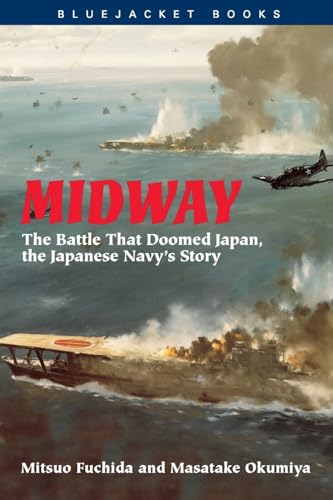
This landmark study was first published in English by the Naval Institute in 1955 and was added to the Classics of Naval Literature series in 1992. Widely acknowledged for its valuable Japanese insights into the battle that turned that tide of war in the Pacific, the book has made a great impact on American readers over the years. Two Japanese naval aviators who participated in the operation provide an unsparing analysis of what caused Japan's staggering defeat.
Mitsuo Fuchida, who led the first air strike on Pearl Harbor, commanded the Akagi carrier air group and later made a study of the battle at the Japanese Naval War College. Masatake Okumiya, one of Japan's first dive-bomber pilots, was aboard the light carrier Ryujo and later served as a staff officer in a carrier division. Armed with knowledge of top-secret documents destroyed by the Japanese and access to private papers, they show the operation to be ill-conceived and poorly planned and executed, and fault their flag officers for lacking initiative, leadership, and clear thinking. With an introduction by an author known for his study of the battle from the American perspective, the work continues to make a significant contribution to World War II literature.
Die Inhaltsangabe kann sich auf eine andere Ausgabe dieses Titels beziehen.
Über die Autorin bzw. den Autor
Mitsuo Fuchida became a Lutheran bishop after the war and continued writing until his death in 1974. Masatake Okumiya became a member of Japan's air self-defense force after the war and was active as a historian until his death.
Auszug. © Genehmigter Nachdruck. Alle Rechte vorbehalten.
Midway
The Battle That Doomed Japan, the Japanese Navy's StoryBy Mitsuo FuchidaBluejacket Books
Copyright © 2001 Mitsuo FuchidaAll right reserved.
ISBN: 9781557504289
Chapter One
Sortie from Hashirajima
A day broke over the western Inland Sea on 27 May1942, the sun's rays slanted down on the greatestconcentration of Japanese fleet strength since the start ofthe Pacific War.
The setting was at the island of Hashirajima, which liesto the south of the well-known city of Hiroshima andsoutheast of the lesser-known coastal town of Iwakuni.The anchorage at Hashirajima is surrounded by hilly littleislands, most of which are cultivated from water's edgeto summit. Camouflaged antiaircraft batteries atop almostevery hill belied the peaceful appearance of these islands.The anchorage was large enough to accommodate the entireJapanese Navy and was well off the ordinary routes ofmerchant ships. It was a wartime stand-by anchorage forCombined Fleet, whose headquarters had been functioningin safety from a battleship group stationed there sincethe start of the war. It had remained there so long, in fact,that naval officers had come to speak of Combined FleetHeadquarters simply as "Hashirajima."
Within the anchorage Commander in Chief CombinedFleet Admiral Isoroku Yamamoto's 68,000-ton flagship,Yamato, was moored to a red buoy. Underwater cablesto shore permitted instant communication with Tokyo.Gathered around Yamato were a total of 68 warships, constitutingthe greater part of the surface strength of theCombined Fleet.
Admiral Yamamoto's Battleship Division 1 consisted ofYamato, Nagato, and Mutsu, which with Ise, Hyuga, Fuso,and Yamashiro of Battleship Division 2 made the total ofseven battleships. Torpedo nets were extended aroundeach of these giants. Pearl Harbor had impressed on usthe importance of protecting ships against torpedo attacks,even in home waters. The other ships were disposedaround the battleships as further protection against attacksby planes or submarines. There were light cruisers Kitakamiand Oi of Cruiser Division 9, flagship Sendai and 12destroyers of Destroyer Squadron 3, eight destroyers ofDestroyer Squadron 1, light carrier Hosho with one destroyerand two torpedo boats, and seaplane carriers Chiyodaand Nisshin, each of which had six midget submarineson board.
All these ships and units except Battleship Division 1belonged to the First Fleet commanded by Vice AdmiralShiro Takasu, whose flag flew in Ise. Both the First Fleetand Battleship Division 1 had remained at Hashirajimasince the outbreak of war, awaiting an opportunity fordecisive surface battle. Aviators of the Carrier Force sarcasticallyreferred to them as the "Hashirajima Fleet."
The 21 ships of our force, commanded by Vice AdmiralChuichi Nagumo, were anchored to the north of the so-called"main strength" just described. To the west of uswas a force under Vice Admiral Nobutake Kondo, commanderof the Second Fleet. Here were heavy cruisersAtago (Kondo's flagship) and Chokai of Cruiser Division4, Myoko and Haguro of Cruiser Division 5, fast battleshipsHiei and Kirishima of Battleship Division 3, light cruiserYura and seven destroyers of Destroyer Squadron 4, andlight carrier Zuiho with one destroyer.
This massive gray armada swung silently at anchor, eachship riding low in the water under a full load of fuel andsupplies taken on board at Kure in preparation for thesortie. The only traffic in the whole area consisted of chuggingyellow Navy tugboats which emitted heavy blacksmoke from their tall stacks. On board the warships therewas little evidence of activity other than the occasionalfluttering of signal flags as messages were exchanged. Butdespite the general quiet of the anchorage, one felt theexcitement permeating the entire fleet.
It was Navy Day, the anniversary of Admiral Togo'sgreat victory over the Russian Fleet in the Battle of Tsushima.Japan's achievements during the first six months ofwar in the Pacific seemed to rival that triumph of 37 yearsearlier. Spirits were high—and why not? Now we wereembarking on another mission which we confidentlythought would add new glory to the annals of the ImperialNavy.
At 0800 Akagi's ensign was raised. Then on her signalmast went up a single flag which gave the tensely awaitedorder, "Sortie as scheduled!"
Standing at the flight deck control post, I turned towatch the ships of Destroyer Squadron 10. White watersplashed from the anchor cables of each destroyer, washingmud from the heavy links as they dragged through thehawseholes. The destroyers soon began to move, and theywere followed by Cruiser Division 8, the second sectionof Battleship Division 3, and Carrier Divisions 1 and 2, inthat order. The Nagumo Force was on its way toward thescene of one of the most significant naval actions in history.
As we steamed out of the anchorage the ships of theother forces, which would sortie two days later, gave us arousing send-off. The crews lined the rails and cheeredand waved their caps as we passed. They seemed to envyour good fortune in being the first to leave. We wavedback a farewell, and a general gaiety prevailed. Every manwas convinced that he was about to participate in yet anotherbrilliant victory.
Two hours later we were halfway across the Iyonada andbefore long would enter Bungo Strait. Beyond the strait itwas expected that we might encounter enemy submarines.Combined reports on their activities were sent out dailyfrom Imperial General Headquarters. Latest reports indicatedthat a dozen or more of them were operating closeto the homeland, reporting on ship movements and seekingto destroy our lines of communication. Occasionallythey would send radio reports to Pearl Harbor, and it wasat such times that our scattered radio direction finderswould endeavor to spot them.
Akagi, the sleek aircraft carrier flagship of Admiral Nagumo,headed westward through Kudako Strait, cruisingeasily at 16 knots on her course toward Bungo Channeland the broad Pacific. Through scattered clouds the sunshone brightly upon the calm blue sea. For several daysthe weather had been cloudy but hot in the western InlandSea, and it was pleasant now to feel the gentle breezewhich swept across Akagi's flight deck.
The fleet had formed a single column for the passagethrough the strait. Twenty-one ships in all, they cruisedalong at intervals of 1,000 yards, resembling for all theworld a peacetime naval review. Far out in front was RearAdmiral Susumu Kimura's flagship, light cruiser Nagara,leading the 12 ships of Destroyer Squadron 10. Next cameRear Admiral Hiroaki Abe's Cruiser Division 8—Tone,the flagship, and Chikuma—followed by the second sectionof Battleship Division 3, made up of fast battleshipsHaruna and Kirishima. (The first section of Battleship Division3, Hiei and Kongo, had been assigned to AdmiralKondo's Invasion Force for this operation.) Behind Kirishimacame large carriers Akagi and Kaga, comprising CarrierDivision 1, under Admiral Nagumo's direct command.Rear Admiral Tamon Yamaguchi's Carrier Division2—Hiryu and Soryu—brought up the...
„Über diesen Titel“ kann sich auf eine andere Ausgabe dieses Titels beziehen.
Suchergebnisse für Midway: The Battle That Doomed Japan, the Japanese...

Beispielbild für diese ISBN
Midway The Battle that Doomed
Anbieter: World of Books (was SecondSale), Montgomery, IL, USA
Verkäuferbewertung 5 von 5 Sternen

Zustand: Acceptable. Item in acceptable condition! Textbooks may not include supplemental items i.e. CDs, access codes etc. Artikel-Nr. 00108055174
Gebraucht kaufen
EUR 9,86
Versand gratis
Versand innerhalb von USA
Versand innerhalb von USA
Anzahl: 1 verfügbar
Beispielbild für diese ISBN
Midway: The Battle that Doomed Japan, the Japanese Navy's Story
Anbieter: World of Books (was SecondSale), Montgomery, IL, USA
Verkäuferbewertung 5 von 5 Sternen
Paperback. Zustand: Good. This landmark study was first published in English by the Naval Institute in 1955 and was added to the Classics of Naval Literature series in 1992. Widely acknowledged for its valuable Japanese insights into the battle that turned that tide of war in the Pacific, the book has made a great impact on American readers over the years. Two Japanese naval aviators who participated in the operation provide an unsparing analysis of what caused Japan's staggering defeat.Mitsuo Fuchida, who led the first air strike on Pearl Harbor, commanded the Akagi carrier air group and later made a study of the battle at the Japanese Naval War College. Masatake Okumiya, one of Japan's first dive-bomber pilots, was aboard the light carrier Ryujo and later served as a staff officer in a carrier division. Armed with knowledge of top-secret documents destroyed by the Japanese and access to private papers, they show the operation to be ill-conceived and poorly planned and executed, and fault their flag officers for lacking initiative, leadership, and clear thinking. With an introduction by an author known for his study of the battle from the American perspective, the work continues to make a significant contribution to World War II literature. Artikel-Nr. CIN1557504288G
Gebraucht kaufen
EUR 9,86
Versand gratis
Versand innerhalb von USA
Versand innerhalb von USA
Anzahl: 1 verfügbar
Beispielbild für diese ISBN
Midway: The Battle that Doomed Japan, the Japanese Navy's Story (Bluejacket Books)
Anbieter: Twice Read Books, Napa, CA, USA
Verkäuferbewertung 5 von 5 Sternen
Soft cover. Zustand: Fine. Like new. Artikel-Nr. 001348
Gebraucht kaufen
EUR 10,99
Versand gratis
Versand innerhalb von USA
Versand innerhalb von USA
Anzahl: 1 verfügbar
Beispielbild für diese ISBN
Midway: The Battle That Doomed Japan, the Japanese Navy's Story (Bluejacket Books)
Anbieter: Wonder Book, Frederick, MD, USA
Verkäuferbewertung 5 von 5 Sternen
Zustand: Good. Good condition. A copy that has been read but remains intact. May contain markings such as bookplates, stamps, limited notes and highlighting, or a few light stains. Artikel-Nr. O10R-00634
Gebraucht kaufen
EUR 11,88
Versand gratis
Versand innerhalb von USA
Versand innerhalb von USA
Anzahl: 1 verfügbar
Beispielbild für diese ISBN
Midway: The Battle That Doomed Japan, the Japanese Navy's Story
Anbieter: Revaluation Books, Exeter, Vereinigtes Königreich
Verkäuferbewertung 5 von 5 Sternen
Paperback. Zustand: Brand New. 352 pages. 8.75x6.00x0.75 inches. In Stock. Artikel-Nr. x-1557504288
Neu kaufen
EUR 36,47
EUR 14,77 Versand
Versand von Vereinigtes Königreich nach USA
Versand von Vereinigtes Königreich nach USA
Anzahl: 2 verfügbar
Beispielbild für diese ISBN
Midway: The Battle That Doomed Japan, the Japanese Navy's Story (Bluejacket Books)
Verlag:
Naval Institute Press, US, 2001
ISBN 10: 1557504288
ISBN 13: 9781557504289
Gebraucht
Paperback
Anbieter: Infinity Books Japan, Tokyo, TKY, Japan
Verkäuferbewertung 2 von 5 Sternen

Paperback. Zustand: Good. Artikel-Nr. RWARE0000060496
Gebraucht kaufen
EUR 8,64
EUR 46,42 Versand
Versand von Japan nach USA
Versand von Japan nach USA
Anzahl: 1 verfügbar
Foto des Verkäufers
Midway
Verlag:
Naval Institute Press Dez 2000, 2000
ISBN 10: 1557504288
ISBN 13: 9781557504289
Neu
Taschenbuch
Anbieter: AHA-BUCH GmbH, Einbeck, Deutschland
Verkäuferbewertung 5 von 5 Sternen
Taschenbuch. Zustand: Neu. Neuware - This landmark study was first published in English by the Naval Institute in 1955 and was added to the Classics of Naval Literature series in 1992. Widely acknowledged for its valuable Japanese insights into the battle that turned that tide of war in the Pacific, the book has made a great impact on American readers over the years. Two Japanese naval aviators who participated in the operation provide an unsparing analysis of what caused Japan's staggering defeat. Mitsuo Fuchida, who led the first air strike on Pearl Harbor, commanded the Akagi carrier air group and later made a study of the battle at the Japanese Naval War College. Masatake Okumiya, one of Japan's first dive-bomber pilots, was aboard the light carrier Ryujo and later served as a staff officer in a carrier division. Armed with knowledge of top-secret documents destroyed by the Japanese and access to private papers, they show the operation to be ill-conceived and poorly planned and executed, and fault their flag officers for lacking initiative, leadership, and clear thinking. With an introduction by an author known for his study of the battle from the American perspective, the work continues to make a significant contribution to World War II literature. Artikel-Nr. 9781557504289
Neu kaufen
EUR 40,18
EUR 35,00 Versand
Versand von Deutschland nach USA
Versand von Deutschland nach USA
Anzahl: 2 verfügbar
Foto des Verkäufers
Midway: The Battle That Doomed Japan, the Japanese Navy\ s Story
Anbieter: moluna, Greven, Deutschland
Verkäuferbewertung 5 von 5 Sternen
Zustand: New. Über den AutorMitsuo Fuchida became a Lutheran bishop after the war and continued writing until his death in 1974.KlappentextTwo Japanese naval aviators who participated in the battle provide an unsparing. Artikel-Nr. 904310952
Neu kaufen
EUR 30,02
EUR 48,99 Versand
Versand von Deutschland nach USA
Versand von Deutschland nach USA
Anzahl: Mehr als 20 verfügbar
Beispielbild für diese ISBN
Midway
Anbieter: Mooney's bookstore, Den Helder, Niederlande
Verkäuferbewertung 4 von 5 Sternen

Zustand: Very Good. Artikel-Nr. AAAE9DF0305DB35
Gebraucht kaufen
EUR 84,02
EUR 14,95 Versand
Versand von Niederlande nach USA
Versand von Niederlande nach USA
Anzahl: 1 verfügbar