
Verwandte Artikel zu The Jazz Book: From Ragtime to the 21st Century
Inhaltsangabe
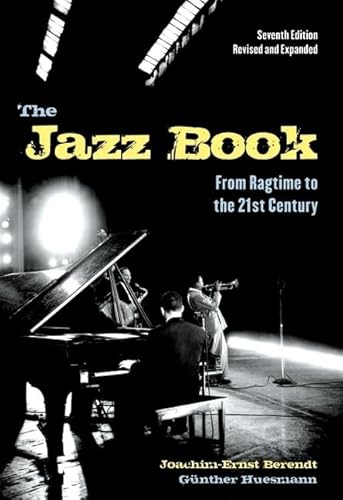
For fifty years The Jazz Book has been the most encyclopedic interpretive history of jazz available in one volume.
In this new seventh edition, each chapter has been completely revised and expanded to incorporate the dominant styles and musicians since the book's last publication in 1992, as well as the fruits of current research about earlier periods in the history of jazz. In addition, new chapters have been added on John Zorn, jazz in the 1990s and beyond, samplers, the tuba, the harmonica, non-Western instruments, postmodernist and repertory big bands, how the avant-garde has explored tradition, and many other subjects.
With a widespread resurgence of interest in jazz, The Jazz Book will continue well into the 21st century to fill the need for information about an art form widely regarded as America's greatest contribution to the world's musical culture.
Die Inhaltsangabe kann sich auf eine andere Ausgabe dieses Titels beziehen.
Über die Autorin bzw. den Autor
Joachim-Ernst Berendt (1922–2000) was an internationally known authority on jazz and the author of more than 20 books. His Jazz Book was first published in 1952 and has been translated into many languages. Günther Huesmann studied musicology, film and television, and pedagogy; a festival organizer and writer for jazz radio shows, he was responsible for the previous revision of The Jazz Book.
Auszug. © Genehmigter Nachdruck. Alle Rechte vorbehalten.
The Jazz Book
From Ragtime to the 21st Century
By Joachim-Ernst Berendt, Günther Huesmann, H. and B. Bredigkeit, Dan Morgenstern, Tim Nevill, Jeb BishopChicago Review Press Incorporated
Copyright © 2005 Fischer Taschenbuch Verlag GmbH., Frankfurt am Main
All rights reserved.
ISBN: 978-1-55652-820-0All rights reserved.
Contents
Preface,
The Styles of Jazz,
The Musicians of Jazz,
The Elements of Jazz,
The Instruments of Jazz,
The Vocalists of Jazz,
The Big Bands of Jazz,
The Small Bands of Jazz,
The Small Swing Bands,
Toward a Definition of Jazz,
Discography,
Index,
CHAPTER 1
The Styles of Jazz
Jazz has always been the concern of a minority — always. Even in the age of Swing, the thirties, the jazz of creative black musicians was — except for very few recordings — recognized by only a few. Still, taking an active interest in jazz means working for a majority, because the popular music of our times feeds on jazz: all the music we hear in TV series and elevators, in hotel lobbies and in ads, in movies and on MP3 players; all the music to which we dance, from Charleston to rock, funk and hip-hop; all those sounds that daily engulf us — all that music comes from jazz (because their beats came to Western music through jazz).
Taking an active interest in jazz means improving the quality of the "sounds around us" — the level of musical quality, which implies, if there is any justification in talking about musical quality, the spiritual, intellectual, human quality — the level of our consciousness. In these times, when musical sounds accompany the takeoff of a plane as well as a detergent sales pitch, the "sounds around us" directly influence our way of life, the quality of our lives. That is why we can say that taking an active interest in jazz means carrying some of the power, warmth, and intensity of jazz into our lives.
Because of this, there is a direct and concretely demonstrable connection between the different kinds, forms, and styles of jazz on the one hand and the periods and spaces of time of their creation on the other hand.
The most impressive thing about jazz, aside from its musical value, in our opinion is its stylistic development. The evolution of jazz shows the continuity, logic, unity, and inner necessity that characterize all true art. This development constitutes a whole, and those who single out one phase and view it as either uniquely valid or as an aberration destroy this wholeness of conception. They distort that unity of large-scale evolution without which one can speak of fashions, but not of styles. It is our conviction that the styles of jazz are genuine and reflect their own particular times in the same sense that classicism, baroque, romanticism, and impressionism reflect their respective periods in European concert music.
Let's suggest one way of getting an impression of the wealth and scope of the different jazz styles. After reading about the early styles, ragtime and New Orleans, skip a few chapters and jump into the one on free jazz, listening to some of the characteristic records as well (which can easily be found with the help of the discography at the end of the book). What other art form has developed such contrasting, yet clearly interrelated, styles within a span of only fifty years?
It is important to be aware of the flowing, streamlike character of jazz history. It certainly is no coincidence that the word stream has been used again and again by jazz critics and musicians in connection with different jazz styles — interestingly enough, as "mainstream" first for Swing jazz, later for the main tendency of today's jazz, or as in "third stream." There is one mighty stream that flows from New Orleans right up to our contemporary music. Even breaks or revolutions in this history, such as the emergence of bebop or, later, free jazz, appear in retrospect as organic or even inevitable developments. The stream may flow over cataracts or form eddies or rapids from time to time, but it continues to flow on as ever the same stream. No one style "replaces" another; one isn't "better" than another. Each incorporates what went before — everything that went before.
Many great jazz musicians have felt the connection between their playing styles and the times in which they live. The untroubled joy of Dixieland corresponds to the days just prior to World War I. The restlessness of the Roaring Twenties comes to life in the Chicago style. Swing embodies the massive standardization of life before World War II; perhaps, to quote Marshall Stearns, Swing "was the answer to the American — and very human — love of bigness." Bebop captures the nervous restlessness of the forties. Cool jazz seems to reflect the resignation of men who live well yet know that H-bombs are being stockpiled. Hard bop is full of protest, soon turned into conformity by the fashion for funk and soul music. This protest gains uncompromising, often angry urgency in free jazz, which characterized the period of the civil rights movement and the student revolt. In the seventies there was a renewed phase of consolidation. Some aspects of jazz-rock went along with the age's faith in technology. The jazz of the eighties, on the other hand, expresses much of the skepticism of people who live amid affluence but also know where ongoing unquestioned progress has brought them. In its pluralism and its aggressive multistylistic tendencies, the jazz of the nineties is a reaction to the data explosion of the information age. What has been said in such a generalized and simplified way here is even more applicable to the many different styles of individual musicians and bands.
Many jazz musicians have viewed attempts at reconstructing past jazz styles with skepticism. They know that historicism runs counter to the nature of jazz. Jazz stands and falls on being alive, and whatever lives, changes. When Count Basie's music became a worldwide success in the fifties, Lester Young, who had been one of the leading soloists of the old Basie band, was asked to participate in a recording with his old teammates for the purpose of reconstructing the Basie style of the thirties. "I can't do it," Lester said. "I don't play that way any more. I play different; I live different. This is later. That was then. We change, move on." Obviously, this is also true about contemporary reconstructions of historical jazz styles.
Around 1890: Ragtime
Jazz originated in New Orleans: a truism, with all that is true and false about such statements. It is true that New Orleans was the most important city in the genesis of jazz. It is false that it was the only one. Jazz — the music of a continent, a century, a civilization — was too much in the air to be reducible to the patented product of a single city. Similar ways of playing evolved in Memphis and St. Louis, in Dallas and Kansas City, in other cities of the South and Midwest. And this, too, is the hallmark of a style: different people in different places making the same (or similar) artistic discoveries independently of each other.
It has become customary to speak of New Orleans style as the first style in jazz. But before New Orleans style developed, there was ragtime. Its capital was not New Orleans but Sedalia, Missouri, where Scott Joplin had settled. Joplin, born in Texas in 1868, was the leading ragtime composer and pianist — and thus we have made the decisive point about ragtime: It was largely composed, primarily pianistic...
„Über diesen Titel“ kann sich auf eine andere Ausgabe dieses Titels beziehen.
Suchergebnisse für The Jazz Book: From Ragtime to the 21st Century

Beispielbild für diese ISBN
The Jazz Book: From Ragtime to the 21st Century
Anbieter: World of Books (was SecondSale), Montgomery, IL, USA
Verkäuferbewertung 5 von 5 Sternen

Hardback. Zustand: Good. For fifty years>The Jazz Book>has been the most encyclopedic interpretive history of jazz available in one volume. In this new seventh edition, each chapter has been completely revised and expanded to incorporate the dominant styles and musicians since the book's last publication in 1992, as well as the fruits of current research about earlier periods in the history of jazz. In addition, new chapters have been added on John Zorn, jazz in the 1990s and beyond, samplers, the tuba, the harmonica, non-Western instruments, postmodernist and repertory big bands, how the avant-garde has explored tradition, and many other subjects. With a widespread resurgence of interest in jazz, The Jazz Book>will continue well into the 21st century to fill the need for information about an art form widely regarded as America's greatest contribution to the world's musical culture. Artikel-Nr. 00103419171
Gebraucht kaufen
EUR 14,66
Versand gratis
Versand innerhalb von USA
Versand innerhalb von USA
Anzahl: 1 verfügbar
Beispielbild für diese ISBN
The Jazz Book : From Ragtime to the 21st Century
Verlag:
Chicago Review Press, Incorporated, 2009
ISBN 10: 1556528205
ISBN 13: 9781556528200
Gebraucht
Hardcover
Anbieter: Better World Books, Mishawaka, IN, USA
Verkäuferbewertung 5 von 5 Sternen
Zustand: Good. Former library copy. Pages intact with minimal writing/highlighting. The binding may be loose and creased. Dust jackets/supplements are not included. Includes library markings. Stock photo provided. Product includes identifying sticker. Better World Books: Buy Books. Do Good. Artikel-Nr. 6114753-6
Gebraucht kaufen
EUR 14,67
Versand gratis
Versand innerhalb von USA
Versand innerhalb von USA
Anzahl: 2 verfügbar
Foto des Verkäufers
The Jazz Book: From Ragtime to the 21st Century
Anbieter: WeBuyBooks, Rossendale, LANCS, Vereinigtes Königreich
Verkäuferbewertung 5 von 5 Sternen
hardcover. Zustand: Like New. Most items will be dispatched the same or the next working day. An apparently unread copy in perfect condition. Dust cover is intact with no nicks or tears. Spine has no signs of creasing. Pages are clean and not marred by notes or folds of any kind. Artikel-Nr. rev3222834570
Gebraucht kaufen
EUR 27,26
EUR 12,55 Versand
Versand von Vereinigtes Königreich nach USA
Versand von Vereinigtes Königreich nach USA
Anzahl: 1 verfügbar