
Verwandte Artikel zu A Kid's Guide to African American History: More...
A Kid's Guide to African American History: More Than 70 Activities - Softcover
Buch 2 von 5: A Kid's Guide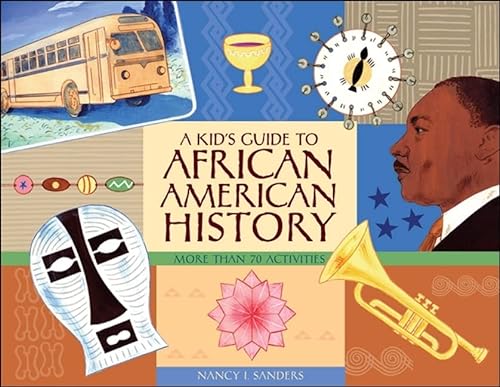
Inhaltsangabe
What do all these people have in common: the first man to die in the American Revolution, a onetime chief of the Crow Nation, the inventors of peanut butter and the portable X-ray machine, and the first person to make a wooden clock in this country? They were all great African Americans. For parents and teachers interested in fostering cultural awareness among children of all races, this book includes more than 70 hands-on activities, songs, and games that teach kids about the people, experiences, and events that shaped African American history. This expanded edition contains new material throughout, including additional information and biographies. Children will have fun designing an African mask, making a medallion like those worn by early abolitionists, playing the rhyming game "Juba," inventing Brer Rabbit riddles, and creating a unity cup for Kwanzaa. Along the way they will learn about inspiring African American artists, inventors, and heroes like Harriet Tubman, Benjamin Banneker, Rosa Parks, Langston Hughes, and Louis Armstrong, to name a few.
Die Inhaltsangabe kann sich auf eine andere Ausgabe dieses Titels beziehen.
Über die Autorin bzw. den Autor
Nancy I. Sanders is the author of many books, including 25 Read and Write Mini-Books that Teach Word Families and Old Testament Days.
Auszug. © Genehmigter Nachdruck. Alle Rechte vorbehalten.
A Kid's Guide to African American History
More Than 70 Activities
By Nancy I. SandersChicago Review Press Incorporated
Copyright © 2007 Nancy I. Sanders
All rights reserved.
ISBN: 978-1-55652-653-4All rights reserved.
Contents
Time Line,
Acknowledgments,
Introduction,
1 The Glories of Africa,
2 Colonial America,
3 Life on a Plantation,
4 Free African Americans and Abolitionists,
5 Civil War and the Road to Freedom,
6 The Turn of the Century,
7 The Civil Rights Movement,
8 Hope For Today and a Better Tomorrow,
Suggested Reading List for Kids,
Teacher Resources,
Selected Bibliography,
Index,
CHAPTER 1
The Glories of Africa
History is often silent about many things that happened long, long ago. Nobody is living today who can give us firsthand accounts of events many years before we were born. But we have clues that help us discover important things about the past. Special scientists called archaeologists (say it: ark-ee-ALL-uh-gists) use these clues to help us understand what Africa was like hundreds of years ago.
There are pictures on the tombs of Egyptian pharaohs (say it: FAIR-ohs) showing dark-skinned rulers as well as light-skinned ones. Queen Nefertari (say it: nef-fer-TAR-ee), one of the most famous figures known today from Egypt, has been identified as black. There are ancient documents listing important victories and accomplishments by kings from African countries. Stories have been passed down from generation to generation describing the glories and wonders that used to exist. All these clues, and more, paint a picture to help us understand what ancient Africa was really like.
Prior to 800 B.C., the dark-skinned people from Ethiopia (say it: EE-thee-OH-pee-ah) in Africa had important contact with ancient Egypt. They traded goods and materials back and forth. They fought wars with each other. They married each other and had children.
The fact that the color of their skin was different did not seem to matter very much to them.
For many years, Ethiopia had to pay taxes to Egypt and was under Egypt's rule. However, in the eighth century B.C., the Ethiopians went to war against the Egyptians and won. For more than a hundred years, the land was ruled by Ethiopian pharaohs.
Around 400 B.C., people in Africa made important progress and accomplished great achievements. In the years known as the African metal age, Africans worked with metals such as iron, copper, tin, silver, and bronze. They built large cities where crafters developed skills in leather, glass, gold, and weaving. They planted many crops. A huge system of trading developed. It was an age of progress and excitement.
A Sandstone Column
Some of the Ethiopian rulers were known for building beautiful temples and monuments. A sandstone column still stands, carved with many detailed designs, in the ruins of an Ethiopian temple. With this activity, you can make a replica.
Materials
Adult supervision required
Wooden spoon
1 cup (200 g) clean sand
½ cup (60 g) cornstarch 1 teaspoon (5 g) cream of
Paper drinking cup of tartar
Old cooking pot
¾ cup (177 ml) hot water
Paper plate
Toothpicks
Dump the sand, cornstarch, and cream of tartar into the old pot. Use the wooden spoon to stir the mixture well. Add the hot water and cook over medium heat. Stir well until the mixture of sand is too thick to stir any more. Cool slightly and then spoon the mixture into a cup, tightly packing down the sand. Turn the cup upside down over a paper plate and let the sand mixture dump out to form a column on the plate. (You may need to squeeze the end of the paper cup to get it started.) Smooth the sides of the column with your hands. Use a toothpick to carve designs in your sandstone column like the one pictured here.
Design a Mask
African sculpture is known for its variety of styles, different designs, and great strength portrayed in the characters. Researchers have found African sculpture in many forms, including masks.
Materials
Illustrations of mask
Typing paper
Pencil
Scissors
1 9 by 11-inch (48 by 28 cm) sheet of black poster board
1 9 by 11-inch (48 by 28 cm) sheet of white poster board
Glue
White cotton household string
Use the illustration of the mask as a guide to trace the nose, eyes, and mouth onto typing paper. Cut these out and use them as a pattern to cut the pieces from black poster board. Cut the outline of the face out of white poster board. Glue the nose, eyes, and mouth to the face. Spread glue on the area of the white poster board that isn't covered by the nose, eyes, or mouth. Carefully glue short pieces of string in rows over the white poster board to resemble the original, carved design of the mask.
The Middle Ages
Africa was rich in gold. Traders arrived from the north with large groups, or caravans, of more than 12,000 camels at a time. The camels carried heavy loads of salt, sugar, wheat, fruit, and fabric across the dry Sahara Desert until they reached the kingdoms in West Africa of Ghana (say it: GAH-nah), Mali (say it: ???-lee), and Songhay. Why did the traders travel so far and on such dangerous journeys across the hot desert? What did the traders want? They wanted the gold of Africa.
The kingdoms of Ghana, Mali, and Songhay grew powerful and wealthy by trading their gold and other products to the caravans from the north. By the Middle Ages, they had developed banking systems, school systems, and entire systems of law.
The kings of these kingdoms were unbelievably rich. One ruler of Ghana lived in a splendid castle filled with sculpture and decorated with beautiful windows. This ruler kept an army of 200,000 fighting men. Soldiers in the armies of these rulers often wore chain mail, a type of armor, and rode horses. Troops carried impressive shields and armed themselves with swords and lances.
The City of Timbuktu
By the 15th century, the kingdom of Songhay dominated the area with power. The city of Timbuktu (say it: tim-buck-TOO) in Songhay became an intellectual center where people traveled from far away to experience its dazzling excitement and study with its scholars.
During this time, Timbuktu was home to more than 100,000 people. The towers of two important mosques (say it: mosks) stood high above the other buildings. Flat-roofed buildings spread out across the city.
Moslem youths came to study law, math, and medicine at the University of Sankore in Timbuktu. Scholars came to Timbuktu to study its large collections of manuscripts, which included famous selections from Greek and Arabic literature. Scholars came to write their own books, too. The trading of books brought in more money than almost any other kind of business. The kings paid judges, doctors, and writers a large amount of money to do their jobs. People enjoyed dancing, fencing, gymnastics, and chess. Great respect was paid to learned people in this intellectual center of West Africa.
Potato Stamp Painting
Some artists painted Timbuktu during the Middle Ages to show a city made of square and round buildings. In the center of the pictures, they showed a tall mosque towering over the city. You can make a stamp from a potato to paint a picture of Timbuktu as it might have appeared during the Middle Ages.
Materials
Adult supervision required
1 potato, uncooked
Table knife, not...
„Über diesen Titel“ kann sich auf eine andere Ausgabe dieses Titels beziehen.
Suchergebnisse für A Kid's Guide to African American History: More...

Beispielbild für diese ISBN
A Kid's Guide to African Ameri
Anbieter: World of Books (was SecondSale), Montgomery, IL, USA
Verkäuferbewertung 5 von 5 Sternen

Zustand: Acceptable. Item in acceptable condition! Textbooks may not include supplemental items i.e. CDs, access codes etc. Artikel-Nr. 00099746222
Gebraucht kaufen
EUR 3,85
Versand gratis
Versand innerhalb von USA
Versand innerhalb von USA
Anzahl: 1 verfügbar
Beispielbild für diese ISBN
A Kid's Guide to African American History : More Than 70 Activities
Verlag:
Chicago Review Press, Incorporated, 2007
ISBN 10: 1556526539
ISBN 13: 9781556526534
Gebraucht
Softcover
Anbieter: Better World Books, Mishawaka, IN, USA
Verkäuferbewertung 5 von 5 Sternen
Zustand: Good. Former library copy. Pages intact with minimal writing/highlighting. The binding may be loose and creased. Dust jackets/supplements are not included. Includes library markings. Stock photo provided. Product includes identifying sticker. Better World Books: Buy Books. Do Good. Artikel-Nr. 5897780-6
Gebraucht kaufen
EUR 6,17
Versand gratis
Versand innerhalb von USA
Versand innerhalb von USA
Anzahl: 3 verfügbar
Beispielbild für diese ISBN
A Kid's Guide to African American History: More Than 70 Activities
Anbieter: ThriftBooks-Reno, Reno, NV, USA
Verkäuferbewertung 5 von 5 Sternen
Paperback. Zustand: Good. No Jacket. Pages can have notes/highlighting. Spine may show signs of wear. ~ ThriftBooks: Read More, Spend Less. Artikel-Nr. G1556526539I3N00
Gebraucht kaufen
EUR 6,99
Versand gratis
Versand innerhalb von USA
Versand innerhalb von USA
Anzahl: 2 verfügbar
Beispielbild für diese ISBN
A Kid's Guide to African American History: More Than 70 Activities
Anbieter: ThriftBooks-Phoenix, Phoenix, AZ, USA
Verkäuferbewertung 5 von 5 Sternen
Paperback. Zustand: Good. No Jacket. Pages can have notes/highlighting. Spine may show signs of wear. ~ ThriftBooks: Read More, Spend Less. Artikel-Nr. G1556526539I3N00
Gebraucht kaufen
EUR 6,99
Versand gratis
Versand innerhalb von USA
Versand innerhalb von USA
Anzahl: 2 verfügbar
Beispielbild für diese ISBN
A Kid's Guide to African American History: More Than 70 Activities
Anbieter: ThriftBooks-Dallas, Dallas, TX, USA
Verkäuferbewertung 5 von 5 Sternen
Paperback. Zustand: Good. No Jacket. Pages can have notes/highlighting. Spine may show signs of wear. ~ ThriftBooks: Read More, Spend Less. Artikel-Nr. G1556526539I3N00
Gebraucht kaufen
EUR 7,05
Versand gratis
Versand innerhalb von USA
Versand innerhalb von USA
Anzahl: 2 verfügbar
Beispielbild für diese ISBN
A Kid's Guide to African American History: More Than 70 Activities
Anbieter: ThriftBooks-Dallas, Dallas, TX, USA
Verkäuferbewertung 5 von 5 Sternen
Paperback. Zustand: Fair. No Jacket. Readable copy. Pages may have considerable notes/highlighting. ~ ThriftBooks: Read More, Spend Less. Artikel-Nr. G1556526539I5N00
Gebraucht kaufen
EUR 7,05
Versand gratis
Versand innerhalb von USA
Versand innerhalb von USA
Anzahl: 1 verfügbar
Beispielbild für diese ISBN
A Kid's Guide to African American History: More Than 70 Activities
Anbieter: ThriftBooks-Atlanta, AUSTELL, GA, USA
Verkäuferbewertung 5 von 5 Sternen
Paperback. Zustand: Very Good. No Jacket. May have limited writing in cover pages. Pages are unmarked. ~ ThriftBooks: Read More, Spend Less. Artikel-Nr. G1556526539I4N00
Gebraucht kaufen
EUR 7,05
Versand gratis
Versand innerhalb von USA
Versand innerhalb von USA
Anzahl: 1 verfügbar
Beispielbild für diese ISBN
A Kid's Guide to African American History: More Than 70 Activities
Anbieter: ThriftBooks-Atlanta, AUSTELL, GA, USA
Verkäuferbewertung 5 von 5 Sternen
Paperback. Zustand: Good. No Jacket. Pages can have notes/highlighting. Spine may show signs of wear. ~ ThriftBooks: Read More, Spend Less. Artikel-Nr. G1556526539I3N00
Gebraucht kaufen
EUR 7,05
Versand gratis
Versand innerhalb von USA
Versand innerhalb von USA
Anzahl: 2 verfügbar
Beispielbild für diese ISBN
A Kid's Guide to African American History: More Than 70 Activities
Anbieter: ThriftBooks-Atlanta, AUSTELL, GA, USA
Verkäuferbewertung 5 von 5 Sternen
Paperback. Zustand: Fair. No Jacket. Readable copy. Pages may have considerable notes/highlighting. ~ ThriftBooks: Read More, Spend Less. Artikel-Nr. G1556526539I5N00
Gebraucht kaufen
EUR 7,05
Versand gratis
Versand innerhalb von USA
Versand innerhalb von USA
Anzahl: 1 verfügbar
Beispielbild für diese ISBN
A Kid's Guide to African American History: More than 70 Activities (A Kid's Guide series)
Verlag:
Chicago Review Press (edition 2nd), 2007
ISBN 10: 1556526539
ISBN 13: 9781556526534
Gebraucht
Paperback
Anbieter: BooksRun, Philadelphia, PA, USA
Verkäuferbewertung 5 von 5 Sternen
Paperback. Zustand: Very Good. 2nd. It's a well-cared-for item that has seen limited use. The item may show minor signs of wear. All the text is legible, with all pages included. It may have slight markings and/or highlighting. Artikel-Nr. 1556526539-11-1
Gebraucht kaufen
EUR 7,65
Versand gratis
Versand innerhalb von USA
Versand innerhalb von USA
Anzahl: 1 verfügbar