
Verwandte Artikel zu So You Want to Start a Brewery?: The Lagunitas Story
Inhaltsangabe
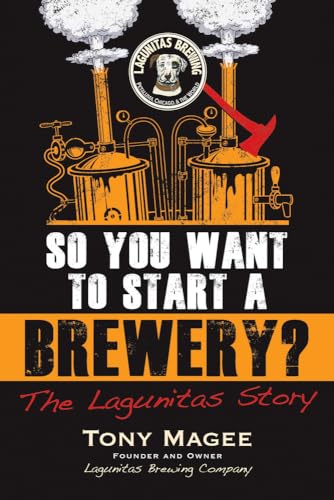
In 1993, Tony Magee, who had foundered at every job he&;d ever had, decided to become the founder of a brewery. So You Want to Start a Brewery? is the thrilling first-person account of his gut-wrenching challenges and unexpected successes.
Based in Petaluma, California, the Lagunitas Brewing Company makes craft beer that is simple and flavorful and defies categorization. The same could be said for this book. Equal parts memoir, narrative, and business story&;with liberal dashes of pop culture and local color&;this honest yet hilarious account of a one-of-a-kind, made-in-America journey just happens to culminate with the success of one of the nation&;s most popular craft beer brands. In twenty years, Lagunitas has grown from a shoestring operation to be the fifth largest&;and the fastest growing&;craft brewer in the United States.
 
First published in a limited edition two years ago by a tiny California press, So You Want to Start a Brewery? has here been revised and updated to include Lagunitas&;s establishment of a new brewery in Chicago, set to open in 2014. So You Want to Start a Brewery? is unglamorous and full of entertaining digressions, but it&;s never afraid to mess with the nuts and bolts. This is a must-read for all who have considered starting their own business&;or have sweated blood working to get one on its feet. Told in the vibrant voice of Tony Magee&;the man closest to the process&;this blow-by-blow chronicle will introduce beer drinkers and entrepreneurs to the reality of starting a craft brewery from the ground up.
Die Inhaltsangabe kann sich auf eine andere Ausgabe dieses Titels beziehen.
Über die Autorin bzw. den Autor
Tony Magee is the founder and CEO of the Lagunitas Brewing Company.
Auszug. © Genehmigter Nachdruck. Alle Rechte vorbehalten.
So You Want to Start a Brewery?
The Lagunitas Story
By Tony MageeChicago Review Press Incorporated
Copyright © 2014 Tony Magee
All rights reserved.
ISBN: 978-1-55652-562-9All rights reserved.
Contents
Fauxword,
Introduction — The Days Before the First Days,
1 The First Days Don't Sweat the Small Stuff,
2 The Tyranny of Fast Growth What Doesn't Kill You Makes You Stronger,
3 But What Kind of Beer ...? Building a Beer in Make-or-Break Times,
4 Creative Funding Robbing Peter to Pay Paul,
5 Dramas and Debacles Good Judgment Born from Bad Experience,
6 Tried and Tested The Art of Staying Ahead of the Game,
7 The Birth of a Brand A Rose By Any Other Name ...,
8 The Arrival of our IPA The Beer That Was Destined to Become Our Destiny,
9 Flavors and Labels How a Rogue Brand was Established,
10 Down with Dogma Feeling Around for the Edges,
11 The Experimental Recipes You Win Some. You Lose Some,
12 The Brewery The Story of the Place Itself,
13 Moving to Petaluma Friends and Frenemies and Petty Tyrants,
14 Moving Again Why a Brewery is Like a Rubik's Cube,
15 A Word About Brewers The Ghosts in the Machines,
16 The St. Patrick's Day Massacre A.k.a.. The Undercover Shutdown Investigation,
17 The Beer Sanctuary and Finally, A Bona Fide Place to Drink the Beer,
18 Current Life on Planet Lagunitas Still Doing Our Best to Keep It Real,
Afterword Thoughts on Thinking,
Epilogue,
Index,
CHAPTER 1
THE FIRST DAYS
DON'T SWEAT THE SMALL STUFF
The best piece of seemingly useless advice I'd ever been given with respect to what it would take to start the brewery was this: "Imagine the largest amount of money you think it will require to get the brewery up and going, and then triple it." I can't exactly remember who said that to me, although I wish I could, because I'd like to call them and tell them that they were right. I wouldn't be calling to thank them, because that would be like calling to thank the guy that yelled "Stop!" right before you got creamed by a speeding bus. But right they were.
By 1992 my wife and I were slowly rising from the marital and economic ashes, a little worse for the wear and tear, while my younger brother was working for a big and famous brewpub chain in Oregon. He described the business and told me where I could get a kit to make a batch of home brew. Up until then I had never even considered the idea of making my own beer. I'd been digging getting drunk at the famous Marin Brewing Co. pub and I thought the gear for brewing was pretty sexy looking. For me, cool and functional stuff has always been sexy — like a nice reverb unit, a great speaker, or a vintage guitar — and brewing gear fit right in.
So I went down to the local home-brew supply shop my brother recommended and got the standard five-gallon plastic pail, a strainer, hop packets, yeast, malt syrup — everything you need to brew beer. I had my first brewing "stuff," and with it, I made a batch of a prefab recipe pack called "California Common Beer." It turned out pretty vile. I hardly knew why, but the instructions were simple enough, so I blamed myself and tried again. This time, I brewed a different prepackaged recipe of a California pale ale ... and it was transcendent. Again, I hardly knew why.
There is one basic truth to learning how to play a musical instrument: if you practice, you will get better. You may never be Itzhak Perlman (and maybe that's not really a bad thing), but you will eventually improve. I knew that the same had to be true for brewing, and so I set about discovering what it was that I didn't know.
In principle, brewing is a primitive process that Mother Nature was doing all by her omnipresent lonesome, eons before humans were imagined, with just a wad of starch, some heat, a little rain, and a random flock of yeast. Humans have evolved it into a very complex process filled with precision and control, but the essential operation is as simple as singing a major scale: do, re, mi, fa, so, la, ti, do. In its fullest expression, brewing approaches Stravinsky and even beyond. Learning is often less a system of affirmation than a process of elimination. As in: "I'll never let the dog lick the spoon again before I stir the pitching yeast."
As brewing awareness morphed into understanding, I developed small opinions about what I wanted to accomplish when I brewed a beer. This is another music-simile-laden moment. When you begin to really learn a melodic phrase, you ask yourself, What do I want to try to get these notes to say? After the first couple of brews, I remember asking the home-brew supply shop owner which yeast strain might convert the most sugars to alcohol (even then I only wanted to make stronger beers), and I remember him looking away from me and saying to the ceiling, "That is not a question a brewer would ask." I wasn't deterred, but in that moment I already knew I would be making unconventional and non–stylistically describable beers.
Up until just recently, I wrote all the recipes for the brewery myself. Now I art direct, which is just as much fun. Strict style has never really figured into our recipes. Because of that, we have never done well in the myriad brewing competitions that happen each year. "Not appropriate for style" is the most common comment. Styles are for home brewers and academics. For us, they are jumping-off points for further improvisation. As a student musician, I won plenty of medals and awards of special recognition, but in the end, that didn't mean that I would be a successful working musician. It is the work that matters. All of the awards are just fingers pointing at the moon, and you should never mistake the finger for the moon. There are maybe two judged events that we enter each year — the Great American Beer Festival (GABF), in particular — mostly because it is required in order to be part of the public tasting sessions that follow them.
But even if we were to accidentally win a medal at GABF, I wouldn't make a big deal out of it with posters or advertisements. Some beer companies will, and that's cool for them, but it's not important for us. I mean, if you win, it doesn't mean that you will succeed, and if you lose, it doesn't mean you will fail. So why not just avoid the background noise altogether and get back to work? But I digress.
Back in early 1993 I was reminded of something called the Florence Nightingale effect, where wounded soldiers routinely fall in love with their nurses during recovery. I think that brewing was like my nurse as I came out of an unusually hard period in my life, and by the third batch (after three weeks of brewing), I was already sitting on the living room floor making up a pretend income statement and intensely adding up columns of guesstimated production volumes and costs and overhead and everything I could think of to get some idea of how much beer I would have to make to break even. My wife and I were $38,000 behind on taxes by then, and at that point I aspired merely to break even. But before I had any idea what I was going to do or what it was going to take to get 'er done, I rented a space in a nearby building, applied for a license, bought and installed a three-tier home-brewing setup, and began plans to install a real commercial brewery ... while also still learning how to make beer. By December of that same year, all of these things actually happened.
My crude initial income statement predicted some...
„Über diesen Titel“ kann sich auf eine andere Ausgabe dieses Titels beziehen.
Suchergebnisse für So You Want to Start a Brewery?: The Lagunitas Story

Beispielbild für diese ISBN
So You Want to Start a Brewery?: The Lagunitas Story
Anbieter: World of Books (was SecondSale), Montgomery, IL, USA
Verkäuferbewertung 5 von 5 Sternen

Paperback. Zustand: Very Good. So You Want to Start a Brewery? is the first-person account of Tony Magee's gut-wrenching challenges and heart-warming successes in founding Lagunitas Brewing Company. In just 20 years, the company has grown from a seat-of-the-pants, one-man operation to be the fifth largest--and the fastest growing--craft brewer in the United States. This equal part memoir, narrative, and business story is an illuminating yet hilarious account anchored strongly in time and place as a one-of-a-kind, made-in-America journey that culminates with the success of one of the nation's most popular and enduring craft beer brands. Artikel-Nr. 00106186150
Gebraucht kaufen
EUR 4,05
Versand gratis
Versand innerhalb von USA
Versand innerhalb von USA
Anzahl: 2 verfügbar
Beispielbild für diese ISBN
So You Want to Start a Brewery?: The Lagunitas Story
Anbieter: World of Books (was SecondSale), Montgomery, IL, USA
Verkäuferbewertung 5 von 5 Sternen
Paperback. Zustand: Good. So You Want to Start a Brewery? is the first-person account of Tony Magee's gut-wrenching challenges and heart-warming successes in founding Lagunitas Brewing Company. In just 20 years, the company has grown from a seat-of-the-pants, one-man operation to be the fifth largest--and the fastest growing--craft brewer in the United States. This equal part memoir, narrative, and business story is an illuminating yet hilarious account anchored strongly in time and place as a one-of-a-kind, made-in-America journey that culminates with the success of one of the nation's most popular and enduring craft beer brands. Artikel-Nr. 00064225738
Gebraucht kaufen
EUR 4,05
Versand gratis
Versand innerhalb von USA
Versand innerhalb von USA
Anzahl: 10 verfügbar
Beispielbild für diese ISBN
So You Want to Start a Brewery?: The Lagunitas Story
Verlag:
Chicago Review Press (edition Illustrated), 2014
ISBN 10: 1556525621
ISBN 13: 9781556525629
Gebraucht
Paperback
Anbieter: BooksRun, Philadelphia, PA, USA
Verkäuferbewertung 5 von 5 Sternen
Paperback. Zustand: Very Good. Illustrated. It's a well-cared-for item that has seen limited use. The item may show minor signs of wear. All the text is legible, with all pages included. It may have slight markings and/or highlighting. Artikel-Nr. 1556525621-11-6
Gebraucht kaufen
EUR 4,83
Versand gratis
Versand innerhalb von USA
Versand innerhalb von USA
Anzahl: 1 verfügbar
Beispielbild für diese ISBN
So You Want to Start a Brewery?
Anbieter: ThriftBooks-Atlanta, AUSTELL, GA, USA
Verkäuferbewertung 5 von 5 Sternen
Paperback. Zustand: Very Good. No Jacket. May have limited writing in cover pages. Pages are unmarked. ~ ThriftBooks: Read More, Spend Less. Artikel-Nr. G1556525621I4N00
Gebraucht kaufen
EUR 6,03
Versand gratis
Versand innerhalb von USA
Versand innerhalb von USA
Anzahl: 1 verfügbar
Beispielbild für diese ISBN
So You Want to Start a Brewery?
Anbieter: ThriftBooks-Dallas, Dallas, TX, USA
Verkäuferbewertung 5 von 5 Sternen
Paperback. Zustand: Very Good. No Jacket. May have limited writing in cover pages. Pages are unmarked. ~ ThriftBooks: Read More, Spend Less. Artikel-Nr. G1556525621I4N00
Gebraucht kaufen
EUR 6,03
Versand gratis
Versand innerhalb von USA
Versand innerhalb von USA
Anzahl: 1 verfügbar
Beispielbild für diese ISBN
So You Want to Start a Brewery? : The Lagunitas Story
Verlag:
Chicago Review Press, Incorporated, 2014
ISBN 10: 1556525621
ISBN 13: 9781556525629
Gebraucht
Softcover
Anbieter: Better World Books, Mishawaka, IN, USA
Verkäuferbewertung 5 von 5 Sternen
Zustand: Good. Pages intact with minimal writing/highlighting. The binding may be loose and creased. Dust jackets/supplements are not included. Stock photo provided. Product includes identifying sticker. Better World Books: Buy Books. Do Good. Artikel-Nr. 6240253-75
Gebraucht kaufen
EUR 6,12
Versand gratis
Versand innerhalb von USA
Versand innerhalb von USA
Anzahl: 1 verfügbar
Beispielbild für diese ISBN
So You Want to Start a Brewery? : The Lagunitas Story
Verlag:
Chicago Review Press, Incorporated, 2014
ISBN 10: 1556525621
ISBN 13: 9781556525629
Gebraucht
Softcover
Anbieter: Better World Books: West, Reno, NV, USA
Verkäuferbewertung 5 von 5 Sternen
Zustand: Very Good. Pages intact with possible writing/highlighting. Binding strong with minor wear. Dust jackets/supplements may not be included. Stock photo provided. Product includes identifying sticker. Better World Books: Buy Books. Do Good. Artikel-Nr. 8733746-6
Gebraucht kaufen
EUR 6,12
Versand gratis
Versand innerhalb von USA
Versand innerhalb von USA
Anzahl: 1 verfügbar
Beispielbild für diese ISBN
So You Want to Start a Brewery?: The Lagunitas Story
Anbieter: Wonder Book, Frederick, MD, USA
Verkäuferbewertung 5 von 5 Sternen
Zustand: Very Good. Very Good condition. A copy that may have a few cosmetic defects. May also contain light spine creasing or a few markings such as an owner's name, short gifter's inscription or light stamp. Bundled media such as CDs, DVDs, floppy disks or access codes may not be included. Artikel-Nr. I04B-04595
Gebraucht kaufen
EUR 6,36
Versand gratis
Versand innerhalb von USA
Versand innerhalb von USA
Anzahl: 1 verfügbar
Beispielbild für diese ISBN
So You Want to Start a Brewery?: The Lagunitas Story
Anbieter: Wonder Book, Frederick, MD, USA
Verkäuferbewertung 5 von 5 Sternen
Zustand: Good. Good condition. A copy that has been read but remains intact. May contain markings such as bookplates, stamps, limited notes and highlighting, or a few light stains. Artikel-Nr. F28A-04040
Gebraucht kaufen
EUR 6,36
Versand gratis
Versand innerhalb von USA
Versand innerhalb von USA
Anzahl: 1 verfügbar
Foto des Verkäufers
So You Want to Start a Brewery?
Anbieter: WeBuyBooks, Rossendale, LANCS, Vereinigtes Königreich
Verkäuferbewertung 5 von 5 Sternen
paperback. Zustand: Very Good. Most items will be dispatched the same or the next working day. A copy that has been read, but is in excellent condition. Pages are intact and not marred by notes or highlighting. The spine remains undamaged. Artikel-Nr. rev2139578911
Gebraucht kaufen
EUR 2,34
EUR 6,50 Versand
Versand von Vereinigtes Königreich nach USA
Versand von Vereinigtes Königreich nach USA
Anzahl: 1 verfügbar