
Verwandte Artikel zu The Cartoon Music Book
Inhaltsangabe
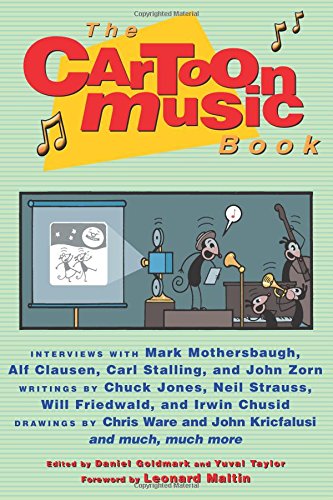
The popularity of cartoon music, from Carl Stalling&;s work for Warner Bros. to Disney sound tracks and The Simpsons&; song parodies, has never been greater. This lively and fascinating look at cartoon music&;s past and present collects contributions from well-known music critics and cartoonists, and interviews with the principal cartoon composers. Here Mark Mothersbaugh talks about his music for Rugrats, Alf Clausen about composing for The Simpsons, Carl Stalling about his work for Walt Disney and Warner Bros., Irwin Chusid about Raymond Scott&;s work, Will Friedwald about Casper the Friendly Ghost, Richard Stone about his music for Animaniacs, Joseph Lanza about Ren and Stimpy, and much, much more.
Die Inhaltsangabe kann sich auf eine andere Ausgabe dieses Titels beziehen.
Über die Autorin bzw. den Autor
Daniel Goldmark is an assistant professor of music at the University of Alabama and for four years was an editor and producer for Rhino Records; his Tunes for ’Toons is scheduled to be published in 2003. He lives in Tuscaloosa, Alabama. Yuval Taylor is the editor of A Cappella; his edited collections include The Future of Jazz and I Was Born a Slave. He lives in Chicago.
Auszug. © Genehmigter Nachdruck. Alle Rechte vorbehalten.
The Cartoon Music Book
By Daniel Goldmark, Yuval TaylorChicago Review Press Incorporated
Copyright © 2002 A Cappella Books
All rights reserved.
ISBN: 978-1-55652-473-8All rights reserved.
Contents
Foreword by Leonard Maltin,
Acknowledgments,
Introduction by Daniel Goldmark and Yuval Taylor,
Main Title,
Untitled by Chris Ware,
Tunes for Toons: A Cartoon Music Primer by Neil Strauss,
Part 1: An Episodic History of Cartoon Music,
Animated Cartoons and Slap-Stick Comedy by Edith Lang and George West,
Make Walt's Music: Music for Disney Animation, 1928–1967 by Ross Care,
An Interview with Carl Stalling by Mike Barrier,
Hidey Hidey Hidey Ho ... Boop-Boop-A Doop! The Fleischer Studio and Jazz Cartoons by Jake Austen,
I Love to Hear a Minstrel Band: Walt Disney's The Band Concert by David Wondrich,
Disney, Stokowski, and the Genius of Fantasia by Charles L. Granata,
Music and the Animated Cartoon by Chuck Jones,
Classical Music and Hollywood Cartoons: A Primer on the Cartoon Canon by Daniel Goldmark,
Music in Cartoons by Scott Bradley,
Personality on the Sound Track: A Glimpse Behind the Scenes and Sequences in Filmland by Scott Bradley,
Make Mine Music and the End of the Swing Era by Stuart Nicholson,
Sublime Perversity: The Music of Carl Stalling by Will Friedwald,
Carl Stalling, Improviser & Bill Lava, Acme Minimalist by Kevin Whitehead,
Raymond Scott: Accidental Music for Animated Mayhem by Irwin Chusid,
Winston Sharples and the "Inner Casper" (or Huey Has Two Mommies) by Will Friedwald,
An Interview with Hoyt Curtin by Barry Hansen and Earl Kress,
Rock 'n' Roll Cartoons by Jake Austen,
"Put One Note in Front of the Other": The Music of Maury Laws by Greg Ehrbar,
Part II: Cartoon Music Today,
Merrie Melodies: Cartoon Music's Contemporary Resurgence by Elisabeth Vincentelli,
An Interview with Mark Mothersbaugh by Daniel Goldmark,
Robots, Romance, and Ronin: Music in Japanese Anime by Milo Miles,
An Interview with Richard Stone, Steve Bernstein, and Julie Bernstein by Daniel Goldmark,
An Interview with Alf Clausen by Daniel Goldmark,
I Kid Because I Love: The Music of The Simpsons by Will Friedwald,
An Interview with John Zorn by Philip Brophy,
Rhapsody in Spew: Romantic Underscores in The Ren & Stimpy Show by Joseph Lanza,
Untitled by John Kricfalusi,
End Title,
A Very Visual Kind of Music: The Cartoon Soundtrack Beyond the Screen by John Corbett,
Cartoon Music: A Select Discography by Greg Ehrbar,
Bibliography by Daniel Goldmark,
About the Contributors,
Index,
CHAPTER 1
Tunes for Toons: A Cartoon Music Primer
by NEIL STRAUSS
"If you can write for animation," said Hoyt Curtin, composer for classic Hanna-Barbera cartoons from The Flintstones to Scooby-Doo, "you can write for anything." Cartoon music is among the most engaging and experimental forms of twentieth-century music, exploring the more outrageous extremes of instrumentation, rhythm, and nonmusical sound. It is a genre in which rapid tempo changes, unusual instrumental effects, experimental percussion, post-modern quotation, shock chords, and musical genre-shifting are de rigeur. From the warped takes on Liszt and Rossini that occur when a fly lands on a conductor's nose to the free-jazz solos that certain animated animals play on the heads of other animated animals, the laughs lie in perverting the sounds we've come to expect from concerts and canines. Just try watching a classic Tom and Jerry or Bugs Bunny cartoon with the sound off, and see how flat the jokes fall.
The history of this music has rarely been told, for the sole reason that it wasn't until recently that cartoon music was even considered a viable genre unto itself. Cartoon music, for the purposes of this primer, is score — orchestral or instrumental accompaniment — as opposed to the circle-of-life songs of Disney films, the pop hits that fill some big-budget film features, and the tongue-in-cheek parodies that populate The Simpsons. Born in the 1920s, cartoon music experienced its golden years in the 1940s and '50s, before television studios increased the workload, lowered the budget, and, with the advent of synthesizers, eviscerated the art.
Interestingly, many of the more modern avant-garde musicians who have been drawn to cartoon music, like John Zorn and Sun Ra, have their roots in improvisation. This makes sense, because many of the early composers for cartoons started out as improvisers themselves, playing organ and other instruments to accompany silent movies.
Perhaps one of the most important chance meetings in cartoon music history occurred in the early 1920s at the Isis Theatre in Kansas City, where Carl Stalling, then a film accompanist and conductor, first encountered Walt Disney, who was just beginning his involvement in film. After Disney left for Hollywood and began producing cartoons, the two renewed their bond (originally created over their shared excitement about combining music and film) and Stalling was soon given the first two silent Mickey Mouse shorts to score. The job was a perfect fit for the wildly talented Stalling, and he was quickly hired as the studio's first music director.
In the meantime, Max Fleischer at Fleischer Studios was experimenting on a more in-depth level with adding music to cartoons. The studio's "Song Car-Tune," Oh Mabel (1924), introduced the infamous bouncing ball, which landed on the appropriate lyric to a popular song in time to the music (which was played by the theater accompanist) for audiences to sing along to. The "car-tune" received such an enthusiastic response at its first screening that the theater manager rewound the short and showed it again. A few shorts later, Max Fleischer was introduced to Lee de Forest, who had developed Phonofilm, a method of recording sound on the edge of motion picture film. (Incidentally, the instructional film on the use of Phonofilm was animated. Thus cartoons played an integral part in the advent of sound in film). Fleischer fell in love with the idea and produced the first theatrical film of any kind with a synchronized soundtrack, My Old Kentucky Home, in 1926. Subsequently, he added sound to his earlier bouncing-ball films, many of which featured Koko the Clown. These were the first theatrical releases of sound films, predating even Warner Bros.' first live-action motion picture with a music track, Don Juan (which preceded 1927's more famous Jazz Singer by more than a year).
Even Paul Terry's Terrytoons studio beat Disney to sound with its first Aesop's Fables series film, Dinner Time (1928). Terrytoons claimed to be the first studio to prescore its cartoons. Working with brilliant Terrytoons composer Philip A. Scheib, the studio's animators drew frames to fit his scores, which were recorded in one take.
The advent of sound solved a problem that plagued composer Paul Hindemith, a Felix the Cat fanatic who composed a score for Felix at the Circus, which he attempted to premiere at the Baden-Baden festival. Much to his chagrin, the machine selected to synchronize his pianola roll with the film projector malfunctioned and the composition was subsequently lost.
Determined to keep up with the competition, Walt Disney traveled to New York to work on his first actual sound cartoon, Steamboat Willie. At Cinephone studios in 1928, the well-known...
„Über diesen Titel“ kann sich auf eine andere Ausgabe dieses Titels beziehen.
Suchergebnisse für The Cartoon Music Book

Beispielbild für diese ISBN
The Cartoon Music Book
Anbieter: World of Books (was SecondSale), Montgomery, IL, USA
Verkäuferbewertung 5 von 5 Sternen

Zustand: Good. Item in good condition. Textbooks may not include supplemental items i.e. CDs, access codes etc. Artikel-Nr. 00105478784
Gebraucht kaufen
EUR 7,62
Versand gratis
Versand innerhalb von USA
Versand innerhalb von USA
Anzahl: 2 verfügbar
Beispielbild für diese ISBN
The Cartoon Music Book
Verlag:
Chicago Review Press, Incorporated, 2002
ISBN 10: 1556524730
ISBN 13: 9781556524738
Gebraucht
Softcover
Anbieter: Better World Books, Mishawaka, IN, USA
Verkäuferbewertung 5 von 5 Sternen
Zustand: Very Good. Former library copy. Pages intact with possible writing/highlighting. Binding strong with minor wear. Dust jackets/supplements may not be included. Includes library markings. Stock photo provided. Product includes identifying sticker. Better World Books: Buy Books. Do Good. Artikel-Nr. 5196607-6
Gebraucht kaufen
EUR 9,88
Versand gratis
Versand innerhalb von USA
Versand innerhalb von USA
Anzahl: 1 verfügbar
Beispielbild für diese ISBN
The Cartoon Music Book
Verlag:
Chicago Review Press, Incorporated, 2002
ISBN 10: 1556524730
ISBN 13: 9781556524738
Gebraucht
Softcover
Anbieter: Better World Books: West, Reno, NV, USA
Verkäuferbewertung 5 von 5 Sternen
Zustand: Very Good. Pages intact with possible writing/highlighting. Binding strong with minor wear. Dust jackets/supplements may not be included. Stock photo provided. Product includes identifying sticker. Better World Books: Buy Books. Do Good. Artikel-Nr. 9986395-6
Gebraucht kaufen
EUR 9,88
Versand gratis
Versand innerhalb von USA
Versand innerhalb von USA
Anzahl: 4 verfügbar
Beispielbild für diese ISBN
The Cartoon Music Book
Verlag:
Chicago Review Press, Incorporated, 2002
ISBN 10: 1556524730
ISBN 13: 9781556524738
Gebraucht
Softcover
Anbieter: Better World Books, Mishawaka, IN, USA
Verkäuferbewertung 5 von 5 Sternen
Zustand: Very Good. Pages intact with possible writing/highlighting. Binding strong with minor wear. Dust jackets/supplements may not be included. Stock photo provided. Product includes identifying sticker. Better World Books: Buy Books. Do Good. Artikel-Nr. 9986395-6
Gebraucht kaufen
EUR 9,88
Versand gratis
Versand innerhalb von USA
Versand innerhalb von USA
Anzahl: 1 verfügbar
Beispielbild für diese ISBN
The Cartoon Music Book
Anbieter: Kennys Bookstore, Olney, MD, USA
Verkäuferbewertung 5 von 5 Sternen
Zustand: New. 2002. Paperback. Editor(s): Goldmark, Daniel; Taylor, Yuval. Num Pages: 336 pages, b/w illus. BIC Classification: AS; AVA; AVGC6. Category: (G) General (US: Trade). Dimension: 227 x 154 x 17. Weight in Grams: 442. . . . . . Books ship from the US and Ireland. Artikel-Nr. V9781556524738
Neu kaufen
EUR 27,13
EUR 9,16 Versand
Versand innerhalb von USA
Versand innerhalb von USA
Anzahl: Mehr als 20 verfügbar
Beispielbild für diese ISBN
The Cartoon Music Book
Anbieter: Revaluation Books, Exeter, Vereinigtes Königreich
Verkäuferbewertung 5 von 5 Sternen
Paperback. Zustand: Brand New. illustrated edition. 336 pages. 8.75x6.00x0.75 inches. In Stock. Artikel-Nr. zk1556524730
Neu kaufen
EUR 27,85
EUR 11,66 Versand
Versand von Vereinigtes Königreich nach USA
Versand von Vereinigtes Königreich nach USA
Anzahl: 1 verfügbar