
Verwandte Artikel zu The True Adventures of the Rolling Stones
Inhaltsangabe
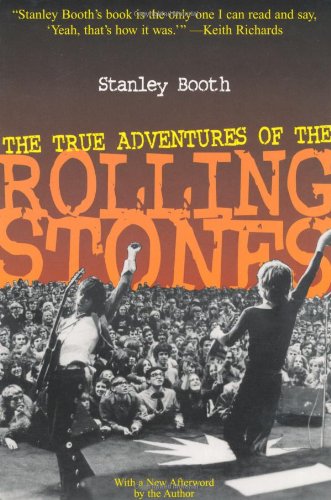
Stanley Booth, a member of the Rolling Stones’ inner circle, met the band just a few months before Brian Jones drowned in a swimming pool in 1968. He lived with them throughout their 1969 American tour, staying up all night together listening to blues, talking about music, ingesting drugs, and consorting with groupies. His thrilling account culminates with their final concert at Altamont Speedway—a nightmare of beating, stabbing, and killing that would signal the end of a generation’s dreams of peace and freedom. But while this book renders in fine detail the entire history of the Stones, paying special attention to the tragedy of Brian Jones, it is about much more than a writer and a rock band. It has been called—by Harold Brodkey and Robert Stone, among others—the best book ever written about the sixties. In Booth’s new afterword, he finally explains why it took him 15 years to write the book, relating an astonishing story of drugs, jails, and disasters.
Die Inhaltsangabe kann sich auf eine andere Ausgabe dieses Titels beziehen.
Über die Autorin bzw. den Autor
Stanley Booth is the author of Rythm Oil: A Journey Through the Music of the American South and Keith: Till I Roll Over Dead. He has written for Rolling Stone, Esquire, and Playboy. He lives in Brunswick, Georgia.
Auszug. © Genehmigter Nachdruck. Alle Rechte vorbehalten.
The True Adventures of the Rolling Stones
By Stanley BoothChicago Review Press Incorporated
Copyright © 2000 Stanley Booth
All rights reserved.
ISBN: 978-1-55652-400-4All rights reserved.
Contents
THE KILLING GROUND,
THE ELEPHANTS' GRAVEYARD,
DANCE TO THE DEATH,
CODA,
AFTERWORD: ONE HALF OF FOREVER,
CHAPTER 1
THE KILLING GROUND
It is late. All the little snakes are asleep. The world is black outside the car windows, just the dusty clay road in the headlights. Far from the city, past the last crossroads (where they used to bury suicides in England, with wooden stakes driven through their hearts), we are looking for a strange California hillside where we may see him, may even dance with him in his torn, bloody skins, come and play.
A train overpass opens in the sky before us; as we come out of it there is an unmarked fork in the road. The Crystals are singing "He's a Rebel." The driver looks left, right, left again. "He don't know where he's going," Keith says. "Do you — are you sure this is the way?" Mick asks. Turning left, the driver does not answer. The radio is quite loud. "Maybe he didn't hear you." Mick closes his eyes. Certain we are lost, but so tired, with no sleep for the past forty hours, less able each moment to protest, to change direction, we proceed in a black Cadillac limousine into the vastness of space.
See the way he walks down the street
Watch the way he shuffles his feet
Oh, how he holds his head up high
When he goes walkin' by
He's my guy
When he holds my hand I'm so proud
'Cause he's not just one of the crowd
My baby's always the one
To try the things they've never done
And just because of that they say
He's a rebel
And he'll never ever be
Any good
He's a rebel
'Cause he never ever does
What he should
"Something up ahead here," the driver says. Parked by the road is a Volkswagen van, a German police dog tied by a rope to the back door handle. The dog barks as we pass. Farther on there are more cars and vans, some with people in them, but most of the people are in the road, walking in small groups, carrying sleeping bags, canvas knapsacks, babies, leading more big ugly dogs. "Let's getout," Keith says. "Don't lose us," Mick tells the driver, who says, "Where are you going?" but we are already gone, the five of us, Ron the Bag Man, Tony the Spade Heavy, the Okefenokee Kid, and of course Mick and Keith, Rolling Stones. The other members of the band are asleep back in San Francisco at the Huntington Hotel, except Brian, who is dead and, some say, never sleeps.
The road descends between rolling dry-grass shoulders, the kind of bare landscape where in 1950s science fiction movies the teenager and his busty girlfriend, parked in his hot rod, receive unearthly visitors, but it is crowded now with young people, most with long hair, dressed in heavy clothes, blue jeans, army fatigue jackets, against the December night air that revives us as we walk. Mick is wearing a long burgundy overcoat, and Keith has on a Nazi leather greatcoat, green with mold, that he will leave behind tomorrow or more accurately today, about sixteen hours from now, in the mad blind panic to get away from the place we are lightly swaggering toward. Mick and Keith are smiling, it is their little joke, to have the power to create this gathering by simply wishing for it aloud and the freedom to walk like anybody else along the busy barren path. There are laughter and low talking within groups, but little cross-conversation, though it seems none of us is a stranger; each wears the signs, the insignia, of the campaigns that have brought us, long before most of us have reached the age of thirty, to this desolate spot on the western slope of the New World.
"Tony, score us a joint," Keith says, and before we have been another twenty steps giant black Tony has dropped back and fallen into stride with a boy who's smoking and hands Tony the joint, saying "Keep it." So we smoke and follow the trail down to a basin where the shoulders stretch into low hills already covered with thousands of people around campfires, some sleeping, some playing guitars, some passing smokes and great red jugs of wine. For a moment it stops us; it has the dream-like quality of one's deepest wishes, to have all the good people, all one's family, all the lovers, together in some private country of night. It is as familiar as our earliest dreams and yet so grand and final, camp-fires flickering like distant stars as far as our eyes can see, that it is awesome, and as we start up the hillside to our left, walking on sleeping bags and blankets, trying not to step on anyone's head, Keith is saying it's like Morocco, outside the gates of Marrakech, hear the pipes ...
The people are camped right up to a cyclone fence topped with barbed wire, and we are trying to find the gate, while from behind us the Maysles film brothers approach across sleeping bodies with blinding blue-white quartz lamps. Mick yells to turn off the lights, but they pretend to be deaf and keep coming. The kids who have been looking up as we pass, saying Hi, Mick, now begin to join us; there is a caravan of young girls and boys strung out in the spotlights when we reach the gate which is, naturally, locked. Inside we can see the Altamont Speed-way clubhouse and some people we know standing outside it. Mick calls, "Could we get in, please?" and one of them comes over, sees who we are, and sets out to find someone who can open the gate. It takes a while, and the boys and girls all want autographs and to go inside with us. Mick tells them we can't get in ourselves yet, and no one has a pen except me, and I have learned not to let go of mine because they get the signatures and go spinning away in a frenzy of bliss and exhilaration, taking my trade with them. So we stand on one foot and then the other, swearing in the cold, and no one comes to let us in, and the gate, which is leaning, rattles when I shake it, and I say we could push it down pretty easy, and Keith says, "The first act of violence."
1
Something about the curious wanderings of these griots through the yellow desert northward into the Maghreb country, often a solitary wandering; their performances at Arab camps on the long journey, when the black slaves came out to listen and weep; then the hazardous voyage into Constantinople, where they play old Congo airs for the great black population of Stamboul, whom no laws or force can keep within doors when the sound of griot music is heard in the street. Then I would speak of how the blacks carry their music with them to Persia and even to mysterious Hadramaut, where their voices are held in high esteem by Arab masters. Then I would touch upon the transplantation of Negro melody to the Antilles and the two Americas, where its strangest black flowers are gathered by the alchemists of musical science and the perfume thereof extracted by magicians. ... (How is that for a beginning?)
Lafcadio Hearn: in a letter to Henry E. Krehbiel
She was sitting on a cream-colored couch, pale blond head bent over a red-jacketed book, legs crossed, one heel resting on the marble coffee table. Behind her in the picture window there was a thick green hedge and then, far away below, the City of the Angels, bone-white buildings reaching out to where, this being a fairly clear day, the Pacific Ocean could be seen, glinting in the sunlight through the poison mist that the land and sky became at the horizon. There were other people on the matching couches of the room, the lobby of that motel-like...
„Über diesen Titel“ kann sich auf eine andere Ausgabe dieses Titels beziehen.
Suchergebnisse für The True Adventures of the Rolling Stones

Beispielbild für diese ISBN
The True Adventures of the Rolling Stones
Anbieter: ThriftBooks-Atlanta, AUSTELL, GA, USA
Verkäuferbewertung 5 von 5 Sternen

Paperback. Zustand: Good. No Jacket. Pages can have notes/highlighting. Spine may show signs of wear. ~ ThriftBooks: Read More, Spend Less. Artikel-Nr. G1556524005I3N00
Gebraucht kaufen
EUR 7,33
Versand gratis
Versand innerhalb von USA
Versand innerhalb von USA
Anzahl: 2 verfügbar
Beispielbild für diese ISBN
The True Adventures of the Rolling Stones
Anbieter: ThriftBooks-Dallas, Dallas, TX, USA
Verkäuferbewertung 5 von 5 Sternen
Paperback. Zustand: Fair. No Jacket. Readable copy. Pages may have considerable notes/highlighting. ~ ThriftBooks: Read More, Spend Less. Artikel-Nr. G1556524005I5N00
Gebraucht kaufen
EUR 7,33
Versand gratis
Versand innerhalb von USA
Versand innerhalb von USA
Anzahl: 1 verfügbar
Beispielbild für diese ISBN
The True Adventures of the Rolling Stones
Anbieter: ThriftBooks-Dallas, Dallas, TX, USA
Verkäuferbewertung 5 von 5 Sternen
Paperback. Zustand: Good. No Jacket. Pages can have notes/highlighting. Spine may show signs of wear. ~ ThriftBooks: Read More, Spend Less. Artikel-Nr. G1556524005I3N00
Gebraucht kaufen
EUR 7,33
Versand gratis
Versand innerhalb von USA
Versand innerhalb von USA
Anzahl: 1 verfügbar
Beispielbild für diese ISBN
The True Adventures of the Rolling Stones
Anbieter: ThriftBooks-Reno, Reno, NV, USA
Verkäuferbewertung 5 von 5 Sternen
Paperback. Zustand: Good. No Jacket. Pages can have notes/highlighting. Spine may show signs of wear. ~ ThriftBooks: Read More, Spend Less. Artikel-Nr. G1556524005I3N00
Gebraucht kaufen
EUR 7,33
Versand gratis
Versand innerhalb von USA
Versand innerhalb von USA
Anzahl: 1 verfügbar
Beispielbild für diese ISBN
The True Adventures of the Rolling Stones
Anbieter: ThriftBooks-Phoenix, Phoenix, AZ, USA
Verkäuferbewertung 5 von 5 Sternen
Paperback. Zustand: Good. No Jacket. Pages can have notes/highlighting. Spine may show signs of wear. ~ ThriftBooks: Read More, Spend Less. Artikel-Nr. G1556524005I3N00
Gebraucht kaufen
EUR 7,33
Versand gratis
Versand innerhalb von USA
Versand innerhalb von USA
Anzahl: 1 verfügbar
Beispielbild für diese ISBN
The True Adventures of the Rolling Stones
Anbieter: WorldofBooks, Goring-By-Sea, WS, Vereinigtes Königreich
Verkäuferbewertung 5 von 5 Sternen
Paperback. Zustand: Very Good. The book has been read, but is in excellent condition. Pages are intact and not marred by notes or highlighting. The spine remains undamaged. Artikel-Nr. GOR004568129
Gebraucht kaufen
EUR 4,23
EUR 6,69 Versand
Versand von Vereinigtes Königreich nach USA
Versand von Vereinigtes Königreich nach USA
Anzahl: 6 verfügbar
Beispielbild für diese ISBN
The True Adventures of the Rolling Stones
Anbieter: Magers and Quinn Booksellers, Minneapolis, MN, USA
Verkäuferbewertung 5 von 5 Sternen
paperback. Zustand: Very Good. May have light to moderate shelf wear and/or a remainder mark. Complete. Clean pages. Artikel-Nr. 139436
Gebraucht kaufen
EUR 7,57
EUR 3,56 Versand
Versand innerhalb von USA
Versand innerhalb von USA
Anzahl: 1 verfügbar
Foto des Verkäufers
The True Adventures of the Rolling Stones
Anbieter: Hamelyn, Madrid, M, Spanien
Verkäuferbewertung 5 von 5 Sternen
Zustand: Good. : Stanley Booth, miembro del círculo íntimo de los Rolling Stones, conoció a la banda pocos meses antes de que Brian Jones se ahogara en una piscina en 1968. Vivió con ellos durante su gira americana de 1969, quedándose despierto toda la noche escuchando blues, hablando de música, ingiriendo drogas y relacionándose con groupies. Su emocionante relato culmina con su último concierto en el Altamont Speedway, una pesadilla de golpes, puñaladas y asesinatos que señalaría el fin de los sueños de paz y libertad de una generación. Este libro detalla la historia de los Stones, prestando especial atención a la tragedia de Brian Jones, pero es mucho más que un escritor y una banda de rock. Stanley Booth explica por qué tardó 15 años en escribir el libro, relatando una asombrosa historia de drogas, cárceles y desastres. EAN: 9781556524004 Tipo: Libros Categoría: Otros Título: The True Adventures of the Rolling Stones Autor: Stanley Booth Idioma: eng Páginas: 400 Formato: tapa blanda. Artikel-Nr. Happ-2026-02-26-8c893bfc
Gebraucht kaufen
EUR 14,81
EUR 8,99 Versand
Versand von Spanien nach USA
Versand von Spanien nach USA
Anzahl: 1 verfügbar
Foto des Verkäufers
The True Adventures of the Rolling Stones
Anbieter: WeBuyBooks, Rossendale, LANCS, Vereinigtes Königreich
Verkäuferbewertung 5 von 5 Sternen
paperback. Zustand: Good. Most items will be dispatched the same or the next working day. A copy that has been read but remains in clean condition. All of the pages are intact and the cover is intact and the spine may show signs of wear. The book may have minor markings which are not specifically mentioned. Artikel-Nr. rev6886264761
Gebraucht kaufen
EUR 18,05
EUR 8,35 Versand
Versand von Vereinigtes Königreich nach USA
Versand von Vereinigtes Königreich nach USA
Anzahl: 1 verfügbar
Beispielbild für diese ISBN
The True Adventures of the Rolling Stones
Anbieter: Revaluation Books, Exeter, Vereinigtes Königreich
Verkäuferbewertung 5 von 5 Sternen
Paperback. Zustand: Brand New. 8th printing edition. 416 pages. 9.25x6.25x1.00 inches. In Stock. Artikel-Nr. 1556524005
Neu kaufen
EUR 44,48
EUR 14,93 Versand
Versand von Vereinigtes Königreich nach USA
Versand von Vereinigtes Königreich nach USA
Anzahl: 1 verfügbar