
Verwandte Artikel zu More Than Moccasins: A Kid's Activity Guide to...
More Than Moccasins: A Kid's Activity Guide to Traditional North American Indian Life (Hands-On History) - Softcover
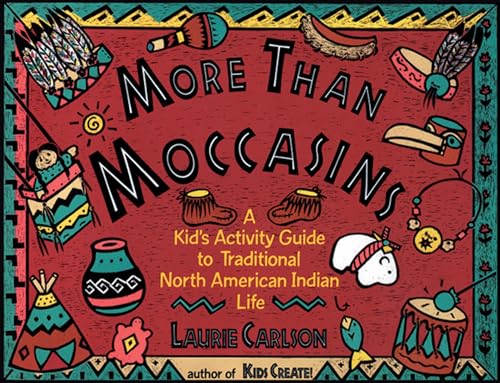
Inhaltsangabe
Kids discover traditions and skills from the people who first settled this continent, including gardening, making useful pottery, and communicating through Navajo codes.
Die Inhaltsangabe kann sich auf eine andere Ausgabe dieses Titels beziehen.
Über die Autorin bzw. den Autor
Laurie Carlson is the author of Colonial Kids, Westward Ho!, Green Thumbs, and Kids Camp! She has taught preschool, primary grades, and children’s art classes. She lives in Cheney, Washington.
Auszug. © Genehmigter Nachdruck. Alle Rechte vorbehalten.
More Than Moccasins
A Kid's Activity Guide to Traditional North American Indian Life
By Laurie CarlsonChicago Review Press Incorporated
Copyright © 1994 Laurie Carlson
All rights reserved.
ISBN: 978-1-55652-213-0All rights reserved.
Contents
Introduction,
Note to Grown-ups,
EVERYDAY LIFE,
THINGS TO WEAR,
SONG AND DANCE,
TOYS,
GAMES,
WHAT'S FOR DINNER?,
Breads,
Meals,
Snacks,
PASS IT ON — TELL SOMEONE,
INDIAN CHILDHOOD,
Bibliography,
CHAPTER 1
EVERYDAY LIFE
Long ago, Indian families had everyday lives much like we do today. Homes had to be built and kept tidy. Treasures and tools had to be stored away carefully. Food had to be cooked, and clothing wore out and had to be replaced. People found different ways to do these things, depending upon what the weather and land was like where they lived.
Whether they lived in traveling camps or large villages, aunts, uncles, cousins, and grandparents all lived nearby; an Indian child was never lonely.
Tepee
The Indians on the Plains hunted the huge herds of buffalo that roamed the grasslands. They used the meat, hides, and bones to make almost everything they needed. The buffalo didn't stay in one place but roamed around looking for grass to eat. The people had to follow them, so the Indians built portable houses that could be moved quickly and easily.
The Dakota people called their beautiful portable homes tepees. They made them from buffalo skins held up by poles. It took between 10 and 40 hides for one tepee, depending upon how wealthy the family was. New tepees were made in the spring to replace old ones that had worn out.
The outside of a tepee was decorated with paint. The top could be held open with poles to let smoke from the fire escape or it could be closed to keep out the rain. In the summer, the bottom could be rolled up to let a cool breeze pass through.
Each spring, all the members of a tribe gathered at one great camp. A council tepee was built in the center and the different bands or family groups put their tepees in a circle around it. Each band had a certain section of the circle so that people could find each other easily. A person would always know where to find an old friend because his or her tepee would be in the same place each spring. After all, they didn't have street signs or house numbers, and these great camps had hundreds of tepees and thousands of people!
When women gathered together to work on a new tepee, they enjoyed a special feast. It took about a day for them to make a new one. When it was time to move the tepees, the women did the work, too. In contests, two Indian women could put up a tepee in less than three minutes! When it was time to move, the tepee was rolled up and tied to a "travois," along with the other things to be moved. The travois was made out of two poles that were fastened to the sides of a horse, a person, or a dog and pulled along the ground.
You can make a toy tepee, or an entire encampment!
MATERIALS
Bowl or plate
Construction paper
Markers, crayons, or paint
Scissors
Tape
The camp was set up around the council tepee.
* Draw a large circle of paper by tracing around the rim of a bowl or plate. Cut the circle out and then cut it in half.
Decorate half the circle with interesting, pretty designs. Roll it into a cone shape and tape or glue the ends together. Cut a slit and fold back the door flaps. Make some clay people to live inside. (Use Play Clay, page 69.)
New tepees were white, but darkened gradually at the top from smoke. Use brown crayon to darken the top part.
Make several to create a whole spring camp!
What kind of furniture was inside a tepee? Only simple, lightweight things that could be carried from camp to camp. Tree boughs were piled and covered with hides for beds.
Use a bowl to trace a large circle.
Roll into a cone and tape. Fold back the door flaps.
Cut the circle in half.
Decorate and build an entire village.
Backrest
Backrests were made by weaving willow branches together. Furs were piled on top so that they were comfortable for people relaxing in their special places in the rear of the tepee and behind the fire.
MATERIALS
Construction paper
3 toothpicks
Scissors
Markers
Glue
* You can make a tiny backrest for your tepee by cutting paper in the shape shown. Decorate it with markers and fold it. Use the toothpicks for the supports. Poke the narrow ends of the toothpicks into the top of the backrest. Glue 2 of the toothpicks securely to the back of the backrest. Spread the third toothpick back for support, like a tripod.
Wigwam
Many tribes lived in villages that stayed in one place. They didn't travel as much as the Plains tribes. People in the Great Lakes area, the East, and California built houses and lived near lakes or rivers. Many of them planted gardens and sold the vegetables to explorers and fur traders. Wigwam-type houses were built by Indians in many areas across the country. They used young trees that could be cut to make poles that bent easily into the framework. The poles were covered with whatever was available — peeled bark, woven grass mats, mud, twigs, and branches.
Indians built the frame of the wigwam by burying the ends of the saplings in the ground, bending them, and then lashing them together with strips of bark or hide. The covering was tied on in bundles. A hole was left in the roof near the center so that smoke from the fire in the center pit could escape.
Cut 1-inch strips.
Tape 2 strips together.
Tape 3 strips to the loop to make a frame.
Tape it into a loop.
Cover with a coffee filter.
MATERIALS
Sheet of paper, 8½ by 11 inches
Coffee filter
Brown paper bag
Scissors
Glue
Tape
Watercolor paints or crayons
* Cut the paper into 1-inch strips. Tape 2 of the strips together to make a long piece. Tape it into a loop to use as the base. Tape 3 strips to make a frame. Use paint or crayons to make the coffee filter brown, green, or tan to match whatever you want to cover it with. Glue it over the framework. Cut a door opening, and fold it back. Glue on leaves, grass clippings, or cut paper strips to cover the coffee filter with a natural-looking roof.
You can also cover your wigwam with torn strips of brown paper bag, dipped in glue. Let it dry hard.
Glue grass or straw to the coffee filter.
You can also dip torn strips of paper in paste and layer them.
Pueblo Village
The desert dwellers in the Southwest created beautiful and practical homes from mud. They formed walls out of building blocks made from a mixture of clay, water, and straw and covered with smooth layers of mud. This kind of house was perfect for the hot, dry climate in the Southwest.
Early explorers called the mud bricks "adobe" (uh-dough-bee), a Spanish word. These adobe buildings were sometimes like big apartment buildings. The Indians built them on top of a flat hill so that they could watch for enemies. When they built the first level, they used logs as beams for the ceiling. They covered the logs with layers of grass and twigs and a thick layer of adobe mud. When it was dry, the next level was built right on top of the first. Each level had several rooms. A large family would live on one level, with grandparents, aunts, uncles, and cousins living in the many rooms. A...
„Über diesen Titel“ kann sich auf eine andere Ausgabe dieses Titels beziehen.
Suchergebnisse für More Than Moccasins: A Kid's Activity Guide to...

Beispielbild für diese ISBN
More Than Moccasins: A Kid's Activity Guide to Traditional North American Indian Life
Anbieter: World of Books (was SecondSale), Montgomery, IL, USA
Verkäuferbewertung 5 von 5 Sternen

Paperback. Zustand: Fair. Kids discover traditions and skills from the people who first settled this continent, including gardening, making useful pottery, and communicating through Navajo codes. Artikel-Nr. 00091886410
Gebraucht kaufen
EUR 4,39
Versand gratis
Versand innerhalb von USA
Versand innerhalb von USA
Anzahl: 3 verfügbar
Beispielbild für diese ISBN
More Than Moccasins: A Kid's Activity Guide to Traditional North American Indian Life
Anbieter: World of Books (was SecondSale), Montgomery, IL, USA
Verkäuferbewertung 5 von 5 Sternen
Paperback. Zustand: Good. Kids discover traditions and skills from the people who first settled this continent, including gardening, making useful pottery, and communicating through Navajo codes. Artikel-Nr. 00085455396
Gebraucht kaufen
EUR 4,39
Versand gratis
Versand innerhalb von USA
Versand innerhalb von USA
Anzahl: Mehr als 20 verfügbar
Beispielbild für diese ISBN
More Than Moccasins: A Kid's Activity Guide to Traditional North American Indian Life (Hands-On History)
Verlag:
Chicago Review Press (edition First Edition), 1994
ISBN 10: 1556522134
ISBN 13: 9781556522130
Gebraucht
Paperback
Erstausgabe
Anbieter: BooksRun, Philadelphia, PA, USA
Verkäuferbewertung 5 von 5 Sternen
Paperback. Zustand: Fair. First Edition. The item might be beaten up but readable. May contain markings or highlighting, as well as stains, bent corners, or any other major defect, but the text is not obscured in any way. Artikel-Nr. 1556522134-7-1
Gebraucht kaufen
EUR 4,90
Versand gratis
Versand innerhalb von USA
Versand innerhalb von USA
Anzahl: 1 verfügbar
Beispielbild für diese ISBN
More Than Moccasins : A Kid's Activity Guide to Traditional North American Indian Life
Verlag:
Chicago Review Press, Incorporated, 1994
ISBN 10: 1556522134
ISBN 13: 9781556522130
Gebraucht
Softcover
Anbieter: Better World Books, Mishawaka, IN, USA
Verkäuferbewertung 5 von 5 Sternen
Zustand: Good. Former library copy. Pages intact with minimal writing/highlighting. The binding may be loose and creased. Dust jackets/supplements are not included. Includes library markings. Stock photo provided. Product includes identifying sticker. Better World Books: Buy Books. Do Good. Artikel-Nr. 4005471-75
Gebraucht kaufen
EUR 6,36
Versand gratis
Versand innerhalb von USA
Versand innerhalb von USA
Anzahl: 3 verfügbar
Beispielbild für diese ISBN
More Than Moccasins : A Kid's Activity Guide to Traditional North American Indian Life
Verlag:
Chicago Review Press, Incorporated, 1994
ISBN 10: 1556522134
ISBN 13: 9781556522130
Gebraucht
Softcover
Anbieter: Better World Books, Mishawaka, IN, USA
Verkäuferbewertung 5 von 5 Sternen
Zustand: Good. Pages intact with minimal writing/highlighting. The binding may be loose and creased. Dust jackets/supplements are not included. Stock photo provided. Product includes identifying sticker. Better World Books: Buy Books. Do Good. Artikel-Nr. 4481857-6
Gebraucht kaufen
EUR 6,36
Versand gratis
Versand innerhalb von USA
Versand innerhalb von USA
Anzahl: 1 verfügbar
Beispielbild für diese ISBN
More Than Moccasins: A Kid's Activity Guide to Traditional North American Indian Life (Hands-On History)
Anbieter: Wonder Book, Frederick, MD, USA
Verkäuferbewertung 5 von 5 Sternen
Zustand: Very Good. Very Good condition. A copy that may have a few cosmetic defects. May also contain light spine creasing or a few markings such as an owner's name, short gifter's inscription or light stamp. Bundled media such as CDs, DVDs, floppy disks or access codes may not be included. Artikel-Nr. E12O-01313
Gebraucht kaufen
EUR 6,43
Versand gratis
Versand innerhalb von USA
Versand innerhalb von USA
Anzahl: 2 verfügbar
Beispielbild für diese ISBN
More Than Moccasins: A Kid's Activity Guide to Traditional North American Indian Life (Hands-On History)
Anbieter: Wonder Book, Frederick, MD, USA
Verkäuferbewertung 5 von 5 Sternen
Zustand: Very Good. Very Good condition. A copy that may have a few cosmetic defects. May also contain light spine creasing or a few markings such as an owner's name, short gifter's inscription or light stamp. Artikel-Nr. B17L-00058
Gebraucht kaufen
EUR 6,43
Versand gratis
Versand innerhalb von USA
Versand innerhalb von USA
Anzahl: 4 verfügbar
Beispielbild für diese ISBN
More Than Moccasins: A Kid's Activity Guide to Traditional North American Indian Life
Anbieter: ThriftBooks-Phoenix, Phoenix, AZ, USA
Verkäuferbewertung 5 von 5 Sternen
Paperback. Zustand: Very Good. No Jacket. May have limited writing in cover pages. Pages are unmarked. ~ ThriftBooks: Read More, Spend Less. Artikel-Nr. G1556522134I4N00
Gebraucht kaufen
EUR 6,46
Versand gratis
Versand innerhalb von USA
Versand innerhalb von USA
Anzahl: 1 verfügbar
Beispielbild für diese ISBN
More Than Moccasins: A Kid's Activity Guide to Traditional North American Indian Life
Anbieter: ThriftBooks-Dallas, Dallas, TX, USA
Verkäuferbewertung 5 von 5 Sternen
Paperback. Zustand: Very Good. No Jacket. May have limited writing in cover pages. Pages are unmarked. ~ ThriftBooks: Read More, Spend Less. Artikel-Nr. G1556522134I4N00
Gebraucht kaufen
EUR 6,48
Versand gratis
Versand innerhalb von USA
Versand innerhalb von USA
Anzahl: 1 verfügbar
Beispielbild für diese ISBN
More Than Moccasins: A Kid's Activity Guide to Traditional North American Indian Life
Anbieter: ThriftBooks-Atlanta, AUSTELL, GA, USA
Verkäuferbewertung 5 von 5 Sternen
Paperback. Zustand: Very Good. No Jacket. Former library book; May have limited writing in cover pages. Pages are unmarked. ~ ThriftBooks: Read More, Spend Less. Artikel-Nr. G1556522134I4N10
Gebraucht kaufen
EUR 6,48
Versand gratis
Versand innerhalb von USA
Versand innerhalb von USA
Anzahl: 1 verfügbar