
Verwandte Artikel zu Cabo de Gata
Inhaltsangabe
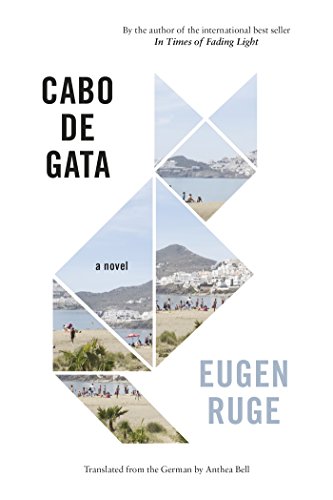
A witty, philosophical novel by the author of the internationally bestselling In Times of Fading Light
Sometimes a cat comes into your life when you least expect it.
An unnamed writer finds himself in Cabo de Gata, a sleepy, worn-down Andalusian fishing village. He's left behind his life in Berlin, which it turns out wasn't much--an ex-girlfriend, a neighborhood that had become too trendy for his taste. Surrounded by a desolate landscape that is scoured by surprisingly cold winds (not at all what he expected of southern Spain), he faces his daily failures: to connect with the innkeeper or any of the townsfolk, who all seem to be hiding something; to learn Spanish; to keep warm; to write. At last he succeeds in making an unlikely connection with one of the village's many feral cats. Does the cat have a message for him? And will their tenuous relationship be enough to turn his life around?
With sharp intelligence and wry humor, Eugen Ruge's Cabo de Gata proposes the biggest questions and illustrates how achieving happiness sometimes means giving oneself up to the foreign and the unknown.
Die Inhaltsangabe kann sich auf eine andere Ausgabe dieses Titels beziehen.
Über die Autorin bzw. den Autor
In 2011, Eugen Ruge came to international acclaim when he won the German Book Prize for In Times of Fading Light, his debut novel, which went on to be translated into more than twenty languages. He lives in Berlin.
Auszug. © Genehmigter Nachdruck. Alle Rechte vorbehalten.
Cabo de Gata
A Novel
By Eugen Ruge, Anthea BellGraywolf Press
Copyright © 2013 Rowohlt Verlag GmbH
All rights reserved.
ISBN: 978-1-55597-757-3All rights reserved.
CHAPTER 1
Giving Notice
1
I remember stopping short midmovement. I remember the smell of coffee, or more precisely the smell of the little Arabian coffeepot I inherited from my mother, and what I specifically remember is how it smells inside when it's empty. I mean its own smell after it has brewed coffee hundreds and thousands of times (something I can describe only in rough-and-ready fashion by saying metal and coffee grounds, because usually I remember smells only when I'm actually smelling them).
As soon as I think of the coffeepot I remember the imprint of its ornamental brass handle on my left hand. But most clearly of all I remember the tiny (and probably pointless) movement of my hand when — tack-tack! — I tap the measuring spoon against the rim of the coffeepot and pause for a moment, maybe only a second.
I remember my surprise at suddenly finding myself there in my kitchen, in exactly that attitude, holding that coffeepot, in the middle of the tiny and probably pointless movement — tack-tack! — that I had carried out in just the same way the morning before (and the morning before the morning before), and for a moment I had the feeling that it was the same morning and I was the same man, a man who, like the undead, was doomed to repeat the same sequence again and again. The next moment I would go barefoot into the bathroom, as I had the morning before (and the morning before the morning before), I would have a cold shower, I would go back into the kitchen, still brushing my teeth, to turn down the gas when the coffee foamed up for the first time; I would stir my muesli — four kinds of cereal flakes with apple and banana — would make my way to my desk balancing the coffeepot in my left hand, and the muesli bowl on top of the coffee cup in my right hand, and I would switch on the PC while I began eating my muesli, hearing the fan start up with a sound like a spaceship, hearing the murmur of the hard disk, the eager clatter of the printer briefly testing itself and announcing that it was ready, and then, as on the morning before (and the morning before the morning before), I would sit in front of the screen, staring at the motionless blinking of the cursor, and I would know that, yet again, I wasn't going to get anything done today.
The next thing I remember is the moment when I tore off my old running pants and the cashmere pullover with holes in it (my favorite working clothes), and put on my jeans. I remember the stiff denim of the jeans, and the effort of forcing my body into them while it was still soft with sleep. I remember the despairing rage I felt, which in reality had nothing to do with the stiff fabric, but was the result of my casting my usual habits to the four winds. I was contravening an inescapable ritual, I was playing hooky from my self-imposed duty to work. My rage was vague and confused, but was directed chiefly against my father, as if it were his fault that I was reproducing, or imitating, his own regular, mechanical lifestyle, the way he sat down to work like a robot. The fact that it brought him success made it all the harder to bear.
I remember that a hot day was beginning outside, or rather I remember going down the corridor of the back part of the apartment, where I had been living since Karolin and I split up. I remember the cool air in the corridor and even now when, in my mind's eye, I pass the brightly painted front door of the punks who lived on the ground floor, I remember the smell of stale beer and marijuana and the lukewarm air blowing toward me through that ever-open door. I remember the penetrating heat of the sun outside the apartment building. I remember the brownish color of the asphalt. I remember that I was very soon sweating, because I was too warmly dressed, but most of all I remember the sweat cooling on my back and forehead as I sat in the Coal Café (in full, the People's Own Coal and Energy Café), in the shade of the large chestnut tree, perusing the breakfast menu.
I was the first customer. A waitress was going around with a small bowl, wiping down — a futile act — the garden furniture, which resembled bulky waste and which at the time, in the years of political change, I took for an interim solution, although it has now turned out to be a variant of the bohemian Prenzlauer Berg style in its own right. I forget what I ordered (some kind of Italian or Spanish or healthily organic breakfast), but I do remember that the waitress, who was probably studying business management or political science, addressed me by the formal you pronoun, and although I usually find it slightly intrusive to be addressed with too much informality in places like the Coal Café, the waitress's formality that morning annoyed me.
I don't remember the breakfast itself at all, or only the lettuce leaves that I didn't eat and the crumbs on the tabletop, and even those I recollect just because the sparrows set about pecking them up. I do know that I sat at the table for some time without moving, watching the sparrows. They approached cautiously but also with haste, their little claws slipping around on the tabletop as if they were novice skaters, and I also remember thinking it remarkable that even after thousands of years these birds, who after all had adapted superbly to city life, would probably never master the art of moving on a smooth tabletop without slipping off. It was simply beyond their capabilities, I reflected, but before I could pursue this train of thought any further the waitress came up to clear the table, shooing the sparrows away, and asked if I would like anything else.
Although my financial situation at the time was so precarious that before ordering every cup of coffee, I stopped to wonder whether I could afford it — or perhaps it was for that very reason, perhaps it was because I didn't want to look like a failure down on his luck to the obviously uninterested waitress — I ordered another latte macchiato anyway, and while I waited for my latte macchiato, something happened that I remember to this day in almost every detail.
Outside the café that had once been an ordinary coal merchant's place (and not, as the new owner from the Prenzlauer Berg district unwittingly supposed, a People's Own firm from East German days), a black BMW stopped and three men got out. They were young, or at least younger than I. Two of them wore short-sleeved T-shirts and jeans; the third was rather older than the others, looked more dissipated, and in general was what I imagined a pimp would be like. He wore a dark suit and a flowered shirt with its collar falling over the lapels of the suit jacket; a pair of presumably expensive sunglasses was perched in his mop of curly hair as if it had found its ultimate destination there; and he wore delicate shoes unsuited to any form of serious locomotion. They were moccasins, if that word is still in circulation, with two small strips of leather tied in a mock bow over the instep of each, the ends of the strips in turn forming tiny tassels.
In the "front yard" of the café, which in defiance of the regulations consisted of part of the broad Berlin sidewalk, commandeered for use by its customers, the seating was made up, among other things, of old planks that had once been part of some scaffolding and were now stacked along the wall of the building. They had probably...
„Über diesen Titel“ kann sich auf eine andere Ausgabe dieses Titels beziehen.
Suchergebnisse für Cabo de Gata

Beispielbild für diese ISBN
Cabo de Gata: A Novel
Verlag:
Graywolf Press (edition Translation), 2016
ISBN 10: 155597757X
ISBN 13: 9781555977573
Gebraucht
Paperback
Anbieter: BooksRun, Philadelphia, PA, USA
Verkäuferbewertung 5 von 5 Sternen

Paperback. Zustand: Fair. Translation. The item might be beaten up but readable. May contain markings or highlighting, as well as stains, bent corners, or any other major defect, but the text is not obscured in any way. Artikel-Nr. 155597757X-7-1
Gebraucht kaufen
EUR 5,17
Versand gratis
Versand innerhalb von USA
Versand innerhalb von USA
Anzahl: 1 verfügbar
Beispielbild für diese ISBN
Cabo de Gata
Anbieter: ThriftBooks-Atlanta, AUSTELL, GA, USA
Verkäuferbewertung 5 von 5 Sternen
Paperback. Zustand: As New. No Jacket. Pages are clean and are not marred by notes or folds of any kind. ~ ThriftBooks: Read More, Spend Less. Artikel-Nr. G155597757XI2N00
Gebraucht kaufen
EUR 6,41
Versand gratis
Versand innerhalb von USA
Versand innerhalb von USA
Anzahl: 1 verfügbar
Beispielbild für diese ISBN
Cabo de Gata : A Novel
Anbieter: Better World Books, Mishawaka, IN, USA
Verkäuferbewertung 5 von 5 Sternen
Zustand: Good. Tra. Former library copy. Pages intact with minimal writing/highlighting. The binding may be loose and creased. Dust jackets/supplements are not included. Includes library markings. Stock photo provided. Product includes identifying sticker. Better World Books: Buy Books. Do Good. Artikel-Nr. 38810177-75
Gebraucht kaufen
EUR 7,01
Versand gratis
Versand innerhalb von USA
Versand innerhalb von USA
Anzahl: 1 verfügbar
Beispielbild für diese ISBN
Cabo de Gata : A Novel
Anbieter: Better World Books, Mishawaka, IN, USA
Verkäuferbewertung 5 von 5 Sternen
Zustand: Good. Tra. Pages intact with minimal writing/highlighting. The binding may be loose and creased. Dust jackets/supplements are not included. Stock photo provided. Product includes identifying sticker. Better World Books: Buy Books. Do Good. Artikel-Nr. 14227119-6
Gebraucht kaufen
EUR 7,01
Versand gratis
Versand innerhalb von USA
Versand innerhalb von USA
Anzahl: 1 verfügbar