
Verwandte Artikel zu Fifteen Dogs
Inhaltsangabe
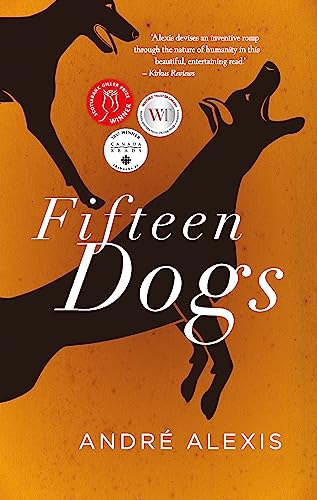
Winner of Canada Reads 2017
Winner of the 2015 Scotiabank Giller Prize
Finalist for the 2015 Toronto Book Awards
Winner of the 2015 Rogers Writers' Trust Fiction Prize
"[Alexis] devises an inventive romp through the nature of humanity in this beautiful, entertaining read … A clever exploration of our essence, communication, and how our societies are organized." – Kirkus Reviews
"This might be the best set-up of the spring." – The Globe & Mail
"André Alexis has established himself as one of our preeminent voices." – Toronto Star
— I wonder, said Hermes, what it would be like if animals had human intelligence.
— I'll wager a year's servitude, answered Apollo, that animals – any animal you like – would be even more unhappy than humans are, if they were given human intelligence.
And so it begins: a bet between the gods Hermes and Apollo leads them to grant human consciousness and language to a group of dogs overnighting at a Toronto veterinary clinic. Suddenly capable of more complex thought, the pack is torn between those who resist the new ways of thinking, preferring the old 'dog' ways, and those who embrace the change. The gods watch from above as the dogs venture into their newly unfamiliar world, as they become divided among themselves, as each struggles with new thoughts and feelings. Wily Benjy moves from home to home, Prince becomes a poet, and Majnoun forges a relationship with a kind couple that stops even the Fates in their tracks.
André Alexis's contemporary take on the apologue offers an utterly compelling and affecting look at the beauty and perils of human consciousness. By turns meditative and devastating, charming and strange, Fifteen Dogs shows you can teach an old genre new tricks.
André Alexis was born in Trinidad and grew up in Canada. His debut novel, Childhood, won the Books in Canada First Novel Award, the Trillium Book Award, and was shortlisted for the Giller Prize and the Writers' Trust Fiction Prize. His other previous books include Asylum, Beauty and Sadness, Ingrid & the Wolf and, most recently, Pastoral, which was also nominated for the Rogers Writers' Trust Fiction Prize and was named a Globe and Mail Top 100 book of 2014.
Die Inhaltsangabe kann sich auf eine andere Ausgabe dieses Titels beziehen.
Über die Autorin bzw. den Autor
André Alexis was born in Trinidad and grew up in Canada. He is the author of the Quincunx, comprised of five novels: Fifteen Dogs, winner of the Giller Prize, CBC Canada Reads, and the Writers’ Trust Fiction Prize; Days by Moonlight, winner of the Writers’ Trust Fiction Prize; Pastoral; The Hidden Keys; and Ring. His debut novel, Childhood, won the Books in Canada First Novel and the Trillium Book Award, and was shortlisted for the Giller Prize and the Writers’ Trust Fiction Prize. His other books include Asylum, The Night Piece, Despair and Other Stories of Ottawa, and most recently Other Worlds, longlisted for the Toronto Book Award. He is the recipient of a Windham Campbell Prize. He lives in Toronto.
Auszug. © Genehmigter Nachdruck. Alle Rechte vorbehalten.
Fifteen Dogs
An Apologue
By André AlexisCOACH HOUSE BOOKS
Copyright © 2015 André Alexis
All rights reserved.
ISBN: 978-1-55245-305-6All rights reserved.
CHAPTER 1
A WAGER
One evening in Toronto, the gods Apollo and Hermes were at the Wheat Sheaf Tavern. Apollo had allowed his beard to grow until it reached his clavicle. Hermes, more fastidious, was clean-shaven, but his clothes were distinctly terrestrial: black jeans, a black leather jacket, a blue shirt.
They had been drinking, but it wasn't the alcohol that intoxicated them. It was the worship their presence elicited. The Wheat Sheaf felt like a temple, and the gods were gratified. In the men's washroom, Apollo allowed parts of himself to be touched by an older man in a business suit. This pleasure, more intense than any the man had known or would ever know again, cost him eight years of his life.
While at the tavern, the gods began a desultory conversation about the nature of humanity. For amusement, they spoke ancient Greek, and Apollo argued that, as creatures go, humans were neither better nor worse than any other, neither better nor worse than fleas or elephants, say. Humans, said Apollo, have no special merit, though they think themselves superior. Hermes took the opposing view, arguing that, for one thing, the human way of creating and using symbols, is more interesting than, say, the complex dancing done by bees.
– Human languages are too vague, said Apollo.
– That may be, said Hermes, but it makes humans more amusing. Just listen to these people. You'd swear they understood each other, though not one of them has any idea what their words actually mean to another. How can you resist such farce?
– I didn't say they weren't amusing, answered Apollo. But frogs and flies are amusing, too.
– If you're going to compare humans to flies, we'll get nowhere. And you know it.
In perfect though divinely accented English – that is, in an English that every patron at the tavern heard in his or her own accent – Apollo said
– Who'll pay for our drinks?
– I will, said a poor student. Please, let me.
Apollo put a hand on the young man's shoulder.
– My brother and I are grateful, he said. We've had five Sleemans each, so you'll not know hunger or want for ten years.
The student knelt to kiss Apollo's hand and, when the gods had gone, discovered hundreds of dollars in his pockets. In fact, for as long as he had the pants he was wearing that evening, he had more money in his pockets than he could spend, and it was ten years to the instant before their corduroy rotted to irrecoverable shreds.
Outside the tavern, the gods walked west along King Street.
– I wonder, said Hermes, what it would be like if animals had human intelligence.
– I wonder if they'd be as unhappy as humans, Apollo answered.
– Some humans are unhappy; others aren't. Their intelligence is a difficult gift.
– I'll wager a year's servitude, said Apollo, that animals – any animal you choose – would be even more unhappy than humans are, if they had human intelligence.
– An earth year? I'll take that bet, said Hermes, but on condition that if, at the end of its life, even one of the creatures is happy, I win.
– But that's a matter of chance, said Apollo. The best lives sometimes end badly and the worst sometimes end well.
– True, said Hermes, but you can't know what a life has been until it is over.
– Are we speaking of happy beings or happy lives? No, never mind. Either way, I accept your terms. Human intelligence is not a gift. It's an occasionally useful plague. What animals do you choose?
As it happened, the gods were not far from the veterinary clinic at Shaw. Entering the place unseen and imperceptible, they found dogs, mostly: pets left overnight by their owners for one reason or another. So, dogs it was.
– Shall I leave them their memories? asked Apollo.
– Yes, said Hermes.
With that, the god of light granted 'human intelligence' to the fifteen dogs who were in the kennel at the back of the clinic.
Somewhere around midnight, Rosie, a German shepherd, stopped as she was licking her vagina and wondered how long she would be in the place she found herself. She then wondered what had happened to the last litter she'd whelped. It suddenly seemed grossly unfair that one should go through the trouble of having pups only to lose track of them.
She got up to have a drink of water and to sniff at the hard pellets that had been left for her to eat. Nosing the food around in its shallow bowl, she was perplexed to discover that the bowl was not dark in the usual way but had, rather, a strange hue. The bowl was astonishing. It was only a kind of bubble-gum pink, but as Rosie had never seen the colour before, it looked beautiful. To her dying day, no colour ever surpassed it.
In the cell beside Rosie's, a grey Neapolitan mastiff named Atticus was dreaming of a wide field, which, to his delight, was overrun by small, furry animals, thousands of them – rats, cats, rabbits and squirrels – moving across the grass like the hem of a dress being pulled away, just out of his reach. This was Atticus's favourite dream, a recurring joy that always ended with him happily bringing a struggling creature back to his beloved master. His master would take the thing, strike it against a rock, then move his hand along Atticus's back and speak his name. Always, the dream always ended this way. But not this night. This night, as Atticus bit down at the neck of one of the creatures, it occurred to him that the creature must feel pain. That thought – vivid and unprecedented – woke him from sleep.
All around the kennel, dogs woke from sleep, startled by strange dreams or suddenly aware of some indefinable change in their environment. Those who had not been sleeping – it is always difficult to sleep away from home – got up and moved to the doors of their cells to see who had entered, so human did this silence feel. At first, each of them assumed that his or her newfound vision was unique. Only gradually did it become clear that all of them shared the strange world they were now living in.
A black poodle named Majnoun barked softly. He stood still, as if contemplating Rosie, who was in the cage facing his. As it happened, however, Majnoun was thinking about the lock on Rosie's cage: an elongated loop fixed to a sliding bolt. The long loop lay between two pieces of metal, effectively keeping the bolt in place and locking the cage door. It was simple, elegant and effective. And yet, to unlock the cage, all one had to do was lift the loop and push the bolt back. Standing on his hind legs and pushing a paw out of his cage, Majnoun did just that. It took him a number of attempts and it was awkward, but after a little while his cage was unlocked and he pushed the door open.
Though most of the dogs understood how Majnoun had opened his cell, not all of them were capable of doing the same. There were various reasons for this. Frick and Frack, two Labrador yearlings who had been left overnight for neutering, were too young and impatient for the doors. The smaller dogs – a chocolate teacup poodle named Athena, a schnauzer named Dougie, a beagle named Benjy – knew they were physically incapable of reaching the bolt and whined their frustration until their cells were opened for them. The older dogs, in particular a Labradoodle named Agatha, were too tired and...
„Über diesen Titel“ kann sich auf eine andere Ausgabe dieses Titels beziehen.
Suchergebnisse für Fifteen Dogs

Beispielbild für diese ISBN
Fifteen Dogs
Anbieter: World of Books (was SecondSale), Montgomery, IL, USA
Verkäuferbewertung 5 von 5 Sternen

Paperback. Zustand: Good. An utterly convincing and moving look at the beauty and perils of consciousness. Artikel-Nr. 00093335981
Gebraucht kaufen
EUR 4,70
Versand gratis
Versand innerhalb von USA
Versand innerhalb von USA
Anzahl: Mehr als 20 verfügbar
Beispielbild für diese ISBN
Fifteen Dogs
Anbieter: World of Books (was SecondSale), Montgomery, IL, USA
Verkäuferbewertung 5 von 5 Sternen
Paperback. Zustand: Very Good. An utterly convincing and moving look at the beauty and perils of consciousness. Artikel-Nr. 00098518556
Gebraucht kaufen
EUR 4,70
Versand gratis
Versand innerhalb von USA
Versand innerhalb von USA
Anzahl: 10 verfügbar
Beispielbild für diese ISBN
Fifteen Dogs
Verlag:
Coach House Books, Canada, Toronto, 2015
ISBN 10: 1552453057
ISBN 13: 9781552453056
Gebraucht
Paperback
Anbieter: WorldofBooks, Goring-By-Sea, WS, Vereinigtes Königreich
Verkäuferbewertung 5 von 5 Sternen
Paperback. Zustand: Very Good. Winner of the 2015 Scotiabank Giller Prize Finalist for the 2015 Toronto Book Awards Winner of the 2015 Rogers Writers' Trust Fiction Prize "[Alexis] devises an inventive romp through the nature of humanity in this beautiful, entertaining read A clever exploration of our essence, communication, and how our societies are organized." Kirkus Reviews "This might be the best set-up of the spring." The Globe & Mail "Andre Alexis has established himself as one of our preeminent voices." Toronto Star I wonder, said Hermes, what it would be like if animals had human intelligence. I'll wager a year's servitude, answered Apollo, that animals any animal you like would be even more unhappy than humans are, if they were given human intelligence. And so it begins: a bet between the gods Hermes and Apollo leads them to grant human consciousness and language to a group of dogs overnighting at a Toronto vet-erinary clinic. Suddenly capable of more complex thought, the pack is torn between those who resist the new ways of thinking, preferring the old 'dog' ways, and those who embrace the change. The gods watch from above as the dogs venture into their newly unfamiliar world, as they become divided among themselves, as each struggles with new thoughts and feelings. Wily Benjy moves from home to home, Prince becomes a poet, and Majnoun forges a relationship with a kind couple that stops even the Fates in their tracks. Andre Alexis's contemporary take on the apologue offers an utterly compelling and affecting look at the beauty and perils of human consciousness. By turns meditative and devastating, charming and strange, Fifteen Dogs shows you can teach an old genre new tricks. Andre Alexis was born in Trinidad and grew up in Canada. His debut novel, Childhood, won the Books in Canada First Novel Award, the Trillium Book Award, and was shortlisted for the Giller Prize and the Writers' Trust Fiction Prize. His other previous books include Asylum, Beauty and Sadness, Ingrid & the Wolf and, most recently, Pastoral, which was also nominated for the Rogers Writers' Trust Fiction Prize and was named a Globe and Mail Top 100 book of 2014. The book has been read, but is in excellent condition. Pages are intact and not marred by notes or highlighting. The spine remains undamaged. Artikel-Nr. GOR007180888
Gebraucht kaufen
EUR 12,47
EUR 6,65 Versand
Versand von Vereinigtes Königreich nach USA
Versand von Vereinigtes Königreich nach USA
Anzahl: 7 verfügbar
Beispielbild für diese ISBN
Fifteen Dogs
Anbieter: Magers and Quinn Booksellers, Minneapolis, MN, USA
Verkäuferbewertung 5 von 5 Sternen
paperback. Zustand: New. Brand New. paperback. Artikel-Nr. 863542
Neu kaufen
EUR 15,87
EUR 3,56 Versand
Versand innerhalb von USA
Versand innerhalb von USA
Anzahl: 1 verfügbar
Beispielbild für diese ISBN
FIFTEEN DOGS: An Apologue.
Verlag:
Coach House Press, Toronto, 2015
ISBN 10: 1552453057
ISBN 13: 9781552453056
Gebraucht
Softcover
Erstausgabe
Anbieter: Bookfever, IOBA (Volk & Iiams), Ione, CA, USA
Verkäuferbewertung 5 von 5 Sternen
Zustand: VERY GOOD. First edition, fifth printing, a trade paperback. An unusual novel by this award-winning writer who born in Trinidad and grew up in Canada. It begins with a bet between the gods Hermes and Apollo which leads them to grant human consciousness and language to a group of dogs who had been left overnight at a Toronto veterinary clinic. Suddenly capable of more complex thought, the pack is torn between those who resist the new ways of thinking, preferring the old 'dog' ways, and those who embrace the change. In awarding this book the Giller Prize, the jury commented "What does it mean to be alive? To think, to feel, to love and to envy? Andre Alexis explores all of this and more in the extraordinary Fifteen Dogs, an insightful and philosophical meditation on the nature of consciousness. Its a novel filled with balancing acts: humour juxtaposed with savagery, solitude with the desperate need to be part of a pack, perceptive prose interspersed with playful poetry. A wonderful and original piece of writing that challenges the reader to examine their own existence and recall the age old question, whats the meaning of life?" 171 pp. Very near fine - appears unread, but part of a poem has been printed inside the back cover. Artikel-Nr. 83192
Gebraucht kaufen
EUR 15,16
EUR 4,41 Versand
Versand innerhalb von USA
Versand innerhalb von USA
Anzahl: 1 verfügbar
Beispielbild für diese ISBN
Fifteen Dogs: An Apologue
Anbieter: Anybook.com, Lincoln, Vereinigtes Königreich
Verkäuferbewertung 5 von 5 Sternen
Zustand: Good. This is an ex-library book and may have the usual library/used-book markings inside.This book has soft covers. In good all round condition. Please note the Image in this listing is a stock photo and may not match the covers of the actual item,400grams, ISBN:9781552453056. Artikel-Nr. 4846356
Gebraucht kaufen
EUR 10,72
EUR 15,48 Versand
Versand von Vereinigtes Königreich nach USA
Versand von Vereinigtes Königreich nach USA
Anzahl: 1 verfügbar
Beispielbild für diese ISBN
Fifteen Dogs
Anbieter: Revaluation Books, Exeter, Vereinigtes Königreich
Verkäuferbewertung 5 von 5 Sternen
Paperback. Zustand: Brand New. 160 pages. 8.50x5.25x0.75 inches. In Stock. Artikel-Nr. __1552453057
Neu kaufen
EUR 17,41
EUR 11,87 Versand
Versand von Vereinigtes Königreich nach USA
Versand von Vereinigtes Königreich nach USA
Anzahl: 1 verfügbar