
Verwandte Artikel zu K9 Agression Control: Teaching the "Out" (K9...
K9 Agression Control: Teaching the "Out" (K9 Professional Training) - Softcover
Buch 9 von 15: K9 Professional Training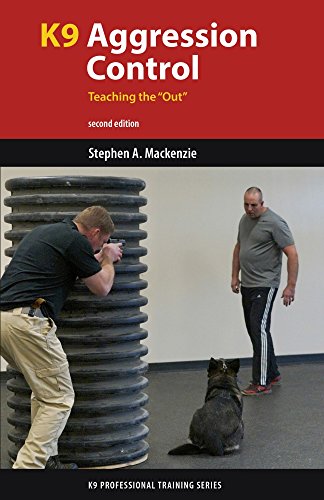
Inhaltsangabe
Includes a new chapter on indicating without biting.
Learn how to:
- Choose the right dog and training method.
- Train dogs that will out reliably in all situations.
- Solve common problems in aggression-control training.
Aggression control training requires dogs to think while they are excited and under stress, which is no easy task. Dr. Stephen A. Mackenzie has been teaching and using non-compulsive methods for aggression-control training for more than 30 years. His techniques have worked for hundreds of dogs, and have been used and adapted by many skilled trainers and decoys for their individual circumstances.
K9 Aggression Control provides a flexible approach to aggression control that is rooted in obedience training. You may be someone who uses a muzzle, sees a role for toys and games, and works with a decoy who likes to drop the sleeve, or you might not want a muzzle, toy, or dropped sleeve anywhere near your dog—either way this book has options for you. It details techniques and variations so you can choose the options you prefer. Dr. Mackenzie also gives decoys sound advice on controlling a dog’s excitement level, working with handlers, and making the best use of equipment.
A new chapter in this revised and updated edition shows you how to train dogs to indicate a person’s location without biting—essential for the search and rescue trainer and a real plus for modern police forces looking for ways to reduce liability.
Die Inhaltsangabe kann sich auf eine andere Ausgabe dieses Titels beziehen.
Über die Autorin bzw. den Autor
Dr. Stephen A. Mackenzie has been a deputy sheriff for more than 20 years and has been training and handling police service dogs for more than 30 years. A popular seminar instructor, he has testified in both criminal and civil cases as a court-recognized expert in animal behavior. He is currently a professor of animal science at the State University of New York at Cobleskill.
Auszug. © Genehmigter Nachdruck. Alle Rechte vorbehalten.
CHAPTER 1: SELECTING THE CORRECT DOG AND THE YERKES-DODSON LAW
SELECTING THE CORRECT DOG
Training a police dog is a large, multifaceted project. Unfortunately, on the very first day of this project, many trainers inadvertently and unconsciously doom themselves to failure by selecting the wrong type of dog. Good police dogs must be able to learn and solve problems when they are highly excited, and therefore, only dogs with the ability to think clearly when excited and quickly calm down when it is appropriate should be taken into training. Time and time again we see trainers testing canine candidates for confidence, environmental soundness, approachability, aggression, hunting behavior, and other important qualities and do nothing to evaluate the dogs’ ability to keep a clear head and calm down quickly. This is regrettable, since these are the qualities that allow us to teach aggression control later.
There seem to be two major conditions for confident dogs with high levels of aggression: one, the aggression can be accompanied by a clear-headed attitude or, two, the aggression can be unreasonable and expressed when the dog is unprovoked and remain high even after the original provocation has ceased. Police dogs are supposed to react to how people behave not how they are dressed. If a dog flings himself aggressively at the decoy when the decoy is acting normally simply because the decoy is in a bite suit or wearing a sleeve, this is unprovoked aggression that will make extra work for us later. If the dog is uncontrollable in this situation, we will probably have trouble with impulse control later. When the aggression level of a dog remains high even after the stimulation for aggression has stopped, the dog is telling us as clearly as he can that he is going to give us control problems later. Unfortunately, many trainers see dogs like this and think they are “high in drive,” score them highly, and pay money for them when in fact they are not superior candidates; they are simply wild animals that are not suitable for training to be a modern, approachable police dog. Please do not mistake the intent here; a high level of aggression is indeed necessary to produce a good police dog, but it is not enough by itself. We need a dog that is highly aggressive but also able to remain calm, to solve problems, and to learn new things in exciting situations. Calmness is a behavior, and it can be selected for and rewarded just like any other behavior. Unfortunately, very few trainers do this.
TESTING FOR CALMNESS AND A CLEAR HEAD
There are several ways to test for calmness and a clear head, and if you already have a good method, you might want to stick with it. If you are inexperienced or have no favorite test, the following method will get you started.
Take the dog to a location he is not familiar with and have a person dressed in a bite suit or wearing a sleeve stand passively in the middle of the test area, not stimulating the dog in any way. If the dog is trained in obedience, do some on-leash obedience around the decoy to see if the dog can focus on the handler, even with the decoy near. If the dog cannot break his focus on the decoy to pay attention to the handler, the dog is reacting only to how the decoy is dressed when he should be reacting to the peaceful behavior exhibited by the decoy.
If the dog is not trained in obedience, have the decoy display the same passive behavior while you produce the dog’s favorite toy or treat, and see if the dog will leave the non-aggressive decoy to play or receive his favorite reward. A dog that can shift his focus away from the decoy can easily learn neutral reactions, which are very important and will usually result in good impulse control later. This will reduce the number of bad bites you experience and decrease your liability problems in the future. A dog with mental balance also can learn to bite passive suspects when the time comes, so you need not worry about that.
Once you have determined that the dog is not biting things without reason, you can stake him out (back-tie him) to something solid or have a person who is unknown to the dog hold his leash. Have a competent decoy work the dog while you evaluate his potential for the types of aggression you are interested in. See my book K9 Decoys and Aggression: A Manual for Training Police Dogs (Brush Education, 2015) for descriptions of the different types of aggression. When you have seen enough to be certain that the dog has high levels of the appropriate types of aggression, have the decoy stop working with and stimulating the dog and wait a few minutes. Then have the decoy approach the dog in a neutral or passive manner, again without displaying any threatening or stimulating signals. A good candidate dog will not show aggression at this point since there is no justification for it and he has had sufficient time to calm down .
(Figures missing)
If the dog continues to act aggressively when there is no reason for such behavior, he will likely have control problems later. This doesn’t mean you can’t train this animal, but it does mean that there is a better dog out there and that it’s in your best interest to keep looking for him.
Whether you use the above described method or have your own approach to testing dogs for the presence of a reasonable attitude and a clear head, make sure that this is an important item in your decision to accept or reject a canine candidate. A dog should react aggressively only when the decoy shows bad behavior, not any time the decoy is in a bite suit or sleeve. When bad behavior from the decoy ceases, there is no longer any reason for the dog to be aggressive, and he should calm down in a reasonably short amount of time. Dogs that can do this will easily learn aggression control taught using modern, positive techniques. Dogs that cannot keep a clear head will have difficulty.
So why do we see so many dogs with unreasonable responses? We see them because we keep paying people money for such animals. When we refuse to pay money for unreasonable dogs, breeders and vendors will stop bringing them to us. The good ones already have. If we keep our standards at a low level and reward providers for showing us difficult animals, such animals will continue to appear. We must stop rewarding the providers economically for bringing us unsuitable dogs. When we do, we will start seeing strong but balanced, clear-headed dogs that are suitable for aggression control training. We control the economic rewards—it is up to us.
THE YERKES-DODSON LAW
As stated above, aggression-control work requires dogs to be able to think while they are excited. Many of the imported dogs we have been working with lately are having difficulty with this, so a look at the relationship between excitement and cognitive abilities seems to be in order.
In the early 20th century, psychologists Robert M. Yerkes and John D. Dodson began looking at the relationship between emotional arousal and performance. They published a paper in 1908 in which they described what is now known as the Yerkes-Dodson Law, or the inverted U.” As Figure 1.4 shows, they noticed an optimum level of excitement or arousal for any given task. As excitement levels drop or increase from this optimum, performance decreases.
CONSIDER NATURAL EXCITEMENT LEVELS
Dogs that start on the left side of the inverted U need to have their excitement levels increased to reach good performance levels, whereas dogs starting on the right side of the curve need to have their excitement levels decreased to perform well. All our decisions need to be made in light of where we think our dog is on the curve and which way our actions will push him. While there are bound to be minor exceptions to every rule, the Yerkes-Dodson Law has been well accepted for a...
„Über diesen Titel“ kann sich auf eine andere Ausgabe dieses Titels beziehen.
Suchergebnisse für K9 Agression Control: Teaching the "Out" (K9...

Beispielbild für diese ISBN
K9 Aggression Control: Teaching the Out
Anbieter: ThriftBooks-Dallas, Dallas, TX, USA
Verkäuferbewertung 5 von 5 Sternen

Paperback. Zustand: Very Good. No Jacket. May have limited writing in cover pages. Pages are unmarked. ~ ThriftBooks: Read More, Spend Less. Artikel-Nr. G155059706XI4N00
Gebraucht kaufen
EUR 22,10
Versand gratis
Versand innerhalb von USA
Versand innerhalb von USA
Anzahl: 1 verfügbar
Beispielbild für diese ISBN
K9 Agression Control: Teaching the "Out"
Anbieter: PBShop.store UK, Fairford, GLOS, Vereinigtes Königreich
Verkäuferbewertung 5 von 5 Sternen
PAP. Zustand: New. New Book. Shipped from UK. Established seller since 2000. Artikel-Nr. GB-9781550597066
Neu kaufen
EUR 23,93
EUR 4,84 Versand
Versand von Vereinigtes Königreich nach USA
Versand von Vereinigtes Königreich nach USA
Anzahl: 2 verfügbar
Beispielbild für diese ISBN
K9 Aggression Control: Teaching the "Out" (K9 Professional Training Series)
Verlag:
Detselig Enterprises, Limited, 2017
ISBN 10: 155059706X
ISBN 13: 9781550597066
Neu
Softcover
Anbieter: Majestic Books, Hounslow, Vereinigtes Königreich
Verkäuferbewertung 4 von 5 Sternen

Zustand: New. pp. 112. Artikel-Nr. 383504340
Neu kaufen
EUR 28,19
EUR 7,56 Versand
Versand von Vereinigtes Königreich nach USA
Versand von Vereinigtes Königreich nach USA
Anzahl: 3 verfügbar
Beispielbild für diese ISBN
K9 Aggression Control: Teaching the "Out" (K9 Professional Training Series)
Anbieter: Ria Christie Collections, Uxbridge, Vereinigtes Königreich
Verkäuferbewertung 5 von 5 Sternen
Zustand: New. In English. Artikel-Nr. ria9781550597066_new
Neu kaufen
EUR 25,65
EUR 10,90 Versand
Versand von Vereinigtes Königreich nach USA
Versand von Vereinigtes Königreich nach USA
Anzahl: Mehr als 20 verfügbar
Beispielbild für diese ISBN
K9 Aggression Control: Teaching the "Out"
Anbieter: Revaluation Books, Exeter, Vereinigtes Königreich
Verkäuferbewertung 5 von 5 Sternen
Paperback. Zustand: Brand New. 2nd edition. 112 pages. 8.50x5.51x0.27 inches. In Stock. Artikel-Nr. __155059706X
Neu kaufen
EUR 25,66
EUR 11,63 Versand
Versand von Vereinigtes Königreich nach USA
Versand von Vereinigtes Königreich nach USA
Anzahl: 2 verfügbar
Beispielbild für diese ISBN
K9 Agression Control: Teaching the Out
Anbieter: Kennys Bookstore, Olney, MD, USA
Verkäuferbewertung 5 von 5 Sternen
Zustand: New. 2017. 2nd ed. Paperback. . . . . . Books ship from the US and Ireland. Artikel-Nr. V9781550597066
Neu kaufen
EUR 32,33
EUR 9,22 Versand
Versand innerhalb von USA
Versand innerhalb von USA
Anzahl: 2 verfügbar
Foto des Verkäufers
"K9 Agression Control: Teaching the \"Out\" "
Verlag:
Brush Education Inc Apr 2018, 2018
ISBN 10: 155059706X
ISBN 13: 9781550597066
Neu
Taschenbuch
Anbieter: AHA-BUCH GmbH, Einbeck, Deutschland
Verkäuferbewertung 5 von 5 Sternen
Taschenbuch. Zustand: Neu. Neuware - Includes a new chapter on indicating without biting. Learn how to: - Choose the right dog and training method. - Train dogs that will out reliably in all situations. - Solve common problems in aggression-control training. Aggression control training requires dogs to think while they are excited and under stress, which is no easy task. Dr. Stephen A. Mackenzie has been teaching and using non-compulsive methods for aggression-control training for more than 30 years. His techniques have worked for hundreds of dogs, and have been used and adapted by many skilled trainers and decoys for their individual circumstances. K9 Aggression Control provides a flexible approach to aggression control that is rooted in obedience training. You may be someone who uses a muzzle, sees a role for toys and games, and works with a decoy who likes to drop the sleeve, or you might not want a muzzle, toy, or dropped sleeve anywhere near your dog--either way this book has options for you. It details techniques and variations so you can choose the options you prefer. Dr. Mackenzie also gives decoys sound advice on controlling a dog's excitement level, working with handlers, and making the best use of equipment. A new chapter in this revised and updated edition shows you how to train dogs to indicate a person's location without biting--essential for the search and rescue trainer and a real plus for modern police forces looking for ways to reduce liability. Artikel-Nr. 9781550597066
Neu kaufen
EUR 29,08
EUR 35,00 Versand
Versand von Deutschland nach USA
Versand von Deutschland nach USA
Anzahl: 2 verfügbar
Beispielbild für diese ISBN
K9 AGGRESSION CONTROL TEACHING THE OUT
Anbieter: Speedyhen, Hertfordshire, Vereinigtes Königreich
Verkäuferbewertung 5 von 5 Sternen
Zustand: NEW. Artikel-Nr. NW9781550597066
Neu kaufen
EUR 21,06
EUR 47,67 Versand
Versand von Vereinigtes Königreich nach USA
Versand von Vereinigtes Königreich nach USA
Anzahl: 2 verfügbar
Foto des Verkäufers
K9 Aggression Control: Teaching the Out
Verlag:
BRUSH EDUCATION, 2017
ISBN 10: 155059706X
ISBN 13: 9781550597066
Neu
Kartoniert / Broschiert
Anbieter: moluna, Greven, Deutschland
Verkäuferbewertung 5 von 5 Sternen
Kartoniert / Broschiert. Zustand: New. Über den AutorDr. Stephen A. Mackenzie has been a deputy sheriff for more than 20 years and has been training and handling police service dogs for more than 30 years. A popular seminar instructor, he has testified in both criminal a. Artikel-Nr. 904294063
Neu kaufen
EUR 28,81
EUR 48,99 Versand
Versand von Deutschland nach USA
Versand von Deutschland nach USA
Anzahl: 2 verfügbar
Foto des Verkäufers
K9 Agression Control: Teaching the "Out"
Anbieter: preigu, Osnabrück, Deutschland
Verkäuferbewertung 5 von 5 Sternen
Taschenbuch. Zustand: Neu. K9 Agression Control: Teaching the "Out" | Stephen A. Mackenzie | Taschenbuch | K9 Professional Training Series | Kartoniert / Broschiert | Englisch | 2018 | Brush Education Inc | EAN 9781550597066 | Verantwortliche Person für die EU: Libri GmbH, Europaallee 1, 36244 Bad Hersfeld, gpsr[at]libri[dot]de | Anbieter: preigu. Artikel-Nr. 133001242
Neu kaufen
EUR 33,10
EUR 70,00 Versand
Versand von Deutschland nach USA
Versand von Deutschland nach USA
Anzahl: 1 verfügbar