
Verwandte Artikel zu After On: A Novel of Silicon Valley
Inhaltsangabe
The definitive novel of today’s Silicon Valley, After On flash-captures our cultural and technological moment with up-to-the-instant savvy. Matters of privacy and government intrusion, post-Tinder romance, nihilistic terrorism, artificial consciousness, synthetic biology, and much more are tackled with authority and brash playfulness by New York Times bestselling author Rob Reid.
Meet Phluttr—a diabolically addictive new social network and a villainess, heroine, enemy, and/or bestie to millions. Phluttr has ingested every fact and message ever sent to, from, and about her innumerable users. Her capabilities astound her makers—and they don’t even know the tenth of it.
But what’s the purpose of this stunning creation? Is it a front for something even darker and more powerful than the NSA? A bid to create a trillion-dollar market by becoming “The UberX of Sex”? Or a reckless experiment that could spawn the digital equivalent of a middle-school mean girl with enough charisma, dirt, and cunning to bend the entire planet to her will?
Phluttr has it in her to become the greatest gossip, flirt, or matchmaker in history. Or she could cure cancer, bring back Seinfeld, then start a nuclear war. Whatever she does, it’s not up to us. But a motley band of Silicon Valley entrepreneurs, venture capitalists, and engineers might be able to influence her.
After On achieves the literary singularity—fusing speculative satire and astonishing reality into a sharp-witted, ferociously believable, IMAX-wide view of our digital age.
Praise for After On
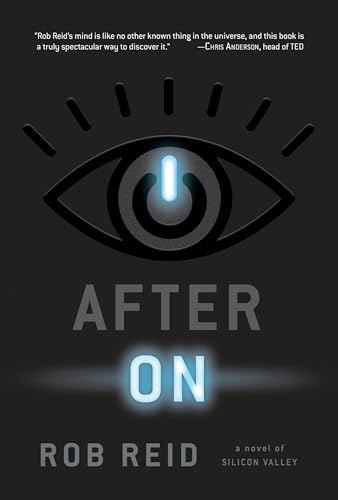
“Rob Reid’s mind is like no other known thing in the universe, and this book is a truly spectacular way to discover it.”—Chris Anderson, head of TED
“An extended philosophy seminar run by a dozen insane Cold War heads-of-station, three millennial COOs and that guy you went to college with who always had the best weed but never did his laundry.”—NPR
“An epic cyberthriller peppered with pop-culture references, metadata, and Silicon Valley in-jokes.”—Kirkus Reviews
“It’s rare to find a book that combines laugh-out-loud humor and cutting-edge science with profound philosophical speculation. This is that book.”—Analog
“[Rob Reid] writes in a humorous and sarcastic style while unveiling a terrifying and frightening scenario that seems all too real.”—Associated Press
Die Inhaltsangabe kann sich auf eine andere Ausgabe dieses Titels beziehen.
Über die Autorin bzw. den Autor
Rob Reid
Auszug. © Genehmigter Nachdruck. Alle Rechte vorbehalten.
Some people think all great books should start with a dare. And those folks can’t be big readers—because really, when was the last time you read a book that began with a dare? Well, this one does. And that’s not some ham-fisted gambit to position it as “great” because we just established that only half literates conflate opening dares with greatness. So it’s, truly, just a simple dare. And it’s this: I dare you to finish the fucker.
And let’s be real—you probably won’t. It’s 547 pages printed, after all. Which is to say, any number of “locations,” “sections,” or “litnodes” on your eReader. And its obnoxious length is nothing compared to the disquieting truths it reveals about a popular social/messaging/hookup platform that humanity already spends 11.2 percent of its online time engaged with. About who really built all that, and why. About who’s listening, and what they’re recording. And (here’s the part that may smart a bit) how terribly uninteresting they almost certainly find you. There’s also some truly scary stuff you just don’t need to know. About the February bombing in San Francisco. About how it actually saved lives (lots of them—and quite possibly, your own). And about how moronically close we came to nuclear war with China on a recent winter’s day (spoiler alert: not my fault).
You don’t have to know any of this. And ignoring the hidden ugliness we can’t do much about makes life easier. So if you tend to avoid facts like the age of the kid who stitched your favorite blazer just outside of Phnom Penh; or how athletically a certain ex once cheated on you; or how painful and scary the last few days of most human lives are; then for God’s sake: Put. The book. Down. Then do yourself a big favor and catch a movie. A numbered sequel, say starring cartoon-men invented to distract tots during the Roosevelt era. You’ll find that plenty challenging, and much more fun. It’ll also be over sooner, leaving you free for more numbered sequels, or maybe some lite sci fi written for the bright teens and dim grown-ups we euphemistically call “Young Adults.”
Are you still there?
If so, sorry if that sounded a bit mean. But we’re better off without whoever just stomped off. Those people offend easily and are always whining about how they feel “unsafe,” or undercherished if their every clumsy kick, catch, and volley isn’t commemorated with trophies. I can’t stand those people. I’ll bet you can’t stand them either. So getting rid of them was worth feigning contempt for some of my own favorite things (pssst: two of the best movies, ever, in my view are Iron Man 1 and 2. Also: I read “Y.A.” stuff constantly. I’ll bet you didn’t know that).
Now that it’s just us, I applaud you for at least attempting to see this thing through. Even you probably won’t get there (those 547 pages, again). But if you do, I can make you three promises. One: I will never talk down to you. Yes, certain facts herein are hard to confront and accept. Certain others are plenty hard to understand. But I think you’re man enough, woman enough, or young adult enough to handle it all. So. No sugarcoating, and no dumbing down. Two: I’ll never lie to you. Everything that follows—however fantastical and hard to believe—is entirely true and precisely depicts the underpinnings of the world you inhabit. And finally: at the very, very end of all this, you will find a glittering prize. Books that end with glittering prizes are even rarer than those that start with dares, so lucky you. But please. No peeksies.
With that, I’m almost done with you. And that may be welcome news! My tone can grate a bit, I know. It’s probably just a phase I’m going through. But I’ll give you your space now. That said, I will check in every so often. Sometimes when you least expect it, as the hit men say. And, of course, I’ll be back at the end, with that glittering prize of yours (and you thought I’d already forgotten).
But for now, let’s begin our story with some quick opening praise for the women and men of Silicon Valley. Yes, yes; I know—“but those fuckers gave us FarmVille!” It’s true. And everyone’s awfully sorry about that. But at its best, the Valley remains an inspiring land, almost bewitchingly so. I mean, where else can a handful of misfits meet up in a garage, share mad bolts of inspiration, then mainline Red Bull, sleep under desks, and code on bleeding fingers until they hack together an agenda-setting product that will rock the world? And then register their millionth user in just weeks? Their ten millionth in mere months? And forge friendships and talents that will last a lifetime—all while getting vastly, shamelessly, pornographically rich?
The answer, of course, is Austin, Seattle, Beijing, London, Oslo, Bangalore, Seoul, Nairobi, Dubai, Buenos Aires, and quite possibly Perth, Australia, among countless other places. But this sort of thing happens on a grander scale in Silicon Valley than anywhere else. And the cliché is dead accurate: we’re designing the future here. We also designed the present, and you’re much better off for that. Snort at this if you must. But do you really want to go back to six broadcast channels, CB radios, typewriters, dominoes and checkers, rotary phones, and thermostats that don’t even speak a single word of English? Didn’t think so.
So, yes. Silicon Valley did give us FarmVille. But across the decades, its countless startups have also rebuilt our world’s foundations. Some relentlessly advanced the microprocessor, enabling the digital wonders of our era. Others honed DNA sequencing, which cracked the human genome and will one day help to cure cancer. Still others pioneered wireless technologies that are finally patching the world’s poorest sectors into a global superplex of information. Literally thousands of Silicon Valley startups in these and countless fields have advanced humanity in palpable ways. And no matter how you cut it—however imaginatively, generously, even schizophrenically you look at things—Giftish.ly was never, ever one of them. Nope! Not even close.
Giftish.ly was an unremembered startup in the wholly forgotten realm of “social gifting.” Even the most obsessive tech historian would struggle to name the year when this concept briefly infatuated a luckless handful of able but misguided entrepreneurs. “Twenty-something-teen” is close enough. So what is social gifting? Or rather, what was (or, really, what wasn’t) it? Well, its boosters reckoned that billions of people neurally lashed to their Facebook newsfeeds would eventually develop an uncontrollable urge to buy shit for each other. Having done so, they’d want to brag about their purchases. The joyous recipients would want to brag right along with them, and a social gifting service would enable all of this. Imagine an inbox clogged with posts like “SAMANTHA just bought GEOFFREY a Giftish.ly Certificate for a MOCHACHINO!” and you’ve glimpsed the daring vision. Only time will tell if social gifting’s pioneers were dead wrong about everything, or merely (and this is a huuuuuuuge badge of honor for Valley also-rans) too early.
Mitchell Prentice is considering this question as he anxiously awaits a response from the squawk box of the blank door at 501 Jones Street. Though he scrupulously keeps the opinion to himself, he now believes the prognosis is grim across the board. Almost as grim as...
„Über diesen Titel“ kann sich auf eine andere Ausgabe dieses Titels beziehen.
Suchergebnisse für After On: A Novel of Silicon Valley

Beispielbild für diese ISBN
After On: A Novel of Silicon Valley
Anbieter: World of Books (was SecondSale), Montgomery, IL, USA
Verkäuferbewertung 5 von 5 Sternen

Zustand: Very Good. Item in very good condition! Textbooks may not include supplemental items i.e. CDs, access codes etc. Artikel-Nr. 00100773910
Gebraucht kaufen
EUR 3,91
Versand gratis
Versand innerhalb von USA
Versand innerhalb von USA
Anzahl: 1 verfügbar
Beispielbild für diese ISBN
After On: A Novel of Silicon Valley
Anbieter: ThriftBooks-Phoenix, Phoenix, AZ, USA
Verkäuferbewertung 5 von 5 Sternen
Paperback. Zustand: Good. No Jacket. Former library book; Pages can have notes/highlighting. Spine may show signs of wear. ~ ThriftBooks: Read More, Spend Less. Artikel-Nr. G152479807XI3N10
Gebraucht kaufen
EUR 5,84
Versand gratis
Versand innerhalb von USA
Versand innerhalb von USA
Anzahl: 1 verfügbar
Beispielbild für diese ISBN
After On: A Novel of Silicon Valley
Anbieter: ThriftBooks-Atlanta, AUSTELL, GA, USA
Verkäuferbewertung 5 von 5 Sternen
Paperback. Zustand: Fair. No Jacket. Readable copy. Pages may have considerable notes/highlighting. ~ ThriftBooks: Read More, Spend Less. Artikel-Nr. G152479807XI5N00
Gebraucht kaufen
EUR 7,92
Versand gratis
Versand innerhalb von USA
Versand innerhalb von USA
Anzahl: 1 verfügbar
Beispielbild für diese ISBN
After On: A Novel of Silicon Valley
Anbieter: ThriftBooks-Atlanta, AUSTELL, GA, USA
Verkäuferbewertung 5 von 5 Sternen
Paperback. Zustand: Good. No Jacket. Former library book; Pages can have notes/highlighting. Spine may show signs of wear. ~ ThriftBooks: Read More, Spend Less. Artikel-Nr. G152479807XI3N10
Gebraucht kaufen
EUR 7,92
Versand gratis
Versand innerhalb von USA
Versand innerhalb von USA
Anzahl: 1 verfügbar
Beispielbild für diese ISBN
After On: A Novel of Silicon Valley
Anbieter: ThriftBooks-Dallas, Dallas, TX, USA
Verkäuferbewertung 5 von 5 Sternen
Paperback. Zustand: Good. No Jacket. Former library book; Pages can have notes/highlighting. Spine may show signs of wear. ~ ThriftBooks: Read More, Spend Less. Artikel-Nr. G152479807XI3N10
Gebraucht kaufen
EUR 7,92
Versand gratis
Versand innerhalb von USA
Versand innerhalb von USA
Anzahl: 1 verfügbar
Beispielbild für diese ISBN
After On: A Novel of Silicon Valley
Anbieter: ThriftBooks-Dallas, Dallas, TX, USA
Verkäuferbewertung 5 von 5 Sternen
Paperback. Zustand: Very Good. No Jacket. May have limited writing in cover pages. Pages are unmarked. ~ ThriftBooks: Read More, Spend Less. Artikel-Nr. G152479807XI4N00
Gebraucht kaufen
EUR 7,92
Versand gratis
Versand innerhalb von USA
Versand innerhalb von USA
Anzahl: 1 verfügbar
Beispielbild für diese ISBN
After On: A Novel of Silicon Valley
Anbieter: ThriftBooks-Dallas, Dallas, TX, USA
Verkäuferbewertung 5 von 5 Sternen
Paperback. Zustand: Fair. No Jacket. Readable copy. Pages may have considerable notes/highlighting. ~ ThriftBooks: Read More, Spend Less. Artikel-Nr. G152479807XI5N00
Gebraucht kaufen
EUR 7,92
Versand gratis
Versand innerhalb von USA
Versand innerhalb von USA
Anzahl: 1 verfügbar
Beispielbild für diese ISBN
After On: A Novel of Silicon Valley
Anbieter: medimops, Berlin, Deutschland
Verkäuferbewertung 5 von 5 Sternen
Zustand: good. Befriedigend/Good: Durchschnittlich erhaltenes Buch bzw. Schutzumschlag mit Gebrauchsspuren, aber vollständigen Seiten. / Describes the average WORN book or dust jacket that has all the pages present. Artikel-Nr. M0152479807X-G
Gebraucht kaufen
EUR 16,66
EUR 10,00 Versand
Versand von Deutschland nach USA
Versand von Deutschland nach USA
Anzahl: 1 verfügbar
Beispielbild für diese ISBN
After On: A Novel of Silicon Valley
Anbieter: medimops, Berlin, Deutschland
Verkäuferbewertung 5 von 5 Sternen
Zustand: very good. Gut/Very good: Buch bzw. Schutzumschlag mit wenigen Gebrauchsspuren an Einband, Schutzumschlag oder Seiten. / Describes a book or dust jacket that does show some signs of wear on either the binding, dust jacket or pages. Artikel-Nr. M0152479807X-V
Gebraucht kaufen
EUR 17,00
EUR 10,00 Versand
Versand von Deutschland nach USA
Versand von Deutschland nach USA
Anzahl: 1 verfügbar
Beispielbild für diese ISBN
After On
Anbieter: PBShop.store UK, Fairford, GLOS, Vereinigtes Königreich
Verkäuferbewertung 5 von 5 Sternen
PAP. Zustand: New. New Book. Shipped from UK. Established seller since 2000. Artikel-Nr. L2-9781524798079
Neu kaufen
EUR 23,14
EUR 5,84 Versand
Versand von Vereinigtes Königreich nach USA
Versand von Vereinigtes Königreich nach USA
Anzahl: Mehr als 20 verfügbar