
Verwandte Artikel zu The Four Tendencies: The Indispensable Personality...
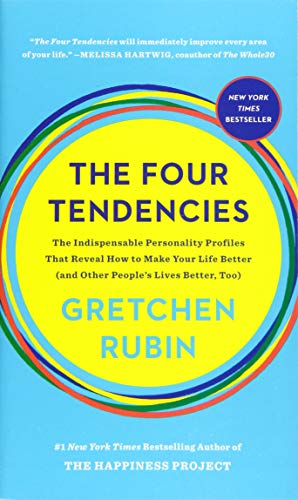
The Four Tendencies: The Indispensable Personality Profiles That Reveal How to Make Your Life Better (and Other People's Lives Better, Too) - Softcover
Inhaltsangabe
NEW YORK TIMES BESTSELLER • Are you an Upholder, a Questioner, an Obliger, or a Rebel? From the author of Better Than Before and The Happiness Project comes a groundbreaking analysis of personality type that “will immediately improve every area of your life” (Melissa Urban, co-founder of the Whole30).
During her multibook investigation into human nature, Gretchen Rubin realized that by asking the seemingly dry question “How do I respond to expectations?” we gain explosive self-knowledge. She discovered that based on their answer, people fit into Four Tendencies:
• Upholders meet outer and inner expectations readily. “Discipline is my freedom.”
• Questioners meet inner expectations, but meet outer expectations only if they make sense. “If you convince me why, I’ll comply.”
• Obligers (the largest Tendency) meet outer expectations, but struggle to meet inner expectations—therefore, they need outer accountability to meet inner expectations. “You can count on me, and I’m counting on you to count on me.”
• Rebels (the smallest group) resist all expectations, outer and inner alike. They do what they choose to do, when they choose to do it, and typically they don’t tell themselves what to do. “You can’t make me, and neither can I.”
Our Tendency shapes every aspect of our behavior, so using this framework allows us to make better decisions, meet deadlines, suffer less stress, and engage more effectively. It’s far easier to succeed when you know what works for you.
With sharp insight, compelling research, and hilarious examples, The Four Tendencies will help you get happier, healthier, more productive, and more creative.
Die Inhaltsangabe kann sich auf eine andere Ausgabe dieses Titels beziehen.
Über die Autorin bzw. den Autor
Gretchen Rubin is one of today’s most influential and thought-provoking observers of happiness and human nature. She’s the author of many books, including the blockbuster New York Times bestsellers Outer Order, Inner Calm; The Four Tendencies; Better Than Before; and The Happiness Project. She has an enormous readership, both in print and online, and her books have sold more than 3.5 million copies worldwide, in more than thirty languages. On her top-ranking, award-winning podcast Happier with Gretchen Rubin, she explores happiness and good habits. She is also a CBS News contributor, providing weekly solutions for living a happier life. Gretchen Rubin started her career in law and was clerking for Supreme Court Justice Sandra Day O’Connor when she realized that she wanted to be a writer. Raised in Kansas City, she lives in New York City with her husband and two daughters.
Auszug. © Genehmigter Nachdruck. Alle Rechte vorbehalten.
1
The Four Tendencies
The Origin of the Four Tendencies • How the Tendencies Weave Throughout Our Characters • Why It’s Helpful to Identify Our Own Tendency • Why It’s Helpful to Identify Others’ Tendencies
I didn’t realize it at the time, but when I walked through the door of the Atlantic Grill restaurant one blustery winter afternoon, I was heading to one of the most significant conversations of my life.
As I bit into my cheeseburger and my friend picked at her salad, she made a comment that would occupy my mind for years. In an offhand way, she mentioned, “I want to get myself in the habit of running, but I can’t, and it really bothers me.” Then she added, in a crucial observation, “When I was on the high school track team, I never missed track practice, so why can’t I go running now?”
“Why?” I echoed.
“Well, you know, it’s so hard to make time for ourselves.”
“Hmmm,” I said.
We started talking about other things, but even after we’d said good-bye, I couldn’t stop thinking about our exchange. She was the same person she’d been in high school, and she was aiming to do the same activity. She’d been able to go running in the past, but not now. Why? Was it her age, her motivation, her family situation, the location, team spirit, or something else?
She assumed that we all have trouble “making time for ourselves.” But actually I don’t have any trouble making time for myself. How were she and I different from each other?
I would spend the next few years trying to answer these questions.
The Origin of the Four Tendencies
They say there are two kinds of people in the world: those who divide the world into two kinds of people, and those who don’t.
I’m definitely the first kind. My great interest is human nature, and I constantly search for patterns to identify what we do and why we do it.
I’ve spent years studying happiness and habits, and it has become obvious to me that there’s no magic, one-size-fits-all answer for building a happier, healthier, more productive life. Different strategies work for different people—in fact, what works for one person may be the very opposite of what works for someone else. Some people are morning people; some are night people. Some do better when they abstain from a strong temptation; others, when they indulge in moderation. Some people love simplicity; some thrive in abundance.
And not only that. As I pondered my friend’s observation about her running habit, I sensed that deep below the “night people vs. morning people” sorts of differences, there existed some kind of bedrock distinction that shaped people’s natures—something profound, but also bold and obvious—that nevertheless eluded my vision.
To help figure out what I was missing, I posed a number of questions to readers of my website, including: “How do you feel about New Year’s resolutions?” “Do you observe traffic regulations—why or why not?” “Would you ever sign up to take a class for fun?” As readers’ responses poured in, I saw that distinct patterns were threaded through the various answers. It was almost weird—as though groups of people had agreed to answer from the same script.
For instance, about New Year’s resolutions, a subset of people gave virtually identical answers: “I’ll keep a resolution if it’s useful, but I won’t start on New Year’s Day, because January 1 is an arbitrary date.” They all used that word: “arbitrary.” I was intrigued by this specific word choice, because the arbitrariness of the January 1 date had never bothered me. Yet these people were all giving the same answer—what did they have in common?
And many people answered, “I don’t make New Year’s resolutions anymore because I never manage to keep them—I never make time for myself.”
Another group said, “I never make resolutions because I don’t like to bind myself.”
There was some meaningful design here, I knew it, but I just couldn’t quite see it.
Then finally, after months of reflection, I had my eureka moment. As I sat at my desk in my home office, I happened to glance at my messy handwritten to-do list—and suddenly it hit me. The simple, decisive question was: “How do you respond to expectations?” I’d found it!
I’d discovered the key. I felt the same excitement that Archimedes must have felt when he stepped out of his bath. I was sitting still, but my mind was racing forward with thoughts about expectations. I grasped at that moment that we all face two kinds of expectations:
•outer expectations—expectations others place on us, like meeting a work deadline
•inner expectations—expectations we place on ourselves, like keeping a New Year’s resolution
And here was my crucial insight: Depending on a person’s response to outer and inner expectations, that person falls into one of four distinct types:
Upholders respond readily to both outer expectations and inner expectations
Questioners question all expectations; they meet an expectation only if they believe it’s justified, so in effect they respond only to inner expectations
Obligers respond readily to outer expectations but struggle to meet inner expectations
Rebels resist all expectations, outer and inner alike
It was that simple. With just one single, straightforward question, all of humanity sorted itself into these categories.
Now I understood why my friend had trouble forming the habit of running: She was an Obliger. When she’d had a team and a coach expecting her, she had no trouble showing up; when she faced her own inner expectations, she struggled. I understood those repetitious comments about New Year’s resolutions. And I understood much, much more.
The Four Tendencies framework clarified the striking patterns of behavior I’d perceived, and I was able to make sense of what everyone else had seen—but no one else had noticed.
When I mapped the complete system on a sheet of paper, in four symmetrical overlapping circles, my framework showed the elegance of a fern frond or a nautilus shell. I truly felt that I’d uncovered a law of nature: human nature.
Or maybe I’d created something more like a Muggle Sorting Hat.
Once I’d identified the framework, I worked to deepen my understanding. “The Strategy of the Four Tendencies” became the first chapter in Better Than Before, my book about habit change; I wrote about the Four Tendencies on my website, gretchenrubin.com; my cohost and sister, Elizabeth Craft, and I talked about the Four Tendencies on our weekly podcast, Happier with Gretchen Rubin. Every time I discussed the framework, readers and listeners responded.
Most people can identify their Tendency from a brief description, but for people who aren’t sure or who want their answers to be analyzed, I designed a quiz. Hundreds of thousands of people have taken the Four Tendencies Quiz, which appears in chapter 2 or at happiercast.com/quiz. People’s answers to the quiz, as well as their open-ended responses, gave me an additional trove of insights. (For one thing, I’ve noticed that people’s Tendencies influence their willingness to take the quiz. Questioners sometimes ask, “Why should I spend my time and effort taking this quiz?” and Rebels sometimes think, “You’re telling me to take this quiz? Well, I won’t do...
„Über diesen Titel“ kann sich auf eine andere Ausgabe dieses Titels beziehen.
Suchergebnisse für The Four Tendencies: The Indispensable Personality...

Beispielbild für diese ISBN
The Four Tendencies
Anbieter: World of Books (was SecondSale), Montgomery, IL, USA
Verkäuferbewertung 5 von 5 Sternen

Zustand: Good. Item in good condition. Textbooks may not include supplemental items i.e. CDs, access codes etc. Artikel-Nr. 00109051415
Gebraucht kaufen
EUR 4,03
Versand gratis
Versand innerhalb von USA
Versand innerhalb von USA
Anzahl: 1 verfügbar
Beispielbild für diese ISBN
The Four Tendencies
Verlag:
Harmony (edition ), 2018
ISBN 10: 1524762423
ISBN 13: 9781524762421
Gebraucht
Mass Market Paperback
Anbieter: BooksRun, Philadelphia, PA, USA
Verkäuferbewertung 5 von 5 Sternen
Mass Market Paperback. Zustand: Very Good. It's a well-cared-for item that has seen limited use. The item may show minor signs of wear. All the text is legible, with all pages included. It may have slight markings and/or highlighting. Artikel-Nr. 1524762423-11-1
Gebraucht kaufen
EUR 6,56
Versand gratis
Versand innerhalb von USA
Versand innerhalb von USA
Anzahl: 2 verfügbar
Beispielbild für diese ISBN
The Four Tendencies
Anbieter: Better World Books: West, Reno, NV, USA
Verkäuferbewertung 5 von 5 Sternen
Zustand: Very Good. Former library copy. Pages intact with possible writing/highlighting. Binding strong with minor wear. Dust jackets/supplements may not be included. Includes library markings. Stock photo provided. Product includes identifying sticker. Better World Books: Buy Books. Do Good. Artikel-Nr. 44975301-75
Gebraucht kaufen
EUR 7,05
Versand gratis
Versand innerhalb von USA
Versand innerhalb von USA
Anzahl: 1 verfügbar
Beispielbild für diese ISBN
The Four Tendencies
Anbieter: ThriftBooks-Dallas, Dallas, TX, USA
Verkäuferbewertung 5 von 5 Sternen
Unknown. Zustand: Good. No Jacket. Pages can have notes/highlighting. Spine may show signs of wear. ~ ThriftBooks: Read More, Spend Less. Artikel-Nr. G1524762423I3N00
Gebraucht kaufen
EUR 7,40
Versand gratis
Versand innerhalb von USA
Versand innerhalb von USA
Anzahl: 1 verfügbar
Beispielbild für diese ISBN
The Four Tendencies
Anbieter: ThriftBooks-Atlanta, AUSTELL, GA, USA
Verkäuferbewertung 5 von 5 Sternen
Unknown. Zustand: Good. No Jacket. Pages can have notes/highlighting. Spine may show signs of wear. ~ ThriftBooks: Read More, Spend Less. Artikel-Nr. G1524762423I3N00
Gebraucht kaufen
EUR 7,40
Versand gratis
Versand innerhalb von USA
Versand innerhalb von USA
Anzahl: 1 verfügbar
Beispielbild für diese ISBN
Four Tendencies
Anbieter: WorldofBooks, Goring-By-Sea, WS, Vereinigtes Königreich
Verkäuferbewertung 5 von 5 Sternen
Paperback. Zustand: Very Good. The book has been read, but is in excellent condition. Pages are intact and not marred by notes or highlighting. The spine remains undamaged. Artikel-Nr. GOR009416807
Gebraucht kaufen
EUR 3,36
EUR 6,53 Versand
Versand von Vereinigtes Königreich nach USA
Versand von Vereinigtes Königreich nach USA
Anzahl: 2 verfügbar
Beispielbild für diese ISBN
The Four Tendencies
Anbieter: Better World Books Ltd, Dunfermline, Vereinigtes Königreich
Verkäuferbewertung 5 von 5 Sternen
Zustand: Very Good. Former library copy. Pages intact with possible writing/highlighting. Binding strong with minor wear. Dust jackets/supplements may not be included. Includes library markings. Stock photo provided. Product includes identifying sticker. Better World Books: Buy Books. Do Good. Artikel-Nr. 44975301-75
Gebraucht kaufen
EUR 5,77
EUR 5,83 Versand
Versand von Vereinigtes Königreich nach USA
Versand von Vereinigtes Königreich nach USA
Anzahl: 1 verfügbar
Beispielbild für diese ISBN
The Four Tendencies: The Indispensable Personality Profiles That Reveal How to Make Your Life Better (and Other People's Lives Better, Too)
Anbieter: medimops, Berlin, Deutschland
Verkäuferbewertung 5 von 5 Sternen
Zustand: good. Befriedigend/Good: Durchschnittlich erhaltenes Buch bzw. Schutzumschlag mit Gebrauchsspuren, aber vollständigen Seiten. / Describes the average WORN book or dust jacket that has all the pages present. Artikel-Nr. M01524762423-G
Gebraucht kaufen
EUR 5,10
EUR 10,00 Versand
Versand von Deutschland nach USA
Versand von Deutschland nach USA
Anzahl: 10 verfügbar
Beispielbild für diese ISBN
The Four Tendencies: The Indispensable Personality Profiles That Reveal How to Make Your Life Better (and Other People's Lives Better, Too)
Anbieter: medimops, Berlin, Deutschland
Verkäuferbewertung 5 von 5 Sternen
Zustand: very good. Gut/Very good: Buch bzw. Schutzumschlag mit wenigen Gebrauchsspuren an Einband, Schutzumschlag oder Seiten. / Describes a book or dust jacket that does show some signs of wear on either the binding, dust jacket or pages. Artikel-Nr. M01524762423-V
Gebraucht kaufen
EUR 5,62
EUR 10,00 Versand
Versand von Deutschland nach USA
Versand von Deutschland nach USA
Anzahl: 2 verfügbar
Foto des Verkäufers
The Four Tendencies
Anbieter: Bookbot, Prague, Tschechien
Verkäuferbewertung 5 von 5 Sternen
Softcover. Zustand: Fine. Leichte Kratzer / Abnutzungen / Druckstellen; Leichte Verschmutzung / Farbtonveränderung. When writing about habits for her last book, Gretchen Rubin stumbled on the biggest discovery of her life--the Four Tendencies. The Tendencies describe how a person responds to motivation, and how that affects family dynamics, happiness, work, and organizations. Investigating the Four Tendencies quickly became the most challenging and important project Gretchen had ever embarked upon. A pleasurable read that also serves as an authoritative reference on a breakthrough personality framework, The Four Tendencies identifies the qualities of Upholders, Questioners, Obligers, and Rebels, examining each in depth while also discussing how it interacts with the world. For readers, the book provides a self-assessment that will empower them to change their actions, overcome stubborn hurdles, and improve relationships. When applied to a family, team, or work setting, the framework unlocks tension so leaders can be effective and groups can be productive. It is already being used by teachers, managers, and coaches successfully across the country. For years, Gretchen Rubin has encouraged readers to be their best selves. The Four Tendencies, infused with Gretchen's optimistic spirit and sharp observations, will help them make their lives happier, healthier, more productive, and more creative. Artikel-Nr. 08b78e82-92fe-4fe7-882d-f7ed639162ba
Gebraucht kaufen
EUR 7,01
EUR 20,99 Versand
Versand von Tschechien nach USA
Versand von Tschechien nach USA
Anzahl: 1 verfügbar