
Verwandte Artikel zu Humble Leadership: The Power of Relationships, Openness,...
Humble Leadership: The Power of Relationships, Openness, and Trust (The Humble Leadership Series, Band 4) - Softcover
Buch 1 von 2: Humble Inquiry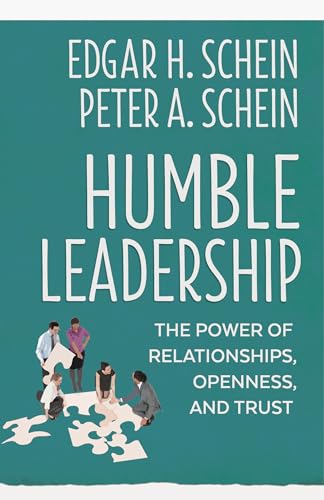
Inhaltsangabe
Bestselling author and father of organizational culture studies, Edgar Schein and Peter Schein trail-blaze with a creative perspective on leadership that encourages vulnerability and empathy as a form of strength.
The more traditional forms of leadership that are based on static hierarchies and professional distance between leaders and followers are growing increasingly outdated and ineffective. As organizations face more complex interdependent tasks, leadership must become more personal in order to insure open trusting communication that will make more collaborative problem solving and innovation possible. Without open and trusting communications throughout organizations, they will continue to face the productivity and quality problems that result from reward systems that emphasize individual competition and "climbing the corporate ladder". Authors Edgar Schein and Peter Schein recognize this reality and call for a reimagined form of leadership that coincides with emerging trends of relationship building, complex group work, diverse workforces, and cultures in which everyone feels psychologically safe. Humble Leadership calls for "here and now" humility based on a deeper understanding of the constantly evolving complexities of interpersonal, group and intergroup relationships that require shifting our focus towards the process of group dynamics and collaboration. Humble Leadership at all levels and in all working groups will be the key to achieving the creativity, adaptiveness, and agility that organizations will need to survive and grow.
Die Inhaltsangabe kann sich auf eine andere Ausgabe dieses Titels beziehen.
Über die Autorin bzw. den Autor
Edgar H. Schein is professor emeritus of the Massachusetts Institute of Technology Sloan School of Management.
Peter A. Schein is the cofounder and COO of the Organizational Culture and Leadership Institute.
Auszug. © Genehmigter Nachdruck. Alle Rechte vorbehalten.
Humble Leadership
The Power of Relationships, Openness, and Trust
By EDGAR H. SCHEIN, Peter A. ScheinBerrett-Koehler Publishers, Inc.
Copyright © 2018 Edgar H. Schein and Peter A. Schein
All rights reserved.
ISBN: 978-1-5230-9538-4All rights reserved.
Contents
Preface, ix,
1 A New Approach to Leadership, 1,
2 Culturally Defined Levels of Relationship, 22,
3 Humble Leadership in Governance: The Singapore Story, 40,
4 Transforming a Medical Center into a Level 2 Culture, 49,
5 Humble Leadership in the US Military, 60,
6 When Hierarchy and Unintended Consequences Stifle Humble Leadership, 79,
7 Humble Leadership and the Future, 100,
8 Humble Leadership Requires Reinforcing the "Soft Stuff", 117,
9 Personizing: Building Level 2 Relationships, 130,
References, 145,
Acknowledgments, 151,
Index, 155,
CHAPTER 1
A New Approach to Leadership
This book introduces a new approach to leadership based more on personal relationships than transactional role relationships.
The good news: employee engagement, empowerment, organizational agility, ambidexterity, innovation ... all of this can flourish in the rapidly changing world when the fundamental relationship between leaders and followers, helpers and clients, and providers and customers becomes more personalized and cooperative.
The bad news: continued deception, scandals, high turnover of disengaged talent, safety and quality problems in industry and health care, all the way to corruption and abuse of power at the highest levels of industry and politics, driven by financial expediency and the obsession with retaining power as primary success criteria ... all of this will continue to happen as long as leader-follower relationships remain impersonal, transactional, and based on the roles and rules that have evolved in the current culture of management that still predominates in our hierarchical bureaucratic organizations.
We therefore need a model of leadership that is more personal and cooperative, that changes relationships both inside organizations and between organization members and their customers, clients, and patients. This model is Humble Leadership.
What Is Leadership? The Leader–Follower Relationship
"Leadership" is wanting to do something new and better, and getting others to go along. This definition applies as much to senior executives developing new strategies, new purposes, and new values as it does to a group member down in the organization suggesting a new way of running a meeting or improving a process to drive better results. Both the word new and the word better remind us that leadership always refers to some task that can be improved and to some group whose values and culture will ultimately determine what is better.
What is new and what is better will always depend on context, the nature of the task, and the cultural values that are operating in the group or organization that is doing the work. What we later may label as "good or effective leadership" thus always begins with someone perceiving a new and better way to do something, an emergent leader. Our focus will be not on the individual and the desired characteristics of that emergent leader, but on the relationships that develop between that person and the potential followers who will have influenced what is finally considered to be new and better and who will implement the new way if they agree to try it. Those potential followers will always be some kind of workgroup or team, so our focus will also be on the relationships between them. They may be co-located or widely spread in a network, and their membership may change, but there will always be some kind of grouping involved, hence group dynamics and group processes will always be intimately involved with leadership.
LEVELS OF RELATIONSHIP
Leader-follower relationships can usefully be differentiated along a continuum of "levels of relationship" that are generally accepted in society, that we have learned to use in our own relationships, and that are, therefore, familiar and comfortable. We introduce these levels now but will explain them in greater detail in Chapter 2. The relationship continuum includes these four levels:
* Level Minus 1: Total impersonal domination and coercion
* Level 1: Transactional role and rule-based supervision, service, and most forms of "professional" helping relationships
* Level 2: Personal cooperative, trusting relationships as in friendships and in effective teams
* Level 3: Emotionally intimate total mutual commitments
Some version of these levels is present and well understood in most societies, and we generally know the difference in our own relationships between coercively giving orders to someone over whom we have power (Level Minus 1) and the broad range of transactional relationships we have with strangers, service providers, and our bosses, direct reports, and peers with whom we maintain appropriate "professional distance" (Level 1).
These arm's-length relationships differ from how we relate to friends and to teammates in collaborative workgroups we have gotten to know as individual human beings (Level 2), and how we relate to our spouses, close friends, and confidants with whom we share our more intimate and private feelings (Level 3).
We already have the attitudes and skills necessary to decide at what level to relate to each other in our daily lives, but have we thought through sufficiently what is the appropriate level of relationship in our workgroups and in our hierarchical relationships? Have we considered what the leadership relationship needs to be as the tasks of organizations become more complex?
In order to explain what we mean by Humble Leadership, we need to consider what these levels mean in the organizational context of today and as we look ahead. Our argument is that Level Minus 1 domination and coercion is a priori morally inappropriate in an established democratic society and is, in any case, ineffective except where tasks are very simple and programmable. Level 1 transactional relationships built around role expectations, and rules of behavior appropriate to those roles, have evolved into what we can think of as the basic managerial culture that still dominates many of our organizations and institutions. It is based on the core US values of individual competitiveness, heroic self-determination, and a concept of work that is linear, machine-like, and based on technical rationality. Level 1, therefore, relies on rules, roles, and the maintenance of appropriate professional distance (Roy, 1970). This existing culture and the way the world is changing lead us to believe that we need a new model based on more personal Level 2, and sometimes even Level 3, relationships and group processes.
Why We Need Another Book about Leadership
There are several reasons why we need a new leadership model.
1. TASK COMPLEXITY IS INCREASING EXPONENTIALLY
The tasks that need to be accomplished in today's world involve a dynamic mix of emerging technologies, collaboration between many kinds of expertise provided by team members, and ecosystem partners, who often come from different occupational and national cultures. The products and services that need to be provided are themselves getting more complex and are constantly shifting in the rapidly changing sociopolitical environment. Information technology and...
„Über diesen Titel“ kann sich auf eine andere Ausgabe dieses Titels beziehen.
Suchergebnisse für Humble Leadership: The Power of Relationships, Openness,...

Foto des Verkäufers
Humble Leadership: The Power of Relationships, Openness, and Trust (The Humble Leadership Series)
Verlag:
Berrett-Koehler Publishers, 2018
ISBN 10: 1523095385
ISBN 13: 9781523095384
Gebraucht
Softcover
Anbieter: Dream Books Co., Denver, CO, USA
Verkäuferbewertung 5 von 5 Sternen

Zustand: acceptable. This copy has clearly been enjoyedâ"expect noticeable shelf wear and some minor creases to the cover. Binding is strong, and all pages are legible. May contain previous library markings or stamps. Artikel-Nr. DBV.1523095385.A
Gebraucht kaufen
EUR 3,79
Versand gratis
Versand innerhalb von USA
Versand innerhalb von USA
Anzahl: 1 verfügbar
Beispielbild für diese ISBN
Humble Leadership: The Power of Relationships, Openness, and Trust
Verlag:
Berrett-Koehler Publishers, 2018
ISBN 10: 1523095385
ISBN 13: 9781523095384
Gebraucht
Paperback
Anbieter: World of Books (was SecondSale), Montgomery, IL, USA
Verkäuferbewertung 5 von 5 Sternen
Paperback. Zustand: Good. Bestselling author and father of organizational culture studies, Edgar Schein and Peter Schein trail-blaze with a creative perspective on leadership that encourages vulnerability and empathy as a form of strength. The more traditional forms of leadership that are based on static hierarchies and professional distance between leaders and followers are growing increasingly outdated and ineffective. As organizations face more complex interdependent tasks, leadership must become more personal in order to insure open trusting communication that will make more collaborative problem solving and innovation possible. Without open and trusting communications throughout organizations, they will continue to face the productivity and quality problems that result from reward systems that emphasize individual competition and climbing the corporate ladder. Authors Edgar Schein and Peter Schein recognize this reality and call for a reimagined form of leadership that coincides with emerging trends of relationship building, complex group work, diverse workforces, and cultures in which everyone feels psychologically safe. Humble Leadership calls for here and now humility based on a deeper understanding of the constantly evolving complexities of interpersonal, group and intergroup relationships that require shifting our focus towards the process of group dynamics and collaboration. Humble Leadership at all levels and in all working groups will be the key to achieving the creativity, adaptiveness, and agility that organizations will need to survive and grow. Artikel-Nr. 00067295052
Gebraucht kaufen
EUR 5,12
Versand gratis
Versand innerhalb von USA
Versand innerhalb von USA
Anzahl: 9 verfügbar
Beispielbild für diese ISBN
Humble Leadership: The Power of Relationships, Openness, and Trust
Verlag:
Berrett-Koehler Publishers, 2018
ISBN 10: 1523095385
ISBN 13: 9781523095384
Gebraucht
Paperback
Anbieter: ThriftBooks-Phoenix, Phoenix, AZ, USA
Verkäuferbewertung 5 von 5 Sternen
Paperback. Zustand: Very Good. No Jacket. May have limited writing in cover pages. Pages are unmarked. ~ ThriftBooks: Read More, Spend Less. Artikel-Nr. G1523095385I4N00
Gebraucht kaufen
EUR 5,95
Versand gratis
Versand innerhalb von USA
Versand innerhalb von USA
Anzahl: 3 verfügbar
Beispielbild für diese ISBN
Humble Leadership: The Power of Relationships, Openness, and Trust
Verlag:
Berrett-Koehler Publishers, 2018
ISBN 10: 1523095385
ISBN 13: 9781523095384
Gebraucht
Paperback
Anbieter: ThriftBooks-Phoenix, Phoenix, AZ, USA
Verkäuferbewertung 5 von 5 Sternen
Paperback. Zustand: Very Good. No Jacket. Former library book; May have limited writing in cover pages. Pages are unmarked. ~ ThriftBooks: Read More, Spend Less. Artikel-Nr. G1523095385I4N10
Gebraucht kaufen
EUR 5,95
Versand gratis
Versand innerhalb von USA
Versand innerhalb von USA
Anzahl: 1 verfügbar
Beispielbild für diese ISBN
Humble Leadership: The Power of Relationships, Openness, and Trust
Verlag:
Berrett-Koehler Publishers, 2018
ISBN 10: 1523095385
ISBN 13: 9781523095384
Gebraucht
Paperback
Anbieter: ThriftBooks-Dallas, Dallas, TX, USA
Verkäuferbewertung 5 von 5 Sternen
Paperback. Zustand: Good. No Jacket. Pages can have notes/highlighting. Spine may show signs of wear. ~ ThriftBooks: Read More, Spend Less. Artikel-Nr. G1523095385I3N00
Gebraucht kaufen
EUR 5,95
Versand gratis
Versand innerhalb von USA
Versand innerhalb von USA
Anzahl: 1 verfügbar
Beispielbild für diese ISBN
Humble Leadership: The Power of Relationships, Openness, and Trust
Verlag:
Berrett-Koehler Publishers, 2018
ISBN 10: 1523095385
ISBN 13: 9781523095384
Gebraucht
Paperback
Anbieter: ThriftBooks-Reno, Reno, NV, USA
Verkäuferbewertung 5 von 5 Sternen
Paperback. Zustand: Good. No Jacket. Pages can have notes/highlighting. Spine may show signs of wear. ~ ThriftBooks: Read More, Spend Less. Artikel-Nr. G1523095385I3N00
Gebraucht kaufen
EUR 5,95
Versand gratis
Versand innerhalb von USA
Versand innerhalb von USA
Anzahl: 1 verfügbar
Beispielbild für diese ISBN
Humble Leadership: The Power of Relationships, Openness, and Trust
Verlag:
Berrett-Koehler Publishers, 2018
ISBN 10: 1523095385
ISBN 13: 9781523095384
Gebraucht
Paperback
Anbieter: ThriftBooks-Reno, Reno, NV, USA
Verkäuferbewertung 5 von 5 Sternen
Paperback. Zustand: Very Good. No Jacket. May have limited writing in cover pages. Pages are unmarked. ~ ThriftBooks: Read More, Spend Less. Artikel-Nr. G1523095385I4N00
Gebraucht kaufen
EUR 5,95
Versand gratis
Versand innerhalb von USA
Versand innerhalb von USA
Anzahl: 4 verfügbar
Beispielbild für diese ISBN
Humble Leadership: The Power of Relationships, Openness, and Trust
Verlag:
Berrett-Koehler Publishers, 2018
ISBN 10: 1523095385
ISBN 13: 9781523095384
Gebraucht
Paperback
Anbieter: ThriftBooks-Dallas, Dallas, TX, USA
Verkäuferbewertung 5 von 5 Sternen
Paperback. Zustand: Very Good. No Jacket. May have limited writing in cover pages. Pages are unmarked. ~ ThriftBooks: Read More, Spend Less. Artikel-Nr. G1523095385I4N00
Gebraucht kaufen
EUR 5,95
Versand gratis
Versand innerhalb von USA
Versand innerhalb von USA
Anzahl: 4 verfügbar
Beispielbild für diese ISBN
Humble Leadership: The Power of Relationships, Openness, and Trust
Verlag:
Berrett-Koehler Publishers, 2018
ISBN 10: 1523095385
ISBN 13: 9781523095384
Gebraucht
Paperback
Anbieter: ThriftBooks-Phoenix, Phoenix, AZ, USA
Verkäuferbewertung 5 von 5 Sternen
Paperback. Zustand: Fair. No Jacket. Readable copy. Pages may have considerable notes/highlighting. ~ ThriftBooks: Read More, Spend Less. Artikel-Nr. G1523095385I5N00
Gebraucht kaufen
EUR 5,95
Versand gratis
Versand innerhalb von USA
Versand innerhalb von USA
Anzahl: 1 verfügbar
Beispielbild für diese ISBN
Humble Leadership: The Power of Relationships, Openness, and Trust
Verlag:
Berrett-Koehler Publishers, 2018
ISBN 10: 1523095385
ISBN 13: 9781523095384
Gebraucht
Paperback
Anbieter: ThriftBooks-Atlanta, AUSTELL, GA, USA
Verkäuferbewertung 5 von 5 Sternen
Paperback. Zustand: Very Good. No Jacket. Missing dust jacket; May have limited writing in cover pages. Pages are unmarked. ~ ThriftBooks: Read More, Spend Less. Artikel-Nr. G1523095385I4N01
Gebraucht kaufen
EUR 5,95
Versand gratis
Versand innerhalb von USA
Versand innerhalb von USA
Anzahl: 1 verfügbar