
Verwandte Artikel zu Panning for Your Client's Gold: 12 Lean Clean Language...
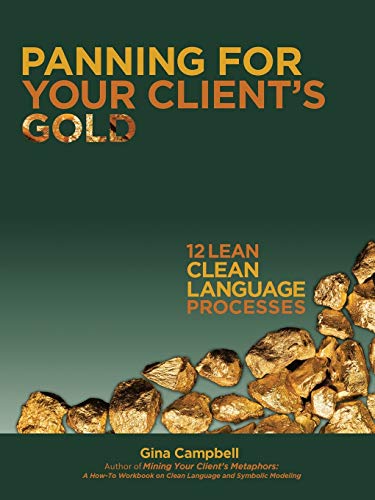
Inhaltsangabe
Looking for easy, effective, and creative ways to engage your client's deeper knowledge of their learning and healing processes?
Psychotherapist David Grove had an insatiable curiosity about how a client subconsciously structures their experience and how change at the subconscious level happens. With a deep respect for the accumulated wisdom in a client's internal world, Grove determined to find ways to keep the facilitator from contaminating the client's experience while fostering self-discovery and self-healing. The result is Clean Language, carefully-worded questions incorporating a client's exact words coupled with strategic processes that create ideal conditions for a client to learn more about themselves. The Clean facilitator directs their client’s attention, trusting that as the client collects information about their mind and body systems’ strengths and weaknesses, insights and confusions, strategies and maladaptations, the system learns from itself, heals, and grows.
Discover twelve easy-to-learn Clean Language processes that combine the science of emergence and Metaphor Therapy as only creative innovator David Grove could.
Clean Language expert Gina Campbell presents twelve Grovian processes for therapists, counselors, coaches, and other helping and healing professionals looking for ways to guide their clients in experiential self-exploration. From among the many process Grove developed, Campbell has selected ones that are easy to master and easy to use. You will learn step by step how to facilitate clients to access their inner knowledge and experiences by projecting them onto a drawing or into the surrounding physical space. Spread out before them, your clients' deeper understandings and perspectives readily reveal themselves.
"Gina Campbell has marshaled an admirable array of material into a wonderful resource. For the first time in one book are twelve golden nuggets from David Grove's life work. Whether you are a new coach or an established therapist, your clients will be delighted with how elegantly you facilitate them to find their own resources and solutions. Panning for Your Client's Gold is a wellspring that you will want to return to again and again."
—James Lawley and Penny Tompkins, authors of Metaphors in Mind: Transformation through Symbolic Modelling
Die Inhaltsangabe kann sich auf eine andere Ausgabe dieses Titels beziehen.
Über die Autorin bzw. den Autor
" Gina Campbell, MEd Gina Campbell has led trainings in Clean Language and Symbolic Modeling since 2005. Drawing upon her decades of experience as an educator, developmental counselor, poetry therapy facilitator, and a certified Clean Language practitioner, she expertly guides her trainees to master and apply these profoundly powerful Clean processes. She resides in Baltimore, Maryland, where she trains helping and healing professionals and conducts private sessions for individuals engaged in personal development. nbsp; http://www.miningyourmetaphors.com"
Auszug. © Genehmigter Nachdruck. Alle Rechte vorbehalten.
Panning For Your Client's Gold
12 Lean Clean Language Processes
By Gina CampbellBalboa Press
Copyright © 2015 Gina Campbell
All rights reserved.
ISBN: 978-1-5043-2927-9All rights reserved.
Contents
About this Book, xiii,
Section One: Theories and Intentions, 1,
Section Two: Priming the Pump, 23,
Section Three: When Space Becomes Psychoactive, 41,
Section Four: When the Page Becomes Psychoactive, 77,
Section Five: Making a Plan, 105,
Section Six: Clean Closures, 121,
Section Seven: Clean Processes with Groups, 127,
Section Eight: Mix and Match, 153,
12 Lean Clean Processes Scripts, 191,
What's Next?, 208,
Resources, 210,
Glossary of Terms, 212,
Bibliography, 214,
Endnotes, 216,
Contact Information, 217,
CHAPTER 1
Theories and Intentions
PANNING FOR YOUR CLIENT'S GOLD
If you are a miner and you want to find gold, there are two ways to go about it. You can mine it, going deep in the earth to search for veins of it. With luck, you tap a primary vein: "hit the mother lode," as they say. The other option is to pan for it, to sift the gravel carried by a stream through a sieve to find what are usually small nuggets. Chance upon a large nugget or find enough smaller ones, and you can amass a wealth of gold.
As a helping or healing professional, you can assist your client in finding his gold, that valuable material that enriches his life by bringing understanding, new perspectives, and sometimes significant shifts and healing. To find it, you could invite him to go deeply into his past and present issues and his mind/body system, like a miner. Or you can guide him to pan for it: you encourage information from the subconscious to come to the surface, touching upon it lightly and briefly. This allows the individual to find his own answers at his own pace, using his expertise on the intricacies of his own self and situation.
Panning for our clients' gold with Clean processes is about:
• Where we as facilitators direct our clients' attention to look for information
• How many and what questions we ask
• How long we spend asking about any one specific detail
Sometimes it benefits your client not to go deeply but to hold his attention near the surface and see what rises to it. This book will give you the right tools and skills to help that happen.
Before we get to the lean Clean processes themselves, let me introduce you to David Grove, the original thinker and grand experimenter who pushed the boundaries of counseling and coaching into new frontiers.
DAVID GROVE
David Grove (1950–2008), originally from New Zealand, was a counseling psychologist by training. Among his early interests in therapeutic techniques were NLP (neurolinguistic programming), Eriksonian hypnosis, and the works of Virginia Satir and Carl Rodgers. Observing and experimenting with clients from his psychotherapy practice, he went on to develop his own theories as to:
• How people internally or subconsciously structure their experiences
• What needs to happen for people to change
• Innovative counseling and coaching processes to help them do it
Most of the 12 Clean processes we will cover are Grove's. A few were developed by others using his general Clean questioning approach.
To give you a conceptual framework to understand what these processes are intended to achieve, let me briefly present six concepts that informed Grove's work. They do not build in a strictly sequential fashion, and there is some overlap. I invite you to notice the concepts' common ground and consider their reoccurring aspects from different perspectives.
But first ...
THE SCIENCE OF EMERGENCE
Emergence attempts to explain how a collection of individual units become complex, self-directing systems. From evolutionary leaps in nature to the growth of cities, from busy ant colonies to sensitive stock markets, self-organizing systems and patterns emerge from innumerable small interactions of the system's parts in response to simple guiding rules, repetitions, and feedback.
When a system reaches a level of complexity for which the existing management structure is no longer adequate, a transformation occurs. Something new, something that is more that just a sum of its parts, comes into existence. By definition, emergent features are unpredictable; there will be characteristics of the new whole that do not exist among its component parts. Thus you cannot know in advance what the "new" will be. Nor can you predict precisely if or when a shift will occur.
Shifts in organizational patterns sift down through the system. In a process termed downward causation, the original component parts that made up the system are affected by the new structure. They change because the individual's system has a feedback loop: it learns from itself. The parts are no longer exactly as they were before.
To give you an example of something that demonstrates emergence, think of a rioting mob. A collection of individuals gather, certain influences are brought to bear — perhaps a speaker inciting hate or a small but critical mass of those present start to run — and individuals start to behave en masse the way they would not alone, often without making a conscious decision to do so. What emerges is a mob mentality. To use a more positive example, take a group of athletes. Individually, they have skills, strengths, and weaknesses and may play a certain way, etc. But something happens to the individuals when they bond as a team. The coach will know it when it happens, for a team is something more than its individual players. It demonstrates a collective, higher order of functioning.
From the microlevel of quantum physics to the macrolevel of the global economy, there are multitudinous examples of emergence at all levels when conditions give rise to some new structure of organization. Fundamental to this concept is that the reorganizing of the system happens naturally, without needing a structural organizer from outside the system. Over the long term, the system self-regulates.
GUIDING CONCEPT #1: We are self-organizing, self-correcting systems
David Grove applied emergence theory to the individual, regarding him as a system of interrelating parts with numerous bits of information, experiences, and coping strategies accumulated over the years. At any given time the system has an organizing structure, a modus operandi or way of functioning.
When the individual has a problem, a contributing factor may be that his system's organization is not optimized to resolve it. Healthy or helpful functioning is not a result of what the interrelating parts are; it is a matter of organization, of how the parts are interacting, which is why, for example, two soldiers with similar combat experiences may experience very different long-term effects.
According to the principles of emergence, with enough pieces of information relating to the problem, a system with a less-than-optimal way of organizing that information will eventually find a better way. This new structure of organization leads to the clients' having a different way of coping or managing, which can in turn, mean new choices and outcomes are possible.
For some clients, the shift filters through the system's parts rapidly. The old structure may have proved to be so inadequate that it collapses and spontaneously disappears entirely. Other times, the new...
„Über diesen Titel“ kann sich auf eine andere Ausgabe dieses Titels beziehen.
Suchergebnisse für Panning for Your Client's Gold: 12 Lean Clean Language...

Beispielbild für diese ISBN
Panning for Your Client's Gold: 12 Lean Clean Language Processes
Anbieter: medimops, Berlin, Deutschland
Verkäuferbewertung 5 von 5 Sternen

Zustand: very good. Gut/Very good: Buch bzw. Schutzumschlag mit wenigen Gebrauchsspuren an Einband, Schutzumschlag oder Seiten. / Describes a book or dust jacket that does show some signs of wear on either the binding, dust jacket or pages. Artikel-Nr. M01504329279-V
Gebraucht kaufen
EUR 5,09
EUR 10,00 Versand
Versand von Deutschland nach USA
Versand von Deutschland nach USA
Anzahl: 1 verfügbar
Beispielbild für diese ISBN
Panning for Your Client's Gold: 12 Lean Clean Language Processes
Anbieter: Ria Christie Collections, Uxbridge, Vereinigtes Königreich
Verkäuferbewertung 5 von 5 Sternen
Zustand: New. In English. Artikel-Nr. ria9781504329279_new
Neu kaufen
EUR 17,98
EUR 13,32 Versand
Versand von Vereinigtes Königreich nach USA
Versand von Vereinigtes Königreich nach USA
Anzahl: Mehr als 20 verfügbar
Beispielbild für diese ISBN
Panning for Your Client's Gold: 12 Lean Clean Language Processes
Anbieter: Revaluation Books, Exeter, Vereinigtes Königreich
Verkäuferbewertung 5 von 5 Sternen
Paperback. Zustand: Brand New. 236 pages. 10.75x8.00x0.50 inches. In Stock. Artikel-Nr. x-1504329279
Neu kaufen
EUR 24,03
EUR 14,75 Versand
Versand von Vereinigtes Königreich nach USA
Versand von Vereinigtes Königreich nach USA
Anzahl: 2 verfügbar