
Verwandte Artikel zu Short Stories by Jesus Leader Guide: The Enigmatic...
Inhaltsangabe
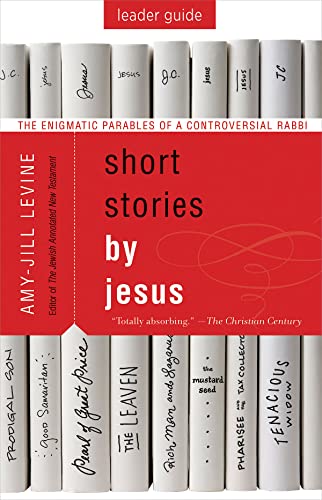
Jesus was a skilled storyteller and perceptive teacher who used parables from everyday life to effectively convey his message and meaning. Life in first-century Palestine was very different from our world today, and many traditional interpretations of Jesus' stories ignore this disparity and have often allowed anti-Semitism and misogyny to color their perspectives.
In this Bible study based on her book Short Stories by Jesus, Amy-Jill Levine analyzes these "problems with parables" taking readers back in time to understand how their original Jewish audience understood them. With this revitalized understanding, she interprets these moving stories for the contemporary reader, showing how the parables are not just about Jesus, but are also about us--and when read rightly, still challenge and provoke us two thousand years later.
The Leader Guide contains everything needed to guide a group through the six-week study including session plans, activities, and discussion questions, as well as multiple format options.
Die Inhaltsangabe kann sich auf eine andere Ausgabe dieses Titels beziehen.
Über die Autorin bzw. den Autor
Amy-Jill Levine ("AJ") is Rabbi Stanley M. Kessler Distinguished Professor of New Testament and Jewish Studies at Hartford International University for Religion and Peace and University Professor of New Testament and Jewish Studies Emerita, Mary Jane Werthan Professor of Jewish Studies Emerita, and Professor of New Testament Studies Emerita at Vanderbilt University. An internationally renowned scholar and teacher, she is the author of numerous books including The Difficult Words of Jesus: A Beginner's Guide to His Most Perplexing Teachings, Short Stories by Jesus: The Enigmatic Parables of a Controversial Rabbi, Entering the Passion of Jesus: A Beginner's Guide to Holy Week, Light of the World: A Beginner's Guide to Advent, Sermon on the Mount: A Beginner's Guide to the Kingdom of Heaven, and Signs and Wonders: A Beginner's Guide to the Miracles of Jesus. She is also the coeditor of the Jewish Annotated New Testament. AJ is the first Jew to teach New Testament at Rome's Pontifical Biblical Institute. In 2021 she was elected to the American Academy of Arts and Sciences. AJ describes herself as an unorthodox member of an Orthodox synagogue and a Yankee Jewish feminist who until 2021 taught New Testament in a Christian divinity school in the buckle of the Bible Belt.
Auszug. © Genehmigter Nachdruck. Alle Rechte vorbehalten.
Short Stories by Jesus Leader Guide
The Enigmatic Parables of a Controversial Rabbi
By Amy-Jill Levine, Michael S. PoteetAbingdon Press
Copyright © 2018 Abingdon Press
All rights reserved.
ISBN: 978-1-5018-5818-5All rights reserved.
Contents
Introduction,
Session 1: Lost Sheep, Lost Coin, Lost Son,
Session 2: The Good Samaritan,
Session 3: The Pearl of Great Price,
Session 4: The Mustard Seed,
Session 5: The Laborers in the Vineyard,
Session 6: The Widow and the Judge,
CHAPTER 1
Lost Sheep, Lost Coin, Lost Son
Session Goals
This session's reading, discussion, reflection, and prayer will equip participants to:
• deepen relationships with fellow participants;
• reevaluate ideas about the nature and purpose of parables;
• consider potential obstacles in interpreting Jesus's parables;
• practice reading and interpreting Jesus's parables as stories before — but not instead of — interpreting them as Scripture;
• explore the three parables in Luke 15;
• practice "counting" who is missing from their personal relationships and their communities of faith;
• plan and commit to at least one way of seeking whom and what they count as "lost."
Suggested Leader Preparation
Jesus my teacher, grant me curiosity and faithful imagination, patience with myself and openness toward this group's participants, a passion to learn more about Scripture and to grow closer to you, and strength to act on the truths you reveal to us in our study. Amen.
• Carefully and prayerfully read Luke 15 in one sitting, several times, before the session. Note words and phrases that attract your attention and meditate on them. Write down questions about your reading and try to find answers. If desired, consult a trusted Bible commentary.
• Carefully read Short Stories by Jesus, Introduction and chapter 1. Note any material about which you need or want to do further research before the session.
• Carefully read Session 1 of the Participant Guide. Write down any questions or observations the material prompts.
• Secure and prepare a comfortable meeting space for your group, easily accessible to all participants regardless of physical ability.
• Materials needed: Bibles (especially in reputable translations not usually used by your group); one or more standard English dictionaries; recent issues of a local newspaper; recent printed church bulletins and newsletters (if available). Optional: name tags, hymnals, light refreshments.
• Have a markerboard or pad of large paper on hand for writing down participants' responses, questions, and insights.
• Choose which discussion questions and activities you will use, keeping in mind your group's interests, previous Bible study experience, and comfort level with academic study (as opposed to purely devotional reading) of Scripture.
• Optional: Display three groups of pennies (or other small objects — small candies, for example) side by side on a table where all will be able to see: one group of 100, a second of 10, and a pair.
As Your Group Gathers
Welcome the participants. Ask each to fill out and wear a name tag (optional). Ask participants to introduce themselves and to talk briefly about why they are interested in this study of Amy-Jill Levine's Short Stories by Jesus. Be ready to talk about why you are interested in facilitating the group, as well!
Optional: Invite participants to look at the three piles of pennies you prepared. Ask them to close their eyes for a moment. Remove one penny from each pile. Ask participants to open their eyes and tell you how the piles are now different.
Tell participants that in today's session they will read and reflect on three of Jesus's parables that involve counting and noticing what, and who, is missing.
Open with this prayer or pray in your own words:
God of all wisdom, you are at work in our world and in our hearts to bring forth a new world and to give us new hearts, in which your will is done on earth as it is in heaven. By your Spirit, teach us in this time together, that we may learn and do all that is needed to receive your rule of grace, for we ask in the name of our Teacher and Savior, Jesus Christ. Amen.
Discuss the Nature and Purpose of Parables
Ask participants: "What is a parable?" Write responses on a large sheet of paper or markerboard.
Invite one or more participants to look up and read aloud the definitions of parable in a standard English dictionary (or from a trusted dictionary website). Ask: "What about these definitions of parable seems familiar or unfamiliar to you, and why?"
Read aloud the following list of information, inviting participants to respond to each with any questions or concerns. Make note of any such responses so they are not lost as you continue the study.
• Parables compare two unlike things by putting them side by side in an unexpected way.
• Parables can vary in length from a few sentences to a longer story.
• Parables carry at least two levels of meaning: the literal and the metaphorical.
• Parables may be but are not always allegorical — that is, the elements in a parable do not necessarily represent one and only one other thing or truth.
• Parables do not have a single meaning.
• Jesus did not invent the parable.
• Parables can be interpreted in many ways, but modern readers should always assume a parable's original audience would have been able to find meaning in it; therefore, modern readers must consider the historical and social setting in which a parable originated (in the case of Jesus's parables, first-century Galilee and Judea).
Read aloud this quotation from Short Stories by Jesus:
Jesus was requiring that [his disciples] do more than listen; he was asking them to think as well. ... What makes the parables mysterious, or difficult, is that they challenge us to look into the hidden aspects of our own values, our own lives. They bring to the surface unasked questions, and they reveal the answers we have always known, but refuse to acknowledge. Our reaction to them should be one of resistance rather than acceptance. ...
If we hear a parable and think, "I really like that" or, worse, fail to take any challenge, we are not listening well enough. ...
When we seek universal morals from a genre that is designed to surprise, challenge, shake up, or indict and look for a single meaning in a form that opens to multiple interpretations, we are necessarily limiting the parables and, so, ourselves.
Ask:
• How do you react to Levine's claim that parables should provoke our resistance rather than our acceptance?
• Why might a teacher like Jesus choose to teach using parables?
• Why, according to Mark 4:10-13, did Jesus teach in parables? How do you react to this reason?
When [Jesus] was alone, those who were around him along with the twelve asked him about the parables. And he said to them, "To you has been given the secret of the kingdom of God, but for those outside, everything comes in parables; in order that
'they may indeed look, but not perceive,
and may indeed listen, but not understand;
so that they may not turn again and be...
„Über diesen Titel“ kann sich auf eine andere Ausgabe dieses Titels beziehen.
Suchergebnisse für Short Stories by Jesus Leader Guide: The Enigmatic...

Beispielbild für diese ISBN
Short Stories by Jesus Leader Guide
Anbieter: World of Books (was SecondSale), Montgomery, IL, USA
Verkäuferbewertung 5 von 5 Sternen

Paperback. Zustand: Good. Jesus was a skilled storyteller and perceptive teacher who used parables from everyday life to effectively convey his message and meaning. Life in first-century Palestine was very different from our world today, and many traditional interpretations of Jesus' stories ignore this disparity and have often allowed anti-Semitism and misogyny to color their perspectives.In this Bible study based on her book Short Stories by Jesus, Amy-Jill Levine analyzes these "problems with parables" taking readers back in time to understand how their original Jewish audience understood them. With this revitalized understanding, she interprets these moving stories for the contemporary reader, showing how the parables are not just about Jesus, but are also about us--and when read rightly, still challenge and provoke us two thousand years later.The Leader Guide contains everything needed to guide a group through the six-week study including session plans, activities, and discussion questions, as well as multiple format options. Artikel-Nr. CIN1501858181G
Gebraucht kaufen
EUR 7,45
Versand gratis
Versand innerhalb von USA
Versand innerhalb von USA
Anzahl: 1 verfügbar
Foto des Verkäufers
Short Stories by Jesus Leader Guide: The Enigmatic Parables of a Controversial Rabbi
Verlag:
Abingdon Press, 2018
ISBN 10: 1501858181
ISBN 13: 9781501858185
Gebraucht
Softcover
Erstausgabe
Anbieter: MW Books, New York, NY, USA
Verkäuferbewertung 5 von 5 Sternen
First Edition. Fine paperback copy; slightly dust-dulled and edge-bumped. Remains well-preserved overall. Physical description; 64 pages. Notes; Leader Guide. Subjects; Jesus Christ Parables. Bible. Gospels Criticism, interpretation, etc. Short stories, Biblical. Levine, Amy-Jill. Christian leadership. 1 Kg. Artikel-Nr. 473634
Gebraucht kaufen
EUR 24,29
Versand gratis
Versand innerhalb von USA
Versand innerhalb von USA
Anzahl: 1 verfügbar
Beispielbild für diese ISBN
Short Stories by Jesus: The Enigmatic Parables of a Controversial Rabbi
Anbieter: Revaluation Books, Exeter, Vereinigtes Königreich
Verkäuferbewertung 5 von 5 Sternen
Paperback. Zustand: Brand New. ldg edition. 64 pages. 8.25x5.50x0.25 inches. In Stock. Artikel-Nr. x-1501858181
Neu kaufen
EUR 15,24
EUR 11,94 Versand
Versand von Vereinigtes Königreich nach USA
Versand von Vereinigtes Königreich nach USA
Anzahl: 2 verfügbar
Beispielbild für diese ISBN
Short Stories by Jesus Leader Guide: The Enigmatic Parables of a Controversial Rabbi
Anbieter: Ria Christie Collections, Uxbridge, Vereinigtes Königreich
Verkäuferbewertung 5 von 5 Sternen
Zustand: New. In English. Artikel-Nr. ria9781501858185_new
Neu kaufen
EUR 17,94
EUR 11,19 Versand
Versand von Vereinigtes Königreich nach USA
Versand von Vereinigtes Königreich nach USA
Anzahl: Mehr als 20 verfügbar
Foto des Verkäufers
Short Stories by Jesus Leader Guide : The Enigmatic Parables of a Controversial Rabbi
Verlag:
United Methodist Publishing House Mai 2018, 2018
ISBN 10: 1501858181
ISBN 13: 9781501858185
Neu
Taschenbuch
Anbieter: AHA-BUCH GmbH, Einbeck, Deutschland
Verkäuferbewertung 5 von 5 Sternen
Taschenbuch. Zustand: Neu. Neuware - Jesus was a skilled storyteller and perceptive teacher who used parables from everyday life to effectively convey his message and meaning. Life in first-century Palestine was very different from our world today, and many traditional interpretations of Jesus' stories ignore this disparity and have often allowed anti-Semitism and misogyny to color their perspectives.In this Bible study based on her book Short Stories by Jesus, Amy-Jill Levine analyzes these 'problems with parables' taking readers back in time to understand how their original Jewish audience understood them. With this revitalized understanding, she interprets these moving stories for the contemporary reader, showing how the parables are not just about Jesus, but are also about us--and when read rightly, still challenge and provoke us two thousand years later.The Leader Guide contains everything needed to guide a group through the six-week study including session plans, activities, and discussion questions, as well as multiple format options. Artikel-Nr. 9781501858185
Neu kaufen
EUR 29,16
EUR 35,00 Versand
Versand von Deutschland nach USA
Versand von Deutschland nach USA
Anzahl: 2 verfügbar
Foto des Verkäufers
Short Stories by Jesus Leader Guide: The Enigmatic Parables of a Controversial Rabbi
Anbieter: moluna, Greven, Deutschland
Verkäuferbewertung 5 von 5 Sternen
Zustand: New. Über den AutorAmy-Jill Levine ( AJ ) is Rabbi Stanley M. Kessler Distinguished Professor of New Testament and Jewish Studies at Hartford International University for Religion and Peace and University Professor of New Testament and J. Artikel-Nr. 596142271
Neu kaufen
EUR 21,70
EUR 48,99 Versand
Versand von Deutschland nach USA
Versand von Deutschland nach USA
Anzahl: Mehr als 20 verfügbar
Beispielbild für diese ISBN
Short Stories by Jesus Leader Guide: The Enigmatic Parables of a Controversial Rabbi
Anbieter: Wonder Book, Frederick, MD, USA
Verkäuferbewertung 5 von 5 Sternen
Zustand: As New. Like New condition. A near perfect copy that may have very minor cosmetic defects. Artikel-Nr. R01L-01695
Gebraucht kaufen
EUR 131,93
Versand gratis
Versand innerhalb von USA
Versand innerhalb von USA
Anzahl: 1 verfügbar