
Verwandte Artikel zu Endless Frontier: Vannevar Bush, Engineer of the American...
Inhaltsangabe
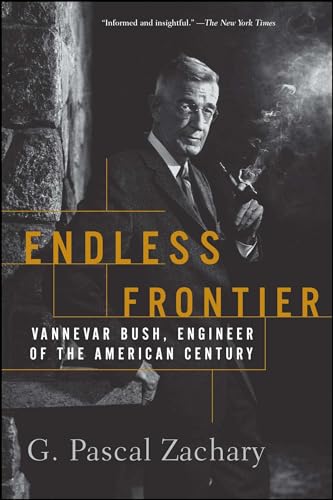
A prodigiously researched biography of Vannevar Bush, one of America’s most awe-inspiring polymaths and the secret force behind the biggest technological breakthroughs of the twentieth century.
As the inventor and public entrepreneur who launched the Manhattan Project, helped to create the military-industrial complex, conceived a permanent system of government support for science and engineering, and anticipated both the personal computer and the Internet, Vannevar Bush is the twentieth century’s Ben Franklin.
In this engaging look at one of America’s most awe-inspiring polymaths, writer G. Pascal Zachary brings to life an American original—a man of his time, ours, and beyond. Zachary details how Bush cofounded Raytheon and helped build one of the most powerful early computers in the world at MIT. During World War II, he served as Roosevelt’s adviser and chief contact on all matters of military technology, including the atomic bomb. He launched the Manhattan Project and oversaw a collection of 6,000 civilian scientists who designed scores of new weapons. After the war, his attention turned to the future. He wrote essays that anticipated the rise of the Internet and boldly equated national security with research strength, outlining a system of permanent federal funding for university research that endures to this day.
However, Bush’s hopeful vision of science and technology was leavened by an understanding of the darker possibilities. While cheering after witnessing the Trinity atomic test, he warned against the perils of a nuclear arms race. He led a secret appeal to convince President Truman not to test the Hydrogen Bomb and campaigned against the Red Scare.
Elegantly and expertly relayed by Zachary, Vannevar’s story is a grand tour of the digital leviathan we know as the modern American life.
Die Inhaltsangabe kann sich auf eine andere Ausgabe dieses Titels beziehen.
Über die Autorin bzw. den Autor
G. Pascal Zachary is a professor of practice at Arizona State University, where he teaches on the history and future of innovation, technological change and science in society. Endless Frontier won the Institute of Electronics and Electrical Engineers’ first literary award. He is also the author of Showstopper, on the making of a software program, and The Diversity Advantage: Multicultural Identity in the New World Economy.
Auszug. © Genehmigter Nachdruck. Alle Rechte vorbehalten.
Endless Frontier
Chapter 1
“The sea was all around”
(1890–1909)
When I was young I could follow an underground stream, in Provincetown on Cape Cod where I spent much of my youth, with assurance and precision. It flowed out of a pond a mile back, traversed part of the town, flowed under our house, and finally emerged below high water mark.
—Vannevar Bush
Richard Perry Bush, a short man wearing a tall silk hat, was on his way home from a funeral. If he didn’t like funerals, it didn’t show. He officiated at two, sometimes three funerals a week in Chelsea, an industrial city near Boston. In the 1890s Chelsea was a place where old Americans and new immigrants collided. As he walked down Broadway, Chelsea’s main avenue, friends and well-wishers hailed him. It seemed he couldn’t go more than a few feet without seeing someone he knew. He brought a sunny outlook to life, which was probably why he was in such demand for funerals. He seemed always ready to speak a comforting word. A tolerant and civic-minded minister, he had a sense of poetry, yet was practical and no pushover. A fellow minister said, “His manliness was his power.”1
Perry wore a moustache and long sideburns. He had narrow, dark hooded eyes, a small mouth, a broad, sharp nose and coarse hair strenuously parted near the middle of his head. He was born in 1855 in Provincetown, a scenic but declining fishing and trading center at the tip of Cape Cod, smack on the Atlantic Ocean. The Pilgrims had first stopped at the tip of the cape in 1620 before forming a permanent settlement in Plymouth. Fishing drew the Pilgrims back to the tip each year, and Provincetown was incorporated in 1727. By the Revolutionary War, however, it had just 205 inhabitants and 36 families.
Though isolated, Provincetown seemed to give its residents a window on the world. From High Pole Hill in town, some thought they could see the whole world. Visiting Provincetown about the time of Perry’s birth, Henry Thoreau wrote that the “dry land itself came through and out of the water in its way to the heavens.”2
As a boy in Provincetown, Perry felt “the sea was all around [him]. It was his playmate. It was his inspiration. Something of the moods of the sea were always with him.” The sea had sustained his ancestors for as far back as he knew. His father, also Richard Perry, was a sea captain whose own ancestors (and those of his wife) stretching back six generations were among Massachusetts’ earliest settlers, well established a century before the American Revolution. Most of this self-reliant crowd earned their living from the sea: traveling to Africa, South America and other exotic ports of call; whaling; trading; bankrolling the voyages of others. The elder Richard, born in 1828 and also raised in Provincetown, went to sea at an early age. In his prime he commanded both fishing and cargo vessels, “winning for himself a high reputation for uprightness and attention to business.”3
The vagaries of the seafaring trade meant the Bush family was comfortable but not wealthy. Perry sailed as a cook on a fishing boat at the age of 14, just four years after the Civil War. He did not aspire to a life at sea, however. He was smitten instead with religious feeling, though he turned his back on his parents’ strict Methodist creed. Such religious rifts were common in Provincetown. When Methodism first attracted some residents in the 1790s and they began to build a church, rival faiths were jealous. A mob tore down the frame of the building, built a bonfire with the wood and burned an effigy of the Methodist preacher.
Perry was drawn to a cooler, more temporal spirituality, yet one that was still muscular. His religious journey, however, took him away from Provincetown. Bent on becoming a minister, he attended Tufts College, an academically rigorous school in Medford, Massachusetts, founded by the liberal Universalist faith. A boyhood friend named John Vannevar joined Perry at Tufts, making the break with his family easier.
It took courage for Perry to leave his family and strike out on his own. “I left my home while yet a boy to seek my fortune in the world,” he later recalled. “Going out from home I lost the tie that might have bound me” to family traditions. It also meant fending more for himself. To help pay his school bills, Perry supplied wealthier students with coal for the stoves in their rooms. He carried the fuel himself, sometimes climbing three flights of stairs to make a delivery, the coal on his back.4
In 1879, Perry graduated from the divinity school and then moved to the nearby town of Everett, where he spent 13 years as a pastor. Building a life with little family help gave him “a lot of sympathy for anybody struggling with any kind of difficulty.” In 1892, he went to Chelsea, becoming the pastor of the Church of the Redeemer, a 50-year-old Universalist church. Perry arrived at his new post with his wife, Emma Linwood Paine, the daughter of a prominent Provincetown family and the mother of their three children. Edith, the oldest, was ten. Reba was five. The third and youngest child was a one-year-old boy. Born on March 11, 1890, the boy was named Vannevar, after Perry’s lifelong pal.5
In Chelsea, Perry quickly emerged as a civic leader. “A man of strong convictions, he had a remarkable power for making friends.” His religious convictions helped. Universalism, a Protestant offshoot with affinities to the Deism of Thomas Jefferson and other revolutionary-era figures, held that all men will be saved, no matter what their earthly actions. The faith flourished in 18th-century England, then spread to the colonies. By the late 19th century, Universalists espoused a belief in a single God and rejected the idea of Christ’s divinity and the Trinity. Adherents possessed an ecumenical spirit rare for the times and an appetite for social action. Perry himself “was always loyal to his church, but mankind was more important than any church, and when he was called upon to help he never stopped to ask as to a man’s creed, or race, or color, but only as to his need and the way in which he might be comforted or helped.”6
Perry’s Universalist creed made him sensitive to the swift and unsettling changes occurring in his city of 40,000. Through the Civil War, Chelsea remained largely rural and was dominated by a few landowners. Its people intensely supported the Yankees in the conflict, sending 1,000 men into battle by the time of Lee’s surrender. After the war, Chelsea emerged as a summer resort, catering to wealthy Bostonians and gaining a reputation as perhaps the poshest of Boston’s suburbs. But in the last third of the century Chelsea’s population quadrupled, and business, attracted by the easy connections to Boston proper, thrived. By 1880, 150 manufacturing firms were located in the city. Within a decade, the number had doubled and business investment had quadrupled.7
The boom drastically changed the character of Chelsea. Many of those wishing larger residences had moved to Brookline, Newton and other nearby towns. By the turn of...
„Über diesen Titel“ kann sich auf eine andere Ausgabe dieses Titels beziehen.
Suchergebnisse für Endless Frontier: Vannevar Bush, Engineer of the American...

Beispielbild für diese ISBN
Endless Frontier: Vannevar Bush, Engineer of the American Century
Anbieter: World of Books (was SecondSale), Montgomery, IL, USA
Verkäuferbewertung 5 von 5 Sternen

Paperback. Zustand: Very Good. A prodigiously researched biography of Vannevar Bush, one of America's most awe-inspiring polymaths and the secret force behind the biggest technological breakthroughs of the twentieth century. As the inventor and public entrepreneur who launched the Manhattan Project, helped to create the military-industrial complex, conceived a permanent system of government support for science and engineering, and anticipated both the personal computer and the Internet, Vannevar Bush is the twentieth century's Ben Franklin. In this engaging look at one of America's most awe-inspiring polymaths, writer G. Pascal Zachary brings to life an American original--a man of his time, ours, and beyond. Zachary details how Bush cofounded Raytheon and helped build one of the most powerful early computers in the world at MIT. During World War I, he served as Roosevelt's adviser and chief contact on all matters of military technology, including the atomic bomb. He launched the Manhattan Project and oversaw a collection of 6,000 civilian scientists who designed scores of new weapons. After the war, his attention turned to the future. He wrote essays that anticipated the rise of the Internet and boldly equated national security with research strength, outlining a system of permanent federal funding for university research that endures to this day. However, Bush's hopeful vision of science and technology was leavened by an understanding of the darker possibilities. While cheering after witnessing the Trinity atomic test, he warned against the perils of a nuclear arms race. He led a secret appeal to convince President Truman not to test the Hydrogen Bomb and campaigned against the Red Scare. Elegantly and expertly relayed by Zachary, Vannevar's story is a grand tour of the digital leviathan we know as the modern American life. Artikel-Nr. 00108090437
Gebraucht kaufen
EUR 12,37
Versand gratis
Versand innerhalb von USA
Versand innerhalb von USA
Anzahl: 1 verfügbar
Beispielbild für diese ISBN
Endless Frontier : Vannevar Bush, Engineer of the American Century
Anbieter: Better World Books, Mishawaka, IN, USA
Verkäuferbewertung 5 von 5 Sternen
Zustand: Good. Pages intact with minimal writing/highlighting. The binding may be loose and creased. Dust jackets/supplements are not included. Stock photo provided. Product includes identifying sticker. Better World Books: Buy Books. Do Good. Artikel-Nr. 51665573-6
Gebraucht kaufen
EUR 14,68
Versand gratis
Versand innerhalb von USA
Versand innerhalb von USA
Anzahl: 1 verfügbar
Beispielbild für diese ISBN
Endless Frontier : Vannevar Bush, Engineer of the American Century
Anbieter: Better World Books: West, Reno, NV, USA
Verkäuferbewertung 5 von 5 Sternen
Zustand: Very Good. Former library copy. Pages intact with possible writing/highlighting. Binding strong with minor wear. Dust jackets/supplements may not be included. Includes library markings. Stock photo provided. Product includes identifying sticker. Better World Books: Buy Books. Do Good. Artikel-Nr. 68119874-75
Gebraucht kaufen
EUR 14,68
Versand gratis
Versand innerhalb von USA
Versand innerhalb von USA
Anzahl: 1 verfügbar
Beispielbild für diese ISBN
Endless Frontier: Vannevar Bush, Engineer of the American Century
Anbieter: Books From California, Simi Valley, CA, USA
Verkäuferbewertung 4 von 5 Sternen

paperback. Zustand: Good. Artikel-Nr. mon0003936446
Gebraucht kaufen
EUR 11,43
EUR 4,43 Versand
Versand innerhalb von USA
Versand innerhalb von USA
Anzahl: 2 verfügbar
Beispielbild für diese ISBN
Endless Frontier
Anbieter: Kennys Bookstore, Olney, MD, USA
Verkäuferbewertung 5 von 5 Sternen
Zustand: New. Artikel-Nr. V9781501196454
Neu kaufen
EUR 30,38
EUR 9,33 Versand
Versand innerhalb von USA
Versand innerhalb von USA
Anzahl: Mehr als 20 verfügbar
Beispielbild für diese ISBN
Endless Frontier: Vannevar Bush, Engineer of the American Century
Anbieter: Revaluation Books, Exeter, Vereinigtes Königreich
Verkäuferbewertung 5 von 5 Sternen
Paperback. Zustand: Brand New. reprint edition. 527 pages. 9.00x6.00x1.50 inches. In Stock. Artikel-Nr. x-1501196456
Neu kaufen
EUR 27,61
EUR 14,74 Versand
Versand von Vereinigtes Königreich nach USA
Versand von Vereinigtes Königreich nach USA
Anzahl: 2 verfügbar
Foto des Verkäufers
Endless Frontier : Vannevar Bush, Engineer of the American Century
Anbieter: AHA-BUCH GmbH, Einbeck, Deutschland
Verkäuferbewertung 5 von 5 Sternen
Taschenbuch. Zustand: Neu. Neuware - A prodigiously researched biography of Vannevar Bush, one of America's most awe-inspiring polymaths and the secret force behind the biggest technological breakthroughs of the twentieth century.As the inventor and public entrepreneur who launched the Manhattan Project, helped to create the military-industrial complex, conceived a permanent system of government support for science and engineering, and anticipated both the personal computer and the Internet, Vannevar Bush is the twentieth century's Ben Franklin. In this engaging look at one of America's most awe-inspiring polymaths, writer G. Pascal Zachary brings to life an American originala man of his time, ours, and beyond. Zachary details how Bush cofounded Raytheon and helped build one of the most powerful early computers in the world at MIT. During World War II, he served as Roosevelt's adviser and chief contact on all matters of military technology, including the atomic bomb. He launched the Manhattan Project and oversaw a collection of 6,000 civilian scientists who designed scores of new weapons. After the war, his attention turned to the future. He wrote essays that anticipated the rise of the Internet and boldly equated national security with research strength, outlining a system of permanent federal funding for university research that endures to this day. However, Bush's hopeful vision of science and technology was leavened by an understanding of the darker possibilities. While cheering after witnessing the Trinity atomic test, he warned against the perils of a nuclear arms race. He led a secret appeal to convince President Truman not to test the Hydrogen Bomb and campaigned against the Red Scare. Elegantly and expertly relayed by Zachary, Vannevar's story is a grand tour of the digital leviathan we know as the modern American life. Artikel-Nr. 9781501196454
Neu kaufen
EUR 27,32
EUR 35,00 Versand
Versand von Deutschland nach USA
Versand von Deutschland nach USA
Anzahl: 1 verfügbar
Foto des Verkäufers
Endless Frontier: Vannevar Bush, Engineer of the American Century
Anbieter: moluna, Greven, Deutschland
Verkäuferbewertung 5 von 5 Sternen
Zustand: New. Über den AutorG. Pascal ZacharyKlappentextrnrnA prodigiously researched biography of Vannevar Bush, one of America s most awe-inspiring polymaths and the secret force behind the biggest technological breakthrough. Artikel-Nr. 903497530
Neu kaufen
EUR 23,43
EUR 48,99 Versand
Versand von Deutschland nach USA
Versand von Deutschland nach USA
Anzahl: Mehr als 20 verfügbar