
Verwandte Artikel zu The Daughter's Tale: A Novel
Inhaltsangabe
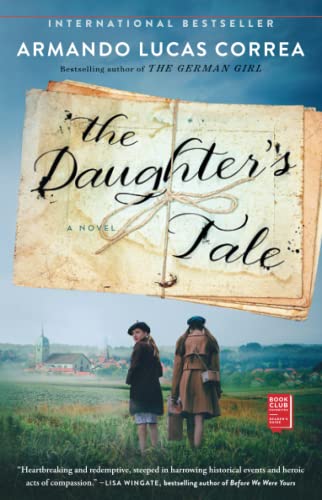
From the internationally bestselling author of The German Girl, an unforgettable, “searing” (People) saga exploring a hidden piece of World War II history and the lengths a mother will go to protect her children—perfect for fans of Lilac Girls, We Were the Lucky Ones, and The Alice Network.
Seven decades of secrets unravel with the arrival of a box of letters from the distant past, taking readers on a harrowing journey from Nazi-occupied Berlin, to the South of France, to modern-day New York City.
Berlin, 1939. The dreams that Amanda Sternberg and her husband, Julius, had for their daughters are shattered when the Nazis descend on Berlin, burning down their beloved family bookshop and sending Julius to a concentration camp. Desperate to save her children, Amanda flees toward the South of France. Along the way, a refugee ship headed for Cuba offers another chance at escape and there, at the dock, Amanda is forced to make an impossible choice that will haunt her for the rest of her life. Once in Haute-Vienne, her brief respite is interrupted by the arrival of Nazi forces, and Amanda finds herself in a labor camp where she must once again make a heroic sacrifice.
New York, 2015. Eighty-year-old Elise Duval receives a call from a woman bearing messages from a time and country that she forced herself to forget. A French Catholic who arrived in New York after World War II, Elise is shocked to discover that the letters were from her mother, written in German during the war. Her mother’s words unlock a floodgate of memories, a lifetime of loss un-grieved, and a chance—at last—for closure.
Based on true events and “breathtakingly threaded together from start to finish with the sound of a beating heart” (The New York Times Book Review), The Daughter’s Tale is an unforgettable family saga of love, survival, and redemption.
Die Inhaltsangabe kann sich auf eine andere Ausgabe dieses Titels beziehen.
Über die Autorin bzw. den Autor
Armando Lucas Correa is an award-winning journalist, editor, author, and the recipient of several awards from the National Association of Hispanic Publications and the Society of Professional Journalism. He is the author of the international bestseller The German Girl, which is now being published in seventeen languages and has sold more than one million copies; The Daughter’s Tale; and The Night Traveler, for which he was awarded the Cintas Foundation Creative Writing Fellowship. He lives in New York City with his husband and their three children. Visit ArmandoLucasCorrea.com.
Auszug. © Genehmigter Nachdruck. Alle Rechte vorbehalten.
Chapter 1
1
“Is this Ms. Duval? Elise Duval?” The voice on the phone repeated her name while she remained silent. “We were in Cuba recently. My daughter and I have some letters in German that belong to you.”
Elise had always been able to foresee the future. But not today. Today, she could never have predicted.
For an instant, she thought the call must be a mistake. After all, she was French, and had been living in New York for the last seventy years, ever since an uncle on her mother’s side had adopted her at the end of the war. Now, her only living relatives were her daughter, Adele, and her grandson, Etienne. They were her entire world, and everything that came before was shrouded in darkness.
“Ms. Duval?” the woman’s voice said again, gentle but insistent. Fraught with terror, Elise groped for some support, afraid she might faint.
“You can come see me this afternoon,” was all she managed to say before hanging up, neglecting to check first whether she had any appointments, or if she should consult her daughter. She heard the woman’s name, Ida Rosen, and her daughter’s, Anna, but her memory was a blank, closed to the past. She was certain only that she had no wish to verify the credentials of the stranger and her daughter. There was no need to give them her address, because they already had it. The call had not been a mistake. That much she knew.
Elise spent the next few hours trying to imagine what might lie behind their brief conversation. Rosen, she repeated to herself as she searched among the dim shadows of those who had crossed the Atlantic with her after the war.
Only a few hours had passed, and already the call was beginning to fade in her limited, selective memory. “There’s no time to remember,” she used to tell her husband, then her daughter, and now her grandson.
She felt vaguely guilty at having agreed so readily to receive this stranger. She should have asked who had written the letters, why they had ended up in Cuba, what Mrs. Rosen and her daughter were doing there. Instead, she had said nothing.
When the doorbell finally rang, her heart leapt out of her chest. She tried to shut her eyes and prepare herself, taking a deep breath and counting the heartbeats: one, two, three, four, five, six—a trick learned from childhood, one of her only clear memories. She had no idea how long she had spent in her bedroom, dressed in her navy-blue suit, waiting.
It was as if her senses had suddenly been heightened at the sound of the bell. Her hearing became sharper. Now, she could just make out the breathing of the two strangers outside the door waiting to see a weary old widow. But why? She paused with her hand on the lock, hoping against hope this visit was no more than an illusion, something she had dreamed, one of the many crazy notions brought on by the years. She closed her eyes and tried to visualize what would happen, but nothing came.
It was becoming clear to Elise that this meeting wasn’t about the future. Instead, it signified the return of a past she could no longer keep out, a constant shadow ever since the day she had disembarked in the port of New York, when the hand of an uncle who was to become a father rescued her from her oblivion. But he could never bring back her memories, removed by necessity, for the sake of her survival.
She opened the door resolutely. A shaft of light blinded her. The noise of the elevator, a neighbor going downstairs, a dog barking, and the wail of an ambulance siren distracted her for a second. The woman’s smile brought her back to reality.
Elise motioned for them to come in. Without yet saying a word, she avoided making the slightest gesture that might betray her terror. The girl, Anna, who looked to be twelve years old, came over and hugged her round the waist. She had no idea how to respond. Maybe she should have let her hands drop onto the little girl’s shoulders, or stroked her hair the way she used to do when her own daughter was the same age.
“You’ve got blue eyes,” she said timidly.
What a ridiculous thing to say! I should have said she had beautiful eyes, thought Elise, trying not to notice that they were the same blue, almond-shaped, and hooded eyes as hers, that her profile… No, she told herself fearfully, because it was her own reflection she saw in the face of this strange little girl.
Making an effort, Elise led the pair of them into the living room. Just as she was asking them to sit down, Anna handed her a small, lusterless, ebony box.
Elise carefully opened the box. By the time she finished unfolding the first letter, written in faded ink on a page from a botanical album, her eyes were brimming with tears.
“Does this belong to me?” she whispered, clasping the crucifix around her neck, a charm that had accompanied her ever since she could remember.
“Your eyes,” she repeated, staring at Anna with anguish.
Elise tried to stand up, but could feel her heart failing her. She was losing control over herself, over the life she had so carefully constructed. She could see her own face at a distance, staring at the scene from afar like another witness in the room.
Her palms grew sweaty, the box fell from her grasp, the letters spilling out onto the carpet. A photograph of a family with two little girls with a frightened gaze lay buried among yellowing sheets of paper. Elise saw herself closing her eyes and a stabbing pain in her chest took away her balance. Collapsing onto the faded carpet, she knew it was happening, at last: the final act of forgetting.
Silence, walls of silence all around her. She tried to recall how many times a heart could stop and then start beating again. One… silence. Two… another, even longer pause. Three… the void. The silence between one heartbeat and the next cut her off from the world. She wanted to hear one more. Four. And another. She breathed in as deeply as she could. Five… just one more and she would be safe. Silence. Six!
“Elise!” The shout made her stir. “Elise!”
That name, that name. Elise. It wasn’t her, for she was no one. She did not exist, she had never existed. She had lived a life that didn’t belong to her, had created a family she had deceived, spoke a language that wasn’t hers. All these years spent fleeing from who she truly was. To what end? She was a survivor, and that was not a mistake, nor a misunderstanding.
By the time the paramedics lifted her onto the gurney, she had already forgotten the other woman and her blue-eyed daughter, forgotten the letters written in a strange language, the photograph.
But in the space of forgetting, a memory emerged. Herself, as a little girl, trying to find her way through a thick forest, surrounded by enormous trees that prevented her from seeing the sky. How could she know where she was going, if she couldn’t see the stars? Blood on her cheek, hands, her dress, but not hers. A body lying lifeless on the ground in a gory mess. No helping hand to support her. She could feel the thick, damp air, hear her childish voice stammer: “Mama! Mama!” She was lost, abandoned in the darkness.
In the fog of jumbled memories, she saw it all: the letters, the ebony box, the purple jewel case, a threadbare soccer ball, a wounded soldier. Withered flowers and blurred lines.
It had taken this little girl,...
„Über diesen Titel“ kann sich auf eine andere Ausgabe dieses Titels beziehen.
Suchergebnisse für The Daughter's Tale: A Novel

Beispielbild für diese ISBN
The Daughter's Tale
Verlag:
Washington Square Press, 2020
ISBN 10: 1501187945
ISBN 13: 9781501187940
Gebraucht
Paperback
Anbieter: World of Books (was SecondSale), Montgomery, IL, USA
Verkäuferbewertung 5 von 5 Sternen

Paperback. Zustand: Good. From the internationally bestselling author of The German Girl, an unforgettable, "searing" (People) saga exploring a hidden piece of World War II history and the lengths a mother will go to protect her children--perfect for fans of Lilac Girls, We Were the Lucky Ones, and The Alice Network. Seven decades of secrets unravel with the arrival of a box of letters from the distant past, taking readers on a harrowing journey from Nazi-occupied Berlin, to the South of France, to modern-day New York City. Berlin, 1939. The dreams that Amanda Sternberg and her husband, Julius, had for their daughters are shattered when the Nazis descend on Berlin, burning down their beloved family bookshop and sending Julius to a concentration camp. Desperate to save her children, Amanda flees toward the South of France. Along the way, a refugee ship headed for Cuba offers another chance at escape and there, at the dock, Amanda is forced to make an impossible choice that will haunt her for the rest of her life. Once in Haute-Vienne, her brief respite is interrupted by the arrival of Nazi forces, and Amanda finds herself in a labor camp where she must once again make a heroic sacrifice. New York, 2015. Eighty-year-old Elise Duval receives a call from a woman bearing messages from a time and country that she forced herself to forget. A French Catholic who arrived in New York after World War II, Elise is shocked to discover that the letters were from her mother, written in German during the war. Her mother's words unlock a floodgate of memories, a lifetime of loss un-grieved, and a chance--at last--for closure. Based on true events and "breathtakingly threaded together from start to finish with the sound of a beating heart" (The New York Times Book Review), The Daughter's Tale is an unforgettable family saga of love, survival, and redemption. Artikel-Nr. 00064399957
Gebraucht kaufen
EUR 3,66
Versand gratis
Versand innerhalb von USA
Versand innerhalb von USA
Anzahl: Mehr als 20 verfügbar
Beispielbild für diese ISBN
The Daughters Tale
Anbieter: World of Books (was SecondSale), Montgomery, IL, USA
Verkäuferbewertung 5 von 5 Sternen
Zustand: Acceptable. Item in acceptable condition! Textbooks may not include supplemental items i.e. CDs, access codes etc. Artikel-Nr. 00102768556
Gebraucht kaufen
EUR 3,66
Versand gratis
Versand innerhalb von USA
Versand innerhalb von USA
Anzahl: 1 verfügbar
Beispielbild für diese ISBN
The Daughter's Tale: A Novel
Verlag:
Atria Books (edition Reprint), 2020
ISBN 10: 1501187945
ISBN 13: 9781501187940
Gebraucht
Paperback
Anbieter: BooksRun, Philadelphia, PA, USA
Verkäuferbewertung 5 von 5 Sternen
Paperback. Zustand: Very Good. Reprint. It's a well-cared-for item that has seen limited use. The item may show minor signs of wear. All the text is legible, with all pages included. It may have slight markings and/or highlighting. Artikel-Nr. 1501187945-11-1
Gebraucht kaufen
EUR 4,68
Versand gratis
Versand innerhalb von USA
Versand innerhalb von USA
Anzahl: 1 verfügbar
Beispielbild für diese ISBN
The Daughter's Tale
Anbieter: ThriftBooks-Reno, Reno, NV, USA
Verkäuferbewertung 5 von 5 Sternen
Paperback. Zustand: Very Good. No Jacket. May have limited writing in cover pages. Pages are unmarked. ~ ThriftBooks: Read More, Spend Less. Artikel-Nr. G1501187945I4N00
Gebraucht kaufen
EUR 5,87
Versand gratis
Versand innerhalb von USA
Versand innerhalb von USA
Anzahl: 1 verfügbar
Beispielbild für diese ISBN
The Daughter's Tale
Anbieter: ThriftBooks-Atlanta, AUSTELL, GA, USA
Verkäuferbewertung 5 von 5 Sternen
Paperback. Zustand: Very Good. No Jacket. May have limited writing in cover pages. Pages are unmarked. ~ ThriftBooks: Read More, Spend Less. Artikel-Nr. G1501187945I4N00
Gebraucht kaufen
EUR 5,87
Versand gratis
Versand innerhalb von USA
Versand innerhalb von USA
Anzahl: 1 verfügbar
Beispielbild für diese ISBN
The Daughter's Tale
Anbieter: ThriftBooks-Dallas, Dallas, TX, USA
Verkäuferbewertung 5 von 5 Sternen
Paperback. Zustand: Very Good. No Jacket. May have limited writing in cover pages. Pages are unmarked. ~ ThriftBooks: Read More, Spend Less. Artikel-Nr. G1501187945I4N00
Gebraucht kaufen
EUR 5,87
Versand gratis
Versand innerhalb von USA
Versand innerhalb von USA
Anzahl: 1 verfügbar
Beispielbild für diese ISBN
The Daughter's Tale: A Novel
Anbieter: Wonder Book, Frederick, MD, USA
Verkäuferbewertung 5 von 5 Sternen
Zustand: Very Good. Very Good condition. A copy that may have a few cosmetic defects. May also contain light spine creasing or a few markings such as an owner's name, short gifter's inscription or light stamp. Artikel-Nr. I25A-04409
Gebraucht kaufen
EUR 6,33
Versand gratis
Versand innerhalb von USA
Versand innerhalb von USA
Anzahl: 1 verfügbar
Beispielbild für diese ISBN
The Daughter's Tale: A Novel
Anbieter: Wonder Book, Frederick, MD, USA
Verkäuferbewertung 5 von 5 Sternen
Zustand: As New. Like New condition. A near perfect copy that may have very minor cosmetic defects. Artikel-Nr. L07B-01568
Gebraucht kaufen
EUR 6,33
Versand gratis
Versand innerhalb von USA
Versand innerhalb von USA
Anzahl: 2 verfügbar
Beispielbild für diese ISBN
The Daughter's Tale : A Novel
Verlag:
Washington Square Press, 2020
ISBN 10: 1501187945
ISBN 13: 9781501187940
Gebraucht
Softcover
Anbieter: Better World Books, Mishawaka, IN, USA
Verkäuferbewertung 5 von 5 Sternen
Zustand: Very Good. Reprint. Pages intact with possible writing/highlighting. Binding strong with minor wear. Dust jackets/supplements may not be included. Stock photo provided. Product includes identifying sticker. Better World Books: Buy Books. Do Good. Artikel-Nr. 18404691-6
Gebraucht kaufen
EUR 6,47
Versand gratis
Versand innerhalb von USA
Versand innerhalb von USA
Anzahl: 1 verfügbar
Beispielbild für diese ISBN
The Daughter's Tale : A Novel
Verlag:
Washington Square Press, 2020
ISBN 10: 1501187945
ISBN 13: 9781501187940
Gebraucht
Softcover
Anbieter: Better World Books, Mishawaka, IN, USA
Verkäuferbewertung 5 von 5 Sternen
Zustand: Good. Reprint. Pages intact with minimal writing/highlighting. The binding may be loose and creased. Dust jackets/supplements are not included. Stock photo provided. Product includes identifying sticker. Better World Books: Buy Books. Do Good. Artikel-Nr. 18430093-6
Gebraucht kaufen
EUR 6,47
Versand gratis
Versand innerhalb von USA
Versand innerhalb von USA
Anzahl: 2 verfügbar