
Verwandte Artikel zu Wildhood: The Astounding Connections between Human...
Inhaltsangabe
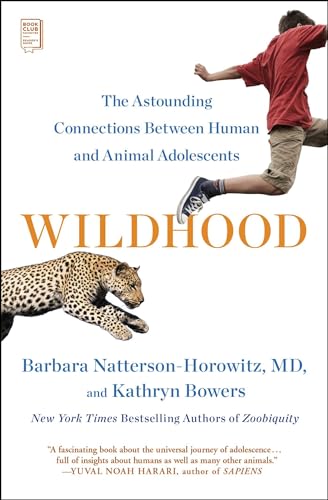
A New York Times Editor’s Pick ** People Best Books ** Publishers Weekly Most Anticipated Books ** Chicago Tribune 28 Books You Need to Read Now **
“It blew my mind to discover that adolescent animals and humans are so similar…I loved this book!” —Temple Grandin, author of Animals Make Us Human and Animals in Translation
A “vivid…and fascinating” (Los Angeles Times) investigation of human and animal adolescence from the New York Times bestselling authors of Zoobiquity.
Harvard evolutionary biologist Barbara Natterson-Horowitz and animal behaviorist Kathryn Bowers studied thousands of wild species searching for evidence of human-like adolescence in other animals. With a groundbreaking synthesis of animal behavior, human psychology, and evolutionary biology, their research uncovered something remarkable: the same four high-stakes tests shape the destiny of every adolescent on planet Earth—how to be safe, how to navigate social hierarchies, how to connect romantically, and how to live independently. Safety. Status. Sex. Self-reliance.
To bring these challenges to life, the authors analyzed GPS and radio collar data from four wild adolescent animals. Will a predator-naïve penguin become easy prey? Can a low-born hyena socialize his way to a better life? Did a young humpback choose the right mate? Will a newly independent grey wolf starve, or will he become self-reliant? The result is a game-changing perspective on anxiety, risky behavior, sexual first times, and leaving home that can help teenagers and young adults coming of age in a rapidly changing world.
As they discover that “adolescence isn’t just for humans” through “rollicking tales of young animals navigating risk, social hierarchy, and sex with all the bravura (and dopiness) of our own teenage beasts” (People), readers will learn that in fact, this volatile and vulnerable phase of life creates the basis of adult confidence, success, and even happiness. This is an invaluable guide for parents, teenagers, and anyone who cares about adolescence, who will find “the similarities between animal and human teenagers uncanny, and the lessons they have to learn remarkably similar” (The New York Times Book Review).
Die Inhaltsangabe kann sich auf eine andere Ausgabe dieses Titels beziehen.
Über die Autorinnen und Autoren
Barbara Natterson-Horowitz, MD, is a Visiting Professor at Harvard University in the Department of Human Evolutionary Biology. She is also Professor of Medicine/Cardiology at UCLA and President of the International Society of Evolution, Medicine, and Public Health. She is the coauthor of Zoobiquity and Wildhood.
Kathryn Bowers is an animal behaviorist and writer who has taught at UCLA and Harvard. A Future Tense Fellow at New America in Washington, DC, she was an editor at the Atlantic Monthly, CNN-International in London, and at Zócalo Public Square in Los Angeles. She is the coauthor of Zoobiquity and Wildhood.
Auszug. © Genehmigter Nachdruck. Alle Rechte vorbehalten.
Wildhood
Prologue
Our quest to understand the nature of adolescence began on a cold California beach in 2010. We stood on a sand dune, contemplating a stretch of the Pacific, an expanse with an intriguing nickname: the Triangle of Death.
We’d been drawn there by a marine biologist’s unusual story. The Triangle of Death, he’d told us, owed its reputation to a horde of particularly lethal inhabitants: great white sharks. Hundreds of these colossal predators live in this region, and they’re so notoriously ravenous that even the local sea life has learned to stay out of their way. Lush kelp forests grow up and down the California coast, but not in the Triangle, so any animal foolish or unlucky enough to venture in there has nowhere to hide. So treacherous are those waters that even the scientists who work in them don’t get out of their boats.
But, the biologist said, that wasn’t the most interesting part. Counterintuitively and at great danger to itself, one animal does regularly enter the Triangle of Death: the California sea otter. But not all of them. Only one specific kind joyrides into the death zone, and it’s not the mature adults. It’s certainly not the baby pups. No, the magnificent knuckleheads that swim into the cold, barren, shark-filled Triangle of Death are adolescents. Sometimes they die in a flash of teeth and a swirl of blood. But more often than not, these thrill-seeking animal “teens” emerge with hard-won experience, newfound confidence, and more sea smarts than they had as parent-protected, dependent juveniles.
At the time, we were researching our first book, Zoobiquity, which explores the ancient and essential connection between human and animal health. (We work as a team: Barbara is a visiting professor in the Department of Human Evolutionary Biology at Harvard and professor of medicine in the Division of Cardiology at UCLA. Kathryn, a science writer, is a certified animal behaviorist. Together we’ve designed and taught courses at Harvard and UCLA.) Gazing over the Triangle of Death, we were struck by how these adolescent otters sounded a lot like teenagers we knew: taking risks, seeking out danger, doing scary things their parents had grown out of. After regarding the ocean for a few more moments, we walked back up the beach, over a dune, and onto a spit of land overlooking a different scene.
In a cove protected from the whitecaps, kayakers slowly paddled through the calm water. This inlet, called Moss Landing, is a prime location for observing wildlife, including sea otters. The extended families of the adolescents drawn to the Triangle of Death come here to feed, relax, and socialize.
On that day there were dozens of the sleek creatures floating on their backs, twisting and twirling through the water. The panorama resembled open-swim hour at a public pool—with young and old otters cavorting together. Older animals swimming leisurely made way for splashing groups of youth. We saw otters diving for sea urchins and learning to break them open, play-fighting in pairs and groups, and testing out the nose-grabbing behavior these animals use when they court. Although it looked like carefree recreation, we’d later learn that this was actually a cove full of teachable moments for the younger members of the group.
As we watched, pandemonium suddenly broke out. The water exploded in a churn of white as a group of otters powered at top speed from one end of the inlet to the other. What just happened? we asked our biologist guide. Was it a shark? Had a predator entered the shallow bay?
No, the biologist responded, pointing. That kayak got too close. And look—they didn’t all get spooked. There, still floating comfortably, undisturbed, was one cluster of otters. The gray fur on their heads showed they were mature adults, experienced and discerning. The skittish ones who’d taken flight were the adolescents who couldn’t yet tell the difference between a great white and a Sea Ghost 130.
Swimming up to sharks one moment, then fleeing from a plastic boat the next: these inexperienced adolescents were both overly bold and overly cautious. But we observed that these animal adolescents were also exuberantly socializing with their peers, experimenting with sexual behaviors, and fumbling with how to feed themselves. The parallels with our own species, and even with our own younger selves, were remarkable.
It also crossed our minds, as it has often since we started researching animal-human overlaps, that we might be anthropomorphizing this otter behavior—reading too much into the antics of these wild mammals. From the beginning of our research together, we’d made it a point to avoid projecting human qualities onto other species, thinking it a central scientific danger. But as we learned more about work from fields including neurobiology, genomics, and molecular phylogeny, we realized the bigger danger might be denying humans’ real and demonstrable connections with other animals, in body and behavior. The real threat, we recognized, wasn’t perhaps anthropomorphism, but its opposite, what primatologist and ethologist Frans de Waal calls “anthropodenial.”
Over and over in our work we’ve refuted claims of human uniqueness: Wild animals can and do get so-called human diseases like heart failure, lung cancer, eating disorders, and addiction. They can develop insomnia and anxiety. Some overeat when they’re stressed. They’re not all heterosexual. Some are timid; some are bold. Nearly every time we’ve encountered claims of human exceptionalism, we’ve found them to be incorrect.
And there, in the water right in front of us, was another striking parallel. Although it happens at any point from a few days to many years after they’re born, all animals have a “teenage” period. Boys and girls don’t become men and women overnight. And the transition from foal to stallion, joey to kangaroo, or sea otter cub to sea otter elder is just as distinct, just as necessary, and just as extraordinary. All animals need time, experiences, practice, and failure to become mature adults.
That day at the Triangle of Death we caught a glimpse of animal adolescence. And once we’d seen it there, we began to see it everywhere.
A NEW WAY OF SEEING
It was, almost quite literally, as if we’d taken off a blindfold. Our physical vision hadn’t changed, but our perception had, and suddenly a whole new way of understanding what it means to grow up revealed itself. Flocks of birds, pods of whales, groups of young people, our own children—even memories of our own adolescence and young adulthood—would never look the same.
Over the next several years we focused our research on understanding animals in this in-between phase, the ones too physically grown to be juveniles but not yet possessing the experience to be considered mature.
Watching a herd of wildebeest crossing a crocodile-infested river, we noticed that the first ones in the water were big but gangly adolescents. Oblivious to danger, exuberant with inexperience, they leapt right in while their more prudent elders held back, swimming across safely once the crocodiles were occupied chasing the adolescents.
In Manhattan, Kansas, of all places, we came face-to-face with two young adult hyenas and observed how one bullied the other although they were the same age and size....
„Über diesen Titel“ kann sich auf eine andere Ausgabe dieses Titels beziehen.
Suchergebnisse für Wildhood: The Astounding Connections between Human...

Beispielbild für diese ISBN
Wildhood: The Astounding Connections Between Human and Animal Adolescents
Anbieter: ThriftBooks-Atlanta, AUSTELL, GA, USA
Verkäuferbewertung 5 von 5 Sternen

Paperback. Zustand: Good. No Jacket. Pages can have notes/highlighting. Spine may show signs of wear. ~ ThriftBooks: Read More, Spend Less. Artikel-Nr. G1501164708I3N00
Gebraucht kaufen
EUR 6,26
Versand gratis
Versand innerhalb von USA
Versand innerhalb von USA
Anzahl: 1 verfügbar
Beispielbild für diese ISBN
Wildhood: The Astounding Connections Between Human and Animal Adolescents
Anbieter: ThriftBooks-Dallas, Dallas, TX, USA
Verkäuferbewertung 5 von 5 Sternen
Paperback. Zustand: Good. No Jacket. Missing dust jacket; Pages can have notes/highlighting. Spine may show signs of wear. ~ ThriftBooks: Read More, Spend Less. Artikel-Nr. G1501164708I3N01
Gebraucht kaufen
EUR 6,26
Versand gratis
Versand innerhalb von USA
Versand innerhalb von USA
Anzahl: 1 verfügbar
Beispielbild für diese ISBN
Wildhood: The Astounding Connections Between Human and Animal Adolescents
Anbieter: ThriftBooks-Dallas, Dallas, TX, USA
Verkäuferbewertung 5 von 5 Sternen
Paperback. Zustand: Good. No Jacket. Former library book; Pages can have notes/highlighting. Spine may show signs of wear. ~ ThriftBooks: Read More, Spend Less. Artikel-Nr. G1501164708I3N10
Gebraucht kaufen
EUR 6,26
Versand gratis
Versand innerhalb von USA
Versand innerhalb von USA
Anzahl: 1 verfügbar
Beispielbild für diese ISBN
Wildhood : The Astounding Connections Between Human and Animal Adolescents
Anbieter: Better World Books: West, Reno, NV, USA
Verkäuferbewertung 5 von 5 Sternen
Zustand: Very Good. Pages intact with possible writing/highlighting. Binding strong with minor wear. Dust jackets/supplements may not be included. Stock photo provided. Product includes identifying sticker. Better World Books: Buy Books. Do Good. Artikel-Nr. 41063024-6
Gebraucht kaufen
EUR 9,90
Versand gratis
Versand innerhalb von USA
Versand innerhalb von USA
Anzahl: 1 verfügbar
Beispielbild für diese ISBN
Wildhood: The Astounding Connections between Human and Animal Adolescents
Anbieter: Books From California, Simi Valley, CA, USA
Verkäuferbewertung 4 von 5 Sternen

Paperback. Zustand: Very Good. Cover and edges may have some wear. Artikel-Nr. mon0004233759
Gebraucht kaufen
EUR 6,70
EUR 4,36 Versand
Versand innerhalb von USA
Versand innerhalb von USA
Anzahl: 1 verfügbar
Beispielbild für diese ISBN
Wildhood: The Astounding Connections Between Human and Animal Adolescents
Anbieter: Revaluation Books, Exeter, Vereinigtes Königreich
Verkäuferbewertung 5 von 5 Sternen
Paperback. Zustand: Brand New. reprint edition. 354 pages. 8.25x5.25x1.00 inches. In Stock. Artikel-Nr. x-1501164708
Neu kaufen
EUR 19,77
EUR 11,66 Versand
Versand von Vereinigtes Königreich nach USA
Versand von Vereinigtes Königreich nach USA
Anzahl: 2 verfügbar
Beispielbild für diese ISBN
Wildhood: The Astounding Connections between Human and Animal Adolescents
Anbieter: Kennys Bookstore, Olney, MD, USA
Verkäuferbewertung 5 von 5 Sternen
Zustand: New. 2020. Reprint. paperback. . . . . . Books ship from the US and Ireland. Artikel-Nr. V9781501164705
Neu kaufen
EUR 23,69
EUR 9,17 Versand
Versand innerhalb von USA
Versand innerhalb von USA
Anzahl: Mehr als 20 verfügbar
Foto des Verkäufers
Wildhood : The Astounding Connections Between Human and Animal Adolescents
Verlag:
Scribner Book Company Jul 2020, 2020
ISBN 10: 1501164708
ISBN 13: 9781501164705
Neu
Taschenbuch
Anbieter: AHA-BUCH GmbH, Einbeck, Deutschland
Verkäuferbewertung 5 von 5 Sternen
Taschenbuch. Zustand: Neu. Neuware - A New York Times Editor's Pick \*\* People Best Books \*\* Publishers Weekly Most Anticipated Books \*\* Chicago Tribune 28 Books You Need to Read Now \*\* "It blew my mind to discover that adolescent animals and humans are so similarI loved this book!" Temple Grandin, author of Animals Make Us Human and Animals in Translation A "vividand fascinating" (Los Angeles Times) investigation of human and animal adolescence and nature's guide to growing up from the New York Times bestselling authors of Zoobiquity.Harvard evolutionary biologist Barbara Natterson-Horowitz and animal behaviorist Kathryn Bowers studied thousands of wild species searching for evidence of human-like adolescence in other animals. With a groundbreaking synthesis of animal behavior, human psychology, and evolutionary biology, their research uncovered something remarkable: the same four high-stakes tests shape the destiny of every adolescent on planet Earthhow to be safe, how to navigate social hierarchies, how to connect romantically, and how to live independently. Safety. Status. Sex. Self-reliance. To bring these challenges to life, the authors analyzed GPS and radio collar data from four wild adolescent animals. Will a predator-naïve penguin become easy prey Can a low-born hyena socialize his way to a better life Did a young humpback choose the right mate Will a newly independent grey wolf starve, or will he become self-reliant The result is a game-changing perspective on anxiety, risky behavior, sexual first times, and leaving home that can help teenagers and young adults coming of age in a rapidly changing world. As they discover that "adolescence isn't just for humans" through "rollicking tales of young animals navigating risk, social hierarchy, and sex with all the bravura (and dopiness) of our own teenage beasts" (People), readers will learn that in fact, this volatile and vulnerable phase of life creates the basis of adult confidence, success, and even happiness. This is an invaluable guide for parents, teenagers, and anyone who cares about adolescence and the science of growing up, who will find "the similarities between animal and human teenagers uncanny, and the lessons they have to learn remarkably similar" (The New York Times Book Review). Artikel-Nr. 9781501164705
Neu kaufen
EUR 31,44
EUR 35,00 Versand
Versand von Deutschland nach USA
Versand von Deutschland nach USA
Anzahl: 2 verfügbar
Foto des Verkäufers
Wildhood
Verlag:
SCRIBNER BOOKS CO, 2020
ISBN 10: 1501164708
ISBN 13: 9781501164705
Neu
Kartoniert / Broschiert
Anbieter: moluna, Greven, Deutschland
Verkäuferbewertung 5 von 5 Sternen
Kartoniert / Broschiert. Zustand: New. Über den AutorrnrnBarbara Natterson-Horowitz, MD, is a Visiting Professor at Harvard University in the Department of Human Evolutionary Biology. She is also Professor of Medicine/Cardiology at UCLA and President of the International Society. Artikel-Nr. 333886306
Neu kaufen
EUR 18,54
EUR 48,99 Versand
Versand von Deutschland nach USA
Versand von Deutschland nach USA
Anzahl: Mehr als 20 verfügbar