
Verwandte Artikel zu House of Names: A Novel
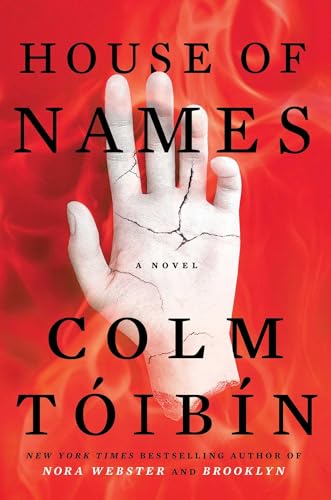
Inhaltsangabe
* A Washington Post Notable Fiction Book of the Year
* Named a Best Book of 2017 by NPR, The Guardian, The Boston Globe, St. Louis Dispatch
From the thrilling imagination of bestselling, award-winning Colm Tóibín comes a retelling of the story of Clytemnestra—spectacularly audacious, violent, vengeful, lustful, and instantly compelling—and her children.
“I have been acquainted with the smell of death.” So begins Clytemnestra’s tale of her own life in ancient Mycenae, the legendary Greek city from which her husband King Agamemnon left when he set sail with his army for Troy. Clytemnestra rules Mycenae now, along with her new lover Aegisthus, and together they plot the bloody murder of Agamemnon on the day of his return after nine years at war.
Judged, despised, cursed by gods she has long since lost faith in, Clytemnestra reveals the tragic saga that led to these bloody actions: how her husband deceived her eldest daughter Iphigeneia with a promise of marriage to Achilles, only to sacrifice her because that is what he was told would make the winds blow in his favor and take him to Troy; how she seduced and collaborated with the prisoner Aegisthus, who shared her bed in the dark and could kill; how Agamemnon came back with a lover himself; and how Clytemnestra finally achieved her vengeance for his stunning betrayal—his quest for victory, greater than his love for his child.
In House of Names, Colm Tóibín brings a modern sensibility and language to an ancient classic, and gives this extraordinary character new life, so that we not only believe Clytemnestra’s thirst for revenge, but applaud it. He brilliantly inhabits the mind of one of Greek myth’s most powerful villains to reveal the love, lust, and pain she feels. Told in fours parts, this is a fiercely dramatic portrait of a murderess, who will herself be murdered by her own son, Orestes. It is Orestes’ story, too: his capture by the forces of his mother’s lover Aegisthus, his escape and his exile. And it is the story of the vengeful Electra, who watches over her mother and Aegisthus with cold anger and slow calculation, until, on the return of her brother, she has the fates of both of them in her hands.
Die Inhaltsangabe kann sich auf eine andere Ausgabe dieses Titels beziehen.
Über die Autorin bzw. den Autor
Colm Tóibín is the author of ten novels, including The Magician, winner of the Rathbones Folio Prize; The Master, winner of the Los Angeles Times Book Prize; Brooklyn, winner of the Costa Book Award; The Testament of Mary; and Nora Webster, as well as two story collections and several books of criticism. He is the Irene and Sidney B. Silverman Professor of the Humanities at Columbia University and has been named as the Laureate for Irish Fiction for 2022–2024 by the Arts Council of Ireland. Three times shortlisted for the Booker Prize, Tóibín lives in Dublin and New York.
Auszug. © Genehmigter Nachdruck. Alle Rechte vorbehalten.
House of Names
I have been acquainted with the smell of death. The sickly, sugary smell that wafted in the wind towards the rooms in this palace. It is easy now for me to feel peaceful and content. I spend my morning looking at the sky and the changing light. The birdsong begins to rise as the world fills with its own pleasures and then, as day wanes, the sound too wanes and fades. I watch as the shadows lengthen. So much has slipped away, but the smell of death lingers. Maybe the smell has entered my body and been welcomed there like an old friend come to visit. The smell of fear and panic. The smell is here like the very air is here; it returns in the same way as light in the morning returns. It is my constant companion; it has put life into my eyes, eyes that grew dull with waiting, but are not dull now, eyes that are alive now with brightness.
I gave orders that the bodies should remain in the open under the sun a day or two until the sweetness gave way to stench. And I liked the flies that came, their little bodies perplexed and brave, buzzing after their feast, upset by the continuing hunger they felt in themselves, a hunger I had come to know too and had come to appreciate.
We are all hungry now. Food merely whets our appetite, it sharpens our teeth; meat makes us ravenous for more meat, as death is ravenous for more death. Murder makes us ravenous, fills the soul with satisfaction that is fierce and then luscious enough to create a taste for further satisfaction.
A knife piercing the soft flesh under the ear, with intimacy and precision, and then moving across the throat as soundlessly as the sun moves across the sky, but with greater speed and zeal, and then his dark blood flowing with the same inevitable hush as dark night falls on familiar things.
*
They cut her hair before they dragged her to the place of sacrifice. My daughter had her hands tied tight behind her back, the skin on the wrists raw with the ropes, and her ankles bound. Her mouth was gagged to stop her cursing her father, her cowardly, two-tongued father. Nonetheless, her muffled screams were heard when she finally realized that her father really did mean to murder her, that he did mean to sacrifice her life for his army. They had cropped her hair with haste and carelessness; one of the women managed to cut into the skin around my daughter’s skull with a rusty blade, and when Iphigenia began her curse, that is when a man tied an old cloth around her mouth so that her words could not be heard. I am proud that she never ceased to struggle, that never once, not for one second, despite the ingratiating speech she had made, did she accept her fate. She did not give up trying to loosen the twine around her ankles or the ropes around her wrists so that she could get away from them. Or stop trying to curse her father so that he would feel the weight of her contempt.
No one is willing now to repeat the words she spoke in the moments before they muffled her voice, but I know what those words were. I taught them to her. They were words I made up to shrivel her father and his followers, with their foolish aims, they were words that announced what would happen to him and those around him once the news spread of how they dragged our daughter, the proud and beautiful Iphigenia, to that place, how they pulled her through the dust to sacrifice her so they might prevail in their war. In that last second as she lived, I am told she screamed aloud so that her voice pierced the hearts of those who heard her.
Her screams as they murdered her were replaced by silence and by scheming when Agamemnon, her father, returned and I fooled him into thinking that I would not retaliate. I waited and I watched for signs, and smiled and opened my arms to him, and I had a table here prepared with food. Food for the fool! I was wearing the special scent that excited him. Scent for the fool!
I was ready as he was not, the hero home in glorious victory, the blood of his daughter on his hands, but his hands washed now as though free of all stain, his hands white, his arms outstretched to embrace his friends, his face all smiles, the great soldier who would soon, he believed, hold up a cup in celebration and put rich food into his mouth. His gaping mouth! Relieved that he was home!
I saw his hands clench in sudden pain, clench in the grim, shocked knowledge that at last it had come to him, and in his own palace, and in the slack time when he was sure he would enjoy the old stone bath and the ease to be found there.
That was what inspired him to go on, he said, the thought that this was waiting for him, healing water and spices and soft, clean clothes and familiar air and sounds. He was like a lion as he laid his muzzle down, his roaring all done, his body limp, and all thought of danger far from his mind.
I smiled and said that, yes, I too had thought of the welcome I would make for him. He had filled my waking life and my dreams, I told him. I had dreamed of him rising all cleansed from the perfumed water of the bath. I told him his bath was being prepared as the food was being cooked, as the table was being laid, and as his friends were gathering. And he must go there now, I said, he must go to the bath. He must bathe, bathe in the relief of being home. Yes, home. That is where the lion came. I knew what to do with the lion once he came home.
*
I had spies to tell me when he would come back. Men lit each fire that gave the news to farther hills where other men lit fires to alert me. It was the fire that brought the news, not the gods. Among the gods now there is no one who offers me assistance or oversees my actions or knows my mind. There is no one among the gods to whom I appeal. I live alone in the shivering, solitary knowledge that the time of the gods has passed.
I am praying to no gods. I am alone among those here because I do not pray and will not pray again. Instead, I will speak in ordinary whispers. I will speak in words that come from the world, and those words will be filled with regret for what has been lost. I will make sounds like prayers, but prayers that have no source and no destination, not even a human one, since my daughter is dead and cannot hear.
I know as no one else knows that the gods are distant, they have other concerns. They care about human desires and antics in the same way that I care about the leaves of a tree. I know the leaves are there, they wither and grow again and wither, as people come and live and then are replaced by others like them. There is nothing I can do to help them or prevent their withering. I do not deal with their desires.
I wish now to stand here and laugh. Hear me tittering and then howling with mirth at the idea that the gods allowed my husband to win his war, that they inspired every plan he worked out and every move he made, that they knew his cloudy moods in the morning and the strange and silly exhilaration he could exude at night, that they listened to his implorings and discussed them in their godly homes, that they watched the murder of my daughter with approval.
The bargain was simple, or so he believed, or so his troops believed. Kill the innocent girl in return for a change in the wind. Take her out of the world, use a knife on her flesh to ensure that she would never again walk into a room or wake in the morning. Deprive the world of her grace. And as a reward, the gods would make the wind blow in her father’s favor on the day he needed wind for his sails. They would hush the wind on the other days when his enemies needed it. The gods would make his men...
„Über diesen Titel“ kann sich auf eine andere Ausgabe dieses Titels beziehen.
Weitere beliebte Ausgaben desselben Titels

Suchergebnisse für House of Names: A Novel

Foto des Verkäufers
House of Names: A Novel
Anbieter: Dream Books Co., Denver, CO, USA
Verkäuferbewertung 5 von 5 Sternen

Zustand: very_good. Pages are clean with no markings. May show minor signs of wear or cosmetic defects marks, cuts, bends, or scuffs on the cover, spine, pages, or dust jacket. May have remainder marks on edges. Artikel-Nr. DBV.1501140213.VG
Gebraucht kaufen
EUR 3,68
Versand gratis
Versand innerhalb von USA
Versand innerhalb von USA
Anzahl: 1 verfügbar
Beispielbild für diese ISBN
House of Names
Anbieter: World of Books (was SecondSale), Montgomery, IL, USA
Verkäuferbewertung 5 von 5 Sternen
Zustand: Good. Item in good condition. Textbooks may not include supplemental items i.e. CDs, access codes etc. Artikel-Nr. 00096913882
Gebraucht kaufen
EUR 3,72
Versand gratis
Versand innerhalb von USA
Versand innerhalb von USA
Anzahl: 4 verfügbar
Beispielbild für diese ISBN
House of Names
Anbieter: World of Books (was SecondSale), Montgomery, IL, USA
Verkäuferbewertung 5 von 5 Sternen
Zustand: Very Good. Item in very good condition! Textbooks may not include supplemental items i.e. CDs, access codes etc. Artikel-Nr. 00108291654
Gebraucht kaufen
EUR 3,72
Versand gratis
Versand innerhalb von USA
Versand innerhalb von USA
Anzahl: 1 verfügbar
Beispielbild für diese ISBN
House of Names
Anbieter: World of Books (was SecondSale), Montgomery, IL, USA
Verkäuferbewertung 5 von 5 Sternen
Zustand: Good. Good condition ex-library book with usual library markings and stickers. Artikel-Nr. 00106594884
Gebraucht kaufen
EUR 4,12
Versand gratis
Versand innerhalb von USA
Versand innerhalb von USA
Anzahl: 1 verfügbar
Beispielbild für diese ISBN
House of Names: A Novel
Verlag:
Scribner (edition First Edition), 2017
ISBN 10: 1501140213
ISBN 13: 9781501140211
Gebraucht
Hardcover
Erstausgabe
Anbieter: BooksRun, Philadelphia, PA, USA
Verkäuferbewertung 5 von 5 Sternen
Hardcover. Zustand: Very Good. First Edition. With dust jacket. It's a well-cared-for item that has seen limited use. The item may show minor signs of wear. All the text is legible, with all pages included. It may have slight markings and/or highlighting. Artikel-Nr. 1501140213-11-6-29
Gebraucht kaufen
EUR 5,26
Versand gratis
Versand innerhalb von USA
Versand innerhalb von USA
Anzahl: 1 verfügbar
Beispielbild für diese ISBN
House of Names
Anbieter: ThriftBooks-Dallas, Dallas, TX, USA
Verkäuferbewertung 5 von 5 Sternen
Hardcover. Zustand: Very Good. No Jacket. Missing dust jacket; May have limited writing in cover pages. Pages are unmarked. ~ ThriftBooks: Read More, Spend Less. Artikel-Nr. G1501140213I4N01
Gebraucht kaufen
EUR 6,35
Versand gratis
Versand innerhalb von USA
Versand innerhalb von USA
Anzahl: 1 verfügbar
Beispielbild für diese ISBN
House of Names
Anbieter: ThriftBooks-Atlanta, AUSTELL, GA, USA
Verkäuferbewertung 5 von 5 Sternen
Hardcover. Zustand: Good. No Jacket. Pages can have notes/highlighting. Spine may show signs of wear. ~ ThriftBooks: Read More, Spend Less. Artikel-Nr. G1501140213I3N00
Gebraucht kaufen
EUR 6,35
Versand gratis
Versand innerhalb von USA
Versand innerhalb von USA
Anzahl: 1 verfügbar
Beispielbild für diese ISBN
House of Names
Anbieter: ThriftBooks-Atlanta, AUSTELL, GA, USA
Verkäuferbewertung 5 von 5 Sternen
Hardcover. Zustand: Good. No Jacket. Former library book; Pages can have notes/highlighting. Spine may show signs of wear. ~ ThriftBooks: Read More, Spend Less. Artikel-Nr. G1501140213I3N10
Gebraucht kaufen
EUR 6,35
Versand gratis
Versand innerhalb von USA
Versand innerhalb von USA
Anzahl: 1 verfügbar
Beispielbild für diese ISBN
House of Names
Anbieter: ThriftBooks-Atlanta, AUSTELL, GA, USA
Verkäuferbewertung 5 von 5 Sternen
Hardcover. Zustand: Very Good. No Jacket. Former library book; May have limited writing in cover pages. Pages are unmarked. ~ ThriftBooks: Read More, Spend Less. Artikel-Nr. G1501140213I4N10
Gebraucht kaufen
EUR 6,35
Versand gratis
Versand innerhalb von USA
Versand innerhalb von USA
Anzahl: 1 verfügbar
Beispielbild für diese ISBN
House of Names
Anbieter: ThriftBooks-Reno, Reno, NV, USA
Verkäuferbewertung 5 von 5 Sternen
Hardcover. Zustand: Good. No Jacket. Former library book; Pages can have notes/highlighting. Spine may show signs of wear. ~ ThriftBooks: Read More, Spend Less. Artikel-Nr. G1501140213I3N10
Gebraucht kaufen
EUR 6,35
Versand gratis
Versand innerhalb von USA
Versand innerhalb von USA
Anzahl: 1 verfügbar