
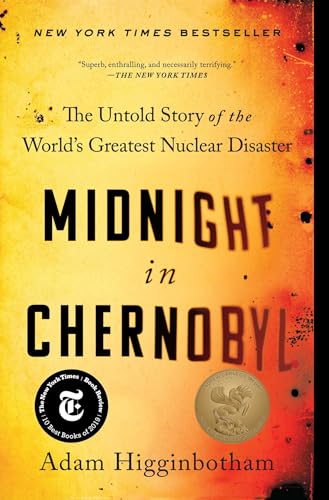
Verwandte Artikel zu Midnight in Chernobyl: The Untold Story of the World's...
Inhaltsangabe
A New York Times Best Book of the Year
A Time Best Book of the Year
A Kirkus Reviews Best Nonfiction Book of the Year
2020 Andrew Carnegie Medals for Excellence Winner
From journalist Adam Higginbotham, the New York Times bestselling “account that reads almost like the script for a movie” (The Wall Street Journal)—a powerful investigation into Chernobyl and how propaganda, secrecy, and myth have obscured the true story of one of the history’s worst nuclear disasters.
Early in the morning of April 26, 1986, Reactor Number Four of the Chernobyl Atomic Energy Station exploded, triggering one of the twentieth century’s greatest disasters. In the thirty years since then, Chernobyl has become lodged in the collective nightmares of the world: shorthand for the spectral horrors of radiation poisoning, for a dangerous technology slipping its leash, for ecological fragility, and for what can happen when a dishonest and careless state endangers its citizens and the entire world. But the real story of the accident, clouded from the beginning by secrecy, propaganda, and misinformation, has long remained in dispute.
Drawing on hundreds of hours of interviews conducted over the course of more than ten years, as well as letters, unpublished memoirs, and documents from recently-declassified archives, Adam Higginbotham brings the disaster to life through the eyes of the men and women who witnessed it firsthand. The result is a “riveting, deeply reported reconstruction” (Los Angeles Times) and a definitive account of an event that changed history: a story that is more complex, more human, and more terrifying than the Soviet myth.
“The most complete and compelling history yet” (The Christian Science Monitor), Higginbotham’s “superb, enthralling, and necessarily terrifying...extraordinary” (The New York Times) book is an indelible portrait of the lessons learned when mankind seeks to bend the natural world to his will—lessons which, in the face of climate change and other threats, remain not just vital but necessary.
Die Inhaltsangabe kann sich auf eine andere Ausgabe dieses Titels beziehen.
Über die Autorin bzw. den Autor
Adam Higginbotham has written for The New Yorker, The New York Times Magazine, Wired, GQ, and Smithsonian. He is the author of Midnight in Chernobyl, which was the winner of the William E. Colby Award and the Andrew Carnegie Medal for Excellence in Nonfiction, and Challenger: A True Story of Heroism and Disaster on the Edge of Space. He lives with his family in New York City.
Auszug. © Genehmigter Nachdruck. Alle Rechte vorbehalten.
Chapter 1: The Soviet Prometheus 1 The Soviet Prometheus
At the slow beat of approaching rotor blades, black birds rose into the sky, scattering over the frozen meadows and the pearly knots of creeks and ponds lacing the Pripyat River basin. Far below, standing knee deep in snow, his breath lingering in heavy clouds, Viktor Brukhanov awaited the arrival of the nomenklatura from Moscow.
When the helicopter touched down, the delegation of ministers and Communist Party officials trudged together over the icy field. The savage cold gnawed at their heavy woolen coats and nipped beneath their tall fur hats. The head of the Ministry of Energy and Electrification of the USSR and senior Party bosses from the Soviet Socialist Republic of Ukraine joined Brukhanov at the spot where their audacious new project was to begin. Just thirty-four years old, clever and ambitious, a dedicated Party man, Brukhanov had come to western Ukraine with orders to begin building what—if the Soviet central planners had their way—would become the greatest nuclear power station on earth.
As they gathered near the riverbank, the dozen men toasted their plans with shots of cognac. A state photographer posed them between long-handled shovels and a theodolite, the helicopter waiting, squat and awkward, in the background. They stood in the snow and watched as Minister Neporozhny drove a ceremonial stake, centimeter by centimeter, into the iron ground.
It was February 20, 1970. After months of deliberation, the Soviet authorities had at last settled on a name for the new power plant that would one day make the USSR’s nuclear engineering famous across the globe. They had considered a few options: the North Kiev, or the Western Ukraine, or, perhaps, the Pripyat Atomic Energy Station. But finally, Vladimir Scherbitsky, the formidable leader of the Ukrainian Communist Party, signed a decree confirming that the station would take the name of the regional capital: a small but ancient town of two thousand people, fourteen kilometers from where Brukhanov and his bosses stood in the snow-covered field.
The town of Chernobyl had been established in the twelfth century. For the next eight hundred years, it was home to peasants who fished in the rivers, grazed cows in the meadows, and foraged for mushrooms in the dense woods of northwestern Ukraine and southern Belarus. Swept repeatedly by pogrom, purge, famine, and war, by the second half of the twentieth century, Chernobyl was finally at peace. It had evolved into a quiet provincial center, with a handful of factories, a hospital, a library, a Palace of Culture; there was a small shipyard to service the tugs and barges that plied the Pripyat and the Dnieper, the two rivers that met nearby. Water permeated the surrounding countryside, an endlessly flat landscape of peat bogs, marshes, and sodden forests that formed part of the Dnieper River basin, a network of thirty-two thousand rivers and streams that covered almost half of Ukraine. Just fifteen kilometers downstream from the site chosen for the new power station, the rivers joined and flowed onward to the Kiev Sea, a massive hydroelectric reservoir providing fresh water to the two and a half million citizens of the republic’s capital, two hours’ drive away to the southeast.
Viktor Brukhanov had arrived in Chernobyl earlier that winter. He checked into the town’s only hotel: a bleak, single-story building on Sovietskaya Street. Slight but athletic, he had a narrow, anxious face, an olive complexion, and a head of tight, dark curls. The oldest of four children, Brukhanov was born to ethnically Russian parents but raised in Uzbekistan, amid the mountains of Soviet Central Asia. He had an exotic look: when they eventually met, the divisional KGB major thought the young director could be Greek.
He sat down on his hotel bed and unpacked the contents of his briefcase: a notebook, a set of blueprints, and a wooden slide rule. Although now the director and, as yet, sole employee of the Chernobyl Atomic Energy Station, Brukhanov knew little about nuclear power. Back at the Polytechnic Institute in Tashkent, he had studied electrical engineering. He had risen quickly from lowly jobs in the turbine shop of an Uzbek hydroelectric power plant to overseeing the launch of Ukraine’s largest coal-fired station in Slavyansk, in the industrial east of the republic. But at the Ministry of Energy in Moscow, knowledge and experience were regarded as less important qualifications for top management than loyalty and an ability to get things done. Technical matters could be left to the experts.
At the dawn of the 1970s, in a bid to meet its surging need for electricity and to catch up with the West, the USSR embarked upon a crash program of reactor building. Soviet scientists had once claimed to lead the world in nuclear engineering and astonished their capitalist counterparts in 1954 by completing the first reactor to generate commercial electricity. But since then, they had fallen hopelessly behind. In July 1969, as US astronauts made their final preparations to land on the moon, the Soviet minister of energy and electrification called for an aggressive expansion of nuclear construction. He set ambitious targets for a network of new plants across the European part of the Soviet Union, with giant, mass-produced reactors that would be built from the Gulf of Finland to the Caspian Sea.
That winter, as the 1960s came to a close, the energy minister summoned Brukhanov to Moscow and offered him his new assignment. It was a project of enormous prestige. Not only would it be the first atomic power plant in Ukraine, but it was also new territory for the Ministry of Energy and Electrification, which had never before built a nuclear station from scratch. Until this point, every reactor in the USSR had been constructed by the Ministry of Medium Machine Building: the clandestine organization behind the Soviet atom weapons program, so secret that its very name was a cipher, designed to discourage further curiosity. But whatever the challenges, Brukhanov, a true believer, gladly enlisted to carry the banner of the Red Atom.
Sitting alone on his hotel bed, the young engineer confronted his responsibility for conjuring from an empty field a project expected to cost almost 400 million rubles. He drew up lists of the materials to begin building and, using his slide rule, calculated their attendant costs. Then he delivered his estimates to the state bank in Kiev. He traveled to the city almost every day by bus; when there wasn’t a bus, he thumbed a ride. As the project had no accountant, there was no payroll, so he received no wages.
Before Brukhanov could start building the station itself, he had to create the infrastructure he’d need to bring materials and equipment to the site: a rail spur from the station in nearby Yanov; a new dock on the river to receive gravel and reinforced concrete. He hired construction workers, and soon a growing army of men and women at the controls of caterpillar-tracked excavators and massive BelAZ dump trucks began to tear pathways through the forest and scrape a plateau from the dun landscape. To house himself, a newly hired bookkeeper, and the handful of workers who lived on the site, Brukhanov organized a temporary village in a forest clearing nearby. A cluster of wooden huts on wheels, each equipped with a small kitchen and a log-burning stove, the settlement was named simply Lesnoy—“of the woods”—by its new inhabitants. As the weather warmed, Brukhanov had a schoolhouse built where children could be educated up to fourth grade. In August 1970 he was joined in Lesnoy by his young family: his wife, Valentina, their six-year-old daughter, Lilia, and infant son, Oleg.
Valentina and Viktor Brukhanov had spent the first...
„Über diesen Titel“ kann sich auf eine andere Ausgabe dieses Titels beziehen.
Suchergebnisse für Midnight in Chernobyl: The Untold Story of the World's...

Foto des Verkäufers
Midnight in Chernobyl: The Untold Story of the World's Greatest Nuclear Disaster
Anbieter: Dream Books Co., Denver, CO, USA
Verkäuferbewertung 5 von 5 Sternen

Zustand: acceptable. This copy has clearly been enjoyedâ"expect noticeable shelf wear and some minor creases to the cover. Binding is strong, and all pages are legible. May contain previous library markings or stamps. Artikel-Nr. DBV.1501134639.A
Gebraucht kaufen
EUR 5,87
Versand gratis
Versand innerhalb von USA
Versand innerhalb von USA
Anzahl: 1 verfügbar
Beispielbild für diese ISBN
Midnight in Chernobyl The Unto
Anbieter: World of Books (was SecondSale), Montgomery, IL, USA
Verkäuferbewertung 5 von 5 Sternen
Zustand: Acceptable. Item in acceptable condition! Textbooks may not include supplemental items i.e. CDs, access codes etc. Artikel-Nr. 00107689494
Gebraucht kaufen
EUR 6,72
Versand gratis
Versand innerhalb von USA
Versand innerhalb von USA
Anzahl: 2 verfügbar
Beispielbild für diese ISBN
Midnight in Chernobyl The Unto
Anbieter: World of Books (was SecondSale), Montgomery, IL, USA
Verkäuferbewertung 5 von 5 Sternen
Zustand: Very Good. Item in very good condition! Textbooks may not include supplemental items i.e. CDs, access codes etc. Artikel-Nr. 00110604075
Gebraucht kaufen
EUR 6,72
Versand gratis
Versand innerhalb von USA
Versand innerhalb von USA
Anzahl: 1 verfügbar
Beispielbild für diese ISBN
Midnight in Chernobyl The Unto
Anbieter: World of Books (was SecondSale), Montgomery, IL, USA
Verkäuferbewertung 5 von 5 Sternen
Zustand: Good. Item in good condition. Textbooks may not include supplemental items i.e. CDs, access codes etc. Artikel-Nr. 00110311678
Gebraucht kaufen
EUR 6,72
Versand gratis
Versand innerhalb von USA
Versand innerhalb von USA
Anzahl: 2 verfügbar
Beispielbild für diese ISBN
Midnight in Chernobyl: The Untold Story of the World's Greatest Nuclear Disaster
Anbieter: Wonder Book, Frederick, MD, USA
Verkäuferbewertung 5 von 5 Sternen
Zustand: Very Good. Very Good condition. A copy that may have a few cosmetic defects. May also contain light spine creasing or a few markings such as an owner's name, short gifter's inscription or light stamp. Artikel-Nr. P11J-02826
Gebraucht kaufen
EUR 10,22
Versand gratis
Versand innerhalb von USA
Versand innerhalb von USA
Anzahl: 1 verfügbar
Beispielbild für diese ISBN
Midnight in Chernobyl : The Untold Story of the World's Greatest Nuclear Disaster
Anbieter: Better World Books, Mishawaka, IN, USA
Verkäuferbewertung 5 von 5 Sternen
Zustand: Very Good. Former library copy. Pages intact with possible writing/highlighting. Binding strong with minor wear. Dust jackets/supplements may not be included. Includes library markings. Stock photo provided. Product includes identifying sticker. Better World Books: Buy Books. Do Good. Artikel-Nr. 38910740-6
Gebraucht kaufen
EUR 11,21
Versand gratis
Versand innerhalb von USA
Versand innerhalb von USA
Anzahl: 1 verfügbar
Beispielbild für diese ISBN
Midnight in Chernobyl : The Untold Story of the World's Greatest Nuclear Disaster
Anbieter: Better World Books, Mishawaka, IN, USA
Verkäuferbewertung 5 von 5 Sternen
Zustand: Good. Pages intact with minimal writing/highlighting. The binding may be loose and creased. Dust jackets/supplements are not included. Stock photo provided. Product includes identifying sticker. Better World Books: Buy Books. Do Good. Artikel-Nr. 18602458-6
Gebraucht kaufen
EUR 11,21
Versand gratis
Versand innerhalb von USA
Versand innerhalb von USA
Anzahl: 1 verfügbar
Beispielbild für diese ISBN
Midnight in Chernobyl: The Untold Story of the World's Greatest Nuclear Disaster
Anbieter: A Squared Books (Don Dewhirst), South Lyon, MI, USA
Verkäuferbewertung 5 von 5 Sternen
paperback. Zustand: As New. Matte paper covers; light shelf wear; 8vo, 7 3/4" to 9 3/4" tall; illustrations in black and white; Interior is clean and unmarked; 538 pages. Artikel-Nr. SKU1174522
Gebraucht kaufen
EUR 8,96
EUR 5,66 Versand
Versand innerhalb von USA
Versand innerhalb von USA
Anzahl: 1 verfügbar
Beispielbild für diese ISBN
Midnight in Chernobyl: The Untold Story of the World's Greatest Nuclear Disaster
Anbieter: Magers and Quinn Booksellers, Minneapolis, MN, USA
Verkäuferbewertung 5 von 5 Sternen
paperback. Zustand: Very Good. May have light to moderate shelf wear and/or a remainder mark. Complete. Clean pages. Artikel-Nr. 1396898
Gebraucht kaufen
EUR 14,00
EUR 3,48 Versand
Versand innerhalb von USA
Versand innerhalb von USA
Anzahl: 1 verfügbar
Beispielbild für diese ISBN
Midnight in Chernobyl
Anbieter: PBShop.store US, Wood Dale, IL, USA
Verkäuferbewertung 5 von 5 Sternen
PAP. Zustand: New. New Book. Shipped from UK. Established seller since 2000. Artikel-Nr. WB-9781501134630