
Verwandte Artikel zu Everyone Brave is Forgiven
Inhaltsangabe
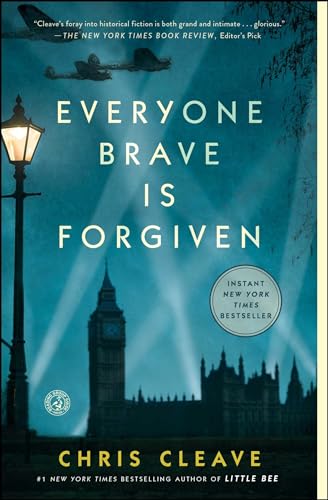
The instant New York Times bestseller from Chris Cleave—the unforgettable novel about three lives entangled during World War II, told “with dazzling prose, sharp English wit, and compassion…a powerful portrait of war’s effects on those who fight and those left behind” (People, Book of the Week).
London, 1939. The day war is declared, Mary North leaves finishing school unfinished, goes straight to the War Office, and signs up. Tom Shaw decides to ignore the war—until he learns his roommate Alistair Heath has unexpectedly enlisted. Then the conflict can no longer be avoided. Young, bright, and brave, Mary is certain she’d be a marvelous spy. When she is—bewilderingly—made a teacher, she finds herself defying prejudice to protect the children her country would rather forget. Tom, meanwhile, finds that he will do anything for Mary.
And when Mary and Alistair meet, it is love, as well as war, that will test them in ways they could not have imagined, entangling three lives in violence and passion, friendship, and deception, inexorably shaping their hopes and dreams. The three are drawn into a tragic love triangle and—as war escalates and bombs begin falling—further into a grim world of survival and desperation.
Set in London during the years of 1939–1942, when citizens had slim hope of survival, much less victory; and on the strategic island of Malta, which was daily devastated by the Axis barrage, Everyone Brave is Forgiven features little-known history and a perfect wartime love story inspired by the real-life love letters between Chris Cleave’s grandparents. This dazzling novel dares us to understand that, against the great theater of world events, it is the intimate losses, the small battles, the daily human triumphs that change us most.
Die Inhaltsangabe kann sich auf eine andere Ausgabe dieses Titels beziehen.
Über die Autorin bzw. den Autor
Chris Cleave is the author of Everyone Brave is Forgiven, Gold, Incendiary, and the #1 New York Times bestseller Little Bee. He lives with his wife and three children in London, England. Visit him at ChrisCleave.com or on Twitter @ChrisCleave.
Auszug. © Genehmigter Nachdruck. Alle Rechte vorbehalten.
Everyone Brave is Forgiven
September, 1939
MARY ALMOST WEPT WHEN she learned that her first duty as a schoolmistress would be to evacuate her class to the countryside. And when she discovered that London had evacuated its zoo animals days before its children, she was furious. If one must be exiled, then at least the capital ought to value its children more highly than macaws and musk oxen.
She checked her lipstick in a pocket mirror, then raised her hand.
“Yes, Miss North?”
“Isn’t it a shame to evacuate the animals first?”
She said it in full hearing of all the children, who were lined up at their muster point outside the empty London Zoo, waiting to be evacuated. They gave a timid cheer. The headmistress eyed Mary coolly, which made her doubt herself. But surely it was wrong to throw the beasts the first lifeline? Wasn’t that the weary old man’s choice Noah had made: filling the ark with dumb livestock instead of lively children who might answer back? This was how the best roots of humanity had drowned. This was why men were the violent inbreds of Ham and Shem and Japheth, capable of declaring for war a season that Mary had earmarked for worsted.
The headmistress only sighed. So: the delay was simply because one did not need to write a marmoset’s name on a luggage tag, accompany it in a second-class train compartment and billet it with a suitable host family in the Cotswolds. The lower primates only wanted a truck for the trip and a good feed at the other end, while the higher Hominidae, with names like Henry and Sarah, had a multiplicity of needs that a diligent bureaucracy had not only to anticipate but also to meet, and furthermore to document, on forms that must first come back from the printer.
“I see,” said Mary. “Thank you.”
Of course it was that. She hated being eighteen. The insights and indignations burned through one’s good sense like hot coals through oven gloves. So, this was why London still teemed with children while London Zoo stood vacant, with three hundred halfpenny portions of monkey nuts in their little twists of newspaper waiting unsold and forlorn in the kiosk.
She raised her hand again, then let it drop.
“Yes?” said Miss Vine. “Was there something else?”
“Sorry,” said Mary. “It was nothing.”
“Oh good.”
The headmistress took her eye off the ranks of the children for a moment. She fixed Mary with a look rich in charity. “Remember you’re on our side now. You know: the grown-ups.”
Mary could almost feel her bones cracking with resentment. “Thank you, Miss Vine.”
This was when the school’s only colored child, sensing an opening, slipped away from the muster and scaled the padlocked main gate of the zoo. The headmistress spun around. “Zachary Lee! Come back here immediately!”
“Or what? You’ll send me to the countryside?”
The whole school gasped. Ten years old, invincible, the Negro boy saluted. He scissored his skinny brown legs over the top of the gate, using the penultimate and the ultimate wrought-iron O’s of LONDON ZOO as the hoops of a pommel horse, and was immediately lost to sight.
Miss Vine turned to Mary. “You had better bring the nigger back, don’t you think?”
It was her first rescue work of the war. Coppery, coltish Mary North searched the abandoned zoo using paths that were still well tended. On her own, she felt better. She sneaked a cigarette. With the other hand she massaged her brow, confident that frustration could be persuaded not to settle there. All downers could be dispatched, as one might flick ash off one’s sleeve, or pilot a wayward bee back out through an open window.
She had already checked the giraffes’ paddock and the big cats’ dens. Now, hearing a cough, she tiptoed into the great apes’ enclosure through a gate that swung unlatched. She kicked through the straw, raising a scent of urine and musk that made her heart rattle with fright. But she hoped it was not easily done, for a zookeeper to miss a whole gorilla when he was counting them into the evacuation truck.
“Come on out, Zachary Lee, I know you’re in here.”
It was eerie to be in the gorilla house, looking out through the smeared glass. “Oh do come on, Zachary darling. You’ll get us both in trouble.”
A second cough, and a rustle under the straw. Then, with his soft American accent, “I’m not coming out.”
“Fine then,” said Mary. “The two of us shall rot here until the war is over, and nobody will ever know what talent we might have shown in its prosecution.”
She sat down beside the boy, first laying her red jacket on the straw to sit on, with the rosy silk lining downward. It was hard to stay glum. One could say what one liked about the war but it had got her out of Mont-Choisi ahead of an afternoon of double French, and might yet have more mercies in store. She lit another cigarette and blew the smoke into a shaft of sunlight.
“May I have one?” said the small voice.
“Beautifully asked,” said Mary. “And no. Not until you are eleven.”
From the muster point came the sound of a tin whistle. It could mean that heavy bombers were converging on London, or it could mean that the children had been organized into two roughly matched teams to begin a game of rounders.
Zachary poked his head up through the straw. It still amazed Mary to see his brown skin, his chestnut eyes. The first time he had smiled, the flash of his pink tongue had delighted her. She had imagined it would be—well, not brown also, but certainly as antithetical to pink as brown skin was to white. A bluish tongue, perhaps, like a skink’s. It would not have surprised her to learn that his blood came out black and his feces a pale ivory. He was the first Negro she had seen up close—if one didn’t count the posters advertising minstrelsy and coon shows—and she still struggled not to gawk.
The straw clung to his hair. “Miss?” he said. “Why did they take the animals away?”
“Different reasons in each case,” said Mary, counting them off on her fingers. “The hippopotami because they are such frightful cowards, the wolves since one can never be entirely sure whose side they are on, and the lions because they are to be parachuted directly into Berlin Zoo to take on Herr Hitler’s big cats.”
“So the animals are at war too?”
“Well of course they are. Wouldn’t it be absurd if it were just us?”
The boy’s expression suggested that he had not previously taken the matter under consideration.
“What are two sevens?” asked Mary, taking advantage.
The boy began his reckoning, in the deliberate and dutiful manner of a child who intended to persevere at least until he ran out of fingers. Not for the first time that week, Mary suppressed both a smile and a delightful suspicion that teaching might not be the worst way to spend the idle hours between breakfast and society.
On Tuesday morning, after taking the register and before distributing milk in little glass bottles, Mary had written the names of her thirty-one children on brown luggage labels and looped them through the top buttonholes of their overcoats. Of course the children had exchanged labels with one another the second her back was turned. They were only human, even if they hadn’t yet made...
„Über diesen Titel“ kann sich auf eine andere Ausgabe dieses Titels beziehen.
Suchergebnisse für Everyone Brave is Forgiven

Beispielbild für diese ISBN
Everyone Brave Is Forgiven
Verlag:
S&S/ Marysue Rucci Books, 2017
ISBN 10: 1501124382
ISBN 13: 9781501124389
Gebraucht
Softcover
Anbieter: World of Books (was SecondSale), Montgomery, IL, USA
Verkäuferbewertung 5 von 5 Sternen

Zustand: Acceptable. Item in acceptable condition! Textbooks may not include supplemental items i.e. CDs, access codes etc. Artikel-Nr. 00094137877
Gebraucht kaufen
EUR 3,72
Versand gratis
Versand innerhalb von USA
Versand innerhalb von USA
Anzahl: 6 verfügbar
Beispielbild für diese ISBN
Everyone Brave Is Forgiven
Anbieter: World of Books (was SecondSale), Montgomery, IL, USA
Verkäuferbewertung 5 von 5 Sternen
Paperback. Zustand: Good. The instant New York Times bestseller from Chris Cleave--the unforgettable novel about three lives entangled during World War II, told "with dazzling prose, sharp English wit, and compassion.a powerful portrait of war's effects on those who fight and those left behind" (People, Book of the Week). London, 1939. The day war is declared, Mary North leaves finishing school unfinished, goes straight to the War Office, and signs up. Tom Shaw decides to ignore the war--until he learns his roommate Alistair Heath has unexpectedly enlisted. Then the conflict can no longer be avoided. Young, bright, and brave, Mary is certain she'd be a marvelous spy. When she is--bewilderingly--made a teacher, she finds herself defying prejudice to protect the children her country would rather forget. Tom, meanwhile, finds that he will do anything for Mary. And when Mary and Alistair meet, it is love, as well as war, that will test them in ways they could not have imagined, entangling three lives in violence and passion, friendship, and deception, inexorably shaping their hopes and dreams. The three are drawn into a tragic love triangle and--as war escalates and bombs begin falling--further into a grim world of survival and desperation. Set in London during the years of 1939-1942, when citizens had slim hope of survival, much less victory; and on the strategic island of Malta, which was daily devastated by the Axis barrage, Everyone Brave is Forgiven features little-known history and a perfect wartime love story inspired by the real-life love letters between Chris Cleave's grandparents. This dazzling novel dares us to understand that, against the great theater of world events, it is the intimate losses, the small battles, the daily human triumphs that change us most. Artikel-Nr. 00095653426
Gebraucht kaufen
EUR 3,72
Versand gratis
Versand innerhalb von USA
Versand innerhalb von USA
Anzahl: 17 verfügbar
Beispielbild für diese ISBN
Everyone Brave is Forgiven
Verlag:
Scribner (edition Reprint), 2017
ISBN 10: 1501124382
ISBN 13: 9781501124389
Gebraucht
Paperback
Anbieter: BooksRun, Philadelphia, PA, USA
Verkäuferbewertung 5 von 5 Sternen
Paperback. Zustand: Very Good. Reprint. It's a well-cared-for item that has seen limited use. The item may show minor signs of wear. All the text is legible, with all pages included. It may have slight markings and/or highlighting. Artikel-Nr. 1501124382-11-18
Gebraucht kaufen
EUR 5,24
Versand gratis
Versand innerhalb von USA
Versand innerhalb von USA
Anzahl: 1 verfügbar
Beispielbild für diese ISBN
Everyone Brave is Forgiven
Verlag:
Scribner (edition Reprint), 2017
ISBN 10: 1501124382
ISBN 13: 9781501124389
Gebraucht
Paperback
Anbieter: BooksRun, Philadelphia, PA, USA
Verkäuferbewertung 5 von 5 Sternen
Paperback. Zustand: Very Good. Reprint. It's a well-cared-for item that has seen limited use. The item may show minor signs of wear. All the text is legible, with all pages included. It may have slight markings and/or highlighting. Artikel-Nr. 1501124382-11-1
Gebraucht kaufen
EUR 5,32
Versand gratis
Versand innerhalb von USA
Versand innerhalb von USA
Anzahl: 1 verfügbar
Beispielbild für diese ISBN
Everyone Brave Is Forgiven
Anbieter: ThriftBooks-Dallas, Dallas, TX, USA
Verkäuferbewertung 5 von 5 Sternen
Paperback. Zustand: Very Good. No Jacket. May have limited writing in cover pages. Pages are unmarked. ~ ThriftBooks: Read More, Spend Less. Artikel-Nr. G1501124382I4N00
Gebraucht kaufen
EUR 6,04
Versand gratis
Versand innerhalb von USA
Versand innerhalb von USA
Anzahl: 2 verfügbar
Beispielbild für diese ISBN
Everyone Brave Is Forgiven
Anbieter: ThriftBooks-Dallas, Dallas, TX, USA
Verkäuferbewertung 5 von 5 Sternen
Paperback. Zustand: Very Good. No Jacket. Former library book; May have limited writing in cover pages. Pages are unmarked. ~ ThriftBooks: Read More, Spend Less. Artikel-Nr. G1501124382I4N10
Gebraucht kaufen
EUR 6,04
Versand gratis
Versand innerhalb von USA
Versand innerhalb von USA
Anzahl: 1 verfügbar
Beispielbild für diese ISBN
Everyone Brave Is Forgiven
Anbieter: ThriftBooks-Phoenix, Phoenix, AZ, USA
Verkäuferbewertung 5 von 5 Sternen
Paperback. Zustand: Very Good. No Jacket. May have limited writing in cover pages. Pages are unmarked. ~ ThriftBooks: Read More, Spend Less. Artikel-Nr. G1501124382I4N00
Gebraucht kaufen
EUR 6,04
Versand gratis
Versand innerhalb von USA
Versand innerhalb von USA
Anzahl: 1 verfügbar
Beispielbild für diese ISBN
Everyone Brave Is Forgiven
Anbieter: ThriftBooks-Reno, Reno, NV, USA
Verkäuferbewertung 5 von 5 Sternen
Paperback. Zustand: Very Good. No Jacket. May have limited writing in cover pages. Pages are unmarked. ~ ThriftBooks: Read More, Spend Less. Artikel-Nr. G1501124382I4N00
Gebraucht kaufen
EUR 6,04
Versand gratis
Versand innerhalb von USA
Versand innerhalb von USA
Anzahl: 1 verfügbar
Beispielbild für diese ISBN
Everyone Brave Is Forgiven
Anbieter: ThriftBooks-Atlanta, AUSTELL, GA, USA
Verkäuferbewertung 5 von 5 Sternen
Paperback. Zustand: Very Good. No Jacket. May have limited writing in cover pages. Pages are unmarked. ~ ThriftBooks: Read More, Spend Less. Artikel-Nr. G1501124382I4N00
Gebraucht kaufen
EUR 6,04
Versand gratis
Versand innerhalb von USA
Versand innerhalb von USA
Anzahl: 2 verfügbar
Beispielbild für diese ISBN
Everyone Brave is Forgiven
Anbieter: Wonder Book, Frederick, MD, USA
Verkäuferbewertung 5 von 5 Sternen
Zustand: Good. Good condition. With remainder mark. A copy that has been read but remains intact. May contain markings such as bookplates, stamps, limited notes and highlighting, or a few light stains. Artikel-Nr. J10Q-01119
Gebraucht kaufen
EUR 6,42
Versand gratis
Versand innerhalb von USA
Versand innerhalb von USA
Anzahl: 1 verfügbar