
Verwandte Artikel zu What No One Tells You: A Guide to Your Emotions from...
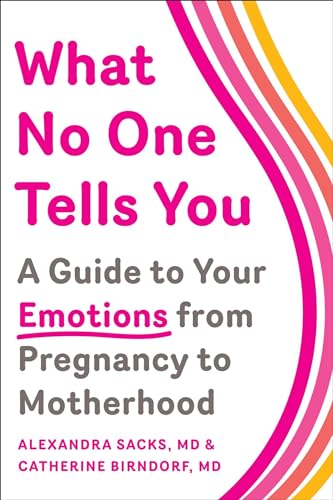
Inhaltsangabe
Your guide to the emotions of pregnancy and early motherhood, from two of America’s top reproductive psychiatrists.
When you are pregnant, you get plenty of advice about your growing body and developing baby. Yet so much about motherhood happens in your head. What everyone really wants to know: Is this normal?
-Even after months of trying, is it normal to panic after finding out you’re pregnant?
-Is it normal not to feel love at first sight for your baby?
-Is it normal to fight with your parents and partner?
-Is it normal to feel like a breastfeeding failure?
-Is it normal to be zonked by “mommy brain?”
In What No One Tells You, two of America’s top reproductive psychiatrists reassure you that the answer is yes. With thirty years of combined experience counseling new and expectant mothers, they provide a psychological and hormonal backstory to the complicated emotions that women experience, and show why it’s natural for “matrescence”—the birth of a mother—to be as stressful and transformative a period as adolescence.
Here, finally, is the first-ever practical guide to help new mothers feel less guilt and more self-esteem, less isolation and more kinship, less resentment and more intimacy, less exhaustion and more pleasure, and learn other tips to navigate the ups and downs of this exciting, demanding time
Die Inhaltsangabe kann sich auf eine andere Ausgabe dieses Titels beziehen.
Über die Autorinnen und Autoren
Alexandra Sacks, MD, is a reproductive psychiatrist affiliated with the Women’s Program at the Columbia University Medical Center and a candidate at the Columbia University Psychoanalytic Center for Training and Research. A leading expert in “matrescence,” she is known for popularizing the concept in her TED talk with more than one million views worldwide, and in her New York Times article “The Birth of a Mother,” the number-one most read piece of 2017 for the “Well Family” section, where she is a regular contributor. Dr. Sacks was a scholar at the DeWitt Wallace Institute for the History of Psychiatry and serves on the American Psychoanalytic Association advisory board for media education. Her work on matrescence and “mommy brain” has been featured in TIME magazine, The Washington Post, The Boston Globe, and on NPR. Dr. Sacks hosts a motherhood podcast from Gimlet Media and is the author, with Catherine Birndorf, of What No One Tells You. Learn more at AlexandraSacksMD.com and @AlexandraSacksMD.
Catherine Birndorf, MD, is a reproductive psychiatrist and clinical associate professor of psychiatry at New York-Presbyterian/Weill Cornell Medical Center, where she founded the Payne Whitney Women’s Program. She is currently the co-founder and medical director of The Motherhood Center, a treatment center in New York City for pregnant and new moms experiencing anxiety and depression. Dr. Birndorf is a board member of Postpartum Support International, a nonprofit organization for awareness, prevention, and treatment of maternal mental health worldwide. For ten years, Dr. Birndorf was a regular mental health columnist for Self magazine and has appeared on numerous television programs including the TODAY show, Good Morning America, CBS Evening News, and CNN. She is the author, with Alexandra Sacks, of What No One Tells You and of the New York Times bestseller The Nine Rooms of Happiness, co-authored with Lucy Danziger. Learn more at DrCatherineBirndorf.com and TheMotherhoodCenter.com.
Auszug. © Genehmigter Nachdruck. Alle Rechte vorbehalten.
What No One Tells You Introduction
Julie had dreamed for years about becoming a mother. It took months of trying, but finally, here she was, excited, grateful, and a bit nauseated. At an early doctor’s appointment, she and her husband were relieved to hear that the screening results were healthy. Julie and her husband hadn’t discussed whether they’d want to know the baby’s sex in advance, but when the doctor asked, “Do you want to find out?” they locked eyes and agreed: “Sure, let’s go for it.” The doctor smiled and said, “Congratulations, you’re having a boy!” Julie’s husband squeezed her hand and beamed, but she felt her heart sink. Since the baby she had always imagined had been a little girl, she felt like she was losing that dream. What’s wrong with me? she asked herself. My baby is healthy, my husband is happy, and all I can feel is disappointment that I’m not having a girl? She plastered on a fake smile, but as she gathered her things to leave the exam room, all she could think was: Am I a horrible person? Will I be able to love my son? Everything was going well, but Julie was spiraling, caught up in her worst fear: being a bad mom.
Julie wasn’t a bad mom, of course. She loved her son, and once he was born, she would say that she couldn’t imagine any other baby than him. But this wasn’t the last time in her pregnancy or motherhood that she would be troubled by mixed feelings—about her son, about herself, about her choice to become a mother. And for Julie, as for many mothers, these ambivalent feelings sent up red flags. Anything less than joy and contentment, Julie thought, must mean there was something wrong. But that couldn’t be further from the truth.
The expectation that babies bring ultimate happiness is not only unrealistic, it’s dangerous. Our culture reinforces a story of motherhood that has left out doubt, uncertainty, and the bittersweet, and this myth has become hazardous to women’s mental health. It’s time to rebirth pregnancy and bring parenting down to earth.
We, the authors of this book, are reproductive psychiatrists: medical doctors who specialize in helping women navigate their emotions before, during, and after pregnancy. Because we listen to their stories every day, we know that most pregnant women and new mothers experience pressure to project an outward image of ease, when inside they’re wresting with chaotic emotions.
Even if motherhood has been a lifelong desire, once it arrives, many women find themselves feeling lost somewhere between who they were before and who they think they should be now. And because many of our patients tell us that the only place they can be honest about their contradictory feelings is in a therapist’s office, we know that too many women are ashamed to speak openly of these struggles for fear of being judged and labeled bad or ungrateful mothers. For most women, it’s this shame and silence that’s the real problem, not the experiences themselves.
Many women tell us they assume that having conflicted and confusing emotions means they are developing a mental illness. Of course, there are some women who need professional intervention. But over time, we’ve come to see that the majority of pregnant women and new mothers experience a natural emotional flux that falls in between bliss and the blues. Nothing as important as motherhood can be purely good or bad—it’s far too complex.
• • •
Society seems to be invested in a “bliss myth,” the idea that joy is the primary emotion of motherhood. But every mother will have moments of ambivalence, because she’s always juggling between giving and taking. Since these conflicting feelings are rarely openly discussed, many women are left feeling that these struggles are their fault.
When women’s stories deviate from this bliss narrative, they may feel alarmed and bury the experience, choosing not to share the uglier moments of motherhood with family and friends, and hardly ever on social media. Their stories are pushed deep down and left untold, and so the cycle continues.
Many of our patients tell us that they haven’t heard sad or challenging stories about motherhood from others, so they are shocked when they have difficulty around common experiences like miscarriage, trouble breastfeeding, fighting with their families and partners, or simply feeling disappointed. A refrain that we hear again and again from our patients is: “Why didn’t anyone tell me it would be like this?”
Sure, we all think we know the list of changes that come with pregnancy—you gain weight, your ankles swell, you have to pee all the time—but the reality is far more intense and abstract. Pregnancy is one of the most transformative events a human can go through, and dramatic changes to the body are never solely physical. Strange hormones will be coursing through your veins. Your role in your family will change—your relationship to your partner and to your own parents—as will how society sees you. It’s a challenging journey, yet guidebooks have been scarce.
Most books about pregnancy are about having a good pregnancy, in which the goal is giving birth to a healthy baby. Most advice on early motherhood focuses on how to care for the baby, this strange and vulnerable new creature you’re suddenly responsible for. Of course, women need this information. But pregnancy is not only the process of giving birth to your new baby—it’s also the process of giving birth to a new you. And that kind of labor doesn’t always feel good or happen easily.
We’ve all seen the Instagram or magazine images of the pregnant woman or postpartum supermom: a wise, efficient, gorgeous but modest multitasker who glows in her delivery room photo and laughs off the challenges of leaking breasts, dirty laundry, sleep training, an intrusive mother-in-law, and a grumpy, sex-starved partner. Her house is always clean, her hair is always done, and she’s back in her skinny jeans just weeks after delivery.
Or maybe your image of the Perfect Mother is different. Maybe she’s a savvy businesswoman juggling office and home life without breaking a sweat. Maybe she’s a grounded earth mother, doing sunrise yoga and preparing organic meals for her family from scratch. Maybe she looks like your own mother. Maybe she’s the exact opposite of your mother. Whoever she is, she’s a perfect—and thus impossible—ideal. This is why the idea of the “good enough mother” (coined by the pediatrician and psychoanalyst Donald Winnicott) is so crucial but feels dangerous to many of us—it sounds like settling. The image of the Perfect Mother looms over us, even when we know that in other areas of life, striving for perfection only sets us up to fail.
Why didn’t anyone tell me it would be like this? Well, we’re here to tell you now. You shouldn’t have to go to a psychiatrist to learn the nuts and bolts of how pregnancy and early motherhood impact your emotional life. This information should be as openly discussed and readily available as the advice in What to Expect When You’re Expecting. After years of repeating this very information to thousands of women, we decided to write this book—at the risk of putting ourselves out of business.
This guidebook will describe how you may change in terms of your moods, hormones, brain chemistry, identity, and relationships when you become a mother. We’ll take you on a chronological tour of the most important moments, from your positive pregnancy test through your baby’s first year, and provide plenty...
„Über diesen Titel“ kann sich auf eine andere Ausgabe dieses Titels beziehen.
Weitere beliebte Ausgaben desselben Titels

Suchergebnisse für What No One Tells You: A Guide to Your Emotions from...

Beispielbild für diese ISBN
What No One Tells You: A Guide
Anbieter: World of Books (was SecondSale), Montgomery, IL, USA
Verkäuferbewertung 5 von 5 Sternen

Zustand: Very Good. Item in very good condition! Textbooks may not include supplemental items i.e. CDs, access codes etc. Artikel-Nr. 00108202305
Gebraucht kaufen
EUR 3,77
Versand gratis
Versand innerhalb von USA
Versand innerhalb von USA
Anzahl: 1 verfügbar
Beispielbild für diese ISBN
What No One Tells You: A Guide
Anbieter: World of Books (was SecondSale), Montgomery, IL, USA
Verkäuferbewertung 5 von 5 Sternen
Zustand: Good. Item in good condition. Textbooks may not include supplemental items i.e. CDs, access codes etc. Artikel-Nr. 00096893265
Gebraucht kaufen
EUR 3,77
Versand gratis
Versand innerhalb von USA
Versand innerhalb von USA
Anzahl: Mehr als 20 verfügbar
Foto des Verkäufers
What No One Tells You: A Guide to Your Emotions from Pregnancy to Motherhood
Anbieter: Dream Books Co., Denver, CO, USA
Verkäuferbewertung 5 von 5 Sternen
Zustand: good. Gently used with minimal wear on the corners and cover. A few pages may contain light highlighting or writing, but the text remains fully legible. Dust jacket may be missing, and supplemental materials like CDs or codes may not be included. May be ex-library with library markings. Ships promptly! Artikel-Nr. DBV.1501112562.G
Gebraucht kaufen
EUR 3,78
Versand gratis
Versand innerhalb von USA
Versand innerhalb von USA
Anzahl: 1 verfügbar
Beispielbild für diese ISBN
What No One Tells You: A Guide to Your Emotions from Pregnancy to Motherhood
Verlag:
Simon & Schuster (edition ), 2019
ISBN 10: 1501112562
ISBN 13: 9781501112560
Gebraucht
Paperback
Anbieter: BooksRun, Philadelphia, PA, USA
Verkäuferbewertung 5 von 5 Sternen
Paperback. Zustand: Very Good. It's a well-cared-for item that has seen limited use. The item may show minor signs of wear. All the text is legible, with all pages included. It may have slight markings and/or highlighting. Artikel-Nr. 1501112562-11-1
Gebraucht kaufen
EUR 5,16
Versand gratis
Versand innerhalb von USA
Versand innerhalb von USA
Anzahl: 1 verfügbar
Foto des Verkäufers
What No One Tells You: A Guide to Your Emotions from Pregnancy to Motherhood
Anbieter: Dream Books Co., Denver, CO, USA
Verkäuferbewertung 5 von 5 Sternen
Zustand: very_good. Pages are clean with no markings. May show minor signs of wear or cosmetic defects marks, cuts, bends, or scuffs on the cover, spine, pages, or dust jacket. May have remainder marks on edges. Artikel-Nr. DBV.1501112562.VG
Gebraucht kaufen
EUR 5,20
Versand gratis
Versand innerhalb von USA
Versand innerhalb von USA
Anzahl: 1 verfügbar
Beispielbild für diese ISBN
What No One Tells You: A Guide to Your Emotions from Pregnancy to Motherhood
Anbieter: ThriftBooks-Dallas, Dallas, TX, USA
Verkäuferbewertung 5 von 5 Sternen
Paperback. Zustand: Very Good. No Jacket. Former library book; May have limited writing in cover pages. Pages are unmarked. ~ ThriftBooks: Read More, Spend Less. Artikel-Nr. G1501112562I4N10
Gebraucht kaufen
EUR 5,77
Versand gratis
Versand innerhalb von USA
Versand innerhalb von USA
Anzahl: 1 verfügbar
Beispielbild für diese ISBN
What No One Tells You: A Guide to Your Emotions from Pregnancy to Motherhood
Anbieter: ThriftBooks-Reno, Reno, NV, USA
Verkäuferbewertung 5 von 5 Sternen
Paperback. Zustand: Good. No Jacket. Pages can have notes/highlighting. Spine may show signs of wear. ~ ThriftBooks: Read More, Spend Less. Artikel-Nr. G1501112562I3N00
Gebraucht kaufen
EUR 5,77
Versand gratis
Versand innerhalb von USA
Versand innerhalb von USA
Anzahl: 2 verfügbar
Beispielbild für diese ISBN
What No One Tells You: A Guide to Your Emotions from Pregnancy to Motherhood
Anbieter: ThriftBooks-Phoenix, Phoenix, AZ, USA
Verkäuferbewertung 5 von 5 Sternen
Paperback. Zustand: Good. No Jacket. Pages can have notes/highlighting. Spine may show signs of wear. ~ ThriftBooks: Read More, Spend Less. Artikel-Nr. G1501112562I3N00
Gebraucht kaufen
EUR 5,77
Versand gratis
Versand innerhalb von USA
Versand innerhalb von USA
Anzahl: 2 verfügbar
Beispielbild für diese ISBN
What No One Tells You: A Guide to Your Emotions from Pregnancy to Motherhood
Anbieter: ThriftBooks-Atlanta, AUSTELL, GA, USA
Verkäuferbewertung 5 von 5 Sternen
Paperback. Zustand: Good. No Jacket. Pages can have notes/highlighting. Spine may show signs of wear. ~ ThriftBooks: Read More, Spend Less. Artikel-Nr. G1501112562I3N00
Gebraucht kaufen
EUR 5,77
Versand gratis
Versand innerhalb von USA
Versand innerhalb von USA
Anzahl: 2 verfügbar
Beispielbild für diese ISBN
What No One Tells You: A Guide to Your Emotions from Pregnancy to Motherhood
Anbieter: ThriftBooks-Dallas, Dallas, TX, USA
Verkäuferbewertung 5 von 5 Sternen
Paperback. Zustand: Good. No Jacket. Pages can have notes/highlighting. Spine may show signs of wear. ~ ThriftBooks: Read More, Spend Less. Artikel-Nr. G1501112562I3N00
Gebraucht kaufen
EUR 5,77
Versand gratis
Versand innerhalb von USA
Versand innerhalb von USA
Anzahl: 2 verfügbar