
Inhaltsangabe
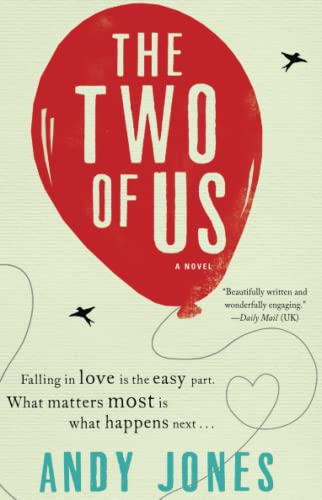
A charming, unconventional love story about a couple who embark on a wildly passionate, two-week fling that will change both of their lives forever. If you loved One Day and The Rosie Project, you will fall head-over-heels for The Two of Us.
Anyone can fall in love. But not everyone can stay there.
Fisher and Ivy have been an item for all of nineteen days. Both of them have been in relationships before, and this time around, they know something is different—they are meant to be together. The fact that they know little else about each other is a minor detail.
But over the next year, a time in which their lives are irrevocably altered, Fisher and Ivy discover that falling in love is one thing—and staying there is an entirely different story.
The Two of Us is a charming, honest, laugh-out-loud novel about life, love, and the importance of taking neither one for granted.
Die Inhaltsangabe kann sich auf eine andere Ausgabe dieses Titels beziehen.
Über die Autorin bzw. den Autor
Andy Jones lives in London with his wife and two little girls. During the day he works at an advertising agency; on weekends and horribly early in the mornings, he writes fiction. He is the author of The Two of Us and The Trouble with Henry and Zoe.
Auszug. © Genehmigter Nachdruck. Alle Rechte vorbehalten.
The Two of Us
PROLOGUE
PEOPLE ASK: How long have you been together? How did you meet?
You’re sitting at a table, fizzing with the defiant ostentation of new love (Is that what it is? Is it love already?), laughing too loud and kissing more enthusiastically than is de rigueur in a quiet country pub, and someone will say, Put her down! Get a room! You make a lovely couple, or some variation on the theme.
You’re surreptitiously nibbling your new girlfriend’s earlobe when a voice says, They serve crisps at the bar, you know. If you’re hungry. You turn and apologize to the large middle-aged lady at the adjacent table. She laughs good-naturedly, then shuffles her chair sideways so she is now sitting at your table. And here it comes . . .
So, she says, how did you two lovebirds meet?
In the last week, we must have been questioned about the particulars of our romance on half a dozen separate occasions. On other nights and afternoons we have told increasingly pale shades of the truth: We work together; Blind date; I cut his hair; Book club. But now, emboldened by wine and routine, Ivy leans forward and says in a conspiratorial voice: It’s awful; I’m best friends with his wife. But—she places her hand on top of mine—you’re a woman of the world, you know what it’s like. When you have to have something?
The woman—ruddy-faced and emanating a warm aroma of cheese and onion—she nods, says, Aye, well, yes, you have a nice . . . you know . . . night, and shuffles back to her own table.
Because the truth is, the truth is too long a story to tell a stranger in a country pub when all you want to do is finish your drink and get upstairs to your room. And anyway, how we met is academic—you don’t ask how the rain began, you simply appreciate the rainbow.
People talk about chemistry, and perhaps it was—something molecular, something transmitted, something genetic. Whatever the mechanism, there was something about Ivy that immediately made me want to not sleep with her. And what higher compliment can a scoundrel pay a lady? Not that it matters, but at the time I was going through a phase where I wasn’t looking for any kind of commitment beyond those to personal hygiene and discretion. I had broken up with my girlfriend six months earlier, I was young, I was free, I was . . . well, let’s just say I was being generous with my affections. Then along came Ivy with her handsome, uncontrived beauty, trailing pheromones, nonchalance, and easy humor.
Not that any of that matters. What matters is that we met. And what matters most is what happens next.
The Two of Us
CHAPTER 1
IT’S THE last week in August and my sunburn prickles as Ivy steers the car into the street I grew up in, towards the house I came home to the day I was born.
When the radio is on Ivy sings; when it’s off she whistles, and she whistles badly. I almost recognize the tune, but can’t quite grasp it. The left side of her face is scarred from a childhood accident—the lines are white now, but the grooves and misalignments are stark—and when she whistles the scars pinch and deepen. Whether this affects her whistling or not, I don’t know, but if her singing is any indication, she’s simply tone deaf and entirely oblivious of the fact. We’ve been together less than three weeks so it’s a little too early to be drawing up a list of “things I like most about my new girlfriend,” but if I were so inclined, Ivy’s careless tuneless whistling would be up there in the top eleven. And whilst we’re on the subject of sequencing, it’s also a bit premature for meet the family. But here we are, about one minute from lift-off.
“Brace yourself,” I say.
Ivy turns to me: “Hnn?”
“The family,” I say. “They’re a bit . . . you know.”
“Don’t worry,” she says. “I’ve done this before. Loads of times, hundreds of times.” And she smiles to herself.
“Funny. Anyway, it’s not you I’m worried about.”
We round a corner and Dad’s house comes into view.
I’ve never paid attention to the way my childhood home looks; it’s been there as long as I’ve been alive and I scrutinize it no more than I do my feet—probably less. But today, with Ivy beside me, I’m aware of its ordinariness, banality, of everything it isn’t. Victorian houses—like the one I live in in London—age improves them, bestows character and integrity; but houses like this, built in the sixties and seventies, they age like old factory workers made ugly with time and effort and smoke and disappointment. Maybe it’s not my sunburn prickling; perhaps it’s my inner snob. I look at Ivy, and she glances back, raises her eyebrows as she pulls up in front of number 9 Rose Park.
And forget the house, wait till she gets a load of the family.
They must have been lying in wait because before Ivy has a chance to kill the engine, my father, sister, brother-in-law, and twin nieces pour out of the front door. I wave, grin, mouth “Hiya” through the windscreen, but no one is looking in my direction. They line up in the middle of the road, faces lit with excitement as Dad opens Ivy’s door as if she’s some kind of dignitary. The twins, Imogen and Rosalind, are only ten years old, so I can forgive them dancing impatiently on the spot and jostling to get a better look at my girlfriend (it does feel good to say: girlfriend), but my sister and Dad have a combined age of almost one hundred, and they’re behaving like imbeciles. And then it comes to me what Ivy was whistling: “It Must Be Love.” She climbs out of the car and straight into a bear hug from my dad. I grimace an apology as he lifts her off her feet, and Ivy either winks or winces in return—but with her face squashed against my old man’s neck, it’s hard to tell which.
As I slip unnoticed from the car, it occurs to me that I may have misidentified Ivy’s whistling. The more I think about it, the more I am convinced it was “House of Fun” or possibly even “Embarrassment.” Whatever it was, it’s definitely Madness.
By the time the welcoming party gets off the road and into the house, I’ve hauled the bags out of the boot and upstairs, taken a pee, boiled a kettle, and made a pot of tea.
“Tea’s in the pot,” I say as everyone troops into the kitchen.
“Have we got any wine?” asks Maria.
“I assume champagne will be okay?” says Dad, opening the fridge with an excruciating flourish.
“Wow,” says Ivy.
“Well,” says Dad, “special occasion, isn’t it. Get the glasses, son.” And he steers Ivy into the living room.
Maria hangs back to help me rinse the dust from five champagne glasses. “Seems nice,” she says, smirking.
“She is. No Hermione?” I say, heading off the inevitable (What does she see in you?) sarcasm from my big sister.
Maria wasn’t quite sixteen when she gave birth to my eldest niece. Mum had been dead less than a year, and baby Herms played a big part in our collective healing. For the first six years of her life (until Maria met and married Hector) I was, I suppose, more like a father than an uncle to Hermione. And more...
„Über diesen Titel“ kann sich auf eine andere Ausgabe dieses Titels beziehen.
Weitere beliebte Ausgaben desselben Titels

Suchergebnisse für The Two of Us: A Novel

Beispielbild für diese ISBN
The Two of Us: A Novel
Anbieter: World of Books (was SecondSale), Montgomery, IL, USA
Verkäuferbewertung 5 von 5 Sternen

Zustand: Good. Item in good condition. Textbooks may not include supplemental items i.e. CDs, access codes etc. Artikel-Nr. 00081092967
Gebraucht kaufen
EUR 3,18
Versand gratis
Versand innerhalb von USA
Versand innerhalb von USA
Anzahl: 2 verfügbar
Beispielbild für diese ISBN
The Two of Us
Anbieter: ThriftBooks-Dallas, Dallas, TX, USA
Verkäuferbewertung 5 von 5 Sternen
Paperback. Zustand: Good. No Jacket. Former library book; Pages can have notes/highlighting. Spine may show signs of wear. ~ ThriftBooks: Read More, Spend Less. Artikel-Nr. G1501109510I3N10
Gebraucht kaufen
EUR 5,88
Versand gratis
Versand innerhalb von USA
Versand innerhalb von USA
Anzahl: 1 verfügbar
Beispielbild für diese ISBN
The Two of Us : A Novel
Verlag:
Washington Square Press, 2016
ISBN 10: 1501109510
ISBN 13: 9781501109515
Gebraucht
Softcover
Anbieter: Better World Books, Mishawaka, IN, USA
Verkäuferbewertung 5 von 5 Sternen
Zustand: Very Good. Reprint. Former library copy. Pages intact with possible writing/highlighting. Binding strong with minor wear. Dust jackets/supplements may not be included. Includes library markings. Stock photo provided. Product includes identifying sticker. Better World Books: Buy Books. Do Good. Artikel-Nr. 9361623-75
Gebraucht kaufen
EUR 6,47
Versand gratis
Versand innerhalb von USA
Versand innerhalb von USA
Anzahl: 1 verfügbar
Beispielbild für diese ISBN
The Two of Us : A Novel
Verlag:
Washington Square Press, 2016
ISBN 10: 1501109510
ISBN 13: 9781501109515
Gebraucht
Softcover
Anbieter: Better World Books, Mishawaka, IN, USA
Verkäuferbewertung 5 von 5 Sternen
Zustand: Good. Reprint. Former library copy. Pages intact with minimal writing/highlighting. The binding may be loose and creased. Dust jackets/supplements are not included. Includes library markings. Stock photo provided. Product includes identifying sticker. Better World Books: Buy Books. Do Good. Artikel-Nr. 7494645-75
Gebraucht kaufen
EUR 6,47
Versand gratis
Versand innerhalb von USA
Versand innerhalb von USA
Anzahl: 1 verfügbar
Beispielbild für diese ISBN
The Two of Us: A Novel
Anbieter: medimops, Berlin, Deutschland
Verkäuferbewertung 5 von 5 Sternen
Zustand: good. Befriedigend/Good: Durchschnittlich erhaltenes Buch bzw. Schutzumschlag mit Gebrauchsspuren, aber vollständigen Seiten. / Describes the average WORN book or dust jacket that has all the pages present. Artikel-Nr. M01501109510-G
Gebraucht kaufen
EUR 4,38
EUR 20,00 Versand
Versand von Deutschland nach USA
Versand von Deutschland nach USA
Anzahl: 1 verfügbar
Beispielbild für diese ISBN
The Two of Us
Anbieter: Revaluation Books, Exeter, Vereinigtes Königreich
Verkäuferbewertung 5 von 5 Sternen
Paperback. Zustand: Brand New. reprint edition. 320 pages. 8.25x5.25x0.75 inches. In Stock. Artikel-Nr. x-1501109510
Neu kaufen
EUR 22,33
EUR 11,69 Versand
Versand von Vereinigtes Königreich nach USA
Versand von Vereinigtes Königreich nach USA
Anzahl: 2 verfügbar
Beispielbild für diese ISBN
The Two of Us: A Novel
Anbieter: Kennys Bookstore, Olney, MD, USA
Verkäuferbewertung 5 von 5 Sternen
Zustand: New. 2016. Reprint. paperback. . . . . . Books ship from the US and Ireland. Artikel-Nr. V9781501109515
Neu kaufen
EUR 26,75
EUR 9,24 Versand
Versand innerhalb von USA
Versand innerhalb von USA
Anzahl: Mehr als 20 verfügbar
Foto des Verkäufers
The Two of Us
Anbieter: moluna, Greven, Deutschland
Verkäuferbewertung 5 von 5 Sternen
Zustand: New. Über den AutorrnrnAndy Jones lives in London with his wife and two little girls. During the day he works at an advertising agency on weekends and horribly early in the mornings, he writes fiction. He is the author of The Two of Us a. Artikel-Nr. 903495398
Neu kaufen
EUR 20,02
EUR 48,99 Versand
Versand von Deutschland nach USA
Versand von Deutschland nach USA
Anzahl: Mehr als 20 verfügbar
Foto des Verkäufers
The Two of Us
Anbieter: AHA-BUCH GmbH, Einbeck, Deutschland
Verkäuferbewertung 5 von 5 Sternen
Taschenbuch. Zustand: Neu. Neuware - A charming, unconventional love story about a couple who embark on a wildly passionate, two-week fling that will change both of their lives forever. If you loved One Day and The Rosie Project, you will fall head-over-heels for The Two of Us.Anyone can fall in love. But not everyone can stay there. Fisher and Ivy have been an item for all of nineteen days. Both of them have been in relationships before, and this time around, they know something is differentthey are meant to be together. The fact that they know little else about each other is a minor detail. But over the next year, a time in which their lives are irrevocably altered, Fisher and Ivy discover that falling in love is one thingand staying there is an entirely different story. The Two of Us is a charming, honest, laugh-out-loud novel about life, love, and the importance of taking neither one for granted. Artikel-Nr. 9781501109515
Neu kaufen
EUR 22,00
EUR 61,41 Versand
Versand von Deutschland nach USA
Versand von Deutschland nach USA
Anzahl: 2 verfügbar