
Verwandte Artikel zu The Game: Harvard, Yale, and America in 1968
Inhaltsangabe
*A New York Times Notable Book*
*A Kirkus Reviews Best Book of the Year*
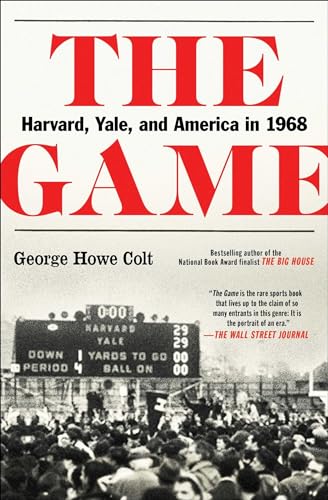
From the bestselling National Book Award finalist and author of The Big House comes “a well-blended narrative packed with top-notch reporting and relevance for our own time” (The Boston Globe) about the young athletes who battled in the legendary Harvard-Yale football game of 1968 amidst the sweeping currents of one of the most transformative years in American history.
On November 23, 1968, there was a turbulent and memorable football game: the season-ending clash between Harvard and Yale. The final score was 29-29. To some of the players, it was a triumph; to others a tragedy. And to many, the reasons had as much to do with one side’s miraculous comeback in the game’s final forty-two seconds as it did with the months that preceded it, months that witnessed the assassinations of Martin Luther King and Robert F. Kennedy, police brutality at the Democratic National Convention, inner-city riots, campus takeovers, and, looming over everything, the war in Vietnam.
George Howe Colt’s The Game is the story of that iconic American year, as seen through the young men who lived it and were changed by it. One player had recently returned from Vietnam. Two were members of the radical antiwar group SDS. There was one NFL prospect who quit to devote his time to black altruism; another who went on to be Pro-Bowler Calvin Hill. There was a guard named Tommy Lee Jones, and fullback who dated a young Meryl Streep. They played side by side and together forged a moment of startling grace in the midst of the storm.
“Vibrant, energetic, and beautifully structured” (NPR), this magnificent and intimate work of history is the story of ordinary people in an extraordinary time, and of a country facing issues that we continue to wrestle with to this day. “The Game is the rare sports book that lives up to the claim of so many entrants in this genre: It is the portrait of an era” (The Wall Street Journal).
Die Inhaltsangabe kann sich auf eine andere Ausgabe dieses Titels beziehen.
Über die Autorin bzw. den Autor
George Howe Colt is the bestselling author of The Big House, which was a National Book Award finalist and a New York Times Notable Book of the Year; Brothers; November of the Soul; and The Game. He lives in Western Massachusetts with his wife, the writer Anne Fadiman.
Auszug. © Genehmigter Nachdruck. Alle Rechte vorbehalten.
The Game
I
Two-a-Days
When Pat Conway decided to play football again, the one thing he didn’t want to do was embarrass himself on the field. Now he’d embarrassed himself before he’d even gotten to the field. It was the first day of practice. In the locker room, listening to the other players joking and laughing as they put on their uniforms, he had pulled on his football pants and drawn the laces tight. But something didn’t feel quite right. He snuck a glance at the players nearby and realized what it was. He had forgotten to put on his girdle, the thick cloth wrap that contained pads for his backbone and hips. The girdle went on before the pants. He looked around sheepishly, worried that someone had noticed, but everyone was busy lacing up shoulder pads or putting on cleats. Conway took off his football pants, cinched the girdle around his waist, and pulled the pants back on. He reached for a crimson stirrup sock and tugged it up his leg—until he realized that the socks, too, went on before the pants. He felt like a fool. He’d forgotten how to put on a football uniform. He unlaced his pants one more time.
Of the 117 candidates for the 1968 Harvard football team who returned to Cambridge on September 1 for three weeks of preseason practice, Pat Conway was, perhaps, the most unlikely. He was twenty-four years old, six years older than some of his teammates. He hadn’t played football in more than three years. He knew almost no one on the team. He’d be trying out for safety, a position he had never played. Six months ago, he had been dodging mortar fire in Vietnam.
Conway had played football for Harvard before. A Sporting News high school All-American from Haverhill, Massachusetts, he had arrived in the fall of 1963 and quickly established himself as a star halfback on the freshman team. (On November 22, after his 48-yard touchdown run gave Harvard a 7–6 lead over Yale, he had been standing on the goal line, ready to receive the second-half kickoff, when the referee walked over and told him that President Kennedy had been shot. Although shaken, the hyper-competitive Conway pleaded with the official not to tell anyone else so they could finish the game.) Sophomore year, Conway started at fullback for the varsity, but he was floundering academically and Harvard put him on probation. The following autumn, falling still further behind, he left school, enlisted in the Marines, and was sent to Vietnam. While his Harvard teammates were playing Yale in November 1967, he had been digging foxholes at Khe Sanh Combat Base. His tour almost up, he had reapplied to Harvard for the spring semester. By the time his paperwork came through, more than 30,000 North Vietnamese troops had surrounded the base. It would be months before Conway was able to fly home.
Conway hadn’t expected to play football when he returned to Harvard for his senior year. But that summer he’d gotten a letter from Coach John Yovicsin saying he had a year of eligibility left; did he want to rejoin the team? Yovicsin told Conway they already had someone—the captain, Vic Gatto—at right halfback, his favorite position. But they needed a safety. Conway said he’d give it a try.
The last time he had touched a football was at Khe Sanh, before all hell broke loose. Someone had come across a battered old ball, and Conway and a few other marines had tossed it around for half an hour one afternoon. Conway never saw the ball again; he assumed it had blown up in a mortar attack.
He had no real expectation of making the team. But ever since he’d started playing Pop Warner in the seventh grade, fall had meant football. Returning to college after almost three years away wouldn’t be easy. Playing football might help him get back to his old life.
Besides, Conway was lonely. He had spent July and August in Cambridge, going to summer school and living alone in a dorm in Harvard Yard, where he had spent his freshman year five years before. He was almost as old as some of his teachers. Everyone he’d been with at Harvard the first time around was off at graduate school or out in the real world. Playing football, he would meet some people. And not just any people, his kind of people: blue-collar guys, regular guys, guys who knew how to work hard. If he didn’t make the team, at least maybe he’d make a few friends.
That summer, Conway took long runs on the Charles River footpath. He “did stadiums”—bounding up and down the steep Harvard Stadium steps. Once in a while he was able to persuade an old high school teammate to throw a football with him. Most of the time, he was on his own. By the start of preseason, he was in pretty good shape, but football shape was something different, and he had no idea what to expect once the hitting began.
* * *
For most of the 116 other players who showed up that first day, there was a comfortable, back-to-school feel. They joshed and kidded, giving each other grief about a particularly colorful T-shirt or the length of someone’s sideburns. At the same time, they were surreptitiously sizing one another up: whose biceps looked especially prominent, which of the incoming sophomores looked as if they might be players. Over dinner they talked about their summers.
It had been a strange, unsettling few months. The summer had seemed to begin on June 6, when Robert Kennedy was assassinated, only nine weeks after the assassination of Martin Luther King Jr. Quarterback George Lalich and linebacker John Emery had been up late watching a movie in a Connecticut motel room, preparing to play for Harvard in the NCAA baseball tournament, when the show was interrupted with news of the shooting. They spent the rest of the night watching the coverage and wondering what the country was coming to.
The summer had ended, a week before preseason began, with the Democratic National Convention in Chicago. Offensive tackle Joe McGrath had been there, working as a congressional aide and staying in a hotel across from Grant Park, where the antiwar demonstrators gathered. One night McGrath had been in the hotel basement, mimeographing the latest draft of the party platform, when a few dozen Chicago policemen, bloodied and furious after an encounter with rock-throwing protestors, came in to regroup. Another night, he’d walked out of the hotel and seen a mass of policemen lined up across from thousands of demonstrators, who were shouting “Oink oink” and “Fascist pigs.” Every so often, billy clubs flailing, the police charged into the crowd, which scattered into the park before coming forward to renew its taunts—at which point the police charged again. For several nights, as delegates at the convention argued over whether to adopt an antiwar plank into the party platform, downtown Chicago itself resembled something of a war zone, as thousands of police and National Guardsmen, employing what one senator called “Gestapo tactics,” teargassed and clubbed protestors, bystanders, and journalists alike.
Between those disturbing events, the Harvard players had settled into their summer jobs. Many of them had worked in construction, which not only paid well but helped them stay in shape. Lalich had been a rod buster at a Chicago steel mill. Cornerback Mike Ananis had unloaded two-by-fours at Boston lumberyards. Not every player did heavy lifting: tackle Bob Dowd had been a counselor at a boys’ camp in New Hampshire; guard Tommy Lee Jones had acted in a summer repertory theater at Harvard, playing the...
„Über diesen Titel“ kann sich auf eine andere Ausgabe dieses Titels beziehen.
Suchergebnisse für The Game: Harvard, Yale, and America in 1968

Beispielbild für diese ISBN
The Game Harvard Yale and Amer
Anbieter: World of Books (was SecondSale), Montgomery, IL, USA
Verkäuferbewertung 5 von 5 Sternen

Zustand: Good. Item in good condition and has highlighting/writing on text. Used texts may not contain supplemental items such as CDs, info-trac etc. Artikel-Nr. 00108020129
Gebraucht kaufen
EUR 5,55
Versand gratis
Versand innerhalb von USA
Versand innerhalb von USA
Anzahl: 1 verfügbar
Beispielbild für diese ISBN
The Game Harvard Yale and Amer
Anbieter: World of Books (was SecondSale), Montgomery, IL, USA
Verkäuferbewertung 5 von 5 Sternen
Zustand: Very Good. Item in very good condition! Textbooks may not include supplemental items i.e. CDs, access codes etc. Artikel-Nr. 00108894919
Gebraucht kaufen
EUR 5,55
Versand gratis
Versand innerhalb von USA
Versand innerhalb von USA
Anzahl: 1 verfügbar
Beispielbild für diese ISBN
The Game: Harvard, Yale, and America in 1968
Anbieter: Wonder Book, Frederick, MD, USA
Verkäuferbewertung 5 von 5 Sternen
Zustand: Good. Good condition. A copy that has been read but remains intact. May contain markings such as bookplates, stamps, limited notes and highlighting, or a few light stains. Artikel-Nr. A05A-05117
Gebraucht kaufen
EUR 6,19
Versand gratis
Versand innerhalb von USA
Versand innerhalb von USA
Anzahl: 1 verfügbar
Beispielbild für diese ISBN
The Game: Harvard, Yale, and America in 1968
Anbieter: Wonder Book, Frederick, MD, USA
Verkäuferbewertung 5 von 5 Sternen
Zustand: Good. Signed Copy . Signed by author on title page. Artikel-Nr. S21F-02335
Gebraucht kaufen
EUR 6,19
Versand gratis
Versand innerhalb von USA
Versand innerhalb von USA
Anzahl: 1 verfügbar
Beispielbild für diese ISBN
The Game : Harvard, Yale, and America In 1968
Anbieter: Better World Books, Mishawaka, IN, USA
Verkäuferbewertung 5 von 5 Sternen
Zustand: Very Good. Former library copy. Pages intact with possible writing/highlighting. Binding strong with minor wear. Dust jackets/supplements may not be included. Includes library markings. Stock photo provided. Product includes identifying sticker. Better World Books: Buy Books. Do Good. Artikel-Nr. 55681868-75
Gebraucht kaufen
EUR 6,95
Versand gratis
Versand innerhalb von USA
Versand innerhalb von USA
Anzahl: 1 verfügbar
Beispielbild für diese ISBN
The Game : Harvard, Yale, and America In 1968
Anbieter: Better World Books, Mishawaka, IN, USA
Verkäuferbewertung 5 von 5 Sternen
Zustand: Very Good. Pages intact with possible writing/highlighting. Binding strong with minor wear. Dust jackets/supplements may not be included. Stock photo provided. Product includes identifying sticker. Better World Books: Buy Books. Do Good. Artikel-Nr. 55373913-6
Gebraucht kaufen
EUR 6,95
Versand gratis
Versand innerhalb von USA
Versand innerhalb von USA
Anzahl: 1 verfügbar
Beispielbild für diese ISBN
The Game
Anbieter: PBShop.store UK, Fairford, GLOS, Vereinigtes Königreich
Verkäuferbewertung 5 von 5 Sternen
PAP. Zustand: New. New Book. Shipped from UK. Established seller since 2000. Artikel-Nr. IB-9781501104794
Neu kaufen
EUR 20,85
EUR 5,85 Versand
Versand von Vereinigtes Königreich nach USA
Versand von Vereinigtes Königreich nach USA
Anzahl: 15 verfügbar
Beispielbild für diese ISBN
The Game: Harvard, Yale, and America in 1968
Anbieter: Revaluation Books, Exeter, Vereinigtes Königreich
Verkäuferbewertung 5 von 5 Sternen
Paperback. Zustand: Brand New. reprint edition. 386 pages. 8.25x5.50x0.75 inches. In Stock. Artikel-Nr. x-1501104799
Neu kaufen
EUR 21,75
EUR 11,65 Versand
Versand von Vereinigtes Königreich nach USA
Versand von Vereinigtes Königreich nach USA
Anzahl: 2 verfügbar
Beispielbild für diese ISBN
The Game: Harvard, Yale, and America in 1968
Anbieter: Kennys Bookstore, Olney, MD, USA
Verkäuferbewertung 5 von 5 Sternen
Zustand: New. 2019. Reprint. paperback. . . . . . Books ship from the US and Ireland. Artikel-Nr. V9781501104794
Neu kaufen
EUR 25,63
EUR 9,03 Versand
Versand innerhalb von USA
Versand innerhalb von USA
Anzahl: Mehr als 20 verfügbar
Beispielbild für diese ISBN
The Game: Harvard, Yale, and America in 1968
Anbieter: Majestic Books, Hounslow, Vereinigtes Königreich
Verkäuferbewertung 4 von 5 Sternen

Zustand: New. Artikel-Nr. 370913836
Neu kaufen
EUR 32,80
EUR 7,57 Versand
Versand von Vereinigtes Königreich nach USA
Versand von Vereinigtes Königreich nach USA
Anzahl: 1 verfügbar